Introduction
Knowledge Graph Construction Tools help organizations transform raw, unstructured, and structured data into interconnected graphs of entities, relationships, and contextual meaning. Instead of storing information as isolated records, knowledge graphs model data as a network of “who, what, when, where, and how” relationships. This enables AI systems to reason over data, improve search relevance, support semantic understanding, and power intelligent applications like recommendation engines, enterprise search, fraud detection, and AI agents.
In the era of LLMs and agentic AI systems, knowledge graphs have become a foundational layer for grounding AI responses, reducing hallucinations, and enabling structured reasoning over enterprise data. These tools combine NLP, entity extraction, relationship mapping, ontology design, and graph storage technologies to build scalable knowledge infrastructures.
Real-world use cases include enterprise knowledge management, healthcare diagnostics, financial fraud detection, customer 360 systems, recommendation engines, supply chain intelligence, and AI-powered copilots.
Evaluation Criteria for Buyers
When evaluating knowledge graph construction tools, consider:
- Entity extraction accuracy
- Relationship inference capabilities
- Schema and ontology flexibility
- Scalability of graph storage
- Integration with AI/LLM systems
- Real-time data ingestion support
- Query performance (graph traversal + semantic search)
- Visualization capabilities
- Governance and access control
- Multimodal data support
- Vector + graph hybrid support
- Ease of building and maintaining graphs
Best for: Enterprises, AI/ML teams, data engineering teams, research organizations, and companies building AI assistants, semantic search, or decision intelligence systems.
Not ideal for: Simple CRUD applications, small datasets with no relational complexity, or teams that only need traditional databases.
What’s Changed in Knowledge Graph Construction Tools
- Deep integration with LLM-based entity extraction pipelines
- Automated ontology generation using AI
- Hybrid graph + vector database architectures
- Real-time knowledge graph updates from streaming data
- Agentic AI systems using graphs for reasoning memory
- GraphRAG becoming a standard architecture pattern
- Improved entity disambiguation using embeddings
- Multimodal knowledge graphs (text, image, video, audio)
- Native support for AI observability and graph explainability
- Self-healing and auto-updating graph structures
- Better interoperability between graph databases and vector stores
- Enterprise governance and lineage tracking improvements
Quick Buyer Checklist
- Supports automatic entity extraction from unstructured data
- Provides relationship inference and linking
- Offers ontology/schema customization
- Integrates with LLM pipelines (RAG / GraphRAG)
- Supports real-time graph updates
- Handles large-scale graph storage efficiently
- Provides graph + vector hybrid search
- Includes visualization tools for relationships
- Offers role-based access control and governance
- Supports multimodal data ingestion
- Provides APIs/SDKs for integration
- Minimizes vendor lock-in risk
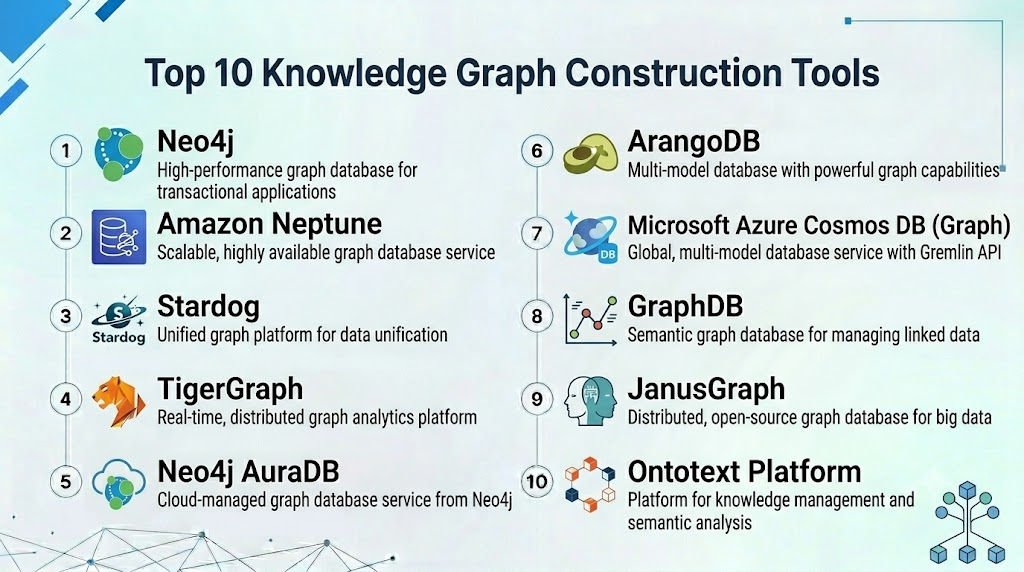
Top 10 Knowledge Graph Construction Tools
1- Neo4j
One-line verdict: Best enterprise-grade graph database and knowledge graph construction platform.
Short description:
Neo4j is one of the most widely adopted graph databases used for building, querying, and managing large-scale knowledge graphs. It supports advanced graph analytics and is heavily used in enterprise AI and data systems.
Standout Capabilities
- Native graph database architecture
- Cypher query language
- Graph analytics and algorithms
- Strong visualization tools
- Enterprise scaling support
- Graph Data Science library
- Real-time graph updates
AI-Specific Depth
- Model support: External LLM + embedding integration
- RAG integration: Strong GraphRAG support
- Evaluation: Not publicly stated
- Guardrails: Role-based access + constraints
- Observability: Query profiling and metrics
Pros
- Mature ecosystem
- Excellent performance
- Strong community support
Cons
- Steep learning curve
- Licensing complexity for enterprise features
- Requires graph expertise
Security & Compliance
RBAC, encryption, enterprise access controls (exact certifications vary by deployment).
Deployment & Platforms
- Cloud
- Self-hosted
- Hybrid
Integrations & Ecosystem
Integrates with AI frameworks, data pipelines, LLM tools, and vector databases via connectors and APIs.
Pricing Model
Open-source core with enterprise and managed cloud tiers.
Best-Fit Scenarios
- Enterprise knowledge graphs
- AI reasoning systems
- Fraud detection platforms
2- Amazon Neptune
One-line verdict: Best fully managed graph database for AWS-based knowledge graph systems.
Short description:
Amazon Neptune is a managed graph database supporting property graphs and RDF-based knowledge graphs, designed for scalable enterprise applications.
Standout Capabilities
- Fully managed graph database
- RDF and property graph support
- High availability architecture
- AWS integration
- Scalable graph storage
- Secure access controls
- Real-time query processing
AI-Specific Depth
- Model support: External AI/LLM integrations
- RAG integration: Supported via pipelines
- Evaluation: Not publicly stated
- Guardrails: AWS IAM-based controls
- Observability: CloudWatch integration
Pros
- Fully managed service
- Strong scalability
- Deep AWS ecosystem integration
Cons
- AWS lock-in
- Limited flexibility vs open-source graphs
- Cost at scale can increase
Deployment & Platforms
- Cloud only (AWS)
Integrations & Ecosystem
Integrates with AWS services like Lambda, S3, SageMaker, and OpenSearch.
Pricing Model
Pay-as-you-go AWS model.
Best-Fit Scenarios
- Enterprise AWS workloads
- AI knowledge systems
- Fraud and risk analysis
3- Stardog
One-line verdict: Best for enterprise semantic knowledge graphs and ontology-driven AI systems.
Short description:
Stardog focuses on enterprise knowledge graphs with strong semantic reasoning, ontology modeling, and data virtualization capabilities.
Standout Capabilities
- Semantic reasoning engine
- Ontology management
- Data virtualization layer
- Graph federation
- AI-ready knowledge layer
- Enterprise search integration
- RDF support
AI-Specific Depth
- Model support: External LLM integration
- RAG integration: Strong GraphRAG support
- Evaluation: Not publicly stated
- Guardrails: Policy-based access controls
- Observability: Query insights and logs
Pros
- Strong semantic reasoning
- Enterprise-ready architecture
- Excellent ontology support
Cons
- Complex setup
- Enterprise-focused pricing
- Requires domain modeling expertise
Deployment & Platforms
- Cloud
- On-premise
- Hybrid
Integrations & Ecosystem
Supports BI tools, AI systems, semantic web standards, and enterprise data platforms.
Pricing Model
Enterprise licensing model.
Best-Fit Scenarios
- Semantic enterprise knowledge graphs
- Regulatory compliance systems
- AI reasoning applications
4- TigerGraph
One-line verdict: Best for real-time large-scale graph analytics and deep relationship discovery.
Short description:
TigerGraph is a high-performance distributed graph database designed for deep-link analytics and real-time knowledge graph construction.
Standout Capabilities
- Distributed graph engine
- Real-time analytics
- Parallel graph processing
- GSQL query language
- Deep link analytics
- High scalability
- Streaming data ingestion
AI-Specific Depth
- Model support: External ML/LLM integration
- RAG integration: Supported via pipelines
- Evaluation: Not publicly stated
- Guardrails: Role-based controls
- Observability: Performance metrics
Pros
- Extremely fast graph traversal
- Scales to massive datasets
- Strong analytics capabilities
Cons
- Complex learning curve
- Requires specialized knowledge
- Enterprise cost structure
Deployment & Platforms
- Cloud
- Self-hosted
Integrations & Ecosystem
Integrates with streaming platforms, ML pipelines, and enterprise data systems.
Pricing Model
Enterprise licensing + cloud offerings.
Best-Fit Scenarios
- Fraud detection
- Real-time recommendation systems
- Network analytics
5- Neo4j AuraDB
One-line verdict: Best managed Neo4j cloud service for fast knowledge graph deployment.
Short description:
AuraDB is Neo4j’s fully managed cloud platform designed to simplify deployment and scaling of graph-based knowledge systems.
Standout Capabilities
- Managed Neo4j service
- Auto-scaling infrastructure
- Built-in backups
- Security controls
- High availability
- Graph visualization
- API access
AI-Specific Depth
- Model support: External LLM integrations
- RAG integration: Strong support
- Evaluation: Not publicly stated
- Guardrails: Access control policies
- Observability: Query monitoring
Pros
- Easy deployment
- Fully managed service
- Strong Neo4j ecosystem
Cons
- Vendor lock-in
- Higher cost than self-hosted
- Limited low-level control
Deployment & Platforms
- Cloud only
Integrations & Ecosystem
Works with AI frameworks, data pipelines, and graph tools via Neo4j ecosystem.
Pricing Model
Subscription-based managed service.
Best-Fit Scenarios
- Cloud-native knowledge graphs
- Rapid prototyping
- Enterprise AI assistants
6- ArangoDB
One-line verdict: Best multi-model database combining graphs, documents, and search.
Short description:
ArangoDB supports graph, document, and key-value models, making it highly flexible for knowledge graph construction.
Standout Capabilities
- Multi-model database
- Graph + document fusion
- AQL query language
- Scalable architecture
- Real-time updates
- Flexible schema design
- Hybrid search support
AI-Specific Depth
- Model support: External embedding/LLM support
- RAG integration: Supported
- Evaluation: Not publicly stated
- Guardrails: Role-based access
- Observability: Query monitoring
Pros
- Highly flexible data model
- Open-source core
- Strong hybrid capabilities
Cons
- Complex architecture
- Smaller ecosystem than Neo4j
- Requires tuning for scale
Deployment & Platforms
- Cloud
- Self-hosted
- Hybrid
Integrations & Ecosystem
Integrates with data pipelines, AI frameworks, and analytics systems.
Pricing Model
Open-source + enterprise tiers.
Best-Fit Scenarios
- Multi-model AI systems
- Hybrid knowledge graphs
- Flexible data applications
7- Microsoft Azure Cosmos DB (Graph)
One-line verdict: Best for Microsoft-centric graph-based knowledge systems.
Short description:
Cosmos DB supports graph data models via Gremlin API, enabling scalable knowledge graph construction within Azure ecosystems.
Standout Capabilities
- Global distribution
- Multi-model support
- Gremlin graph API
- Elastic scaling
- High availability
- Security integration
- Azure ecosystem support
Pros
- Strong enterprise scalability
- Global distribution
- Deep Azure integration
Cons
- Azure dependency
- Complex pricing model
- Graph features less specialized
Deployment & Platforms
- Cloud only (Azure)
Integrations & Ecosystem
Integrates with Azure AI, Synapse, and data services.
Pricing Model
Usage-based Azure pricing.
Best-Fit Scenarios
- Enterprise Azure workloads
- Global applications
- AI-powered enterprise systems
8- GraphDB
One-line verdict: Best RDF-based semantic knowledge graph platform.
Short description:
GraphDB specializes in semantic knowledge graphs using RDF and OWL standards, widely used in enterprise and research applications.
Standout Capabilities
- RDF triple store
- Semantic reasoning
- OWL ontology support
- SPARQL query engine
- Knowledge inference
- Data linking
- Semantic search
Pros
- Strong semantic capabilities
- Excellent ontology support
- Standards-based architecture
Cons
- Steep learning curve
- Less suited for non-semantic graphs
- Performance tuning required
Deployment & Platforms
- Cloud
- On-premise
Best-Fit Scenarios
- Semantic web applications
- Research knowledge systems
- Ontology-driven AI
9- JanusGraph
One-line verdict: Best open-source scalable graph database for distributed systems.
Short description:
JanusGraph is a distributed graph database built for large-scale knowledge graph applications.
Standout Capabilities
- Distributed graph architecture
- Scalable storage backends
- Gremlin query support
- High throughput
- Flexible infrastructure
- Open-source ecosystem
- Batch + real-time ingestion
Pros
- Highly scalable
- Open-source flexibility
- Backend storage choice
Cons
- Complex setup
- Requires DevOps expertise
- Smaller ecosystem
Deployment & Platforms
- Self-hosted
- Cloud (via infrastructure)
Best-Fit Scenarios
- Large-scale graph systems
- Custom knowledge graph pipelines
- Research platforms
10- Ontotext Platform
One-line verdict: Best enterprise semantic knowledge graph and AI reasoning platform.
Short description:
Ontotext provides advanced semantic graph construction, ontology management, and AI-ready knowledge graph infrastructure.
Standout Capabilities
- Semantic graph construction
- Ontology management
- RDF-based architecture
- Knowledge reasoning
- Enterprise data integration
- AI-ready knowledge layer
- Graph analytics
Pros
- Strong semantic reasoning
- Enterprise capabilities
- Ontology expertise
Cons
- Enterprise pricing
- Complex onboarding
- Specialized use cases
Deployment & Platforms
- Cloud
- On-premise
Best-Fit Scenarios
- Semantic enterprise systems
- Knowledge-intensive applications
- AI reasoning platforms
Comparison Table
| Tool | Best For | Deployment | Model Flexibility | Strength | Watch-Out | Public Rating |
|---|---|---|---|---|---|---|
| Neo4j | Enterprise graphs | Hybrid | High | Ecosystem | Complexity | N/A |
| Neptune | AWS graphs | Cloud | High | Managed service | AWS lock-in | N/A |
| Stardog | Semantic graphs | Hybrid | High | Reasoning | Complexity | N/A |
| TigerGraph | Real-time analytics | Hybrid | High | Performance | Learning curve | N/A |
| AuraDB | Managed Neo4j | Cloud | High | Ease of use | Vendor lock-in | N/A |
| ArangoDB | Multi-model | Hybrid | High | Flexibility | Complexity | N/A |
| Cosmos DB | Azure graphs | Cloud | High | Scalability | Azure lock-in | N/A |
| GraphDB | RDF semantic graphs | Hybrid | High | Ontologies | Niche use | N/A |
| JanusGraph | Distributed graphs | Self-hosted | High | Scalability | Ops complexity | N/A |
| Ontotext | Semantic AI graphs | Hybrid | High | Reasoning | Enterprise cost | N/A |
Scoring & Evaluation
| Tool | Core | Reliability | Guardrails | Integrations | Ease | Performance | Security | Support | Weighted Total |
|---|---|---|---|---|---|---|---|---|---|
| Neo4j | 10 | 9 | 9 | 10 | 7 | 9 | 10 | 9 | 9.2 |
| Neptune | 9 | 9 | 9 | 9 | 8 | 9 | 10 | 9 | 9.0 |
| Stardog | 9 | 9 | 9 | 9 | 7 | 8 | 9 | 8 | 8.7 |
| TigerGraph | 9 | 9 | 8 | 8 | 6 | 10 | 8 | 8 | 8.5 |
| AuraDB | 9 | 8 | 8 | 9 | 9 | 8 | 9 | 9 | 8.7 |
| ArangoDB | 9 | 8 | 7 | 9 | 8 | 8 | 8 | 8 | 8.3 |
| Cosmos DB | 9 | 9 | 9 | 9 | 8 | 9 | 10 | 9 | 9.0 |
| GraphDB | 8 | 8 | 8 | 8 | 6 | 8 | 8 | 8 | 7.8 |
| JanusGraph | 9 | 8 | 7 | 8 | 6 | 9 | 8 | 7 | 8.0 |
| Ontotext | 9 | 9 | 9 | 9 | 7 | 8 | 9 | 8 | 8.7 |
Conclusion
Knowledge Graph Construction Tools are becoming foundational infrastructure for AI systems that require structured reasoning, explainability, and contextual intelligence. As organizations move toward GraphRAG, agent-based systems, and multimodal AI architectures, knowledge graphs play a critical role in connecting entities, relationships, and enterprise knowledge into a unified intelligence layer.
