Introduction
Kubernetes policy enforcement tools help teams define, validate, and enforce rules across Kubernetes clusters. In simple terms, these tools make sure workloads follow approved security, compliance, configuration, and operational standards before they run. They can block risky deployments, audit existing resources, mutate configurations, validate image sources, enforce labels, control privileges, and prevent insecure workloads from reaching production.
These tools matter because Kubernetes environments are now larger, more distributed, and more compliance-sensitive. Manual reviews cannot scale across many clusters, namespaces, teams, and deployment pipelines.
Real-world use cases include:
- Blocking privileged containers
- Enforcing approved container registries
- Requiring resource limits and labels
- Preventing insecure Kubernetes manifests
- Auditing clusters for compliance drift
What buyers should evaluate:
- Admission control support
- Policy language simplicity
- Kubernetes-native compatibility
- Audit and reporting capabilities
- GitOps and CI/CD integration
- Multi-cluster scalability
- Policy mutation support
- Developer experience
- Enterprise access controls
- Community and vendor support
Best for: Platform engineering teams, DevSecOps teams, Kubernetes administrators, SRE teams, cloud security teams, regulated enterprises, SaaS companies, financial services, healthcare, and organizations running multi-cluster Kubernetes environments.
Not ideal for: Small teams running only basic Kubernetes workloads, organizations without security governance needs, or teams that only need static YAML checks before deployment instead of live cluster enforcement.
Key Trends in Kubernetes Policy Enforcement Tools
- Policy as Code is becoming standard for Kubernetes governance because manual cluster reviews are too slow and inconsistent.
- Admission control is now a critical security layer for blocking risky workloads before they enter the cluster.
- YAML-friendly policies are gaining adoption because platform teams want security controls that Kubernetes engineers can understand quickly.
- CEL-based native Kubernetes policies are becoming more relevant for teams that want built-in validation without extra tooling.
- AI-assisted policy writing and troubleshooting are emerging as teams look for faster policy creation and better error explanations.
- GitOps and policy enforcement are becoming closely connected because organizations want policies reviewed, versioned, and promoted through Git.
- Multi-cluster governance is now a major enterprise requirement as companies operate Kubernetes across cloud, on-premises, and edge environments.
- Runtime context is influencing policy decisions because teams want to prioritize controls based on real production risk.
- Compliance automation is becoming more important for audit evidence, regulatory frameworks, and internal security standards.
- Open-source policy engines remain strong, but enterprises increasingly want dashboards, support, reporting, and centralized governance.
How We Selected These Tools
- We selected tools that are widely recognized in Kubernetes governance, policy enforcement, admission control, and cloud-native security.
- We included both open-source policy engines and enterprise platforms.
- We evaluated policy depth, Kubernetes-native design, admission control support, and audit capabilities.
- We considered whether each tool supports validation, mutation, generation, reporting, and enforcement workflows.
- We reviewed fit across solo users, SMBs, mid-market teams, and large enterprises.
- We considered ecosystem support for GitOps, CI/CD, Helm, Kubernetes manifests, and cloud-native workflows.
- We evaluated security posture signals such as RBAC, audit logs, SSO, and governance capabilities where confidently known.
- We avoided guessed ratings, certifications, and unsupported claims.
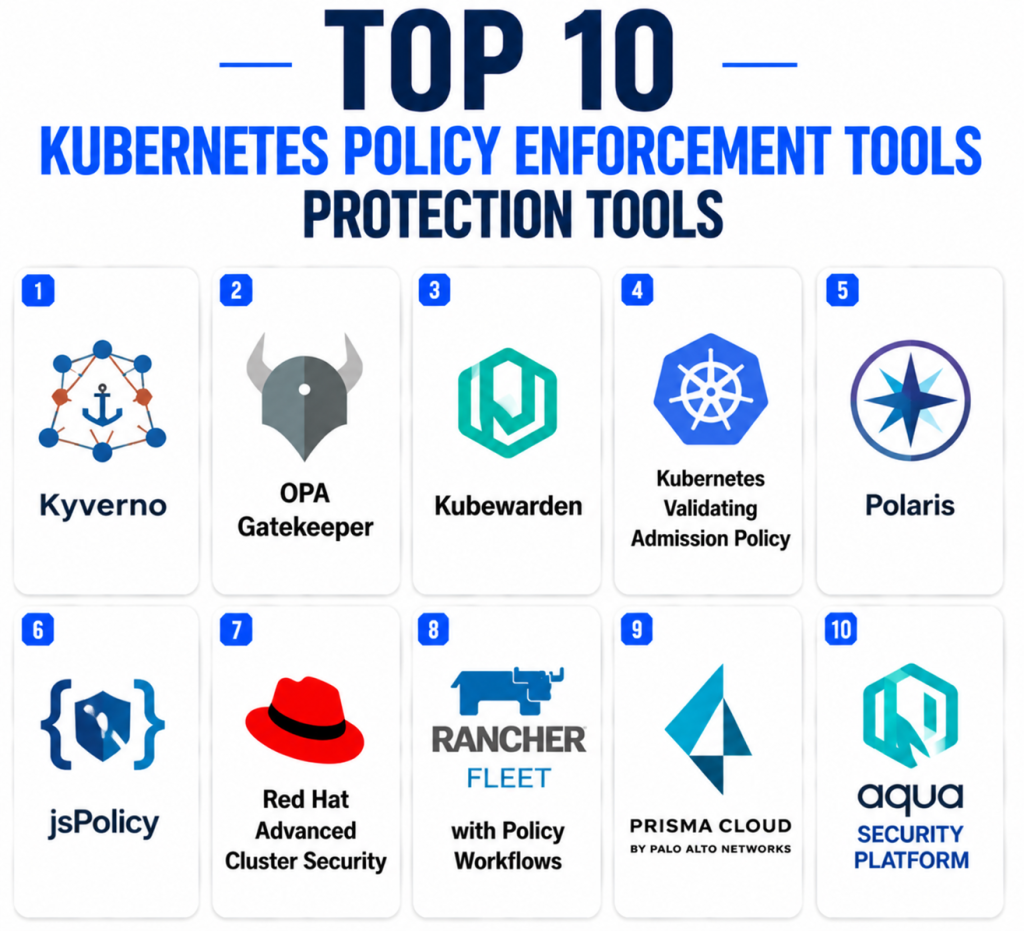
Top 10 Kubernetes Policy Enforcement Tools Protection Tools
1 — Kyverno
Short description:
Kyverno is a Kubernetes-native policy engine designed to validate, mutate, generate, and audit Kubernetes resources using YAML-based policies. It is popular because Kubernetes teams can write policies in a familiar format without learning a separate policy language. Kyverno is commonly used to enforce security standards, apply default configurations, require labels, validate image registries, and audit cluster resources. It is especially useful for platform teams that want practical policy enforcement without adding too much complexity. Kyverno fits organizations adopting GitOps, Kubernetes governance, and cloud-native security. It is a strong option for teams that prioritize usability and Kubernetes-native design.
Key Features
- Kubernetes-native policy enforcement
- YAML-based policy definitions
- Admission control validation
- Resource mutation and generation
- Policy audit mode
- Image verification support
- GitOps-friendly policy management
Pros
- Easier to learn for Kubernetes teams
- Strong validation, mutation, and audit capabilities
- Good fit for GitOps and platform engineering workflows
Cons
- Focused primarily on Kubernetes
- Advanced enterprise reporting may require additional tooling
- Large policy sets require careful governance
Platforms / Deployment
- Linux / Kubernetes
- Self-hosted / Hybrid
Security & Compliance
- Kubernetes RBAC support
- Audit mode
- Admission control enforcement
- Compliance certifications: Not publicly stated
Integrations & Ecosystem
Kyverno works well with Kubernetes-native tooling and GitOps workflows. It is often used alongside CI/CD pipelines, Helm, and cluster management platforms.
- Kubernetes
- Helm
- GitOps tools
- CI/CD pipelines
- Container registries
- Policy repositories
Support & Community
Kyverno has strong open-source documentation and a growing cloud-native community. Commercial support may be available through ecosystem vendors and service providers.
2 — OPA Gatekeeper
Short description:
OPA Gatekeeper brings Open Policy Agent policy enforcement into Kubernetes admission control workflows. It allows teams to write reusable policy constraints and enforce them across Kubernetes clusters. Gatekeeper is useful for organizations that need flexible and expressive policy logic for security, compliance, and operational governance. It is often used by platform teams that already understand OPA and want powerful policy enforcement inside Kubernetes. Gatekeeper supports validation and audit workflows, making it useful for both blocking new violations and discovering existing drift. It is best suited for teams that need flexibility and are comfortable with policy engineering.
Key Features
- OPA-based Kubernetes admission control
- Constraint templates and reusable policies
- Cluster audit capabilities
- Flexible policy logic
- Policy as Code workflows
- Multi-team governance support
- Kubernetes resource validation
Pros
- Highly flexible policy model
- Strong open-source ecosystem
- Good fit for complex enterprise policy needs
Cons
- Rego learning curve
- Less beginner-friendly than YAML-based tools
- Policy maintenance requires skilled ownership
Platforms / Deployment
- Linux / Kubernetes
- Self-hosted / Hybrid
Security & Compliance
- Kubernetes RBAC support
- Audit functionality
- Admission control enforcement
- Compliance certifications: Not publicly stated
Integrations & Ecosystem
Gatekeeper is used across Kubernetes governance, cloud-native security, and platform engineering workflows.
- Kubernetes
- Open Policy Agent
- GitOps workflows
- CI/CD pipelines
- Helm
- Policy libraries
Support & Community
OPA Gatekeeper has strong open-source community support and mature documentation. Enterprise support may be available through vendors using OPA in commercial platforms.
3 — Kubewarden
Short description:
Kubewarden is a Kubernetes policy engine that uses WebAssembly-based policies for admission control. It allows teams to write policies in multiple programming languages, giving developers flexibility beyond traditional policy languages. Kubewarden is useful for organizations that want Kubernetes policy enforcement with strong performance and modern extensibility. It includes a policy marketplace model and supports validation workflows for Kubernetes resources. The tool is especially attractive to teams that want developer-friendly policy creation using familiar languages. It fits platform teams exploring modern policy enforcement approaches in Kubernetes environments.
Key Features
- WebAssembly-based policy engine
- Kubernetes admission control
- Multi-language policy support
- Policy marketplace approach
- Validation policy workflows
- Flexible policy development
- Cloud-native architecture
Pros
- Supports policies written in multiple languages
- Modern WebAssembly-based design
- Good fit for developer-led policy teams
Cons
- Smaller ecosystem than Kyverno or Gatekeeper
- Kubernetes-specific focus
- May require more evaluation for enterprise maturity
Platforms / Deployment
- Linux / Kubernetes
- Self-hosted / Hybrid
Security & Compliance
- Kubernetes admission control
- RBAC depends on cluster configuration
- Auditability depends on deployment setup
- Compliance certifications: Not publicly stated
Integrations & Ecosystem
Kubewarden fits Kubernetes-native workflows and can be integrated into platform engineering governance models.
- Kubernetes
- GitOps workflows
- CI/CD pipelines
- Policy registries
- Container-based workflows
- Cloud-native platforms
Support & Community
Kubewarden has active open-source documentation and a growing community. Enterprise support options should be validated before large-scale adoption.
4 — Kubernetes Validating Admission Policy
Short description:
Kubernetes Validating Admission Policy is a native Kubernetes capability that allows teams to define validation rules using Common Expression Language. It helps enforce rules directly inside Kubernetes without deploying a separate external admission controller for many common use cases. This is useful for teams that want lightweight policy enforcement built into the Kubernetes control plane. It can validate resource configurations, block unsafe settings, and support standardized guardrails. The approach is attractive for teams that prefer fewer moving parts. However, it may not replace full-featured policy engines for mutation, reporting, and complex enterprise workflows.
Key Features
- Native Kubernetes validation
- CEL-based policy expressions
- Admission-time enforcement
- Reduced external dependency footprint
- Resource configuration validation
- Useful for baseline guardrails
- Kubernetes control plane integration
Pros
- Built into Kubernetes
- Fewer moving parts than external controllers
- Useful for straightforward validation rules
Cons
- Less feature-rich than dedicated policy engines
- Not ideal for complex mutation workflows
- Reporting and governance may require additional tooling
Platforms / Deployment
- Linux / Kubernetes
- Self-hosted / Hybrid
Security & Compliance
- Uses Kubernetes-native access controls
- Auditability depends on Kubernetes logging setup
- Compliance certifications: Not publicly stated
Integrations & Ecosystem
Validating Admission Policy fits native Kubernetes governance workflows and can complement other security tools.
- Kubernetes API server
- CEL expressions
- GitOps manifests
- CI/CD validation workflows
- Cluster audit workflows
- Platform engineering guardrails
Support & Community
Support depends on Kubernetes documentation, community resources, and the organization’s Kubernetes distribution or managed service provider.
5 — Polaris
Short description:
Polaris is a Kubernetes policy and configuration validation tool focused on workload best practices. It helps teams identify issues related to security, reliability, efficiency, and configuration quality. Polaris can be used to audit clusters, validate manifests, and guide teams toward safer Kubernetes configurations. It is especially useful for teams that want practical Kubernetes hygiene checks without starting with complex custom policies. Platform engineers and DevOps teams often use it to identify missing resource limits, risky security settings, and misconfigured workloads. Polaris is a good fit for teams improving Kubernetes readiness and governance maturity.
Key Features
- Kubernetes configuration validation
- Cluster auditing
- Workload best-practice checks
- Manifest scanning
- Security and reliability recommendations
- Dashboard visibility
- CI/CD validation support
Pros
- Easy to understand and adopt
- Good for Kubernetes best-practice checks
- Useful for early governance programs
Cons
- Less flexible than full policy engines
- May not replace admission-focused enforcement tools
- Advanced enterprise governance may require additional platforms
Platforms / Deployment
- Web / Linux / Kubernetes
- Self-hosted / Hybrid
Security & Compliance
- Kubernetes security checks
- Audit-style reporting
- RBAC depends on deployment configuration
- Compliance certifications: Not publicly stated
Integrations & Ecosystem
Polaris fits Kubernetes audit and validation workflows across clusters and pipelines.
- Kubernetes
- Helm
- CI/CD pipelines
- GitOps workflows
- YAML manifests
- Cluster dashboards
Support & Community
Polaris has open-source documentation and community usage. Support is primarily community-driven unless adopted through a commercial platform or service provider.
6 — jsPolicy
Short description:
jsPolicy is a Kubernetes policy engine that allows teams to write policies using JavaScript or TypeScript. It is designed for teams that want flexible admission control without learning specialized policy languages. jsPolicy can validate, mutate, and control Kubernetes resources using familiar programming concepts. It may appeal to development teams that already have JavaScript or TypeScript expertise. The tool can be useful for custom policy enforcement, experimentation, and developer-led platform governance. Buyers should validate project activity, support expectations, and production readiness before standardizing on it.
Key Features
- JavaScript and TypeScript-based policies
- Kubernetes admission control
- Validation and mutation workflows
- Custom policy logic
- Developer-friendly policy authoring
- Kubernetes resource governance
- Flexible policy execution
Pros
- Familiar language for many developers
- Flexible policy customization
- Useful for developer-led policy teams
Cons
- Smaller ecosystem than Kyverno or Gatekeeper
- Production support should be validated
- May not be ideal for highly regulated enterprises without support plans
Platforms / Deployment
- Linux / Kubernetes
- Self-hosted / Hybrid
Security & Compliance
- Kubernetes admission control
- RBAC depends on cluster configuration
- Compliance certifications: Not publicly stated
Integrations & Ecosystem
jsPolicy fits Kubernetes admission workflows and custom policy development models.
- Kubernetes
- JavaScript workflows
- TypeScript workflows
- GitOps repositories
- CI/CD pipelines
- Custom policy libraries
Support & Community
Community and support vary by project activity and adoption model. Organizations should validate documentation, release cadence, and long-term maintainability before production rollout.
7 — Red Hat Advanced Cluster Security
Short description:
Red Hat Advanced Cluster Security is a Kubernetes security platform that includes policy enforcement, vulnerability management, compliance, network controls, and runtime security. It is useful for organizations that need broader Kubernetes security governance beyond admission policy alone. The platform helps teams define policies, detect risky deployments, monitor runtime behavior, and enforce security controls across clusters. It is especially relevant for enterprises using Red Hat OpenShift or managing regulated Kubernetes environments. RHACS fits organizations that want centralized visibility and policy-driven protection. It is best suited for mature security and platform teams.
Key Features
- Kubernetes security policy enforcement
- Vulnerability management
- Runtime security monitoring
- Compliance checks
- Network policy visibility
- Multi-cluster security management
- Integration with OpenShift environments
Pros
- Strong fit for OpenShift and enterprise Kubernetes
- Broad security coverage beyond admission control
- Useful for regulated and multi-cluster environments
Cons
- May be too broad for small teams
- Best value in Red Hat or OpenShift environments
- Requires planning for full deployment value
Platforms / Deployment
- Web / Linux / Kubernetes
- Cloud / Self-hosted / Hybrid
Security & Compliance
- RBAC
- SSO integration may be available
- Audit logs may be available
- Compliance reporting features
- Compliance certifications: Not publicly stated here
Integrations & Ecosystem
RHACS integrates with Kubernetes security, OpenShift, CI/CD, and enterprise security workflows.
- Kubernetes
- Red Hat OpenShift
- CI/CD pipelines
- Container registries
- Security dashboards
- DevSecOps workflows
Support & Community
Red Hat provides enterprise support, documentation, and onboarding. Community and ecosystem strength are strongest among OpenShift and enterprise Kubernetes users.
8 — Rancher Fleet with Policy Workflows
Short description:
Rancher Fleet is a GitOps-based deployment and multi-cluster management tool that can support policy-driven Kubernetes operations when combined with Kubernetes policy engines and Rancher governance controls. It helps teams apply consistent configurations across many clusters using Git-based workflows. While Fleet is not a standalone policy engine like Kyverno or Gatekeeper, it is useful for distributing policy resources and maintaining policy consistency at scale. It is especially relevant for organizations managing many Rancher or Kubernetes clusters. Platform teams can use it to deliver policy configurations across environments. It fits organizations that need GitOps-based cluster governance.
Key Features
- Multi-cluster GitOps deployment
- Policy distribution workflows
- Kubernetes configuration management
- Cluster grouping
- Git-based governance
- Rancher ecosystem alignment
- Scalable cluster operations
Pros
- Useful for managing policies across many clusters
- Strong fit for Rancher environments
- Supports Git-based operational consistency
Cons
- Not a standalone policy engine
- Best used with tools like Kyverno or Gatekeeper
- Rancher ecosystem fit should be evaluated
Platforms / Deployment
- Web / Linux / Kubernetes
- Cloud / Self-hosted / Hybrid
Security & Compliance
- RBAC through Rancher and Kubernetes
- Auditability depends on Git and platform logging
- Compliance certifications: Not publicly stated here
Integrations & Ecosystem
Fleet works well with Kubernetes, Rancher, GitOps workflows, and policy-as-code repositories.
- Rancher
- Kubernetes
- Git repositories
- Kyverno
- Gatekeeper
- Helm
Support & Community
Support depends on Rancher ecosystem usage and vendor subscription model. Community resources exist for GitOps and multi-cluster Kubernetes workflows.
9 — Prisma Cloud by Palo Alto Networks
Short description:
Prisma Cloud is a cloud-native application protection platform that includes Kubernetes security, policy enforcement, compliance monitoring, image scanning, runtime protection, and cloud posture management. It is useful for enterprises that need Kubernetes policy controls as part of a broader cloud security strategy. Prisma Cloud can help teams detect risky configurations, enforce security standards, monitor workloads, and manage compliance across cloud-native environments. It is especially suitable for multi-cloud and regulated organizations. The platform provides centralized visibility for security teams. It is best for enterprises that need governance across Kubernetes, containers, cloud workloads, and runtime environments.
Key Features
- Kubernetes policy enforcement
- Cloud-native security posture management
- Container image scanning
- Runtime protection
- Compliance monitoring
- Multi-cloud visibility
- Security policy governance
Pros
- Broad cloud-native security coverage
- Strong enterprise governance focus
- Useful for multi-cloud and regulated environments
Cons
- May be too broad for teams needing only admission control
- Commercial platform investment required
- Implementation can require mature security operations
Platforms / Deployment
- Web
- Cloud / Hybrid
Security & Compliance
- RBAC
- SSO/SAML may be available
- Audit logs may be available
- Compliance monitoring features
- Compliance certifications: Not publicly stated here
Integrations & Ecosystem
Prisma Cloud integrates with Kubernetes, cloud platforms, registries, and security workflows.
- Kubernetes
- AWS
- Azure
- Google Cloud
- Container registries
- CI/CD tools
Support & Community
Palo Alto Networks provides enterprise support, onboarding, documentation, and professional services. Support depth depends on contract and deployment scope.
10 — Aqua Security Platform
Short description:
Aqua Security Platform provides Kubernetes security, container security, image scanning, policy enforcement, runtime protection, and compliance capabilities. It helps organizations define and enforce security policies across the container lifecycle. Aqua is especially useful for teams that need policy enforcement beyond admission controls, including runtime and workload protection. It supports cloud-native environments where security, compliance, and operational control must be centralized. The platform is well suited for enterprises, regulated industries, and Kubernetes-heavy organizations. It is a strong option when policy enforcement needs to connect with image scanning and runtime security.
Key Features
- Kubernetes policy enforcement
- Container image scanning
- Runtime protection
- Compliance reporting
- Cloud-native workload security
- CI/CD and registry integration
- Security governance workflows
Pros
- Broad Kubernetes and container security coverage
- Strong fit for enterprise cloud-native programs
- Connects policy enforcement with runtime security
Cons
- May be broader than small teams need
- Commercial platform requires planning
- Best value comes from wider platform adoption
Platforms / Deployment
- Web / Linux / Kubernetes
- Cloud / Self-hosted / Hybrid
Security & Compliance
- RBAC
- SSO/SAML may be available
- Audit logs may be available
- Compliance monitoring features
- Compliance certifications: Not publicly stated here
Integrations & Ecosystem
Aqua integrates with Kubernetes, CI/CD, registries, and broader cloud-native environments.
- Kubernetes
- Docker
- GitHub Actions
- GitLab CI
- Jenkins
- Container registries
Support & Community
Aqua provides commercial documentation, support, onboarding, and professional services. Its broader ecosystem also includes strong open-source visibility through related cloud-native security tooling.
Comparison Table
| Tool Name | Best For | Platform(s) Supported | Deployment | Standout Feature | Public Rating |
|---|---|---|---|---|---|
| Kyverno | Kubernetes-native policy enforcement | Linux / Kubernetes | Self-hosted / Hybrid | YAML-based policies | N/A |
| OPA Gatekeeper | Flexible enterprise policy logic | Linux / Kubernetes | Self-hosted / Hybrid | OPA-based constraints | N/A |
| Kubewarden | WebAssembly policy enforcement | Linux / Kubernetes | Self-hosted / Hybrid | Multi-language policies | N/A |
| Kubernetes Validating Admission Policy | Built-in Kubernetes validation | Linux / Kubernetes | Self-hosted / Hybrid | Native CEL-based validation | N/A |
| Polaris | Kubernetes best-practice validation | Web / Linux / Kubernetes | Self-hosted / Hybrid | Workload configuration checks | N/A |
| jsPolicy | Developer-friendly custom policies | Linux / Kubernetes | Self-hosted / Hybrid | JavaScript and TypeScript policies | N/A |
| Red Hat Advanced Cluster Security | Enterprise Kubernetes security | Web / Linux / Kubernetes | Cloud / Self-hosted / Hybrid | Multi-cluster security governance | N/A |
| Rancher Fleet with Policy Workflows | Multi-cluster policy distribution | Web / Linux / Kubernetes | Cloud / Self-hosted / Hybrid | GitOps-based policy rollout | N/A |
| Prisma Cloud | Enterprise cloud-native security | Web | Cloud / Hybrid | CNAPP policy governance | N/A |
| Aqua Security Platform | Container and Kubernetes security | Web / Linux / Kubernetes | Cloud / Self-hosted / Hybrid | Policy plus runtime protection | N/A |
Evaluation & Scoring of Kubernetes Policy Enforcement Tools
| Tool Name | Core (25%) | Ease (15%) | Integrations (15%) | Security (10%) | Performance (10%) | Support (10%) | Value (15%) | Weighted Total |
| Kyverno | 9 | 9 | 9 | 8 | 8 | 8 | 10 | 8.85 |
| OPA Gatekeeper | 9 | 7 | 9 | 8 | 8 | 9 | 9 | 8.45 |
| Kubewarden | 8 | 7 | 8 | 8 | 8 | 7 | 8 | 7.75 |
| Kubernetes Validating Admission Policy | 7 | 8 | 7 | 8 | 9 | 8 | 10 | 8.00 |
| Polaris | 7 | 9 | 7 | 7 | 8 | 7 | 9 | 7.75 |
| jsPolicy | 7 | 7 | 7 | 7 | 7 | 6 | 8 | 7.00 |
| Red Hat Advanced Cluster Security | 9 | 7 | 9 | 9 | 8 | 9 | 7 | 8.30 |
| Rancher Fleet with Policy Workflows | 7 | 8 | 8 | 8 | 8 | 8 | 8 | 7.75 |
| Prisma Cloud | 9 | 7 | 9 | 9 | 8 | 9 | 7 | 8.30 |
| Aqua Security Platform | 9 | 7 | 9 | 9 | 8 | 9 | 7 | 8.30 |
These scores are comparative and should be interpreted based on your Kubernetes maturity. Kyverno may score higher for teams that value simplicity, while OPA Gatekeeper may be better for complex policy logic. Enterprise platforms score higher for governance and support but may be heavier to adopt. Native Kubernetes policies offer strong value for simpler validation needs but may not replace full policy platforms.
Which Kubernetes Policy Enforcement Tool Is Right for You?
Solo / Freelancer
Solo users and independent consultants should start with tools that are easy to install and understand. Kyverno, Polaris, and Kubernetes Validating Admission Policy are practical choices. Kyverno is useful for learning real admission control, while Polaris is good for workload best-practice checks.
SMB
Small and medium-sized businesses usually need strong protection without heavy operational complexity. Kyverno is often a strong fit because policies are YAML-based and Kubernetes-native. OPA Gatekeeper is also useful if the team has policy engineering skills. Polaris can complement both by helping identify configuration weaknesses.
Mid-Market
Mid-market companies often need better policy governance, audit visibility, GitOps workflows, and multi-cluster consistency. Kyverno, OPA Gatekeeper, Kubewarden, Rancher Fleet with policy workflows, and Red Hat Advanced Cluster Security can all be useful depending on the environment. Teams should test policy authoring, deployment workflows, and audit reporting before standardizing.
Enterprise
Enterprises should prioritize RBAC, audit logs, SSO, compliance reporting, multi-cluster management, policy lifecycle governance, and support. Red Hat Advanced Cluster Security, Prisma Cloud, Aqua Security Platform, Kyverno, and OPA Gatekeeper are strong candidates. Enterprises using OpenShift may prefer Red Hat Advanced Cluster Security, while broader cloud-native teams may evaluate Prisma Cloud or Aqua Security.
Budget vs Premium
Budget-conscious teams should consider Kyverno, OPA Gatekeeper, Kubewarden, Polaris, jsPolicy, and Kubernetes Validating Admission Policy. Premium platforms such as Red Hat Advanced Cluster Security, Prisma Cloud, and Aqua Security Platform provide broader governance, reporting, runtime context, and support.
Feature Depth vs Ease of Use
Kyverno is easier for Kubernetes teams because policies use YAML. OPA Gatekeeper offers deeper policy flexibility but requires learning Rego. Kubewarden is flexible for teams wanting WebAssembly-based policies. Native Validating Admission Policy is simpler for direct validation but less feature-rich than dedicated tools.
Integrations & Scalability
For GitOps and Kubernetes-native workflows, Kyverno and Gatekeeper are strong options. For multi-cluster policy distribution, Rancher Fleet can help when paired with a policy engine. For enterprise cloud-native security programs, Red Hat Advanced Cluster Security, Prisma Cloud, and Aqua Security Platform provide broader integrations and centralized visibility.
Security & Compliance Needs
Security-focused teams should evaluate admission control reliability, audit logs, enforcement modes, policy exceptions, RBAC, namespace scoping, compliance reporting, and integration with image scanning or runtime security. Regulated organizations should avoid ad hoc policy files and should use version-controlled, tested, and documented policy workflows.
Frequently Asked Questions
1- What is a Kubernetes policy enforcement tool?
A Kubernetes policy enforcement tool validates, blocks, mutates, or audits Kubernetes resources based on defined rules. It helps teams prevent insecure or non-compliant workloads from running in clusters.
2- Why is Kubernetes policy enforcement important?
Kubernetes environments can become risky when teams deploy workloads with excessive privileges, missing resource limits, unsafe images, or weak security settings. Policy enforcement helps prevent these risks automatically.
3- What is admission control in Kubernetes?
Admission control is the process Kubernetes uses to review requests before resources are created or changed. Policy tools use admission control to allow, deny, or modify resources based on rules.
4- What is the difference between Kyverno and OPA Gatekeeper?
Kyverno uses Kubernetes-style YAML policies and is easier for many Kubernetes teams. OPA Gatekeeper uses OPA and Rego, offering more flexible policy logic but with a steeper learning curve.
5- Can Kubernetes policy tools work with GitOps?
Yes. Policies can be stored in Git, reviewed through pull requests, and deployed through GitOps workflows. This helps teams version, audit, and promote policy changes safely.
6- Do policy enforcement tools block deployments?
Yes, many tools can block deployments that violate policy. They can also run in audit mode first so teams can identify violations before enforcing strict rules.
7- Are open-source policy tools enough for enterprises?
Open-source tools like Kyverno and OPA Gatekeeper are widely used, but enterprises may need additional dashboards, support, compliance reporting, and centralized management.
8- What are common implementation mistakes?
Common mistakes include enabling strict policies too quickly, not testing exceptions, writing unclear policies, ignoring developer feedback, and failing to version-control policy changes.
9- Can policy tools enforce image security?
Yes. Many tools can require trusted registries, verify image signatures, block latest tags, or enforce image-related rules. Some enterprise platforms also connect policy enforcement with image scanning.
10- How should teams start with Kubernetes policy enforcement?
Teams should begin with audit mode, identify common violations, create baseline policies, test in non-production clusters, and gradually move to enforcement for high-risk controls.
Conclusion
Kubernetes policy enforcement tools are now essential for secure and reliable cloud-native operations. They help teams prevent unsafe workloads, enforce configuration standards, support compliance, and reduce manual review effort across clusters. Kyverno is a strong choice for teams that want Kubernetes-native YAML policies, while OPA Gatekeeper is better for complex and flexible policy logic. Kubewarden, Polaris, jsPolicy, and native Validating Admission Policy offer useful options for different levels of complexity. Enterprises may prefer Red Hat Advanced Cluster Security, Prisma Cloud, or Aqua Security Platform when policy enforcement must connect with broader container security, runtime protection, and compliance reporting. The best choice depends on your Kubernetes maturity, security requirements, team skills, budget, and governance model. A practical is to shortlist two or three tools, run them in audit mode, test common policies, validate GitOps integration, and then gradually enforce controls across production clusters.
