Introduction
Lead generation platforms are specialized software solutions designed to help businesses attract, capture, qualify, and track potential customers before they enter the sales funnel. These platforms automate outbound and inbound lead acquisition, deliver audience insights, and provide tools that support conversion optimization. In simple terms, lead generation platforms enable companies to generate demand, collect contact information, and turn website visitors and prospect lists into sales opportunities.
In , lead generation remains critical as competition increases for customer attention across digital channels. With evolving privacy regulations and rising acquisition costs, teams need more intelligent ways to reach target buyers, qualify intent, and integrate collected leads back into sales and marketing systems. Modern platforms use AI, automation, and data enrichment to improve lead quality and accelerate revenue growth.
Real-World Use Cases:
- Inbound lead capture: Capturing visitor contact details via forms, landing pages, chat widgets, and gated content.
- Outbound prospecting: Identifying and engaging high‑fit prospects using automated outreach.
- Content syndication: Distributing whitepapers and gated assets to targeted audiences to generate qualified leads.
- Ad‑based audience generation: Driving lead acquisition through paid search, social, display, and video campaigns.
- Website visitor identification: Recognizing anonymous visitors and converting them into prospects.
What Buyers Should Evaluate:
- Ease of lead capture and form builders
- Audience targeting and segmentation capabilities
- Lead enrichment and qualification tools
- Integration with CRM and marketing automation
- Automation and workflow orchestration
- Analytics and attribution reporting
- Use of AI for intent and scoring
- Multi‑channel execution support
- Security and data compliance
- Scalability and performance
Best for: Digital marketing teams, demand generation leaders, small business owners, enterprise marketers, and growth teams seeking to capture and nurture prospects efficiently.
Not ideal for: Teams with extremely niche audiences that need bespoke research, companies without a digital presence, or organizations that already have highly optimized internal lead sources and pipelines.
Key Trends in Lead Generation Platforms
- AI‑powered lead scoring and qualification — Predictive models improve accuracy and prioritization.
- Intent signal integration — Platforms ingest behavior and contextual interest to identify buying signals.
- Conversational capture tools — Chatbots, interactive forms, and voice interfaces increase conversion rates.
- Privacy‑first data practices — Consent management and compliant lead tracking due to regulatory pressures.
- Cross‑channel orchestration — Lead generation across web, email, ads, events, and social.
- Automated nurture and conversion workflows — End‑to‑end workflows from capture to qualification.
- CRM and ecosystem interoperability — Seamless integration into existing revenue tech stacks.
- Account‑level insights for B2B — Understand engagement at the company level, not just individual contacts.
- Real‑time analytics and dashboards — Instant visibility into pipeline impact and lead velocity.
- Dynamic personalization — Tailored experiences based on visitor behavior and profile segments.
How We Selected These Tools (Methodology)
- Evaluated market adoption and mindshare among SMB, mid‑market, and enterprise buyers.
- Reviewed feature completeness, including capture, enrichment, automation, and analytics.
- Assessed reliability and performance signals like uptime, data processing speed, and large volume handling.
- Considered security posture, such as encryption, access controls, and governance features.
- Examined integration ecosystem with CRM, marketing automation, sales engagement, and analytics tools.
- Tested ease of use and workflow configuration for non‑technical marketers.
- Looked at customer fit across segments, from startups to large enterprises.
- Focused on modern relevance (AI features, automation, intent signals) in a 2026 context.
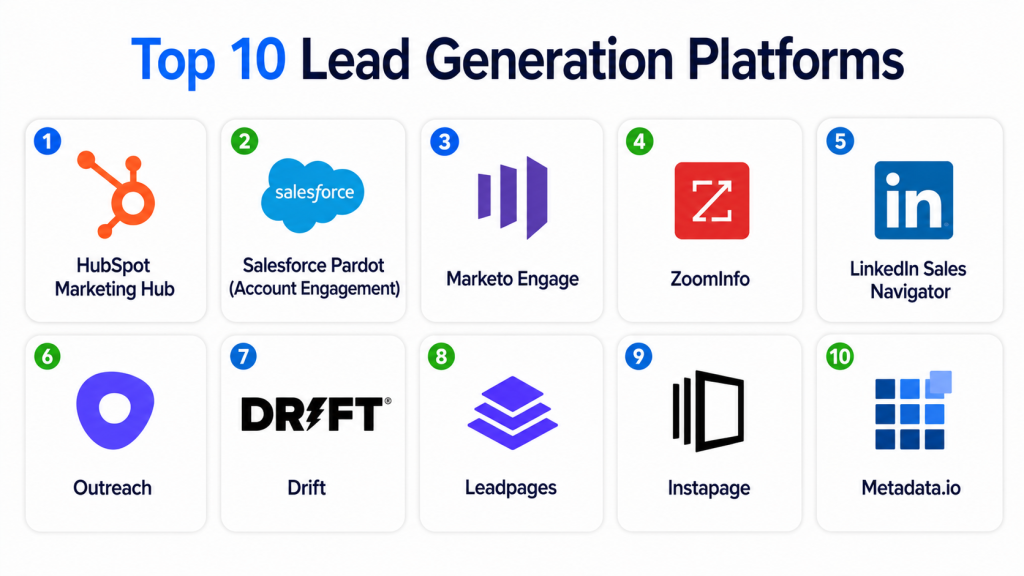
Top 10 Lead Generation Platforms
#1 — HubSpot Marketing Hub
Short description: HubSpot Marketing Hub is a comprehensive inbound marketing platform with strong lead generation capabilities as part of its suite. It provides tools for building landing pages, forms, conversation bots, and automated workflows, all tied seamlessly to CRM data. It’s ideal for SMB and mid‑market teams that want an integrated solution supporting inbound generation, nurturing, and analytics without stitching multiple tools together.
Key Features
- Drag‑and‑drop landing pages and forms
- Lead scoring and lifecycle automation
- Conversational bots and chat tools
- CRM‑native capture and tracking
- Email marketing and nurture workflows
- Analytics dashboards and attribution
Pros
- Strong CRM integration and unified contact database
- Easy to adopt for teams with limited technical resources
Cons
- Advanced lead enrichment may require add‑ons
- Pricing scales with contact volume
Platforms / Deployment
- Web / iOS / Android
- Cloud
Security & Compliance
- SSO/SAML, encryption, role permissions
- Not publicly stated for specific certifications
Integrations & Ecosystem
HubSpot Marketing Hub integrates deeply with CRM, sales tools, and analytics.
- HubSpot CRM
- Sales engagement tools
- Advertising platforms
- Analytics tools
- API extensibility
Support & Community
HubSpot offers extensive documentation, onboarding resources, training, and an active user community.
#2 — Salesforce Pardot (Account Engagement)
Short description: Salesforce Pardot, now often referred to as Account Engagement, is a B2B marketing automation platform with robust lead capture and nurture tools. It is built for teams that require deep alignment between marketing and sales workflows within Salesforce CRM. Pardot supports forms, landing pages, scoring, automation, and reporting, with strong CRM synchronization.
Key Features
- Lead capture forms and landing pages
- Email nurture sequences and automation
- Prospect scoring and grading
- CRM‑native engagement tracking
- Analytics and pipeline influence reporting
- Segmentation and behavior tracking
Pros
- Tight integration with Salesforce Sales Cloud
- Enterprise‑grade automation and reporting
Cons
- More complex to configure and operate
- Costs can be high for smaller teams
Platforms / Deployment
- Web
- Cloud
Security & Compliance
- Enterprise access control and encryption
- Not publicly stated for specific certifications
Integrations & Ecosystem
Pardot is deeply integrated with Salesforce and typically part of broader CRM workflows.
- Salesforce CRM
- Sales engagement tools
- Analytics and reporting systems
- API integrations
Support & Community
Salesforce offers tiered support, documentation, training resources, and a large community network.
#3 — Marketo Engage
Short description: Marketo Engage is a mature marketing automation platform with advanced lead creation, scoring, and nurture capabilities. It supports complex campaigns across multi‑channel lead capture paths. Marketo is suitable for enterprise and mid‑market teams that require sophisticated automation, segmentation, and reporting for lead generation and lifecycle marketing.
Key Features
- Advanced nurture campaigns
- Lead scoring and behavior tracking
- Landing page and form automation
- Multi‑channel engagement orchestration
- Analytics and revenue attribution
- Integration with CRM and data systems
Pros
- Very powerful and flexible for complex programs
- Strong automation capabilities
Cons
- Higher complexity and learning curve
- Requires dedicated operations resources
Platforms / Deployment
- Web
- Cloud
Security & Compliance
- Not publicly stated for specific certifications
- Encryption and access permissions available
Integrations & Ecosystem
Marketo integrates with CRM systems, web analytics, and engagement tools.
- Salesforce CRM
- Microsoft Dynamics
- Data platforms
- Analytics systems
- API support
Support & Community
Adobe offers enterprise support, documentation, and training resources with an active marketing operations community.
#4 — ZoomInfo
Short description: ZoomInfo is a data‑centric lead generation and prospecting platform that helps sales and marketing teams find accurate contact and company information. It excels in intent signals, contact discovery, list building, and prospect enrichment. ZoomInfo’s strength lies in its database, which empowers outbound lead generation and account prioritization.
Key Features
- Contact and company data repository
- Intent signal delivery
- Prospect enrichment and scoring
- List building and segmentation tools
- CRM sync and alerts
- Data hygiene and duplicate suppression
Pros
- Extensive B2B database
- Strong outbound prospecting support
Cons
- Data costs and subscription can be expensive
- Requires data governance to avoid duplicates
Platforms / Deployment
- Web
- Cloud
Security & Compliance
- Data access controls and encryption
- Not publicly stated for certifications
Integrations & Ecosystem
ZoomInfo works with CRM, marketing automation, sales engagement, and analytics platforms.
- Salesforce
- HubSpot
- LinkedIn outreach platforms
- CRM and data tools
Support & Community
Documentation, onboarding, and support services are available; enterprise customers often engage onboarding specialists.
#5 — LinkedIn Sales Navigator
Short description: LinkedIn Sales Navigator is a professional networking tool that supports lead generation by enabling teams to discover, connect with, and nurture leads based on LinkedIn’s extensive professional graph. It is particularly useful for B2B prospecting, relationship building, and social selling.
Key Features
- Advanced lead and account search
- Relationship and network insights
- InMail and messaging features
- CRM integration for lead capture
- Saved lead trends and alerts
- Team link and shared lead visibility
Pros
- Rich professional data and networking signals
- Useful for social selling and prospect research
Cons
- Less automation for inbound capture
- Best value when combined with CRM and engagement tools
Platforms / Deployment
- Web / iOS / Android
- Cloud
Security & Compliance
- Enforces LinkedIn privacy and account security
- Certifications vary by region and plan (Not publicly stated)
Integrations & Ecosystem
LinkedIn integrates with CRM platforms and sales engagement tools to sync lead data.
- Salesforce
- Microsoft Dynamics
- CRM and contact platforms
Support & Community
LinkedIn offers standard support options, resources, and a large professional community.
#6 — Outreach
Short description: Outreach is a sales engagement platform that includes lead sequencing, multi‑channel outreach, and analytics to support outbound lead generation. It helps sales teams automate follow‑ups, tailor messaging, and prioritize prospects within structured cadences. Outreach emphasizes activity orchestration, making it easy to manage large lead lists and maintain engagement consistency.
Key Features
- Email and call sequencing
- Multi‑channel outreach automation
- Engagement analytics
- AI content suggestions
- CRM sync and pipeline visibility
- Task prioritization
Pros
- Strong for structured outbound lead engagement
- Helps reps scale high‑volume outreach
Cons
- Not a traditional inbound lead capture tool
- More specialized for sales teams than marketers
Platforms / Deployment
- Web / iOS / Android
- Cloud
Security & Compliance
- Encryption and access permissions
- Not publicly stated for certifications
Integrations & Ecosystem
Outreach typically syncs with CRM, email, calendar, and analytics.
- Salesforce
- Microsoft Dynamics
- Gmail and Outlook
Support & Community
Outreach offers documentation, training programs, and support tiers.
#7 — Drift
Short description: Drift is a conversational marketing and lead generation platform that uses chatbots and AI assistants to capture, qualify, and convert website visitors in real time. It focuses on conversational forms, bot‑based qualification, and routing leads to sales teams or workflows based on predefined criteria.
Key Features
- Conversational AI bots
- Lead routing and qualification
- Meeting scheduling and handoff
- Multi‑channel engagement
- Website visitor identification
- Analytics and conversion reporting
Pros
- Strong conversational capture and qualification
- Improves conversion rates with real‑time interaction
Cons
- Requires setup and tuning for best ROI
- Not a full marketing automation replacement
Platforms / Deployment
- Web
- Cloud
Security & Compliance
- Role permissions and encryption
- Not publicly stated for compliance certifications
Integrations & Ecosystem
Drift integrates with CRM, sales engagement, marketing automation, and analytics systems.
- Salesforce
- HubSpot
- Marketing automation platforms
Support & Community
Drift provides documentation, onboarding, and support services.
#8 — Leadpages
Short description: Leadpages is a platform focused on inbound lead capture via landing pages and conversion tools. It helps teams build optimized landing pages, pop‑ups, and forms that convert traffic into leads without requiring coding. It is often used by small businesses and campaign‑centric teams that need straightforward lead capture and testing tools.
Key Features
- Drag‑and‑drop landing page builder
- Pop‑ups and alert bars
- Lead capture forms
- A/B testing and conversion insights
- Built‑in templates
- Hosting and publishing tools
Pros
- Quick to implement for campaign capture
- Easy for non‑technical users
Cons
- Limited advanced automation and analytics
- Best used in conjunction with CRM and workflows
Platforms / Deployment
- Web
- Cloud
Security & Compliance
- Standard web platform security
- Not publicly stated for additional certifications
Integrations & Ecosystem
Leadpages integrates with CRM and marketing automation for lead routing and follow‑up.
- HubSpot
- Salesforce
- Email platforms
Support & Community
Leadpages offers documentation, guides, and support tiers.
#9 — Instapage
Short description: Instapage is another landing page platform that prioritizes high‑converting lead capture experiences. It provides tools for building personalized post‑click landing pages, A/B testing, and scalability for large paid campaigns.
Key Features
- Page and element personalization
- A/B testing and analytics
- Heatmap and visitor behavior insights
- Integration with lead capture and CRM tools
- Lead forms and conversion tools
Pros
- Strong landing page optimization features
- Useful for paid campaigns and inbound capture
Cons
- Not a comprehensive lead lifecycle platform
- Best when integrated with automation and CRM tools
Platforms / Deployment
- Web
- Cloud
Security & Compliance
- Standard platform protections
- Not publicly stated for certifications
Integrations & Ecosystem
Instapage connects to CRM, analytics, and automation systems for lead routing.
#10 — Metadata.io
Short description: Metadata.io supports automated demand campaigns by building audiences, managing paid channel execution, and optimizing performance based on intent and engagement signals. It helps marketers automate lead acquisition and quickly test campaign effectiveness across paid channels.
Key Features
- Automation of audience creation
- Paid campaign execution
- Lead acquisition optimization
- Pipeline tracking
- Intent‑based audience scoring
- Analytics dashboards
Pros
- Automates manual campaign setup
- Helps teams test quickly and optimize performance
Cons
- Not a complete inbound capture solution
- Requires tracking and measurement strategy
Platforms / Deployment
- Web
- Cloud
Security & Compliance
- Not publicly stated
Integrations & Ecosystem
Commonly synced with CRM, marketing automation, and advertising channels.
Comparison Table (Top 10)
| Tool Name | Best For | Platform(s) Supported | Deployment | Standout Feature | Public Rating |
|---|---|---|---|---|---|
| HubSpot Marketing Hub | All‑in‑one inbound capture | Web, iOS, Android | Cloud | CRM integration and unified contact view | N/A |
| Salesforce Pardot | Salesforce B2B engagement | Web | Cloud | Salesforce CRM‑native engagement | N/A |
| Marketo Engage | Enterprise lead programs | Web | Cloud | Advanced automation and attribution | N/A |
| ZoomInfo | Data‑centric outbound prospection | Web | Cloud | Vast B2B database and intent signals | N/A |
| LinkedIn Sales Navigator | Social selling lead discovery | Web, iOS, Android | Cloud | Professional network prospecting | N/A |
| Outreach | Sales engagement leads | Web, iOS, Android | Cloud | Sequencing and orchestration | N/A |
| Drift | Conversational capture | Web | Cloud | Chatbot‑driven qualification | N/A |
| Leadpages | Campaign‑centric capture | Web | Cloud | Easy landing page generation | N/A |
| Instapage | Conversion optimization | Web | Cloud | Personalized landing pages and A/B testing | N/A |
| Metadata.io | Paid campaign automation | Web | Cloud | Automated paid audience management | N/A |
Evaluation & Scoring of Lead Generation Platforms
| Tool Name | Core Features (25%) | Ease (15%) | Integrations (15%) | Security (10%) | Performance (10%) | Support (10%) | Value (15%) | Weighted Total |
|---|---|---|---|---|---|---|---|---|
| HubSpot Marketing Hub | 9 | 8 | 9 | 8 | 9 | 8 | 8 | 8.5 |
| Salesforce Pardot | 8 | 7 | 9 | 8 | 8 | 7 | 7 | 7.9 |
| Marketo Engage | 9 | 7 | 8 | 8 | 8 | 8 | 7 | 8.0 |
| ZoomInfo | 9 | 7 | 8 | 7 | 8 | 7 | 7 | 7.9 |
| LinkedIn Sales Navigator | 8 | 8 | 7 | 7 | 8 | 8 | 7 | 7.7 |
| Outreach | 7 | 8 | 8 | 7 | 8 | 8 | 7 | 7.7 |
| Drift | 8 | 8 | 8 | 7 | 8 | 8 | 8 | 8.1 |
| Leadpages | 7 | 9 | 7 | 7 | 7 | 8 | 8 | 7.8 |
| Instapage | 7 | 8 | 7 | 7 | 7 | 8 | 8 | 7.7 |
| Metadata.io | 8 | 8 | 8 | 7 | 8 | 7 | 7 | 7.9 |
Scores show comparative strengths across core lead generation capabilities, ease of use, integrations, security, performance, support, and overall value. Teams should weigh these scores against specific use cases and internal infrastructure requirements.
Which Lead Generation Platform Tool Is Right for You?
Solo / Freelancer
Tools like HubSpot Marketing Hub, Leadpages, or LinkedIn Sales Navigator provide accessible capture tools without heavy infrastructure.
SMB
Drift, HubSpot, and ZoomInfo balance practical capture, qualification, and data enrichment at a reasonable scale without enterprise operations teams.
Mid‑Market
Marketo Engage, Salesforce Pardot, and Outreach provide strong automation, CRM‑centric workflows, and outbound sequencing needed for larger lead volumes.
Enterprise
HubSpot Marketing Hub Enterprise, Marketo Engage, Salesforce Pardot, and ZoomInfo are strong for large‑scale programs with advanced segmentation, attribution, and data governance.
Budget vs Premium
Budget options like Leadpages and Instapage are effective for campaign‑centric capture with limited automation. Premium suites like HubSpot Marketing Hub Enterprise, Marketo Engage, and Salesforce Pardot deliver full lifecycle generation, nurturing, and attribution.
Feature Depth vs Ease of Use
Platforms like HubSpot and Drift prioritize ease of adoption, while Marketo and Salesforce focus on deep automation and complex workflows requiring marketing ops expertise.
Integrations & Scalability
When scaling, platforms with deep CRM sync, API access, and data enrichment like HubSpot Marketing Hub, Salesforce Pardot, and ZoomInfo provide long‑term flexibility and data continuity.
Security & Compliance Needs
All large vendors provide basic security controls like role permissions and encryption. For compliance‑driven industries, verify data governance, consent tracking, and privacy controls during evaluation.
Frequently Asked Questions (FAQs)
1‑ What pricing models do lead generation platforms use?
Most use subscription pricing with tiers based on contacts, automation features, users, or revenue impact tracking. Some add usage fees for outbound contacts or data enrichment.
2‑ How long does onboarding take?
Simple capture tools can be configured in days, while enterprise solutions with CRM integrations and complex workflows may take weeks.
3‑ Is lead generation different from demand generation?
Yes — lead generation focuses on capturing and qualifying individual prospects, while demand generation includes broader brand awareness and interest creation funnel stages.
4‑ Are these platforms secure for customer data?
Most offer encryption, role permissions, and access controls. For regulated industries, verify compliance requirements directly with the vendor.
5‑ What integrations should I look for?
Prioritize CRM, sales engagement, marketing automation, analytics, and advertising tools to ensure captured leads flow through to revenue systems.
6‑ Can these tools help with outbound prospecting?
Yes — platforms like ZoomInfo, Outreach, and LinkedIn Sales Navigator provide outbound prospecting and engagement features.
7‑ How do I measure lead generation success?
Measure volume of qualified leads, conversion rates, cost per lead, pipeline creation, sales velocity, and revenue attribution.
8‑ Do I need an internal CRM to use these tools?
While not required, a CRM significantly improves lead routing, tracking, scoring, and attribution visibility.
9‑ What is lead scoring?
Lead scoring uses data and rules to assign numerical values to prospects based on fit and engagement, ranking them for sales follow‑up priority.
10‑ Can AI improve lead generation?
Yes — modern platforms use AI for predictive scoring, intent analysis, conversation qualification, and automation to improve lead quality and reduce manual work.
Conclusion
Lead generation platforms are essential for modern marketing and sales teams aiming to scale demand capture and accelerate pipeline growth. The right platform depends on use case, company size, CRM strategy, campaign complexity, and budget. HubSpot Marketing Hub and Drift provide broad capture and qualification tools for many teams, while Salesforce Pardot, Marketo Engage, and ZoomInfo are strong choices for CRM‑centric and enterprise programs. Landing page‑centric platforms like Leadpages and Instapage are useful for campaign execution without heavy automation needs. Outreach and Metadata.io support structured outbound and automated campaign optimization needs. To make the best choice, shortlist 2–3 platforms aligned with your workflows, run focused pilots, validate integration fidelity and security requirements, and engage stakeholders across marketing, sales, and operations.
