Introduction
Materials Informatics Platforms are software solutions that apply data science, machine learning, and computational modeling to accelerate the discovery, design, optimization, and deployment of new materials. By integrating materials datasets (experimental, simulation, sensor), analytics, and predictive models, these platforms help researchers and engineers reduce development times, lower costs, and enhance sustainability. In and beyond, materials informatics is critical in industries like aerospace, energy storage, semiconductors, chemicals, and pharmaceuticals where material performance drives competitive advantage.
Real-world use cases include:
- Predicting material properties (strength, conductivity, corrosion resistance).
- Accelerating discovery of novel alloys, polymers, and composites.
- Optimizing processing parameters in advanced manufacturing.
- Integrating sensor and experimental data for real‑time feedback.
- Supporting sustainability by modeling life-cycle impacts and recyclability.
What buyers should evaluate:
- Data integration from experiments, simulations, and literature sources
- Machine learning and AI modeling capabilities
- Predictive analytics for material properties
- Visualization and exploration tools (graphs, correlations, dashboards)
- Integration with simulation tools and lab instruments
- Deployment options (cloud, on‑premises, hybrid)
- Security controls and access governance
- Scalability for big materials datasets
- Support, training, and community resources
- Customization and extensibility for domain‑specific modeling
Best for: Materials scientists, R&D teams, process engineers, data scientists, and innovation labs.
Not ideal for: Small labs or projects that rely on manual spreadsheets and have very limited data.
Key Trends in Materials Informatics Platforms
- AI‑driven property prediction replacing empiricism with data‑centric modeling.
- Cloud‑native collaboration for global R&D teams.
- Physics‑informed machine learning to combine domain knowledge with data.
- Open data standards to improve interoperability across tools.
- Automated experiment design using active learning and closed‑loop workflows.
- Digital twins for materials performance over lifecycle and usage conditions.
- Integration with lab automation and robotics for high‑throughput screening.
- Explainable AI to improve trust and insight into model decisions.
- Sustainability and ESG modeling tied to materials life‑cycle assessment.
- Edge computing for real‑time sensor data in manufacturing environments.
How We Selected These Tools (Methodology)
- Market adoption and relevance in materials R&D and engineering.
- Feature richness across data integration, AI/ML modeling, and analytics.
- Reliability and performance with large datasets and distributed teams.
- Security posture including encryption, RBAC, and audit logging.
- Integration capabilities with simulation engines, lab instruments, and LIMS.
- Scalability from laboratory to enterprise environments.
- Support, documentation, and community engagement quality.
- Innovation in model automation, experiment design, and predictive analytics.
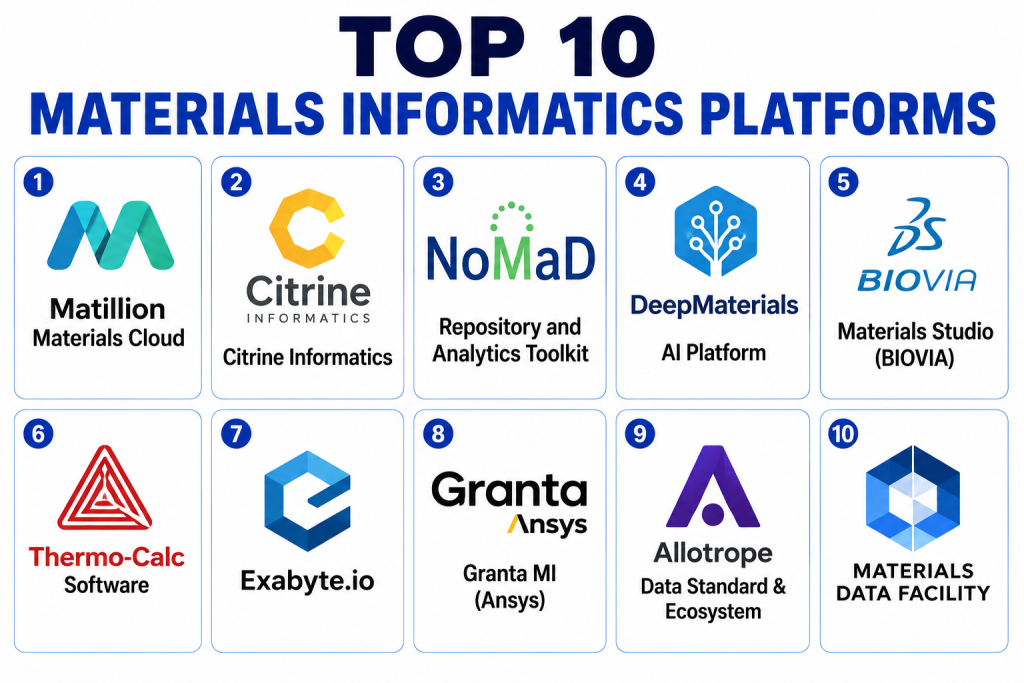
Top 10 Materials Informatics Platforms
1 — Matillion Materials Cloud
Short description: Materials Cloud provides an open platform for managing, sharing, and analyzing materials data using cloud collaboration, integrated workflows, and analytics — suitable for academic and industrial research teams.
Key Features
- Cloud‑based data storage and sharing
- Interactive data exploration tools
- Integration with simulation and experimental datasets
- Versioned workflows and metadata tracking
- Collaboration features for distributed teams
Pros
- Open platform with strong collaboration capabilities
- Suitable for both academic and industrial research
Cons
- May require customization for enterprise workflows
- Learning curve for complex datasets
Platforms / Deployment
- Web
- Cloud
Security & Compliance
- Not publicly stated
Integrations & Ecosystem
- Simulation tool linkages
- Experimental data imports
- Notebook and scripting support
Support & Community
- Community forums
- Documentation and tutorials
2 — Citrine Informatics
Short description: Citrine Informatics uses AI and materials data to drive more predictive material insights and accelerate discovery for energy, chemicals, and advanced manufacturing.
Key Features
- Machine learning prediction of material properties
- High‑throughput screening tools
- Data curation and ontology support
- Integration with experimental and simulation sources
- Visual analytics and model feedback
Pros
- Strong AI modeling capabilities
- Designed for enterprise R&D environments
Cons
- Premium pricing tier
- Complexity for non‑data scientists
Platforms / Deployment
- Web
- Cloud
Security & Compliance
- Not publicly stated
Integrations & Ecosystem
- LIMS and ERP systems
- Simulation engines
- Sensor and experimental system interfaces
Support & Community
- Vendor support and onboarding
- Documentation and examples
3 — NoMaD Repository and Analytics Toolkit
Short description: NoMaD provides an open materials data repository and analytics suite enabling researchers to store, share, and analyze diverse materials datasets with collaborative tools.
Key Features
- Centralized materials database
- Search and query analytics
- Data standardization and metadata labeling
- Collaborative tools for research groups
- Export and interoperability utilities
Pros
- Open and community‑oriented
- Supports large, diverse datasets
Cons
- Not a turnkey commercial platform
- Requires user expertise for best results
Platforms / Deployment
- Web
- Cloud
Security & Compliance
- Not publicly stated
Integrations & Ecosystem
- CLI and API access
- Export to analytical tools
- Interoperability standards
Support & Community
- Active research community
- Documentation and user guides
4 — DeepMaterials AI Platform
Short description: DeepMaterials provides AI‑driven modeling and prediction workflows for materials properties, integrating simulation data and experimental results for predictive insights.
Key Features
- AI property prediction models
- High‑throughput data screening
- Model explainability tools
- Integration with simulation outputs
- Custom model deployment
Pros
- Strong predictive AI capabilities
- Custom model extensibility
Cons
- Requires expertise in AI models
- Less turnkey for non‑technical teams
Platforms / Deployment
- Web
- Cloud
Security & Compliance
- Not publicly stated
Integrations & Ecosystem
- Simulation data connectors
- ERP and R&D systems
- Notebook support (Python)
Support & Community
- Vendor support
- Documentation
5 — Materials Studio (BIOVIA)
Short description: Materials Studio combines modeling, simulation, and informatics tools to enable predictive insights for materials design across chemistry, polymers, and pharmaceuticals.
Key Features
- Atomistic and mesoscale simulation workflows
- Predictive property modeling
- Workflow automation
- Visualization and analytics dashboards
- Integrated database management
Pros
- Broad modeling with informatics integration
- Strong visualization tools
Cons
- Complex interface
- Licensing cost for full modules
Platforms / Deployment
- Windows / Web
- Cloud / Hybrid
Security & Compliance
- Not publicly stated
Integrations & Ecosystem
- Simulation engines
- Laboratory data systems
- Visualization tools
Support & Community
- Vendor support
- Training and documentation
6 — Thermo‑Calc Software
Short description: Thermo‑Calc specializes in thermodynamic and phase diagram modeling but integrates informatics capabilities to accelerate alloy design and multicomponent systems analysis.
Key Features
- Thermodynamic database modeling
- Phase diagram calculation
- Multi‑component system prediction
- Integration with materials databases
- Visualization tools
Pros
- Gold standard for thermodynamic modeling
- Excellent for alloy design
Cons
- Limited AI modeling compared to others
- Requires domain expertise
Platforms / Deployment
- Windows / Web
- Cloud / Hybrid
Security & Compliance
- Not publicly stated
Integrations & Ecosystem
- Materials databases
- Simulation workflows
- Export to analytical tools
Support & Community
- Vendor support
- Documentation
7 — Exabyte.io
Short description: Exabyte.io provides cloud‑native materials simulation and informatics tools enabling integrated workflows from simulation to property prediction and data management.
Key Features
- Cloud‑based simulation workflows
- Automated property prediction
- Data management and sharing
- Collaboration workspaces
- Workflow templating
Pros
- Cloud scalability and collaboration
- Good for distributed teams
Cons
- Subscription model may be expensive
- Requires training for advanced tools
Platforms / Deployment
- Web
- Cloud
Security & Compliance
- Not publicly stated
Integrations & Ecosystem
- Simulation engines
- LIMS and ERP systems
- Visualization tools
Support & Community
- Vendor support
- Tutorials and documentation
8 — Granta MI (Ansys)
Short description: Granta MI centralizes materials data, supports classification and standards compliance, and enables analytics to inform design and engineering decisions.
Key Features
- Centralized materials database
- Standards and compliance tracking
- Integration with CAD/CAE tools
- Analytics and reporting dashboards
- Data governance and access control
Pros
- Excellent for enterprise data governance
- Strong CAD/CAE integration
Cons
- Enterprise pricing
- Focused on materials data governance, less on predictive AI
Platforms / Deployment
- Web / Windows
- Cloud / Hybrid
Security & Compliance
- Encryption, RBAC
- Not publicly stated
Integrations & Ecosystem
- CAD/CAE systems
- ERP and PLM systems
- Analytical and simulation tools
Support & Community
- Vendor support
- Training and documentation
9 — Allotrope Data Standard & Ecosystem
Short description: Allotrope provides an open data standard and ecosystem for materials and analytical data, promoting interoperability and collaborative workflows across tools.
Key Features
- Standardized materials data formats
- API and SDK support
- Interoperability across platforms
- Data federation and indexing
- Metadata tagging and governance
Pros
- Facilitates tool interoperability
- Strong open ecosystem support
Cons
- Not a full standalone platform
- Requires ecosystem adoption
Platforms / Deployment
- Web / Windows / Linux
- Cloud Integration
Security & Compliance
- Not publicly stated
Integrations & Ecosystem
- Analytical instruments
- LIMS and ERP
- AI and modeling tools
Support & Community
- Open ecosystem documentation
- Community forums
10 — Materials Data Facility
Short description: Materials Data Facility provides a cloud‑based research data infrastructure for materials science, allowing storage, discovery, and analytics across large datasets.
Key Features
- Cloud data storage and indexing
- Searchable materials metadata
- API for analytics and data export
- Integration with HPC and simulation workflows
- Collaboration support
Pros
- Scalable big data support
- Designed for research ecosystems
Cons
- Not a dedicated simulation platform
- Mostly focused on data storage and access
Platforms / Deployment
- Web
- Cloud
Security & Compliance
- Not publicly stated
Integrations & Ecosystem
- Simulation engines
- Analytical tools
- Research databases
Support & Community
- Research community support
- Online documentation
Comparison Table (Top 10)
| Tool Name | Best For | Platform(s) Supported | Deployment | Standout Feature | Public Rating |
|---|---|---|---|---|---|
| Matillion Materials Cloud | Collaboration research | Web | Cloud | Shared data & workflows | N/A |
| Citrine Informatics | Predictive AI modeling | Web | Cloud | AI property prediction | N/A |
| NoMaD Repository | Open data research | Web | Cloud | Large open database | N/A |
| DeepMaterials AI Platform | AI predictions | Web | Cloud | AI property models | N/A |
| Materials Studio | Integrated modeling | Win/Web | Cloud/Hybrid | Modeling + analytics | N/A |
| Thermo-Calc | Thermodynamic modeling | Win/Web | Cloud/Hybrid | Phase diagram prediction | N/A |
| Exabyte.io | Cloud workflows | Web | Cloud | Scalable collaboration | N/A |
| Granta MI | Data governance | Web/Win | Cloud/Hybrid | Enterprise materials data | N/A |
| Allotrope Data Standard | Interoperability | Win/Web/Linux | Cloud Integrations | Standardized data | N/A |
| Materials Data Facility | Big data research | Web | Cloud | Scalable data storage | N/A |
Evaluation & Scoring of Materials Informatics Platforms
| Tool Name | Core (25%) | Ease (15%) | Integrations (15%) | Security (10%) | Performance (10%) | Support (10%) | Value (15%) | Weighted Total |
|---|---|---|---|---|---|---|---|---|
| Matillion Materials Cloud | 8 | 7 | 7 | 7 | 8 | 7 | 7 | 7.3 |
| Citrine Informatics | 9 | 7 | 8 | 7 | 9 | 8 | 6 | 7.8 |
| NoMaD Repository | 7 | 7 | 7 | 7 | 7 | 7 | 8 | 7.2 |
| DeepMaterials AI Platform | 8 | 6 | 7 | 7 | 8 | 7 | 7 | 7.2 |
| Materials Studio | 8 | 6 | 8 | 7 | 8 | 7 | 6 | 7.1 |
| Thermo-Calc | 8 | 6 | 7 | 7 | 8 | 7 | 6 | 7.0 |
| Exabyte.io | 8 | 7 | 7 | 7 | 8 | 7 | 7 | 7.2 |
| Granta MI | 8 | 7 | 8 | 8 | 8 | 8 | 6 | 7.5 |
| Allotrope Data Standard | 7 | 6 | 7 | 7 | 7 | 7 | 8 | 7.0 |
| Materials Data Facility | 7 | 7 | 7 | 7 | 7 | 7 | 8 | 7.1 |
Interpretation:
These scores compare platforms across core informatics features, ease of use, integrations, security posture, performance with large datasets, support, and value. Scores are relative and depend on organizational needs — highly technical engineering teams may weigh predictive AI more heavily, while research groups may value data governance and interoperability.
Which Materials Informatics Platform Is Right for You?
Solo / Research Groups
Open platforms like NoMaD or Materials Data Facility offer flexible data storage and sharing for academic and exploratory research.
SMB
Matillion Materials Cloud, DeepMaterials AI Platform, and Exabyte.io provide collaborative workflows with predictive insights suitable for small to mid-sized enterprises.
Mid‑Market
Citrine Informatics and Granta MI balance advanced AI modeling with enterprise data governance and integration capabilities.
Enterprise
Complex R&D organizations benefit from Citrine Informatics, Materials Studio, and Granta MI for robust modeling, analysis, and lifecycle data management.
Budget vs Premium
Open or community platforms are cost‑effective but require expertise to extract insights; premium solutions offer integrated workflows and vendor support.
Feature Depth vs Ease of Use
Advanced AI and analytics deliver deep insights but require experienced users; simpler interfaces and collaboration tools support broader teams.
Integrations & Scalability
Platforms that integrate with simulation engines, lab systems, and ERP scale best across enterprise R&D and production environments.
Security & Compliance Needs
Evaluate encryption, role‑based access, and audit logging where cross‑organizational collaboration and IP protection are critical.
Frequently Asked Questions (FAQs)
1— What is materials informatics?
It’s the application of data science and machine learning to materials data to accelerate discovery, prediction, and optimization of materials properties.
2— How much do these platforms cost?
Costs vary widely — open and research platforms are free or low cost, while enterprise AI modeling tools are premium.
3— Can these tools integrate with lab instruments?
Many platforms support integration with simulation engines, lab data systems, and experiment outputs via APIs.
4— Are AI models accurate for property prediction?
Accuracy depends on dataset quality, model training, and domain knowledge; explainable AI helps build trust in predictions.
5— Do these tools support collaboration?
Cloud-native platforms provide shared workspaces and version control for distributed teams.
6— Is cloud deployment secure?
Secure cloud deployments should include encryption, role-based access, and audit trails; verify vendor offerings.
7— Can these platforms handle big data?
Yes, research data platforms like Materials Data Facility are optimized for large datasets and HPC integration.
8— Is training required?
Advanced features often require training in data science, materials modeling, and platform workflows.
9— Do they support sustainability analysis?
Some platforms include modules for life-cycle assessment and environmental impact modeling.
10— How do I choose the right platform?
Assess your data sources, modeling needs, budget, and integration requirements before selecting a tool.
Conclusion
Materials Informatics Platforms are pivotal for accelerating materials discovery, optimizing processes, and enabling data‑driven engineering decisions. Small research teams may benefit from open platforms like NoMaD and Materials Data Facility, while mid‑market firms can leverage Matillion Materials Cloud or Exabyte.io for collaborative workflows. Enterprise organizations gain the most from advanced AI modeling and data governance tools like Citrine Informatics and Granta MI. Begin by shortlisting based on your domain, compute needs, and integration requirements, pilot key workflows, and validate model predictions with experimental data to ensure insights support your innovation goals.
