Introduction
Chemical Process Simulation Software is used by chemical, petrochemical, pharmaceutical, and energy engineers to model, design, analyze, and optimize industrial chemical processes. These tools simulate reaction kinetics, thermodynamics, fluid dynamics, and equipment behavior, allowing engineers to evaluate processes virtually before physical implementation. In , such software is essential for improving process efficiency, reducing energy consumption, supporting sustainability goals, and ensuring safety and regulatory compliance.
Real-world use cases include:
- Process design and optimization for reactors, distillation, and heat exchangers.
- Safety and risk analysis, including upset scenarios and hazardous reactions.
- Energy, emissions, and carbon footprint evaluation.
- Virtual operator training and decision support.
- Scale-up studies and feasibility analysis for new plants or products.
What buyers should evaluate:
- Process modeling capabilities (thermodynamics, kinetics, transport phenomena)
- Reactor, unit operation, and heat/mass balance modules
- Safety and risk assessment features
- Energy and environmental analysis
- Integration with plant data, MES, and SCADA systems
- Cloud, on-premises, and hybrid deployment flexibility
- User interface and visualization capabilities
- Support, training, and community resources
- Scalability for complex multi-unit processes
- Cost-effectiveness for design, training, and simulation needs
Best for: Chemical engineers, process designers, plant operators, research teams, and training organizations in the chemical and energy sectors.
Not ideal for: Small-scale or highly empirical operations without formal modeling requirements.
Key Trends in Chemical Process Simulation Software
- AI and machine learning integration for predictive process optimization.
- Cloud-based simulation allowing remote collaboration and scalability.
- Digital twin integration for real-time monitoring and virtual plant testing.
- Energy and emissions optimization to meet sustainability goals.
- Multi-scale modeling from molecular to plant scale.
- Enhanced 3D visualization of unit operations and flows.
- Integration with real-time plant data for hybrid simulation approaches.
- Mobile and web-enabled access for distributed teams.
- Advanced safety and scenario analysis for risk mitigation.
- Open-standard compatibility for interoperability with MES, SCADA, and ERP.
How We Selected These Tools (Methodology)
- Evaluated market adoption and credibility in chemical and energy sectors.
- Reviewed feature completeness across reaction, unit operation, and plant simulation modules.
- Assessed performance and reliability with large, multi-unit process simulations.
- Considered security posture, including access control and data protection.
- Evaluated integration capabilities with MES, SCADA, ERP, and plant instrumentation.
- Assessed scalability for pilot plants, R&D, and full-scale production facilities.
- Reviewed vendor support, training, and documentation quality.
- Considered innovation in AI, cloud deployment, and digital twin capabilities.
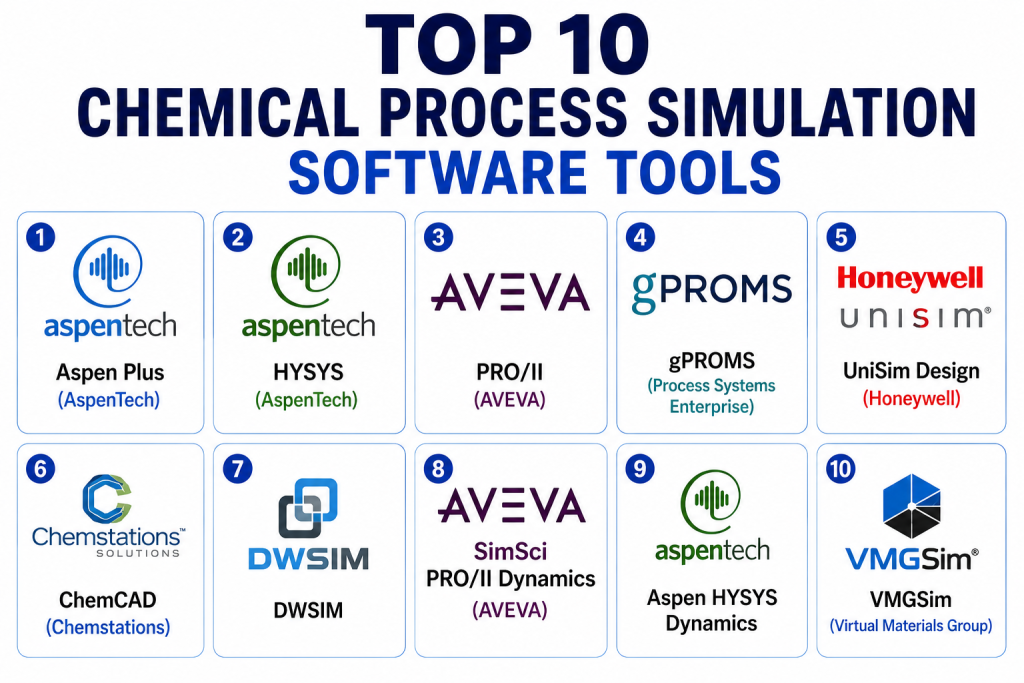
Top 10 Chemical Process Simulation Software Tools
1- Aspen Plus (AspenTech)
Short description: Aspen Plus is a premier chemical process simulator used for designing, optimizing, and analyzing chemical processes, widely adopted in petrochemical, energy, and pharmaceutical industries.
Key Features
- Steady-state process simulation
- Thermodynamic and reaction modeling
- Unit operation library (reactors, distillation, heat exchangers)
- Energy and emissions analysis
- Sensitivity and scenario analysis
Pros
- Industry-standard tool with comprehensive capabilities
- Extensive thermodynamic and unit operation libraries
Cons
- High licensing cost
- Requires experienced users for complex processes
Platforms / Deployment
- Windows
- Cloud / Hybrid
Security & Compliance
- Not publicly stated
Integrations & Ecosystem
- MES, SCADA, ERP integration
- Aspen HYSYS interoperability
- Data export for reporting and analysis
Support & Community
- Extensive vendor support and training
- Online forums and documentation
2- HYSYS (AspenTech)
Short description: Aspen HYSYS focuses on process design and simulation for oil, gas, and chemical plants, with dynamic and steady-state modeling capabilities.
Key Features
- Dynamic and steady-state simulation
- Process optimization and design
- Multi-phase flow and thermodynamic models
- Energy integration and utility analysis
- Scenario and sensitivity studies
Pros
- Strong process optimization tools
- Dynamic simulation for transient studies
Cons
- High cost for small teams
- Complex interface for beginners
Platforms / Deployment
- Windows
- Cloud / Hybrid
Security & Compliance
- Not publicly stated
Integrations & Ecosystem
- Aspen Plus and MES integration
- SCADA connectivity
- ERP and reporting tools
Support & Community
- Vendor-led training
- Documentation and knowledge base
3- PRO/II (AVEVA)
Short description: PRO/II is a chemical process simulation software for steady-state and dynamic analysis, enabling process design, optimization, and safety evaluation.
Key Features
- Steady-state and dynamic simulation
- Heat and material balance calculations
- Process optimization
- Safety and scenario analysis
- Integration with plant data
Pros
- Intuitive interface
- Widely used in chemical and petrochemical industries
Cons
- Limited advanced analytics compared to AspenTech
- May require training for complex modeling
Platforms / Deployment
- Windows
- Cloud / Hybrid
Security & Compliance
- Not publicly stated
Integrations & Ecosystem
- MES and SCADA integration
- ERP systems
- Plant instrumentation data
Support & Community
- Vendor support and training
- Documentation and forums
4- gPROMS (Process Systems Enterprise)
Short description: gPROMS specializes in advanced process modeling with multi-scale, dynamic simulations for chemical, pharmaceutical, and polymer processes.
Key Features
- Dynamic process modeling
- Multi-scale simulation from molecular to plant
- Reaction kinetics and thermodynamics
- Energy and environmental analysis
- Optimization and scenario studies
Pros
- Excellent for complex chemical and polymer processes
- Supports advanced modeling and predictive analytics
Cons
- High complexity
- Premium licensing cost
Platforms / Deployment
- Windows / Linux
- Cloud / Hybrid
Security & Compliance
- Not publicly stated
Integrations & Ecosystem
- ERP, MES, and SCADA data
- Custom simulation APIs
- Reporting and visualization tools
Support & Community
- Vendor training
- Documentation and technical support
5- UniSim Design (Honeywell)
Short description: UniSim Design enables process simulation, optimization, and plant design for refining, petrochemical, and chemical industries.
Key Features
- Steady-state and dynamic simulation
- Unit operation library
- Energy and utility optimization
- Process safety analysis
- Scenario and sensitivity analysis
Pros
- Strong for refining and petrochemical applications
- Integrated energy optimization tools
Cons
- Specialized knowledge required
- Less flexible for research-scale modeling
Platforms / Deployment
- Windows
- Cloud / Hybrid
Security & Compliance
- Not publicly stated
Integrations & Ecosystem
- MES and SCADA integration
- ERP data exchange
- Honeywell plant system compatibility
Support & Community
- Vendor support and training
- Documentation
6- ChemCAD (Chemstations)
Short description: ChemCAD offers steady-state and dynamic chemical process simulation for process design, optimization, and operator training.
Key Features
- Steady-state and dynamic process simulation
- Extensive unit operation library
- Energy and emissions analysis
- Heat and material balance
- Process optimization tools
Pros
- User-friendly interface
- Flexible licensing options
Cons
- Limited advanced analytics
- Less industry-standard than AspenTech
Platforms / Deployment
- Windows
- Cloud / Hybrid
Security & Compliance
- Not publicly stated
Integrations & Ecosystem
- MES and SCADA
- ERP connections
- Data export for analysis
Support & Community
- Vendor documentation
- Training resources
7- DWSIM
Short description: DWSIM is an open-source chemical process simulator for modeling, optimization, and thermodynamic analysis in chemical engineering education and industry.
Key Features
- Open-source steady-state and dynamic simulation
- Thermodynamics and unit operation modeling
- Optimization and sensitivity analysis
- Process visualization and reporting
Pros
- Free and flexible
- Active open-source community
Cons
- Limited commercial support
- Smaller library of industrial-scale unit operations
Platforms / Deployment
- Windows / macOS / Linux
- Cloud via remote servers
Security & Compliance
- Not publicly stated
Integrations & Ecosystem
- Import/export with Excel, CSV, and other formats
- Python and analytical tool integration
Support & Community
- Open-source community
- Online forums and documentation
8- SimSci PRO/II Dynamics (AVEVA)
Short description: PRO/II Dynamics allows dynamic process simulation for plant operations, transient analysis, and safety studies.
Key Features
- Dynamic simulation for transient processes
- Reaction kinetics modeling
- Energy and mass balance calculations
- Scenario and sensitivity analysis
- Safety assessment and hazard modeling
Pros
- Suitable for transient and dynamic studies
- Good integration with plant data
Cons
- Steep learning curve
- Premium pricing
Platforms / Deployment
- Windows
- Cloud / Hybrid
Security & Compliance
- Not publicly stated
Integrations & Ecosystem
- SCADA and MES data integration
- ERP and process data connectors
Support & Community
- Vendor support and training
- Documentation
9- Aspen HYSYS Dynamics
Short description: HYSYS Dynamics is an extension of Aspen HYSYS for dynamic process simulation, control system design, and operator training.
Key Features
- Dynamic simulation and control analysis
- Heat and mass balance calculations
- Operator training scenarios
- Safety and risk assessment
- Process optimization
Pros
- Deep integration with AspenTech ecosystem
- Supports operator training
Cons
- High licensing cost
- Requires experienced users
Platforms / Deployment
- Windows
- Cloud / Hybrid
Security & Compliance
- Not publicly stated
Integrations & Ecosystem
- MES and SCADA integration
- ERP data
- Control system simulators
Support & Community
- Vendor-led support
- Documentation and training programs
10- VMGSim (Virtual Materials Group)
Short description: VMGSim specializes in chemical process simulation for gas processing, refining, and petrochemical plants, offering both steady-state and dynamic capabilities.
Key Features
- Steady-state and dynamic process modeling
- Heat and material balance
- Reactor and distillation modeling
- Gas processing and petrochemical applications
- Scenario and optimization studies
Pros
- Tailored for gas processing and petrochemical workflows
- Reliable and accurate simulation engine
Cons
- Requires domain expertise
- Licensing costs for full features
Platforms / Deployment
- Windows
- Cloud / Hybrid
Security & Compliance
- Not publicly stated
Integrations & Ecosystem
- MES, SCADA, ERP integration
- Data export and analytics
Support & Community
- Vendor support
- Documentation
Comparison Table (Top 10)
| Tool Name | Best For | Platform(s) Supported | Deployment | Standout Feature | Public Rating |
|---|---|---|---|---|---|
| Aspen Plus | Process design | Windows | Cloud/Hybrid | Comprehensive unit ops | N/A |
| HYSYS | Oil & gas | Windows | Cloud/Hybrid | Dynamic simulation | N/A |
| PRO/II | Steady-state & dynamic | Windows | Cloud/Hybrid | Process optimization | N/A |
| gPROMS | Advanced polymer/chemical | Windows/Linux | Cloud/Hybrid | Multi-scale modeling | N/A |
| UniSim Design | Refining & petrochemical | Windows | Cloud/Hybrid | Energy optimization | N/A |
| ChemCAD | Chemical education & industry | Windows | Cloud/Hybrid | Flexible simulation | N/A |
| DWSIM | Open-source | Win/mac/Linux | Cloud | Free & customizable | N/A |
| PRO/II Dynamics | Dynamic plant studies | Windows | Cloud/Hybrid | Transient simulation | N/A |
| HYSYS Dynamics | Operator training | Windows | Cloud/Hybrid | Control & dynamic analysis | N/A |
| VMGSim | Gas & petrochemical | Windows | Cloud/Hybrid | Accurate chemical simulations | N/A |
Evaluation & Scoring of Chemical Process Simulation Tools
| Tool Name | Core (25%) | Ease (15%) | Integrations (15%) | Security (10%) | Performance (10%) | Support (10%) | Value (15%) | Weighted Total |
|---|---|---|---|---|---|---|---|---|
| Aspen Plus | 9 | 7 | 9 | 7 | 9 | 8 | 6 | 8.0 |
| HYSYS | 9 | 7 | 8 | 7 | 9 | 8 | 6 | 7.9 |
| PRO/II | 8 | 7 | 8 | 7 | 8 | 7 | 7 | 7.6 |
| gPROMS | 9 | 6 | 8 | 7 | 9 | 7 | 6 | 7.7 |
| UniSim Design | 8 | 7 | 8 | 7 | 8 | 7 | 7 | 7.6 |
| ChemCAD | 7 | 8 | 7 | 7 | 8 | 7 | 7 | 7.3 |
| DWSIM | 6 | 7 | 6 | 7 | 7 | 6 | 8 | 6.8 |
| PRO/II Dynamics | 8 | 7 | 7 | 7 | 8 | 7 | 7 | 7.4 |
| HYSYS Dynamics | 8 | 7 | 7 | 7 | 8 | 7 | 7 | 7.4 |
| VMGSim | 8 | 7 | 7 | 7 | 8 | 7 | 7 | 7.4 |
Which Chemical Process Simulation Tool Is Right for You?
Solo / Freelancer
DWSIM or ChemCAD is suitable for educational, small-scale, or experimental process simulations.
SMB
ChemCAD, VMGSim, and UniSim Design provide flexible solutions for mid-sized chemical or petrochemical teams.
Mid-Market
Aspen Plus, PRO/II, and HYSYS deliver powerful modeling and optimization for complex industrial processes.
Enterprise
gPROMS, UniSim, and Aspen HYSYS Dynamics offer full-scale dynamic modeling, energy optimization, and operator training for large chemical plants.
Budget vs Premium
Open-source DWSIM minimizes cost but requires technical expertise; premium solutions provide advanced analytics, process libraries, and training.
Feature Depth vs Ease of Use
Enterprise suites have deep capabilities but a learning curve; mid-market tools balance usability and simulation depth.
Integrations & Scalability
Tools integrating MES, SCADA, ERP, and lab data provide scalability for multi-unit, multi-site operations.
Security & Compliance Needs
Consider encryption, access control, and audit logging for collaborative industrial simulation environments.
Frequently Asked Questions (FAQs)
1— What is chemical process simulation software?
Software for modeling, optimizing, and analyzing industrial chemical processes virtually, including reaction, heat, and mass balance.
2— How much does it cost?
Costs vary from free/open-source (DWSIM) to enterprise solutions (Aspen Plus, HYSYS) depending on features and licensing.
3— Can these tools simulate dynamic processes?
Yes, Aspen HYSYS Dynamics, PRO/II Dynamics, and gPROMS support transient and dynamic simulations.
4— Are operator training scenarios supported?
Some platforms like HYSYS Dynamics and UniSim provide virtual training scenarios for operators.
5— Can these tools optimize energy and emissions?
Yes, energy and sustainability modules allow evaluation of consumption, emissions, and optimization opportunities.
6— Do these tools integrate with plant data?
Yes, they can integrate with MES, SCADA, ERP, and IoT sensor networks.
7— Is cloud deployment available?
Many tools offer cloud or hybrid deployment for remote access and collaboration.
8— Are open-source options available?
DWSIM provides open-source flexibility with community support.
9— Do they support multi-unit plant simulation?
Enterprise tools like Aspen Plus and gPROMS support large multi-unit, multi-product simulations.
10— How do I choose the right tool?
Consider scale, industry, simulation depth, integration requirements, and budget when selecting a solution.
Conclusion
Chemical Process Simulation Software is crucial for safe, efficient, and optimized chemical and energy operations. Open-source or mid-market tools like DWSIM, ChemCAD, and VMGSim serve small to mid-size teams, while Aspen Plus, HYSYS, gPROMS, and UniSim provide enterprise-grade capabilities for dynamic simulation, energy optimization, and operator training. Begin by shortlisting tools based on process complexity, data integration needs, and team expertise, pilot critical simulations, and ensure alignment with operational and sustainability goals before full deployment.
