Introduction
Model incident management tools are platforms that help organizations detect, respond to, and resolve issues in production AI systems. These incidents can include model drift, hallucinations, latency spikes, biased outputs, data pipeline failures, or unsafe responses from LLM-powered applications.
incident management has become critical because AI systems are no longer passive models—they are autonomous agents, multi-model systems, and real-time decision engines embedded in business workflows. When something goes wrong, the impact is immediate: financial loss, compliance violations, or user trust breakdown.
Model incident management tools are used for:
- Detecting model drift and performance degradation
- Alerting on hallucinations or unsafe outputs
- Managing LLM and agent failures in production
- Tracking root causes across data, model, and pipeline layers
- Coordinating incident response across ML + platform teams
- Automating rollback of faulty models
- Monitoring cost spikes and latency anomalies
- Ensuring compliance with audit-ready incident logs
To evaluate these platforms, buyers should focus on:
- Real-time detection capabilities
- Multi-model and LLM observability support
- Root cause analysis depth
- Alerting and escalation workflows
- Integration with MLOps/LLMOps pipelines
- Support for RAG and agent workflows
- Automation and rollback capabilities
- Audit logs and compliance readiness
- Scalability across distributed systems
- Ease of integration with existing monitoring stacks
Best for: AI platform teams, MLOps/LLMOps engineers, SRE teams supporting AI systems, and enterprises running mission-critical AI workloads.
Not ideal for: early-stage prototypes, offline ML experiments, or non-production models.
What’s Changed in Model Incident Management
- Shift from model monitoring → AI system incident orchestration
- Native support for LLM hallucination and safety incidents
- Incident tracking across agents, tools, and multi-model chains
- Automated rollback of model versions in production
- Integration with RAG pipelines and vector DB failures
- Real-time cost anomaly detection (token + GPU spikes)
- Unified incident views across data, model, and infrastructure
- AI-driven root cause analysis suggestions
- Policy-based auto-mitigation and guardrail enforcement
- Strong adoption of incident SLAs for AI systems
- Integration with observability + lineage + evaluation systems
- Increased regulatory focus on AI incident audit trails
Quick Buyer Checklist
- Does it detect model drift and performance anomalies in real time?
- Can it handle LLM-specific incidents (hallucinations, unsafe outputs)?
- Does it support multi-model systems and routing failures?
- Is there automated alerting and escalation support?
- Can incidents be traced back to data, features, or prompts?
- Does it support rollback or model redeployment automation?
- Are RAG pipeline failures visible and traceable?
- Does it integrate with monitoring tools (logs, metrics, traces)?
- Are incident timelines and audit logs available?
- Can it detect cost and latency anomalies?
- Does it support CI/CD and MLOps pipelines?
- Is it cloud, hybrid, or self-hosted ready?
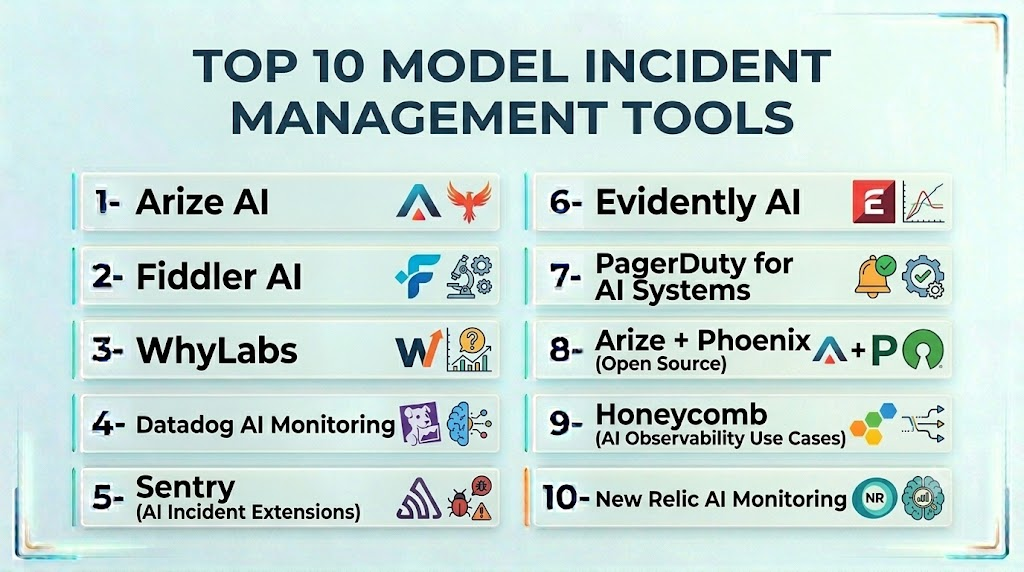
Top 10 Model Incident Management Tools
1- Arize AI
One-line verdict: Best for LLM and ML incident detection with deep observability and root cause analysis.
Short description:
Arize AI is a leading AI observability and incident management platform designed to detect, diagnose, and resolve ML and LLM production issues. It is widely used for debugging real-time AI systems and identifying model degradation.
Standout Capabilities
- Real-time model performance monitoring
- Drift and anomaly detection alerts
- LLM hallucination tracking
- Root cause analysis dashboards
- RAG pipeline tracing
- Feature-level incident detection
- Alerting and notification workflows
AI-Specific Depth
- Model support: Multi-model (ML + LLM systems)
- RAG integration: Strong tracing for retrieval pipelines
- Evaluation: Continuous evaluation and benchmarking
- Guardrails: Limited automated enforcement
- Observability: Deep logs, traces, and metrics
Pros
- Excellent debugging capabilities
- Strong LLM observability
- Fast incident detection
Cons
- Limited automated remediation
- Not a full MLOps suite
Security & Compliance
Not publicly stated
Deployment & Platforms
Cloud-based
Integrations & Ecosystem
- OpenAI APIs
- LangChain
- Vector databases
- Data warehouses
- MLOps pipelines
Pricing Model
Usage-based / enterprise pricing
Best-Fit Scenarios
- LLM production systems
- RAG-based applications
- AI observability teams
2- Fiddler AI
One-line verdict: Strong enterprise-grade AI monitoring and incident diagnostics platform.
Short description:
Fiddler AI focuses on explainability, monitoring, and incident detection for ML and LLM systems in production environments.
Standout Capabilities
- Model performance monitoring dashboards
- Bias and drift detection
- Explainability for incident root cause
- Alerting and anomaly detection
- Feature-level diagnostics
- Incident investigation tools
AI-Specific Depth
- Model support: ML + LLM models
- RAG integration: Limited support
- Evaluation: Explainability-driven evaluation
- Guardrails: Policy-based monitoring
- Observability: Full model telemetry
Pros
- Strong explainability features
- Enterprise-ready monitoring
- Good incident tracing
Cons
- LLM-native features still evolving
- Complex enterprise setup
Security & Compliance
Enterprise RBAC, audit logs (details vary)
Deployment & Platforms
Cloud + hybrid
Integrations & Ecosystem
- ML pipelines
- BI tools
- Data warehouses
- APIs
Pricing Model
Enterprise subscription
Best-Fit Scenarios
- Regulated industries
- Explainable AI systems
- Enterprise ML operations
3- WhyLabs
One-line verdict: Best lightweight AI observability and incident detection platform for data + model drift.
Short description:
WhyLabs provides monitoring and incident detection for ML and LLM systems with a strong focus on data quality and drift detection.
Standout Capabilities
- Data drift detection alerts
- Model performance monitoring
- LLM observability support
- Automated anomaly detection
- Scalable monitoring pipelines
- Privacy-focused architecture
AI-Specific Depth
- Model support: ML + LLM systems
- RAG integration: Basic support
- Evaluation: Metrics-based evaluation
- Guardrails: Monitoring-based only
- Observability: Data + model logs
Pros
- Lightweight and scalable
- Strong privacy design
- Easy integration
Cons
- Limited incident automation
- Less deep root cause tooling
Security & Compliance
Privacy-first architecture; certifications not fully publicly stated
Deployment & Platforms
Cloud + hybrid
Integrations & Ecosystem
- Data pipelines
- ML frameworks
- Cloud storage
- APIs
Pricing Model
Freemium + enterprise
Best-Fit Scenarios
- Data drift monitoring
- Lightweight AI incident tracking
- SMB ML teams
4- Datadog AI Monitoring
One-line verdict: Best unified observability platform extending into AI incident management.
Short description:
Datadog provides infrastructure and application monitoring with expanding capabilities for AI system incident detection and observability.
Standout Capabilities
- Unified logs, metrics, and traces
- AI system anomaly detection
- Latency and cost spike detection
- Alerting and escalation workflows
- End-to-end system monitoring
- Dashboard-based incident response
AI-Specific Depth
- Model support: External ML/LLM integrations
- RAG integration: Indirect via logs/traces
- Evaluation: Not native
- Guardrails: Not available
- Observability: Strong infra + app-level
Pros
- Industry-leading observability
- Strong alerting system
- Broad integrations
Cons
- Not AI-native
- Requires customization for ML incidents
Security & Compliance
Enterprise-grade security controls (certifications vary)
Deployment & Platforms
Cloud-based SaaS
Integrations & Ecosystem
- Kubernetes
- Cloud providers
- CI/CD tools
- APIs
Pricing Model
Usage-based
Best-Fit Scenarios
- Large-scale production systems
- AI + infra unified monitoring
- Enterprise SRE teams
5- Sentry (AI Incident Extensions)
One-line verdict: Best for application-level AI error tracking and incident logging.
Short description:
Sentry is widely used for error tracking and is increasingly adopted for AI application incident monitoring, especially for LLM APIs and front-end AI systems.
Standout Capabilities
- Real-time error tracking
- Stack trace debugging
- Performance monitoring
- API failure alerts
- Release tracking
- Incident grouping
AI-Specific Depth
- Model support: External LLM APIs
- RAG integration: Indirect
- Evaluation: Not available
- Guardrails: Not available
- Observability: App-level telemetry
Pros
- Excellent error debugging
- Easy setup
- Strong developer adoption
Cons
- Not ML-native
- Limited AI-specific insights
Security & Compliance
RBAC, SSO available (enterprise plans)
Deployment & Platforms
Cloud + self-hosted
Integrations & Ecosystem
- Web apps
- APIs
- CI/CD tools
- Cloud platforms
Pricing Model
Freemium + usage-based
Best-Fit Scenarios
- AI-powered applications
- LLM API error tracking
- Frontend AI systems
6- Evidently AI
One-line verdict: Best open-source-style monitoring and drift detection for ML incident detection.
Short description:
Evidently AI focuses on monitoring data drift, model performance, and anomalies that can trigger AI incidents.
Standout Capabilities
- Data drift detection
- Model performance tracking
- Custom monitoring metrics
- Report generation
- Batch anomaly detection
AI-Specific Depth
- Model support: ML-focused + basic LLM support
- RAG integration: Limited
- Evaluation: Statistical evaluation
- Guardrails: Not available
- Observability: Metrics-based
Pros
- Lightweight and flexible
- Open-source friendly
- Strong drift detection
Cons
- No automation workflows
- Limited enterprise features
Security & Compliance
Varies / N/A
Deployment & Platforms
Self-host or cloud
Integrations & Ecosystem
- Python ML stack
- Data pipelines
- BI tools
Pricing Model
Open-source + enterprise options
Best-Fit Scenarios
- ML monitoring systems
- Lightweight AI incident detection
- Data science teams
7- PagerDuty for AI Systems
One-line verdict: Best incident response orchestration tool extended into AI operations.
Short description:
PagerDuty provides incident management and alerting workflows, increasingly used for AI system incident response coordination.
Standout Capabilities
- Alert routing and escalation
- Incident response workflows
- On-call management
- Automation runbooks
- Integration with monitoring systems
AI-Specific Depth
- Model support: External AI systems
- RAG integration: Not native
- Evaluation: Not available
- Guardrails: Not available
- Observability: Incident-level alerts
Pros
- Strong incident orchestration
- Mature alerting system
- Reliable for enterprise ops
Cons
- Not AI-native
- Requires integration layer
Security & Compliance
Enterprise security controls available
Deployment & Platforms
Cloud-based
Integrations & Ecosystem
- Datadog
- Prometheus
- Cloud platforms
- CI/CD tools
Pricing Model
Subscription-based
Best-Fit Scenarios
- Enterprise incident response
- AI + infrastructure ops teams
- SRE workflows
8- Arize + Phoenix (Open Source)
One-line verdict: Best open-source + enterprise hybrid for AI incident debugging.
Short description:
Phoenix (by Arize) provides open-source observability for LLM and ML systems, while Arize adds enterprise incident management features.
Standout Capabilities
- Open-source observability
- LLM trace debugging
- RAG pipeline inspection
- Evaluation workflows
- Incident root cause analysis
AI-Specific Depth
- Model support: ML + LLM systems
- RAG integration: Strong
- Evaluation: Built-in evaluation tooling
- Guardrails: Limited
- Observability: Deep tracing
Pros
- Flexible open-source option
- Strong LLM debugging
- Enterprise scalability
Cons
- Requires setup effort
- Split product ecosystem
Security & Compliance
Not publicly stated
Deployment & Platforms
Cloud + self-host
Integrations & Ecosystem
- LangChain
- OpenAI
- Vector DBs
- ML pipelines
Pricing Model
Open-source + enterprise
Best-Fit Scenarios
- LLM debugging teams
- RAG systems
- AI observability engineers
9- Honeycomb (AI Observability Use Cases)
One-line verdict: Best for high-cardinality observability and incident debugging.
Short description:
Honeycomb provides observability for complex systems and is used in AI pipelines for tracing and incident analysis.
Standout Capabilities
- High-cardinality tracing
- Event-level debugging
- Latency and anomaly detection
- Distributed system observability
- Query-based investigation
AI-Specific Depth
- Model support: External AI systems
- RAG integration: Indirect
- Evaluation: Not native
- Guardrails: Not available
- Observability: Strong distributed tracing
Pros
- Powerful debugging capabilities
- Excellent system-level observability
- Fast incident investigation
Cons
- Not AI-native
- Requires expertise
Security & Compliance
Enterprise-grade controls (varies)
Deployment & Platforms
Cloud-based
Integrations & Ecosystem
- Kubernetes
- Cloud services
- APIs
- Observability stacks
Pricing Model
Usage-based
Best-Fit Scenarios
- Complex distributed AI systems
- Infra + AI observability
- Engineering-heavy teams
10- New Relic AI Monitoring
One-line verdict: Strong all-in-one observability platform with AI incident tracking capabilities.
Short description:
New Relic provides infrastructure and application monitoring with expanding AI observability and incident detection capabilities.
Standout Capabilities
- Full-stack observability
- AI anomaly detection
- Alerting and dashboards
- Performance monitoring
- Distributed tracing
- Incident workflows
AI-Specific Depth
- Model support: External ML/LLM systems
- RAG integration: Indirect
- Evaluation: Not native
- Guardrails: Not available
- Observability: Strong infra + app logs
Pros
- Unified observability platform
- Strong alerting system
- Scalable architecture
Cons
- Not AI-specific
- Requires customization for ML incidents
Security & Compliance
Enterprise security features available
Deployment & Platforms
Cloud-based SaaS
Integrations & Ecosystem
- Cloud providers
- Kubernetes
- CI/CD pipelines
- APIs
Pricing Model
Usage-based
Best-Fit Scenarios
- Enterprise observability stacks
- AI + infra monitoring
- Production-scale systems
Comparison Table
| Tool Name | Best For | Deployment | AI Support Level | Strength | Watch-Out | Public Rating |
|---|---|---|---|---|---|---|
| Arize AI | LLM incident detection | Cloud | High | LLM debugging | Limited remediation | N/A |
| Fiddler AI | Enterprise explainability | Cloud/Hybrid | Medium | Root cause analysis | LLM depth | N/A |
| WhyLabs | Drift detection | Cloud | Medium | Lightweight monitoring | Limited automation | N/A |
| Datadog | Unified observability | Cloud | Medium | Infra + AI monitoring | Not AI-native | N/A |
| Sentry | App-level incidents | Cloud/Self-host | Low | Error tracking | No ML insights | N/A |
| Evidently AI | ML drift detection | Self-host | Medium | Open-source flexibility | No automation | N/A |
| PagerDuty | Incident response | Cloud | Low | Alert orchestration | No AI insights | N/A |
| Arize + Phoenix | LLM debugging | Hybrid | High | Open-source tracing | Setup effort | N/A |
| Honeycomb | System tracing | Cloud | Medium | Deep observability | Complexity | N/A |
| New Relic | Full-stack monitoring | Cloud | Medium | Unified observability | Not AI-specific | N/A |
Scoring & Evaluation (Transparent Rubric)
| Tool | Core | Reliability/Eval | Guardrails | Integrations | Ease | Perf/Cost | Security/Admin | Support | Weighted Total |
|---|---|---|---|---|---|---|---|---|---|
| Arize AI | 9.5 | 9.5 | 7 | 9 | 8 | 8 | 8 | 8 | 8.8 |
| Fiddler AI | 9 | 9 | 8 | 8.5 | 7 | 8 | 9 | 8 | 8.6 |
| WhyLabs | 8.5 | 8 | 6 | 8 | 9 | 8 | 8 | 8 | 8.0 |
| Datadog | 9 | 8 | 6 | 9.5 | 9 | 8.5 | 9 | 9 | 8.6 |
| Sentry | 7.5 | 7 | 5 | 9 | 9 | 9 | 8 | 9 | 7.8 |
| Evidently AI | 8 | 8 | 5 | 8 | 9 | 8 | 7 | 7 | 7.6 |
| PagerDuty | 8 | 7 | 5 | 9 | 9 | 8 | 9 | 9 | 7.9 |
| Arize + Phoenix | 9 | 9 | 6 | 8.5 | 8 | 8 | 8 | 8 | 8.3 |
| Honeycomb | 9 | 8.5 | 6 | 8.5 | 7 | 8.5 | 8 | 8 | 8.2 |
| New Relic | 9 | 8 | 6 | 9.5 | 9 | 8.5 | 9 | 9 | 8.5 |
Which Model Incident Management Tool Is Right for You?
Solo / Freelancer
Use Sentry or Evidently AI for lightweight debugging and monitoring.
SMB
WhyLabs and Sentry offer balanced monitoring and cost efficiency.
Mid-Market
Arize AI or Datadog provide strong observability and incident workflows.
Enterprise
Fiddler AI, Arize AI, and New Relic dominate due to scale and governance.
Regulated industries (finance/healthcare/public sector)
Fiddler AI and PagerDuty ensure auditability, alerting, and structured response.
Budget vs premium
- Budget: Evidently AI, Sentry
- Premium: Arize AI, Datadog, Fiddler AI
Build vs buy
- Build: Evidently AI + open-source observability stack
- Buy: Arize AI, Datadog, New Relic
Common Mistakes & How to Avoid Them
- Treating AI incidents like traditional software incidents
- Ignoring LLM hallucination monitoring
- No rollback strategy for models
- Missing RAG pipeline observability
- Not tracking cost and token spikes
- Lack of alert tuning (too many false positives)
- No root cause analysis workflows
- No evaluation baseline for incidents
- Over-reliance on manual debugging
- Poor integration between ML and SRE teams
- No audit logs for incidents
- Ignoring agent-based workflow failures
- Weak governance around incident response
FAQs
1. What is model incident management?
It is the process of detecting, responding to, and resolving issues in production AI systems such as drift, failures, or unsafe outputs.
It ensures AI systems remain reliable and safe.
2. How is it different from monitoring?
Monitoring tracks system behavior, while incident management focuses on response, escalation, and resolution.
It includes workflows for fixing issues.
3. What types of AI incidents are common?
Common incidents include model drift, hallucinations, latency spikes, cost anomalies, and data pipeline failures.
LLM systems also face prompt injection risks.
4. Do these tools support LLMs?
Yes, modern platforms support LLM-specific incidents like hallucinations and prompt failures.
However, depth varies by vendor.
5. Can incident tools auto-fix issues?
Some platforms support automated rollback or mitigation.
Most still require human-in-the-loop approval.
6. What is RAG incident tracking?
It involves detecting failures in retrieval pipelines such as incorrect or missing context.
It is critical for LLM accuracy.
7. Are these tools expensive?
Costs vary widely from open-source to enterprise pricing models.
Enterprise tools are typically usage-based.
8. Can I integrate incident tools with CI/CD?
Yes, most tools integrate with CI/CD pipelines for automated detection and rollback.
This is common in production AI systems.
9. What is root cause analysis in AI incidents?
It identifies whether issues come from data, model, features, or infrastructure.
It helps speed up debugging.
10. Do these tools support real-time alerts?
Yes, most platforms provide real-time alerting via dashboards, APIs, or notifications.
This is essential for production systems.
11. What is model rollback in incident management?
It is the process of reverting to a previous stable model version after failure detection.
It reduces downtime and risk.
12. What is the biggest challenge in AI incident management?
The biggest challenge is diagnosing issues across complex systems involving models, data, prompts, and infrastructure simultaneously.
Conclusion
Model incident management tools are now essential for maintaining trust, reliability, and safety in modern AI systems. As AI moves toward autonomous agents and multi-model workflows, incident management becomes a core operational layer—not an optional add-on.
The right tool depends on your needs: Arize AI for LLM-heavy systems, Datadog or New Relic for unified observability, and Fiddler AI for enterprise governance. Lightweight tools like Evidently AI and Sentry remain valuable for smaller teams.
