Introduction
Multi-party Computation (MPC) Toolkits are specialized software frameworks that enable multiple parties to jointly compute a function over their inputs while keeping those inputs private. Simply put, MPC allows different organizations or devices to collaborate on data analysis or machine learning without revealing sensitive information to each other.
In , MPC is increasingly relevant due to stricter data privacy regulations, the proliferation of AI-driven applications, and the need for secure collaboration across organizations. Businesses are seeking privacy-preserving techniques to extract insights from distributed datasets while minimizing risk.
Real-world use cases include:
- Financial institutions collaborating on fraud detection models without sharing client data.
- Healthcare organizations jointly training predictive models on patient datasets while complying with HIPAA.
- Cross-company benchmarking for supply chain optimization without revealing proprietary data.
- Federated AI experiments requiring secure aggregation of model updates.
- Research collaborations where datasets cannot leave local premises due to legal restrictions.
Evaluation Criteria for Buyers:
- Supported MPC protocols and cryptographic methods
- Scalability to multiple participants and large datasets
- Integration with AI/ML frameworks and data pipelines
- Security guarantees (encryption, secret sharing)
- Compliance with regulations like GDPR, HIPAA, SOC 2
- Deployment options (cloud, on-premises, hybrid)
- Monitoring, logging, and auditing capabilities
- Ease of use and developer SDKs
- Performance and computational efficiency
- Support and community ecosystem
Best for: Data science teams, security and privacy officers, and organizations in finance, healthcare, telecom, and research sectors.
Not ideal for: Companies handling non-sensitive data, small-scale analytics projects, or scenarios where centralized processing suffices.
Key Trends in Multi-party Computation Toolkits
- Integration with AI and ML pipelines for privacy-preserving model training.
- Cross-organization collaboration becoming standard in regulated industries.
- Support for federated learning workflows leveraging MPC for secure aggregation.
- Advances in cryptography including threshold encryption and optimized secret sharing.
- Edge and IoT device integration to enable distributed computation without centralizing data.
- Automated orchestration for large-scale MPC networks.
- Regulatory compliance features baked into toolkits, ensuring auditability and traceability.
- Open-source frameworks expanding for research and prototyping.
- Hybrid deployment options combining on-premises and cloud for flexibility.
- Performance optimization through parallel computation and lightweight cryptographic operations.
How We Selected These Tools (Methodology)
- Evaluated market adoption and mindshare among enterprises and research institutions.
- Assessed protocol coverage and support for diverse cryptographic methods.
- Reviewed performance and reliability in multi-party computation scenarios.
- Considered security posture, including encryption, secret sharing, and access controls.
- Checked integration with existing data pipelines, AI/ML frameworks, and cloud providers.
- Evaluated customer fit for SMBs, mid-market, and enterprise organizations.
- Assessed ease of deployment and operational overhead.
- Considered support, documentation, and community activity.
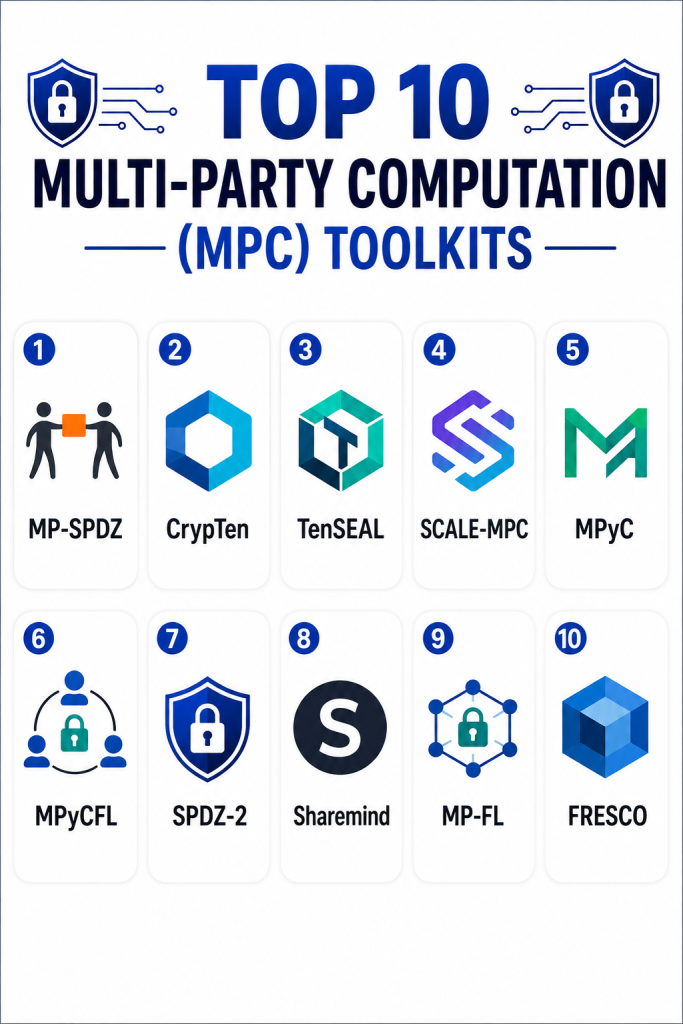
Top 10 Multi-party Computation (MPC) Toolkits
1- MP-SPDZ
Short description: MP-SPDZ is an open-source MPC framework supporting multiple protocols for secure computation across distributed datasets, suitable for research and enterprise-grade applications.
Key Features
- Supports arithmetic and Boolean MPC protocols
- Multiple cryptographic schemes (Shamir secret sharing, SPDZ variants)
- Python and C++ APIs for integration
- Parallel computation for large-scale tasks
- Compatible with federated learning pipelines
- Open-source with modular architecture
Pros
- Flexible and extensible for different MPC protocols
- High-performance computation with parallelization
Cons
- Requires expertise in cryptography and distributed systems
- Steeper learning curve for non-technical users
Platforms / Deployment
- Linux / Cloud / Self-hosted
Security & Compliance
- Supports secure secret sharing and encrypted computation
- Not publicly stated for HIPAA/SOC 2
Integrations & Ecosystem
- Python/C++ APIs for ML and analytics pipelines
- Modular framework for research integration
- Supports federated learning and cross-organization workflows
Support & Community
- Active open-source community
- Extensive documentation and examples
2- CrypTen
Short description: CrypTen is a PyTorch-based MPC framework enabling secure multi-party computation for machine learning, targeting AI researchers and data scientists.
Key Features
- PyTorch integration for AI/ML workflows
- Encrypted tensor operations for privacy-preserving training
- Supports multiple MPC protocols
- GPU acceleration for performance
- Python SDK for development
- Open-source with academic and enterprise adoption
Pros
- Seamless integration with PyTorch
- Optimized for AI/ML workloads
Cons
- Limited support outside PyTorch ecosystem
- Requires understanding of MPC concepts
Platforms / Deployment
- Linux / Cloud / Self-hosted
Security & Compliance
- Encrypted tensor computation
- Not publicly stated for HIPAA/SOC 2
Integrations & Ecosystem
- PyTorch, AI pipelines, Python SDK
- Supports federated and cross-party learning
Support & Community
- Open-source community
- Tutorials and developer guides
3- TenSEAL
Short description: TenSEAL is a library for homomorphic encryption that supports MPC scenarios in AI/ML workflows, focusing on privacy-preserving computation.
Key Features
- CKKS and BFV homomorphic encryption schemes
- Python API for integration with ML pipelines
- Supports tensor operations over encrypted data
- Lightweight and modular design
- Optimized for federated learning
Pros
- Strong privacy guarantees with homomorphic encryption
- Efficient for encrypted ML computation
Cons
- Limited MPC orchestration capabilities
- Technical expertise required
Platforms / Deployment
- Linux / Cloud / Self-hosted
Security & Compliance
- Homomorphic encryption
- Not publicly stated for HIPAA/SOC 2
Integrations & Ecosystem
- Python API for PyTorch integration
- Compatible with federated learning frameworks
- Supports secure analytics workflows
Support & Community
- Open-source documentation
- Active GitHub repository
4- SCALE-MPC
Short description: SCALE-MPC is designed for large-scale secure computation across multiple organizations, focusing on high-performance MPC for sensitive data.
Key Features
- Optimized for multi-party federated computation
- Scalable to dozens of participants
- Modular protocol support
- Python/C++ APIs
- Secure aggregation and computation
- Open-source research framework
Pros
- High scalability for enterprise workloads
- Flexible protocol support
Cons
- Complex setup and configuration
- Requires cryptography knowledge
Platforms / Deployment
- Linux / Cloud / Self-hosted
Security & Compliance
- Secure multi-party computation
- Not publicly stated for HIPAA/SOC 2
Integrations & Ecosystem
- Python/C++ APIs for analytics and ML pipelines
- Supports federated learning
- Modular architecture for integration
Support & Community
- Active open-source research community
- Documentation available
5- MPyC
Short description: MPyC is a Python framework for secure multi-party computation, enabling privacy-preserving collaborative computation across organizations.
Key Features
- Python-native APIs
- Supports arithmetic and Boolean MPC
- Modular protocol design
- Secure computation with multiple parties
- Lightweight and easy to integrate
Pros
- Simple Python API for prototyping
- Flexible for academic and research use
Cons
- Limited enterprise-grade orchestration
- Performance may degrade on very large datasets
Platforms / Deployment
- Linux / Cloud / Self-hosted
Security & Compliance
- Secure multi-party computation
- Not publicly stated for HIPAA/SOC 2
Integrations & Ecosystem
- Python SDK for analytics pipelines
- Integration with AI workflows
- Supports cross-organization collaboration
Support & Community
- Open-source community
- Tutorials and examples
6- MPyCFL
Short description: MPyCFL extends MPyC for federated learning applications, combining MPC with distributed model training.
Key Features
- Supports federated learning with MPC
- Python SDK for ML model integration
- Secure aggregation protocols
- Compatible with PyTorch and TensorFlow
- Modular and extensible
Pros
- Combines MPC and federated learning
- Easy integration with existing ML pipelines
Cons
- Limited scalability for very large organizations
- Requires technical expertise
Platforms / Deployment
- Linux / Cloud / Self-hosted
Security & Compliance
- Secure aggregation and computation
- Not publicly stated for HIPAA/SOC 2
Integrations & Ecosystem
- PyTorch, TensorFlow, Python SDK
- Supports federated learning orchestration
Support & Community
- Open-source documentation
- Community support
7- SPDZ-2
Short description: SPDZ-2 is an advanced MPC framework for secure computation in large multi-party networks, supporting high-performance protocols.
Key Features
- Advanced SPDZ protocol support
- Secure arithmetic and Boolean computation
- Modular and parallelized computation
- Python and C++ SDKs
- Open-source for research and enterprise
Pros
- Optimized for large multi-party computation
- Supports complex protocols
Cons
- High learning curve
- Limited user-friendly deployment tools
Platforms / Deployment
- Linux / Cloud / Self-hosted
Security & Compliance
- Secret-sharing and encrypted computation
- Not publicly stated for HIPAA/SOC 2
Integrations & Ecosystem
- Python/C++ APIs for ML pipelines
- Supports federated and collaborative analytics
Support & Community
- Open-source community
- Documentation available
8- Sharemind
Short description: Sharemind is an enterprise-grade MPC platform for secure data analytics, enabling organizations to collaboratively compute over private datasets.
Key Features
- Enterprise-grade orchestration
- Secure computation protocols
- Scalable for multiple organizations
- APIs for integration with analytics pipelines
- Multi-party data sharing with privacy
Pros
- Enterprise-ready
- Strong privacy and security features
Cons
- Commercial licensing costs
- Technical configuration required
Platforms / Deployment
- Linux / Cloud / Hybrid
Security & Compliance
- Secure computation and access controls
- Not publicly stated for HIPAA/SOC 2
Integrations & Ecosystem
- Analytics pipelines, Python SDKs
- Supports enterprise data workflows
Support & Community
- Enterprise support available
- Documentation and training
9- MP-FL
Short description: MP-FL integrates MPC with federated learning, providing a toolkit for privacy-preserving distributed AI training.
Key Features
- Federated learning with MPC
- Secure aggregation and model training
- Python SDK for ML integration
- Compatible with AI frameworks
- Modular and extensible
Pros
- Combines MPC and federated learning
- Suitable for research and enterprise
Cons
- Setup complexity
- Requires programming knowledge
Platforms / Deployment
- Linux / Cloud / Self-hosted
Security & Compliance
- Secure computation protocols
- Not publicly stated for HIPAA/SOC 2
Integrations & Ecosystem
- PyTorch, TensorFlow, Python SDK
- Supports distributed AI pipelines
Support & Community
- Open-source documentation
- Community support
10- FRESCO
Short description: FRESCO is a Java-based framework for building MPC applications, supporting secure multi-party computation for research and enterprise.
Key Features
- Java SDK for MPC development
- Supports multiple cryptographic protocols
- Modular and extensible design
- Multi-party computation orchestration
- Open-source with research adoption
Pros
- Enterprise and academic adoption
- Modular architecture
Cons
- Java-centric, may not suit Python ML workflows
- Steeper learning curve
Platforms / Deployment
- Linux / Cloud / Self-hosted
Security & Compliance
- Supports secure computation
- Not publicly stated for HIPAA/SOC 2
Integrations & Ecosystem
- Java APIs, analytics pipelines
- Compatible with distributed ML workflows
Support & Community
- Open-source community
- Documentation available
Comparison Table (Top 10)
| Tool Name | Best For | Platform(s) Supported | Deployment | Standout Feature | Public Rating |
|---|---|---|---|---|---|
| MP-SPDZ | Research & enterprise | Linux | Cloud / Self-hosted | Multi-protocol MPC | N/A |
| CrypTen | AI/ML researchers | Linux | Cloud / Self-hosted | PyTorch integration | N/A |
| TenSEAL | ML with homomorphic encryption | Linux | Cloud / Self-hosted | Encrypted tensor computation | N/A |
| SCALE-MPC | Large-scale MPC | Linux | Cloud / Self-hosted | High scalability | N/A |
| MPyC | Research & prototyping | Linux | Cloud / Self-hosted | Python-native MPC | N/A |
| MPyCFL | Federated learning integration | Linux | Cloud / Self-hosted | MPC + FL | N/A |
| SPDZ-2 | Large multi-party networks | Linux | Cloud / Self-hosted | SPDZ protocol support | N/A |
| Sharemind | Enterprise analytics | Linux | Cloud / Hybrid | Enterprise-grade MPC | N/A |
| MP-FL | Distributed AI | Linux | Cloud / Self-hosted | MPC + federated learning | N/A |
| FRESCO | Java MPC apps | Linux | Cloud / Self-hosted | Modular Java SDK | N/A |
Evaluation & Scoring of MPC Toolkits
| Tool Name | Core (25%) | Ease (15%) | Integrations (15%) | Security (10%) | Performance (10%) | Support (10%) | Value (15%) | Weighted Total |
|---|---|---|---|---|---|---|---|---|
| MP-SPDZ | 9 | 7 | 8 | 9 | 8 | 7 | 8 | 8.3 |
| CrypTen | 8 | 8 | 8 | 8 | 8 | 7 | 7 | 7.8 |
| TenSEAL | 8 | 7 | 7 | 9 | 8 | 7 | 7 | 7.8 |
| SCALE-MPC | 9 | 7 | 8 | 9 | 9 | 7 | 8 | 8.4 |
| MPyC | 7 | 8 | 7 | 8 | 7 | 7 | 7 | 7.3 |
| MPyCFL | 8 | 7 | 8 | 8 | 8 | 7 | 7 | 7.7 |
| SPDZ-2 | 9 | 6 | 8 | 9 | 9 | 7 | 8 | 8.2 |
| Sharemind | 9 | 7 | 8 | 9 | 9 | 8 | 8 | 8.5 |
| MP-FL | 8 | 7 | 8 | 8 | 8 | 7 | 7 | 7.7 |
| FRESCO | 8 | 6 | 7 | 8 | 8 | 7 | 7 | 7.5 |
Interpretation: Weighted scores compare each toolkit across core MPC features, usability, integration, security, performance, support, and value, providing a relative assessment for selection.
Which Multi-party Computation Tool Is Right for You?
Solo / Freelancer
Lightweight open-source frameworks like MPyC or CrypTen are ideal for research, experimentation, and prototyping small-scale MPC tasks.
SMB
MPyCFL, MP-FL, or TenSEAL provide scalable options for small teams with privacy-preserving computation needs.
Mid-Market
MP-SPDZ, SPDZ-2, or SCALE-MPC enable mid-market organizations to run collaborative AI and analytics projects with multiple parties.
Enterprise
Sharemind and FRESCO offer enterprise-grade orchestration, regulatory compliance, and secure multi-party computation for large-scale, cross-organization deployments.
Budget vs Premium
Open-source toolkits reduce licensing costs but may require in-house expertise. Enterprise solutions provide professional support, monitoring, and governance.
Feature Depth vs Ease of Use
Enterprise MPC platforms offer advanced security, orchestration, and protocol flexibility, while Python-native frameworks are simpler for research or small-scale use.
Integrations & Scalability
Platforms like MP-SPDZ, Sharemind, and SCALE-MPC scale across multiple participants and integrate with AI and analytics pipelines.
Security & Compliance Needs
Highly regulated industries, such as healthcare and finance, benefit from Sharemind, SCALE-MPC, and SPDZ-2 for robust security and privacy guarantees.
Frequently Asked Questions (FAQs)
1- What is multi-party computation?
MPC is a cryptographic technique allowing multiple parties to jointly compute a function without revealing their individual inputs.
2- How does MPC ensure data privacy?
Data is split into encrypted shares and computations are performed on these shares, preventing any party from accessing raw data.
3- Are these toolkits open-source?
Many MPC frameworks (MPyC, CrypTen, MP-SPDZ, FRESCO) are open-source, with commercial versions available for enterprise deployments.
4- Can MPC work with AI and ML pipelines?
Yes, frameworks like CrypTen, TenSEAL, and MPyCFL integrate with PyTorch, TensorFlow, and other ML platforms.
5- Which industries use MPC most?
Finance, healthcare, government, and research organizations frequently deploy MPC for privacy-preserving computation.
6- Is MPC scalable?
Yes, enterprise-grade platforms like Sharemind, SCALE-MPC, and MP-SPDZ can scale to multiple parties with large datasets.
7- How long does deployment take?
Small-scale experiments may take a few days; full enterprise deployments may require weeks for integration and security testing.
8- Are MPC toolkits cross-platform?
Most Python and Java-based frameworks support Linux and cloud environments, with some support for macOS and Windows.
9- Are there alternatives to MPC?
Yes, federated learning, homomorphic encryption, and secure enclaves can also provide privacy-preserving computation.
10- Do these tools require technical expertise?
Yes, deploying and managing MPC frameworks requires understanding cryptography, distributed systems, and ML integration.
Conclusion
Multi-party Computation toolkits enable privacy-preserving collaborative computation across organizations. Freelancers and research teams benefit from MPyC and CrypTen for experimentation. SMBs can leverage TenSEAL, MPyCFL, or MP-FL for moderate-scale private computation. Mid-market teams can adopt MP-SPDZ, SPDZ-2, or SCALE-MPC for larger collaborative projects. Enterprises needing cross-organization security and compliance should consider Sharemind or FRESCO. Next steps include shortlisting toolkits, piloting secure multi-party workflows, and validating integration with existing AI pipelines and regulatory requirements.
