Introduction
Procure‑to‑Pay (P2P) Suites are comprehensive software solutions that automate and manage the entire procurement lifecycle — from requisition and sourcing to purchasing, invoice processing, payment, and supplier management. A robust P2P suite helps organizations enforce purchasing policies, improve spend visibility, reduce maverick buying, and tighten audit trails. In and beyond, with increasing pressure to optimize cash flow, achieve compliance, and harness AI‑driven insights, P2P technology is central to modern finance and supply chain transformation.
Real‑world use cases include:
- Automating purchase requisitions, approvals, and purchase order issuance.
- Matching invoices to purchase orders and receipts to reduce errors and late payments.
- Centralizing supplier catalogs and negotiated pricing to control spend.
- Enforcing policy compliance and budget gating through automated workflows.
- Facilitating supplier onboarding, performance tracking, and risk monitoring.
What buyers should evaluate:
- End‑to‑end coverage of requisition, sourcing, PO, receiving, invoicing, and payment
- User experience and mobile access
- Integration with ERP, AP/AR, and financial systems
- Automation of workflows and approval rules
- Supplier management and onboarding capabilities
- Analytics and spend visibility
- Security posture and audit controls
- Global support for multi‑currency, tax, and compliance
- AI/ML‑enabled automation features
- Scalability for enterprise usage
Best for: procurement teams, finance leaders, supply chain managers, and shared services centers in mid‑market and enterprise organizations.
Not ideal for: very small businesses without centralized procurement needs or those satisfied with manual purchase and invoice processes.
Key Trends in Procure‑to‑Pay (P2P) Suites
- AI‑assisted invoice capture and matching to automatically validate line items.
- Automated workflow orchestration that adapts approval routing based on rules or spend thresholds.
- Supplier collaboration portals to improve communication and performance visibility.
- Embedded analytics and predictive spend insights supporting budget optimization.
- Cloud‑native deployments for scalability and global access.
- Consolidated supplier catalogs with catalog compliance tracking.
- Integration with ERP and financial systems via APIs and event streams.
- Automated compliance and audit trails simplified by blockchain concepts.
- Programmatic payments and e‑payments reducing cycle times and late fees.
- Flexible pricing models including SaaS subscription tiers and usage‑based costs.
How We Selected These Tools (Methodology)
- Evaluated market adoption and mindshare among procurement and finance leaders.
- Assessed feature completeness, including requisition, sourcing, PO, invoicing, and payment.
- Reviewed performance and reliability for enterprise workloads.
- Verified security posture, including encryption, audit trails, and access controls.
- Examined integration ecosystem with ERP, AP/AR, and analytics platforms.
- Considered customer fit across segments, from mid‑market to global enterprises.
- Analyzed ease of use and onboarding for users and administrators.
- Factored in vendor support, documentation, and training resources.
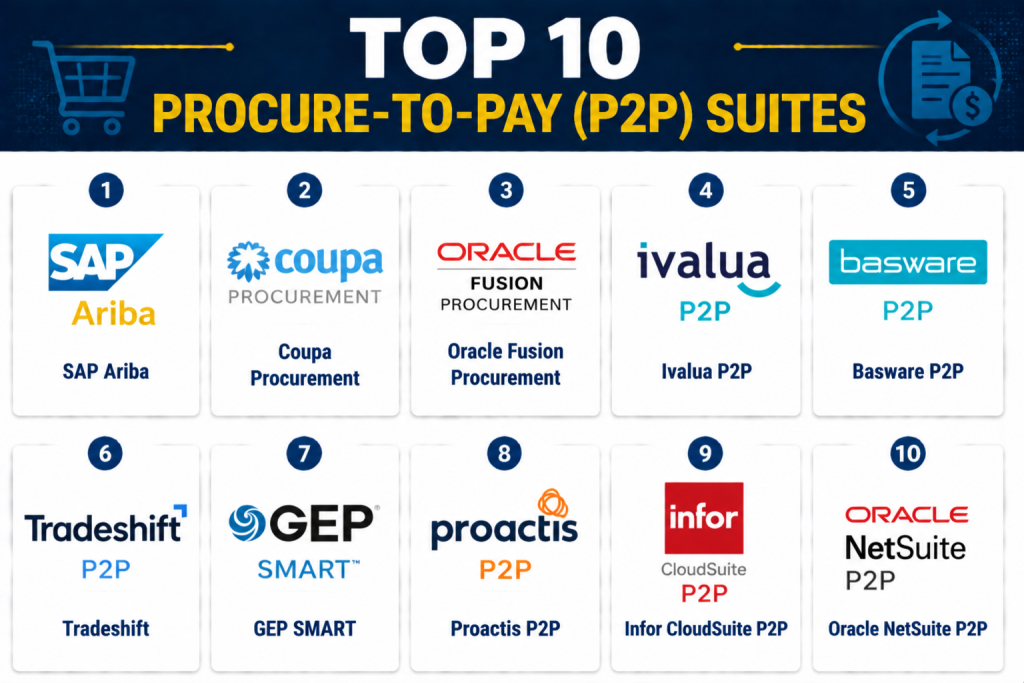
Top 10 Procure‑to‑Pay (P2P) Suites
1 — SAP Ariba
Short description: SAP Ariba is a market‑leading P2P suite that connects buyers and suppliers on a cloud‑based platform, offering comprehensive sourcing, procurement, invoicing, and supplier management capabilities designed for enterprise‑scale operations.
Key Features
- End‑to‑end P2P lifecycle coverage
- Centralized supplier network
- Automated PO and invoice matching
- Dynamic discounting and e‑payments
- Analytics and spend visibility
- Compliance and risk scoring
Pros
- Enterprise‑grade scalability and integration
- Extensive supplier network and catalog management
Cons
- Premium pricing and implementation complexity
- Learning curve for new users
Platforms / Deployment
- Web / Cloud
Security & Compliance
- Encryption, role‑based access, audit logs
- Varies / N/A: Specific certifications not publicly stated
Integrations & Ecosystem
SAP Ariba integrates widely:
- SAP ERP and finance modules
- Third‑party ERPs
- AP/AR and analytics systems
Support & Community
Comprehensive documentation, training, and global support ecosystem.
2 — Coupa Procurement
Short description: Coupa is a popular SaaS P2P suite with a focus on spend optimization, ease of use, and rapid deployment. It blends procurement, invoicing, and supplier management with analytics and AI‑powered insights.
Key Features
- Guided procurement experience
- Supplier management and catalogs
- Invoice automation
- Budgeting and compliance
- AI/ML‑driven spend insights
- Dashboard reporting
Pros
- Highly intuitive user experience
- Strong analytics and spend visibility
Cons
- Advanced features may require additional modules
- Pricing can be high for smaller teams
Platforms / Deployment
- Web / Cloud
Security & Compliance
- Encryption, access control, audit logs
- Varies / N/A: Certification details
Integrations & Ecosystem
- ERP integrations
- AP automation systems
- Analytics platforms
Support & Community
Documentation, customer success programs, and community forums.
3 — Oracle Fusion Procurement
Short description: Oracle Fusion Procurement is part of the Oracle Cloud suite, offering integrated P2P capabilities built for global enterprises with deep financial and supply chain synchronization.
Key Features
- Requisition to PO automation
- Supplier qualification and onboarding
- Invoice matching and dispute handling
- Contract repository and compliance
- Global tax and compliance support
- Analytics and scenario modeling
Pros
- Strong integration with finance and supply chain
- Deep global compliance features
Cons
- Implementation can be complex
- ERP dependency for full value
Platforms / Deployment
- Web / Cloud
Security & Compliance
- Encryption, audit trails, RBAC
- Varies / N/A: Certifications
Integrations & Ecosystem
- Oracle ERP
- HR and expense systems
- Analytics and reporting
Support & Community
Extensive documentation and enterprise support.
4 — Ivalua P2P
Short description: Ivalua provides a flexible P2P suite known for configurability, supplier collaboration, and integrated contract and supplier risk modules.
Key Features
- Requisition and sourcing
- Supplier onboarding and collaboration
- Invoice and payment workflows
- Configurable rules and approvals
- Risk and compliance modules
- Analytics and dashboards
Pros
- Highly configurable for diverse use cases
- Strong supplier engagement tools
Cons
- Customization may require implementation expertise
- Analytics depth varies by module
Platforms / Deployment
- Web / Cloud
Security & Compliance
- Encryption, audit logs
- Varies / N/A: Certifications
Integrations & Ecosystem
- ERP platforms
- Supplier data feeds
- Reporting and BI tools
Support & Community
Documentation, onboarding, and professional support.
5 — Basware P2P
Short description: Basware’s P2P suite emphasizes networked procurement and AP automation, offering strong invoice automation and e‑procurement capabilities.
Key Features
- Networked procurement
- Invoice automation
- e‑Invoicing and compliance
- Catalog and supplier management
- Spend visibility
- Reporting and alerts
Pros
- Strong AP automation
- Easy onboarding for suppliers
Cons
- Less deep sourcing capabilities
- Premium pricing tiers
Platforms / Deployment
- Web / Cloud
Security & Compliance
- Encryption, audit logs
- Varies / N/A: Certifications
Integrations & Ecosystem
- ERP and financial systems
- Logistics and inventory systems
- Analytics tools
Support & Community
Documentation and support services.
6 — Tradeshift
Short description: Tradeshift offers a cloud‑based P2P and supply chain platform with a focus on collaboration, e‑invoicing, and flexible supplier engagement models.
Key Features
- Supplier network
- e‑Invoicing and PO automation
- Workflow automation
- Spend analytics
- Mobile supplier engagement
- API connectivity
Pros
- Strong supplier collaboration
- Flexible network model
Cons
- May require configuration for enterprise rules
- Analytics depth varies
Platforms / Deployment
- Web / Cloud
Security & Compliance
- Encryption, audit trails
- Varies / N/A: Regulatory certifications
Integrations & Ecosystem
- ERP systems
- AP and AR platforms
- Supplier networks
Support & Community
Support documentation and community resources.
7 — GEP SMART
Short description: GEP SMART is a unified procurement platform that includes P2P, sourcing, contract management, and supplier performance modules.
Key Features
- Requisition and PO automation
- Supplier management
- Invoice and payment workflows
- Contract repository
- Spend analytics
- Workflow automation
Pros
- Unified suite across procurement functions
- Strong supplier performance tracking
Cons
- Premium pricing
- Implementation requires planning
Platforms / Deployment
- Web / Cloud
Security & Compliance
- Encryption, audit logs
- Varies / N/A: Certifications
Integrations & Ecosystem
- ERP and finance systems
- Contract and sourcing tools
- Analytics platforms
Support & Community
Documentation and onboarding support.
8 — Proactis P2P
Short description: Proactis provides P2P automation focused on mid‑market organizations looking for procurement control, invoice automation, and spend tracking.
Key Features
- Purchase requests and approvals
- Invoice matching
- Supplier directory
- Spend dashboards
- Budget controls
- Alerts and notifications
Pros
- Solid mid‑market focus
- Easy to configure workflows
Cons
- Less advanced sourcing tools
- Analytics depth varies
Platforms / Deployment
- Web / Cloud
Security & Compliance
- Encryption, audit logs
- Varies / N/A: Certifications
Integrations & Ecosystem
- ERP and finance systems
- Reporting and BI tools
- Supplier portals
Support & Community
Documentation and support services.
9 — Infor CloudSuite P2P
Short description: Infor’s P2P offering supports requisitioning, procurement, invoicing, and supplier management tightly integrated with Infor’s broader ERP suite.
Key Features
- Requisition and approval workflows
- Supplier onboarding and profiles
- Invoice automation
- Spend analytics
- Compliance controls
- Mobile interfaces
Pros
- Integration with Infor ERP
- Strong compliance support
Cons
- Best value when bundled with broader Infor suite
- Mid‑market focus limits enterprise scaling
Platforms / Deployment
- Web / Cloud
Security & Compliance
- Encryption, audit logs
- Varies / N/A: Certifications
Integrations & Ecosystem
- Infor ERP and finance
- Analytics tools
- Reporting systems
Support & Community
Documentation and professional support.
10 — Oracle NetSuite P2P
Short description: Oracle NetSuite provides cloud‑native P2P capabilities as part of the NetSuite ERP platform, designed for mid‑market to growth enterprises with cohesive procurement, invoicing, and payment workflows.
Key Features
- Purchase requisitions and approvals
- Supplier management
- Invoice and payment automation
- Budgeting and compliance
- Reporting and dashboards
- Mobile access
Pros
- Seamless integration with NetSuite ERP
- Cloud‑native and scalable
Cons
- Best fit for NetSuite customers
- Advanced analytics may require add‑ons
Platforms / Deployment
- Web / Cloud
Security & Compliance
- Encryption, audit logs
- Varies / N/A: Certifications
Integrations & Ecosystem
- NetSuite ERP
- AP/AR and financial tools
- Analytics platforms
Support & Community
NetSuite documentation and support forums.
Comparison Table (Top 10)
| Tool Name | Best For | Platform(s) Supported | Deployment | Standout Feature | Public Rating |
|---|---|---|---|---|---|
| SAP Ariba | Enterprises | Web | Cloud | Large supplier network | N/A |
| Coupa Procurement | Mid‑to‑Enterprise | Web | Cloud | Spend visibility & UX | N/A |
| Oracle Fusion Procurement | Global Enterprises | Web | Cloud | Deep ERP integration | N/A |
| Ivalua P2P | Flexible mid‑enterprise | Web | Cloud | Configurable workflows | N/A |
| Basware P2P | AP automation | Web | Cloud | Networked procurement | N/A |
| Tradeshift | Collaborative P2P | Web | Cloud | Supplier engagement | N/A |
| GEP SMART | Unified procurement | Web | Cloud | Supplier performance | N/A |
| Proactis P2P | Mid‑market procurement | Web | Cloud | Mid‑market automation | N/A |
| Infor CloudSuite P2P | ERP‑integrated | Web | Cloud | ERP coupling | N/A |
| Oracle NetSuite P2P | Growth enterprises | Web | Cloud | Seamless NetSuite integration | N/A |
Evaluation & Scoring of P2P Suites
| Tool Name | Core (25%) | Ease (15%) | Integrations (15%) | Security (10%) | Performance (10%) | Support (10%) | Value (15%) | Weighted Total |
|---|---|---|---|---|---|---|---|---|
| SAP Ariba | 9 | 7 | 9 | 8 | 9 | 8 | 7 | 8.4 |
| Coupa Procurement | 8 | 8 | 8 | 8 | 8 | 8 | 7 | 8.2 |
| Oracle Fusion Procurement | 9 | 7 | 9 | 8 | 9 | 7 | 7 | 8.2 |
| Ivalua P2P | 8 | 7 | 8 | 8 | 8 | 7 | 7 | 7.7 |
| Basware P2P | 7 | 8 | 7 | 7 | 7 | 7 | 7 | 7.3 |
| Tradeshift | 7 | 7 | 7 | 7 | 7 | 7 | 7 | 7.2 |
| GEP SMART | 8 | 7 | 8 | 8 | 8 | 7 | 7 | 7.8 |
| Proactis P2P | 7 | 8 | 7 | 7 | 7 | 7 | 7 | 7.2 |
| Infor CloudSuite P2P | 7 | 7 | 7 | 7 | 7 | 7 | 7 | 7.0 |
| Oracle NetSuite P2P | 8 | 8 | 8 | 8 | 8 | 8 | 7 | 8.0 |
Interpreting the Scores: Weighted totals compare core procurement capabilities, ease of use, integration ecosystem, security posture, performance, support offerings, and overall value. Higher totals indicate strong alignment with contemporary P2P requirements, while ‘value’ scores reflect relevance to organizational size and spend complexity.
Which Procure‑to‑Pay Tool Is Right for You?
Solo / Freelancer
- Rarely necessary unless building procurement automation services or advising clients. Value comes mainly in mid‑market and enterprise contexts.
SMB
- Oracle NetSuite P2P, Proactis P2P, or Basware P2P provide affordable, cloud‑native P2P functionality with core automation.
Mid‑Market
- Coupa Procurement, Ivalua P2P, or GEP SMART strike a balance between feature breadth and usability for growing procurement organizations.
Enterprise
- SAP Ariba, Oracle Fusion Procurement, and GEP SMART deliver enterprise‑grade global capabilities, supplier network reach, and integrated analytics.
Budget vs Premium
- Smaller teams can start with NetSuite or Proactis; premium enterprise suites like Ariba or Oracle Fusion offer deep compliance and global support.
Feature Depth vs Ease of Use
- Platforms like Coupa and Ivalua emphasize user experience; enterprise systems like Ariba and Oracle Fusion provide deeper configuration and scenario power.
Integrations & Scalability
- Look for strong ERP, financial, and analytics integrations to support cross‑system spend transparency and compliance.
Security & Compliance Needs
- Ensure encryption, audit logs, role‑based access, and support for global tax, compliance, and audit trails.
Frequently Asked Questions (FAQs)
1— What pricing models are typical?
SaaS subscription, usage tiers, or enterprise licensing based on users, modules, and spend volumes.
2— How long does implementation take?
SMB deployments can launch in weeks; enterprise rollouts often span 3–6 months including training.
3— Can P2P suites integrate with existing ERPs?
Yes, leading suites offer connectors or APIs for ERP, AP/AR, finance, and supply chain systems.
4— Do these tools support mobile access?
Most provide mobile apps or responsive interfaces for approvals and supplier interactions.
5— Are analytics included?
Yes, dashboards and spend analytics are core features in mid‑tier and enterprise suites.
6— How secure are P2P platforms?
They typically include encryption, role‑based access, audit trails, and compliance readiness.
7— Does supplier collaboration improve?
Yes, many suites offer portals for supplier onboarding, catalogs, performance tracking, and invoicing.
8— Can P2P reduce invoice processing time?
Yes, automated matching and workflows significantly shorten cycle times and improve accuracy.
9— Do these tools help with compliance?
Yes, they support policy enforcement, audit trails, and regulatory reporting.
10— Are P2P suites suitable for distributed teams?
Absolutely — cloud‑native suites enable global procurement teams to collaborate in real time.
Conclusion
Procure‑to‑Pay (P2P) Suites enable organizations to unify purchasing, supplier management, invoicing, and payment workflows while improving spend control, compliance, and operational efficiency. Enterprise solutions like SAP Ariba, Coupa Procurement, and Oracle Fusion Procurement deliver deep, global capabilities, while mid‑market suites such as GEP SMART, Ivalua, and NetSuite P2P offer flexible, scalable options. Next steps: shortlist 2–3 tools aligned with your organizational size and spend complexity, run pilots to validate workflows and integrations, and scale deployment to improve financial controls, spend visibility, and supplier collaboration.
