Introduction
Risk Management Information Systems (RMIS) are software platforms designed to centralize, manage, and analyze risk-related data for organizations. They help companies identify, monitor, and mitigate operational, financial, compliance, and insurance risks, providing decision-makers with real-time insights and actionable reporting. In and beyond, with growing regulatory pressures, cyber threats, and complex global operations, RMIS platforms have become critical for enterprise risk and insurance teams to proactively manage exposures and optimize risk strategies.
Real-world use cases include:
- Centralizing claims, loss, and incident data for insurers and corporate risk managers.
- Tracking regulatory compliance and audit findings across departments.
- Monitoring vendor and third-party risk exposures.
- Identifying trends in operational or safety incidents to prevent future losses.
- Supporting insurance program management, including renewals, certificates, and policies.
Evaluation Criteria for Buyers:
- Centralized risk data repository
- Real-time dashboards and reporting
- Integration with insurance, ERP, HR, and audit systems
- Incident and claims management
- Compliance tracking (regulatory, OSHA, ISO standards)
- Analytics for risk trends and predictive modeling
- Scalability across multiple departments or locations
- User experience and configurability
- Security, access controls, and audit logs
- Vendor support, training, and community
Best for: risk managers, insurance professionals, compliance officers, audit teams, and enterprise executives in industries like healthcare, manufacturing, finance, and utilities.
Not ideal for: very small organizations with minimal risk data, single-office operations, or companies that do not require centralized risk intelligence.
Key Trends in Risk Management Information Systems
- AI-powered risk scoring to prioritize high-impact exposures.
- Predictive analytics to forecast claims, losses, and operational incidents.
- Integration with ERP and HR systems for cross-functional risk monitoring.
- Cloud-native platforms offering scalability and multi-site deployment.
- Automated reporting for compliance and insurance renewal requirements.
- Cybersecurity risk modules integrated into enterprise RMIS.
- Mobile access for field risk assessments and incident reporting.
- Workflow automation for incident investigation and remediation tracking.
- Interoperability with third-party data sources for benchmarking and risk intelligence.
- Flexible subscription or SaaS-based pricing to accommodate diverse organizational sizes.
How We Selected These Tools (Methodology)
- Evaluated market adoption and mindshare among insurers and large enterprises.
- Assessed feature completeness, including incident, claims, and compliance management.
- Reviewed performance and reliability, including scalability and uptime.
- Verified security posture, such as encryption, audit trails, and role-based access.
- Examined integration ecosystem with ERP, HR, insurance, and analytics platforms.
- Considered customer fit across segments: mid-market vs enterprise, insurance carriers, brokers, and corporate risk teams.
- Analyzed ease of use and configurability for risk administrators.
- Factored in vendor support, documentation, and training offerings.
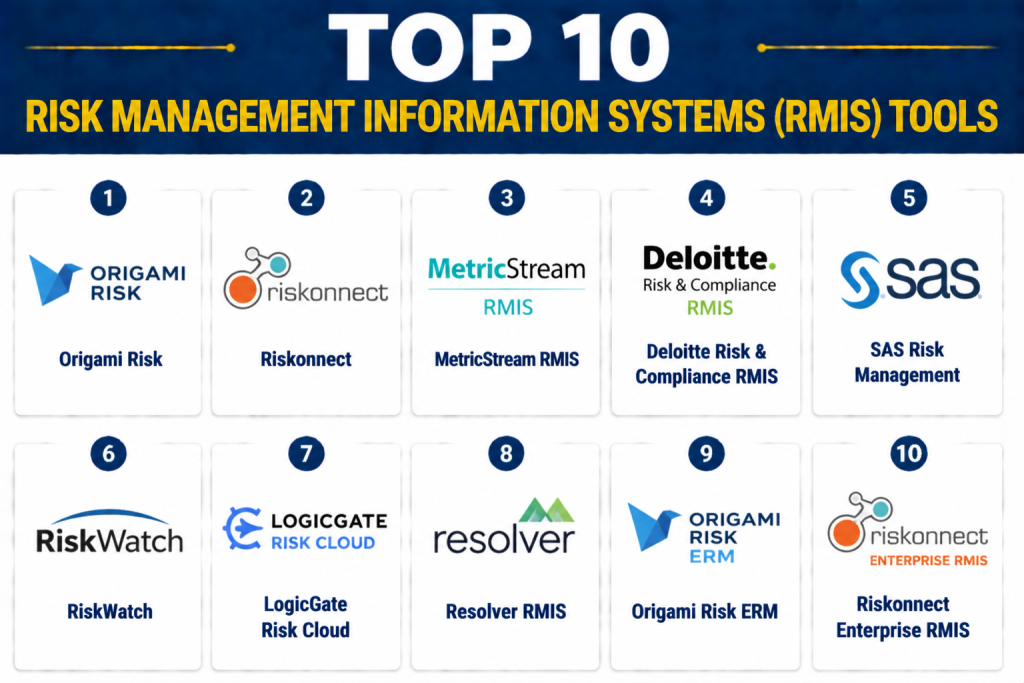
Top 10 Risk Management Information Systems (RMIS) Tools
1 — Origami Risk
Short description: Origami Risk is an enterprise RMIS platform for insurance carriers, brokers, and corporate risk managers, offering claims management, policy administration, and analytics dashboards to streamline risk oversight.
Key Features
- Centralized claims and policy management
- Automated workflows for incident investigation
- Real-time dashboards and reporting
- Integration with HR and ERP systems
- Predictive analytics for risk exposures
- Compliance and audit tracking
Pros
- Comprehensive platform for insurance and risk management
- Strong analytics and reporting capabilities
Cons
- Implementation may require consulting support
- Pricing can be high for smaller organizations
Platforms / Deployment
- Web / Cloud
Security & Compliance
- Encryption, role-based access, audit logs
- Not publicly stated: ISO or SOC certifications
Integrations & Ecosystem
- ERP and HR systems
- Insurance carriers and brokers
- Third-party data feeds
Support & Community
- Professional onboarding, documentation, and customer support
2 — Riskonnect
Short description: Riskonnect provides a cloud-native RMIS solution that centralizes risk, claims, and compliance management, supporting enterprise workflows and real-time analytics for informed decision-making.
Key Features
- Enterprise risk dashboards
- Incident and claims tracking
- Automated compliance management
- Predictive analytics and reporting
- Workflow automation
- Integration with ERP and HR systems
Pros
- Scalable for multi-location enterprises
- Strong compliance and audit support
Cons
- Customization may require technical resources
- Higher learning curve for new users
Platforms / Deployment
- Web / Cloud
Security & Compliance
- Encryption, audit trails, role-based access
- HIPAA / GDPR compliance where applicable
Integrations & Ecosystem
- ERP and insurance management systems
- Analytics and BI tools
- API connectivity for third-party integrations
Support & Community
- Onboarding, training, and documentation provided
3 — MetricStream RMIS
Short description: MetricStream delivers a comprehensive RMIS platform that combines enterprise risk management, compliance, and governance modules with real-time analytics to mitigate operational and regulatory risks.
Key Features
- Enterprise risk management modules
- Compliance tracking and audit readiness
- Incident and claims reporting
- Predictive and prescriptive analytics
- Dashboard and reporting tools
- Integration with ERPs
Pros
- Strong GRC capabilities
- Scalable for global organizations
Cons
- Costly for mid-market companies
- Complex setup for multiple modules
Platforms / Deployment
- Web / Cloud
Security & Compliance
- Encryption, audit trails
- ISO 27001 / SOC 2 (varies by deployment)
Integrations & Ecosystem
- ERP, HR, and compliance systems
- Data visualization tools
- APIs for custom reporting
Support & Community
- Extensive documentation, training, and global support
4 — Deloitte Risk & Compliance RMIS
Short description: Deloitte’s RMIS platform provides integrated risk management, regulatory reporting, and compliance tracking for enterprise clients with multi-location operations.
Key Features
- Enterprise risk dashboards
- Compliance and regulatory tracking
- Incident and claim management
- Audit and reporting modules
- Predictive analytics
- Integration with ERP and HR
Pros
- Consulting-backed deployment
- Extensive analytics and reporting
Cons
- High consulting and licensing fees
- Primarily for enterprise-level deployment
Platforms / Deployment
- Web / Cloud
Security & Compliance
- Encryption, access controls
- HIPAA/GDPR for healthcare clients
Integrations & Ecosystem
- ERP and HR
- Third-party compliance databases
- Custom APIs
Support & Community
- Professional services and dedicated support teams
5 — SAS Risk Management
Short description: SAS provides a robust RMIS platform with advanced analytics, machine learning, and scenario modeling for enterprise risk and insurance management.
Key Features
- Risk scoring and predictive analytics
- Incident, claim, and loss reporting
- Workflow automation
- Compliance dashboards
- Scenario modeling and simulation
- Integration with core systems
Pros
- Advanced analytics for decision-making
- Scalable for large organizations
Cons
- Requires data science expertise
- Premium pricing
Platforms / Deployment
- Web / Cloud / Hybrid
Security & Compliance
- Encryption and audit logs
- HIPAA/GDPR where applicable
Integrations & Ecosystem
- ERP, claims, and HR systems
- Data warehouses and analytics platforms
- API integration
Support & Community
- Documentation, training, and professional services
6 — RiskWatch
Short description: RiskWatch RMIS specializes in compliance-driven risk assessment, offering dashboards, scoring, and workflow tools for operational and insurance risks.
Key Features
- Automated risk assessments
- Compliance and audit management
- Real-time dashboards
- Incident and claims tracking
- Reporting and analytics
- Integration APIs
Pros
- Strong compliance focus
- Easy-to-use dashboards
Cons
- Smaller ecosystem compared to enterprise RMIS
- Limited advanced predictive analytics
Platforms / Deployment
- Web / Cloud
Security & Compliance
- Encryption, audit trails
- Not publicly stated: certifications
Integrations & Ecosystem
- ERP, compliance, and HR systems
- Reporting tools
- API access
Support & Community
- Documentation and support services
7 — LogicGate Risk Cloud
Short description: LogicGate provides a low-code RMIS platform for enterprise risk, compliance, and audit management with workflow automation and reporting.
Key Features
- Low-code configuration
- Workflow automation
- Risk scoring and dashboards
- Compliance and audit modules
- Case management
- Integration APIs
Pros
- Rapid configuration for complex workflows
- Strong visual dashboards
Cons
- May require internal admin resources
- Less industry-specific templates
Platforms / Deployment
- Web / Cloud
Security & Compliance
- Encryption, role-based access, audit logs
- Not publicly stated: certifications
Integrations & Ecosystem
- ERP and HR systems
- Audit and compliance tools
- API support
Support & Community
- Documentation and professional services
8 — Resolver RMIS
Short description: Resolver RMIS delivers enterprise-grade risk, incident, and compliance management with reporting dashboards and workflow automation.
Key Features
- Risk and incident tracking
- Compliance monitoring
- Automated alerts and workflows
- Analytics dashboards
- Integration with enterprise systems
- Mobile support
Pros
- Comprehensive workflow management
- Scalable for global enterprises
Cons
- Requires training and onboarding
- Pricing geared to mid-large enterprises
Platforms / Deployment
- Web / Cloud
Security & Compliance
- Encryption, audit logs
- Not publicly stated: ISO/SOC certifications
Integrations & Ecosystem
- ERP, HR, claims systems
- BI tools
- API support
Support & Community
- Documentation, professional onboarding, and support
9 — Origami Risk ERM
Short description: Origami Risk ERM platform combines insurance, operational, and compliance risk management with centralized dashboards and predictive analytics.
Key Features
- Claims and policy management
- Compliance and regulatory tracking
- Incident reporting and workflow
- Predictive analytics and dashboards
- Integration with insurance carriers
- Reporting and alerts
Pros
- Unified risk platform
- Strong reporting and analytics
Cons
- Premium pricing
- Onboarding requires configuration
Platforms / Deployment
- Web / Cloud
Security & Compliance
- Encryption and audit logs
- HIPAA/GDPR where applicable
Integrations & Ecosystem
- ERP, HR, claims management
- Analytics tools
- API connectivity
Support & Community
- Professional support and documentation
10 — Riskonnect Enterprise RMIS
Short description: Riskonnect offers a cloud-native RMIS platform with enterprise risk, compliance, and insurance claims management, focusing on workflow automation and data visibility.
Key Features
- Enterprise risk dashboards
- Incident and claims tracking
- Compliance and audit management
- Workflow automation
- Analytics and reporting
- Integration with HR and ERP systems
Pros
- Cloud-native and scalable
- Workflow automation and analytics
Cons
- Implementation complexity for multi-site organizations
- Cost may be high for smaller enterprises
Platforms / Deployment
- Web / Cloud
Security & Compliance
- Encryption, access controls, audit logs
- HIPAA/GDPR where applicable
Integrations & Ecosystem
- ERP, HR, claims, and compliance systems
- APIs for custom integration
- Analytics tools
Support & Community
- Onboarding, documentation, and professional services
Comparison Table (Top 10 RMIS)
| Tool Name | Best For | Platform(s) Supported | Deployment | Standout Feature | Public Rating |
|---|---|---|---|---|---|
| Origami Risk | Insurance & corporate | Web | Cloud | Claims + Policy Management | N/A |
| Riskonnect | Enterprise | Web | Cloud | Enterprise dashboards | N/A |
| MetricStream | Enterprise | Web | Cloud | GRC integration | N/A |
| Deloitte RMIS | Enterprise | Web | Cloud | Consulting-backed deployment | N/A |
| SAS Risk Management | Analytics teams | Web | Cloud / Hybrid | Predictive analytics | N/A |
| RiskWatch | Compliance teams | Web | Cloud | Automated risk assessments | N/A |
| LogicGate | ERM teams | Web | Cloud | Low-code workflow | N/A |
| Resolver | Enterprises | Web | Cloud | Incident + Compliance workflows | N/A |
| Origami ERM | Multi-line risk | Web | Cloud | Unified risk management | N/A |
| Riskonnect Enterprise | Enterprise | Web | Cloud | Workflow automation | N/A |
Evaluation & Scoring of RMIS
| Tool Name | Core (25%) | Ease (15%) | Integrations (15%) | Security (10%) | Performance (10%) | Support (10%) | Value (15%) | Weighted Total |
|---|---|---|---|---|---|---|---|---|
| Origami Risk | 9 | 7 | 8 | 8 | 8 | 8 | 7 | 8.0 |
| Riskonnect | 9 | 7 | 8 | 8 | 8 | 8 | 7 | 8.0 |
| MetricStream | 8 | 7 | 8 | 8 | 8 | 7 | 7 | 7.7 |
| Deloitte RMIS | 8 | 7 | 7 | 8 | 8 | 7 | 7 | 7.6 |
| SAS Risk Management | 9 | 7 | 8 | 8 | 9 | 7 | 7 | 8.0 |
| RiskWatch | 7 | 8 | 7 | 7 | 7 | 7 | 7 | 7.1 |
| LogicGate | 8 | 7 | 7 | 7 | 8 | 7 | 7 | 7.5 |
| Resolver | 8 | 7 | 7 | 7 | 8 | 7 | 7 | 7.5 |
| Origami ERM | 8 | 7 | 8 | 7 | 8 | 7 | 7 | 7.6 |
| Riskonnect Enterprise | 9 | 7 | 8 | 8 | 8 | 8 | 7 | 8.0 |
Interpretation: Weighted scores reflect comparative capability across core features, ease of use, integrations, security, performance, support, and value. Selection depends on organization size, risk complexity, and data integration needs.
Which RMIS Tool Is Right for You?
Solo / Freelancer
- Typically unnecessary; small firms can manage risk with spreadsheets or lightweight compliance tools.
SMB Organizations
- RiskWatch, LogicGate, or Origami ERM offer affordable, cloud-based RMIS solutions with core functionality.
Mid-Market Enterprises
- SAS Risk Management, Deloitte RMIS, or Resolver provide predictive analytics, workflow automation, and compliance support.
Large Enterprise
- Riskonnect, MetricStream, and Origami Risk deliver enterprise-grade capabilities, multi-site integration, and analytics.
Budget vs Premium
- Smaller organizations can adopt RiskWatch or LogicGate; premium enterprise tools provide comprehensive risk, claims, and compliance management.
Feature Depth vs Ease of Use
- Enterprise platforms offer deep analytics and automation but require training; mid-market solutions balance usability with features.
Integrations & Scalability
- Large enterprises require integration with ERP, HR, claims, and analytics; smaller organizations may need basic API integrations.
Security & Compliance Needs
- Ensure encryption, IAM, audit logs, HIPAA/GDPR compliance, and enterprise-grade access controls.
Frequently Asked Questions (FAQs)
1— What pricing models are typical?
SaaS subscription, enterprise licensing, or usage-based; scales with risk modules, users, or claims volume.
2— How long does implementation take?
Small deployments: a few weeks; enterprise multi-site: 3–6 months including configuration and training.
3— Can RMIS integrate with ERPs?
Yes, most RMIS platforms support API or native connectors to ERP, HR, and claims systems.
4— Are AI features essential?
AI enables predictive analytics, fraud detection, and incident prioritization, especially for large enterprises.
5— Do these tools support real-time dashboards?
Yes, most provide real-time dashboards for risk, claims, and compliance monitoring.
6— How secure are RMIS platforms?
Enterprise RMIS platforms provide encryption, access control, audit logs, and HIPAA/GDPR compliance.
7— Can RMIS handle multiple locations?
Yes, cloud-native platforms scale for multi-site global enterprises.
8— What mistakes should organizations avoid?
Avoid ignoring integration needs, underestimating training, and failing to validate workflows before full deployment.
9— Are RMIS solutions industry-specific?
Some focus on insurance, others on enterprise risk; selection should align with organizational needs.
10— Do RMIS platforms provide regulatory reporting?
Yes, built-in reporting supports compliance with regulatory requirements and internal audits.
Conclusion
Risk Management Information Systems (RMIS) are vital for organizations to centralize risk data, improve decision-making, and maintain regulatory compliance. Enterprise solutions like Riskonnect, MetricStream, and Origami Risk offer comprehensive analytics, workflow automation, and integration capabilities, while mid-market tools like SAS Risk Management, Resolver, and LogicGate provide balance between functionality and usability. shortlist aligned with organizational size and risk complexity, run a pilot to validate workflows and reporting, and scale deployment while monitoring risk visibility, compliance, and operational efficiency.
