Introduction
Telecom OSS/BSS Systems Protection Tools help communication service providers manage networks, customers, billing, service orders, operations, assurance, charging, inventory, and digital service delivery. In simple terms, OSS handles the technical and operational side of telecom services, while BSS handles the business side such as customers, products, subscriptions, billing, payments, and revenue. Together, these systems help telecom operators launch services, manage networks, serve customers, reduce downtime, and protect business continuity.
These platforms matter because telecom providers now manage 5G, fiber, IoT, cloud-native services, enterprise connectivity, digital marketplaces, and high customer expectations. Real-world use cases include subscriber billing, product catalog management, order management, network inventory, service assurance, fault management, charging, customer care, partner settlement, and digital service monetization.
Buyers should evaluate scalability, cloud readiness, integration depth, API support, AI automation, product catalog flexibility, charging accuracy, security controls, deployment model, vendor support, migration complexity, and compatibility with telecom standards.
Best for: telecom operators, mobile network operators, fixed broadband providers, ISPs, MVNOs, digital service providers, wholesale carriers, fiber operators, cable operators, enterprise connectivity providers, and telecom transformation teams.
Not ideal for: very small businesses that only need simple billing, companies without telecom-grade operational complexity, or teams better served by lightweight CRM, helpdesk, or subscription billing tools instead of full OSS/BSS platforms.
Key Trends in Telecom OSS/BSS Systems Protection Tools
- Cloud-native OSS/BSS modernization is accelerating: Telecom providers are moving away from monolithic legacy systems toward modular, API-first, cloud-native platforms that support faster service launches and easier scaling.
- AI-driven operations are becoming practical: AI is increasingly used for service assurance, predictive maintenance, customer support, churn analysis, revenue leakage detection, network optimization, and intelligent workflow automation.
- 5G monetization is pushing BSS flexibility: Operators need charging, policy, billing, and product catalog systems that support network slicing, enterprise offers, IoT bundles, private networks, and usage-based services.
- Open APIs and interoperability are becoming core requirements: Telecom buyers increasingly expect platforms to support TM Forum-style APIs, modular components, and easier integration with partner ecosystems.
- Real-time charging and billing are more important: Telecom providers need systems that can support prepaid, postpaid, hybrid, usage-based, subscription, partner, and enterprise billing models.
- Service assurance is becoming customer-experience driven: Operators want to link network events with customer impact, SLA risk, service health, and proactive care workflows.
- Cybersecurity and data governance are critical: OSS/BSS platforms handle sensitive customer, network, payment, and operational data, so access control, audit trails, encryption, and compliance readiness are essential.
- Partner ecosystems are expanding: Telecom operators are becoming digital service aggregators, so BSS systems need partner onboarding, revenue sharing, settlement, product bundling, and marketplace support.
- Legacy migration remains a major challenge: Many providers still rely on older billing, inventory, and order systems, making phased modernization and coexistence strategies important.
- Automation is extending across the service lifecycle: Operators want automated order capture, provisioning, assurance, ticketing, fault handling, billing validation, and customer notifications.
How We Selected These Tools
- We prioritized vendors widely recognized in telecom OSS, BSS, charging, billing, service orchestration, network operations, and digital transformation.
- We considered feature completeness across product catalogs, customer management, order management, charging, billing, assurance, inventory, provisioning, and analytics.
- We evaluated suitability for communication service providers, mobile operators, fixed-line providers, ISPs, MVNOs, enterprise telecom providers, and digital service providers.
- We included platforms with strong relevance to cloud-native transformation, 5G monetization, real-time charging, service assurance, and digital customer experience.
- We considered integration depth with network systems, CRM, ERP, payment gateways, policy control, mediation, cloud platforms, APIs, and partner ecosystems.
- We looked at deployment flexibility, including cloud, self-hosted, and hybrid approaches where publicly understood.
- We avoided invented public ratings, unsupported certifications, and unverified compliance claims.
- We focused on buyer value, including operational resilience, scalability, automation, service agility, revenue protection, and long-term transformation readiness.
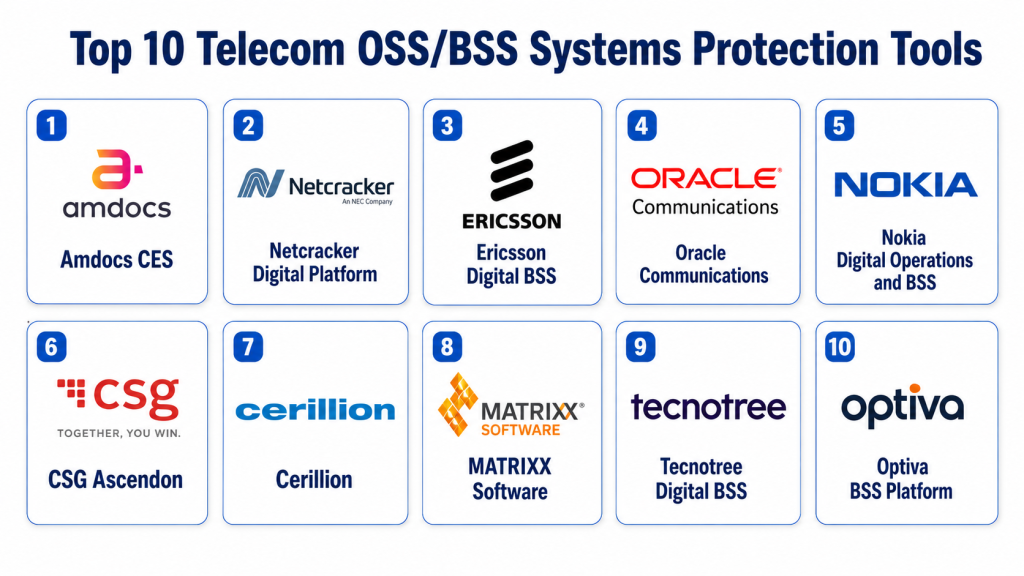
Top 10 Telecom OSS/BSS Systems Protection Tools
1 — Amdocs CES
Short description: Amdocs CES is a telecom-focused customer experience, OSS/BSS, monetization, and service management platform for communication service providers.
It supports digital customer journeys, product management, billing, charging, care, order management, and service operations.
The platform is designed for large telecom providers that need scale, reliability, and broad transformation capabilities.
It is useful for mobile, fixed, broadband, cable, enterprise telecom, and digital service providers.
Amdocs is often considered by operators modernizing legacy BSS and improving digital customer experience.
It is best suited for complex telecom environments where many business and operational systems must work together.
Key Features
- Telecom billing, charging, and monetization support
- Product catalog and offer management
- Customer care and digital experience workflows
- Order management and service lifecycle support
- Integration with network and business systems
- Support for 5G, enterprise, and digital service monetization
- Analytics and automation options for telecom operations
Pros
- Strong fit for large telecom operators
- Broad OSS/BSS and customer experience coverage
- Useful for complex digital transformation programs
Cons
- Implementation can be complex and resource-intensive
- May be more than smaller operators need
- Pricing and project scope require careful planning
Platforms / Deployment
Cloud / Self-hosted / Hybrid options vary by product and operator requirements.
Security & Compliance
Security controls may include RBAC, identity integration, encryption, audit logs, and enterprise governance features. Specific certifications and compliance coverage should be verified directly with the vendor.
Integrations & Ecosystem
Amdocs CES is designed for large telecom ecosystems and can connect with network, IT, customer, charging, billing, and partner systems. It is often used in multi-year transformation programs.
- CRM and customer care platforms
- Network and service management systems
- Charging and billing workflows
- Payment and revenue systems
- Partner and marketplace ecosystems
- APIs and telecom integration frameworks
Support & Community
Amdocs provides enterprise support, managed services, implementation resources, consulting, and telecom transformation expertise. Support depth depends on contract scope and deployment model.
2 — Netcracker Digital Platform
Short description: Netcracker Digital Platform is a telecom OSS/BSS and digital transformation platform for service providers.
It supports digital BSS, customer engagement, revenue management, orchestration, service assurance, and partner ecosystems.
The platform is useful for providers moving toward cloud-native operations and digital service monetization.
It is commonly considered by telecom operators needing integrated business and operational workflows.
Netcracker is especially relevant for providers handling 5G, enterprise services, cloud connectivity, and digital marketplaces.
It is best for mid-to-large telecom operators that want strong OSS/BSS transformation capabilities.
Key Features
- Digital BSS and customer engagement workflows
- Revenue management and monetization support
- Service orchestration and fulfillment
- Partner ecosystem and marketplace support
- Service assurance and operational analytics
- Product catalog and order management
- Cloud-native and modular transformation options
Pros
- Strong telecom-specific OSS/BSS depth
- Useful for digital service provider transformation
- Good fit for complex partner and enterprise service models
Cons
- Implementation planning can be significant
- Smaller operators may find it too broad
- Full value depends on integration and process maturity
Platforms / Deployment
Cloud / Self-hosted / Hybrid options vary by project and product configuration.
Security & Compliance
Security features may include access controls, authentication integration, encryption, audit logs, and administrative governance. Specific compliance claims should be verified directly.
Integrations & Ecosystem
Netcracker is built for telecom environments where BSS, OSS, network, customer, partner, and revenue systems must work together. It supports complex integration-heavy operating models.
- Network orchestration systems
- CRM and digital customer channels
- Billing, charging, and revenue systems
- Partner marketplace workflows
- Cloud and enterprise service platforms
- APIs and telecom standards-based integrations
Support & Community
Netcracker provides enterprise telecom support, implementation services, professional consulting, and managed services options. Support and onboarding depend on project size and agreement.
3 — Ericsson Digital BSS
Short description: Ericsson Digital BSS is a telecom business support system suite focused on charging, billing, product management, customer management, and monetization.
It helps service providers manage customer subscriptions, offers, revenue, charging, and digital service experiences.
The platform is useful for operators pursuing 5G monetization, convergent charging, and customer-centric business models.
It is commonly considered by mobile operators and large telecom providers with Ericsson ecosystem alignment.
Ericsson Digital BSS supports complex telecom revenue models and service provider transformation needs.
It is best for providers looking for telecom-grade BSS backed by a major network and software vendor.
Key Features
- Convergent charging and billing support
- Product and offer management
- Customer lifecycle and account management
- Support for 5G and digital service monetization
- Revenue management workflows
- Integration with telecom network and policy systems
- Digital customer experience support
Pros
- Strong fit for telecom operators with Ericsson ecosystem
- Useful for 5G and convergent charging use cases
- Supports large-scale telecom business workflows
Cons
- Best value may depend on ecosystem alignment
- Implementation can require telecom transformation expertise
- Smaller operators may need a lighter BSS option
Platforms / Deployment
Cloud / Self-hosted / Hybrid options vary by product and operator requirements.
Security & Compliance
Enterprise controls may include RBAC, identity integration, encryption, audit logs, and operational governance. Specific compliance details should be verified directly with Ericsson.
Integrations & Ecosystem
Ericsson Digital BSS fits into telecom environments that require charging, network, policy, CRM, and customer experience integration. It is especially relevant where Ericsson network or telecom software is already present.
- Ericsson telecom ecosystem
- Charging and policy systems
- CRM and customer care workflows
- Network service platforms
- Digital customer channels
- APIs and telecom integrations
Support & Community
Ericsson provides enterprise support, telecom consulting, implementation services, managed services, and global delivery resources. Support depth depends on contract and deployment scope.
4 — Oracle Communications
Short description: Oracle Communications offers telecom OSS/BSS solutions for billing, charging, revenue management, service orchestration, network management, and customer operations.
It is designed for communication service providers that need enterprise-grade telecom software connected with business and operational systems.
The platform is useful for operators managing complex revenue models, customer accounts, orders, and network services.
Oracle’s telecom portfolio can support both traditional and digital service provider use cases.
It is often considered by enterprises that already use Oracle technology across finance, databases, cloud, or business applications.
It is best for telecom providers needing scalable business operations and deep enterprise integration.
Key Features
- Billing, charging, and revenue management
- Service orchestration and order management
- Product and customer management workflows
- Integration with Oracle enterprise applications
- Network and operational support capabilities
- Support for digital service monetization
- Analytics and reporting options
Pros
- Strong enterprise software foundation
- Useful for complex telecom billing and revenue workflows
- Good fit for Oracle-aligned organizations
Cons
- Implementation may require specialized expertise
- Product selection can be complex across Oracle portfolio
- Smaller providers may prefer simpler telecom BSS platforms
Platforms / Deployment
Cloud / Self-hosted / Hybrid options vary by product and deployment model.
Security & Compliance
Oracle enterprise products commonly include access controls, identity integration, encryption, audit logging, and administrative governance. Specific certifications and compliance scope should be verified directly by product and region.
Integrations & Ecosystem
Oracle Communications can integrate with enterprise systems, telecom networks, customer platforms, financial systems, and cloud infrastructure. It is strong for providers that need telecom and enterprise IT alignment.
- Oracle Cloud and enterprise applications
- Billing and financial systems
- CRM and customer care platforms
- Network and service orchestration systems
- Policy and charging systems
- APIs and middleware integrations
Support & Community
Oracle provides enterprise support, documentation, implementation partners, professional services, and global customer success programs. Support quality depends on contract and product scope.
5 — Nokia Digital Operations and BSS
Short description: Nokia provides telecom operations and business software for network operations, service assurance, charging, customer experience, and digital operations.
Its OSS/BSS capabilities are useful for operators managing mobile, fixed, broadband, and enterprise services.
The platform supports telecom network visibility, service management, automation, and monetization-related workflows.
It is especially relevant for operators with Nokia network infrastructure or multi-vendor operational environments.
Nokia’s telecom software portfolio can help providers improve reliability, service quality, and operational efficiency.
It is best for service providers looking for network-aware OSS/BSS and operations modernization.
Key Features
- Network operations and service assurance
- Charging and monetization support
- Customer experience and service quality insights
- Fault, performance, and configuration workflows
- Automation for telecom operations
- Support for mobile, fixed, and enterprise services
- Integration with network and operational systems
Pros
- Strong network operations heritage
- Useful for service assurance and telecom operations
- Good fit for operators with Nokia ecosystem alignment
Cons
- Product scope should be reviewed carefully by use case
- May require complex telecom integration
- Smaller providers may need more lightweight platforms
Platforms / Deployment
Cloud / Self-hosted / Hybrid options vary by product and operator environment.
Security & Compliance
Security controls may include access management, auditability, encryption, and enterprise governance features. Specific compliance details should be verified directly with Nokia.
Integrations & Ecosystem
Nokia’s telecom software integrates with network systems, operations platforms, assurance workflows, charging systems, and service management environments. It is valuable where network and service operations are tightly connected.
- Nokia network systems
- Multi-vendor network operations
- Service assurance systems
- Charging and monetization workflows
- Telecom inventory and service platforms
- APIs and automation integrations
Support & Community
Nokia provides enterprise telecom support, managed services, documentation, professional services, and implementation expertise. Support varies by region, contract, and deployment model.
6 — CSG Ascendon
Short description: CSG Ascendon is a cloud-based digital monetization and customer engagement platform for telecom, media, entertainment, and digital service providers.
It supports subscription billing, digital commerce, revenue management, customer journeys, and partner monetization.
The platform is useful for providers launching digital services, content bundles, enterprise offers, and recurring revenue models.
CSG is often considered by companies that need flexible billing and customer experience workflows.
It is especially relevant for telecom operators expanding beyond traditional connectivity into digital services.
It is best for providers that prioritize monetization, customer lifecycle management, and digital commerce.
Key Features
- Subscription billing and revenue management
- Digital commerce and customer engagement
- Product catalog and offer management
- Partner and digital service monetization
- Customer lifecycle and account workflows
- Payment and recurring revenue support
- Cloud-based operational model
Pros
- Strong monetization and digital commerce focus
- Useful for telecom and media subscription models
- Good fit for digital service bundling
Cons
- Less focused on deep network OSS functions
- Best value depends on monetization use cases
- Integration with legacy telecom systems may require planning
Platforms / Deployment
Web / Cloud
Security & Compliance
Security features may include role-based access, authentication controls, encryption, auditability, and operational governance. Specific certifications should be verified directly with CSG.
Integrations & Ecosystem
CSG Ascendon connects with customer channels, billing systems, payment services, product catalogs, partner systems, and digital commerce workflows. It is strongest for revenue and subscriber lifecycle use cases.
- Payment gateways and revenue systems
- Digital commerce platforms
- Customer care and CRM systems
- Partner monetization workflows
- Product catalog systems
- APIs and integration frameworks
Support & Community
CSG provides enterprise support, implementation services, documentation, and customer success resources. Support strength depends on project scope and subscription agreement.
7 — Cerillion
Short description: Cerillion provides BSS and OSS solutions for telecom providers, including billing, charging, CRM, product catalog, order management, and service management.
Its platform is used by communication service providers that need integrated business support and operational workflows.
Cerillion is relevant for operators, MVNOs, broadband providers, and digital service providers seeking a modular telecom suite.
The system supports convergent billing, subscription management, enterprise services, and customer lifecycle operations.
It is useful for providers that need a practical telecom-grade platform without the scale of the largest transformation vendors.
It is best for mid-market telecom providers, challengers, MVNOs, and service providers with complex billing needs.
Key Features
- Convergent billing and charging
- CRM and customer management
- Product catalog and order management
- Service management and provisioning workflows
- Subscription and recurring revenue support
- Reporting and operational visibility
- Modular telecom BSS/OSS suite
Pros
- Strong fit for mid-market telecom providers
- Practical integrated BSS/OSS capabilities
- Useful for billing and customer lifecycle management
Cons
- May not match the global scale of the largest vendors
- Integration effort depends on legacy environment
- Advanced network OSS needs should be validated carefully
Platforms / Deployment
Cloud / Self-hosted / Hybrid options vary by customer requirement.
Security & Compliance
Security controls may include access management, authentication, audit logs, encryption, and administrative controls. Specific compliance details should be verified directly with the vendor.
Integrations & Ecosystem
Cerillion supports telecom workflows across billing, CRM, service management, product catalog, and provisioning. It can integrate with network systems, customer channels, payment platforms, and third-party services.
- CRM and customer service workflows
- Network provisioning systems
- Payment and revenue platforms
- Product catalog and order systems
- Customer portals and digital channels
- APIs and integration tools
Support & Community
Cerillion provides implementation support, customer services, documentation, and telecom-focused delivery resources. Support depends on deployment and service agreement.
8 — MATRIXX Software
Short description: MATRIXX Software provides cloud-native charging and monetization solutions for telecom operators and digital service providers.
It focuses on real-time charging, digital commerce, pricing agility, and 5G monetization use cases.
The platform is useful for providers that need flexible pricing, usage-based models, prepaid/postpaid convergence, and enterprise service offers.
MATRIXX is especially relevant for telecom teams modernizing charging systems to support digital and 5G services.
It is not a complete OSS/BSS suite by itself, but it is strong in charging and monetization.
It is best for operators that need real-time revenue agility and cloud-native charging capabilities.
Key Features
- Real-time charging and monetization
- Cloud-native architecture
- Support for usage-based pricing models
- Prepaid, postpaid, and hybrid service support
- 5G and enterprise monetization use cases
- Digital commerce support
- API-driven integration model
Pros
- Strong real-time charging focus
- Good fit for 5G monetization
- Useful for agile pricing and digital offers
Cons
- Not a full OSS/BSS replacement
- Must integrate with CRM, billing, order, and network systems
- Best suited for monetization-focused transformation
Platforms / Deployment
Cloud / Hybrid options may vary by customer environment.
Security & Compliance
Security controls may include access governance, encryption, identity integration, and operational controls. Specific compliance certifications should be verified directly with the vendor.
Integrations & Ecosystem
MATRIXX integrates with telecom BSS, network charging, product catalog, CRM, digital commerce, and policy systems. It is strongest as a monetization and charging layer.
- Product catalog and CRM systems
- Billing and revenue workflows
- Network policy and charging systems
- Digital commerce channels
- 5G service platforms
- APIs and cloud-native integrations
Support & Community
MATRIXX provides telecom-focused support, implementation resources, and customer success services. Community visibility is strongest among charging, monetization, and digital BSS transformation teams.
9 — Tecnotree Digital BSS
Short description: Tecnotree Digital BSS is a telecom business support system platform focused on digital customer experience, charging, billing, product catalogs, order management, and marketplace workflows.
It serves communication service providers, MVNOs, and digital service providers seeking faster service launch and customer engagement.
The platform is useful for operators modernizing customer journeys, digital channels, and monetization models.
Tecnotree is particularly relevant for emerging markets, digital operators, and providers expanding beyond connectivity.
It supports customer lifecycle management, product innovation, revenue management, and partner ecosystem use cases.
It is best for providers that need digital BSS capabilities with customer and commerce focus.
Key Features
- Digital BSS and customer experience workflows
- Product catalog and order management
- Billing, charging, and revenue support
- Partner marketplace capabilities
- Customer lifecycle management
- Digital channels and self-care support
- Telecom monetization workflows
Pros
- Strong digital BSS and customer engagement focus
- Useful for digital operators and MVNOs
- Supports marketplace and partner-driven models
Cons
- Deep OSS network operations needs should be validated
- Enterprise-scale fit depends on operator requirements
- Integration with legacy systems requires planning
Platforms / Deployment
Cloud / Hybrid options may vary by product and customer environment.
Security & Compliance
Security controls may include user access management, encryption, auditability, and administrative governance. Specific compliance claims should be verified directly with Tecnotree.
Integrations & Ecosystem
Tecnotree integrates with telecom CRM, billing, digital commerce, partner, order, and charging workflows. It is useful for operators building customer-first digital platforms.
- Customer care and CRM systems
- Digital self-care and commerce channels
- Billing and charging systems
- Product catalog workflows
- Partner marketplace systems
- APIs and telecom integrations
Support & Community
Tecnotree provides implementation services, support resources, documentation, and telecom consulting. Support strength depends on contract, geography, and deployment model.
10 — Optiva BSS Platform
Short description: Optiva provides cloud-native BSS, charging, billing, and revenue management solutions for telecom operators and digital service providers.
Its platform supports real-time charging, subscription management, billing operations, and monetization workflows.
Optiva is useful for mobile operators, MVNOs, and providers looking to modernize billing and charging with cloud-native architecture.
The platform is especially relevant where agility, scalability, and cost efficiency are important.
It can support telecom providers seeking faster product launches and improved revenue operations.
It is best for operators that need modern BSS capabilities focused on charging, billing, and monetization.
Key Features
- Cloud-native BSS and charging
- Real-time billing and revenue management
- Subscription and customer lifecycle support
- Product and offer management
- Support for MVNO and mobile operator use cases
- Digital monetization workflows
- Scalable deployment options
Pros
- Strong cloud-native BSS positioning
- Useful for charging and billing modernization
- Good fit for operators seeking agility and cost control
Cons
- Not a complete deep OSS platform by itself
- Integration with existing telecom stack must be validated
- Feature fit depends on operator size and use case
Platforms / Deployment
Cloud / Hybrid options may vary by customer and product configuration.
Security & Compliance
Security controls may include access management, encryption, auditability, and operational governance. Specific certifications and compliance details should be verified directly with Optiva.
Integrations & Ecosystem
Optiva integrates with telecom networks, CRM, charging, billing, product catalog, payment, and customer systems. It is strongest in BSS modernization and revenue operations.
- Charging and billing systems
- CRM and customer management platforms
- Product catalog workflows
- Payment and revenue systems
- Network and policy platforms
- APIs and cloud-native integrations
Support & Community
Optiva provides implementation support, documentation, managed services options, and telecom-focused customer success resources. Support depends on product edition and customer agreement.
Comparison Table
| Tool Name | Best For | Platform(s) Supported | Deployment | Standout Feature | Public Rating |
|---|---|---|---|---|---|
| Amdocs CES | Large telecom transformation | Web / Enterprise platforms | Cloud / Self-hosted / Hybrid | Broad OSS/BSS and customer experience suite | N/A |
| Netcracker Digital Platform | Digital service provider transformation | Web / Enterprise platforms | Cloud / Self-hosted / Hybrid | Integrated digital OSS/BSS and orchestration | N/A |
| Ericsson Digital BSS | 5G charging and telecom monetization | Web / Enterprise platforms | Cloud / Self-hosted / Hybrid | Convergent charging and telecom BSS | N/A |
| Oracle Communications | Enterprise telecom billing and operations | Web / Enterprise platforms | Cloud / Self-hosted / Hybrid | Enterprise-grade telecom revenue and operations | N/A |
| Nokia Digital Operations and BSS | Network-aware operations and assurance | Web / Enterprise platforms | Cloud / Self-hosted / Hybrid | Telecom operations and service assurance depth | N/A |
| CSG Ascendon | Digital monetization and subscriber commerce | Web | Cloud | Subscription and digital commerce monetization | N/A |
| Cerillion | Mid-market telecom BSS/OSS | Web / Enterprise platforms | Cloud / Self-hosted / Hybrid | Integrated billing, CRM, and service management | N/A |
| MATRIXX Software | Real-time charging and 5G monetization | Web / Enterprise platforms | Cloud / Hybrid | Cloud-native real-time charging | N/A |
| Tecnotree Digital BSS | Digital customer experience and BSS | Web / Enterprise platforms | Cloud / Hybrid | Digital BSS and marketplace workflows | N/A |
| Optiva BSS Platform | Cloud-native billing and charging | Web / Enterprise platforms | Cloud / Hybrid | Agile BSS and charging modernization | N/A |
Evaluation & Scoring of Telecom OSS/BSS Systems
| Tool Name | Core (25%) | Ease (15%) | Integrations (15%) | Security (10%) | Performance (10%) | Support (10%) | Value (15%) | Weighted Total (0–10) |
| Amdocs CES | 9.5 | 7.3 | 9.0 | 8.5 | 8.8 | 9.0 | 7.2 | 8.45 |
| Netcracker Digital Platform | 9.3 | 7.5 | 9.0 | 8.5 | 8.7 | 8.8 | 7.4 | 8.42 |
| Ericsson Digital BSS | 8.8 | 7.5 | 8.5 | 8.5 | 8.7 | 8.8 | 7.4 | 8.23 |
| Oracle Communications | 8.7 | 7.2 | 8.7 | 8.7 | 8.5 | 8.6 | 7.2 | 8.14 |
| Nokia Digital Operations and BSS | 8.6 | 7.4 | 8.5 | 8.4 | 8.6 | 8.6 | 7.4 | 8.13 |
| CSG Ascendon | 8.2 | 8.0 | 8.0 | 8.2 | 8.2 | 8.2 | 7.8 | 8.10 |
| Cerillion | 8.1 | 8.0 | 7.8 | 8.0 | 8.0 | 8.0 | 8.1 | 8.00 |
| MATRIXX Software | 8.4 | 8.1 | 8.0 | 8.0 | 8.4 | 7.8 | 8.0 | 8.13 |
| Tecnotree Digital BSS | 8.0 | 8.0 | 7.8 | 8.0 | 8.0 | 7.8 | 8.0 | 7.94 |
| Optiva BSS Platform | 8.0 | 8.1 | 7.8 | 8.0 | 8.1 | 7.8 | 8.2 | 8.01 |
These scores are comparative and should be used as a shortlist guide, not as fixed rankings. A large operator may value Amdocs, Netcracker, Ericsson, Oracle, or Nokia because of scale and enterprise depth. A challenger telecom provider, MVNO, or digital operator may prefer Cerillion, Tecnotree, Optiva, MATRIXX, or CSG depending on billing, charging, and monetization priorities. Always validate real integration complexity, migration cost, product roadmap, security controls, and operational fit before final selection.
Which Telecom OSS/BSS System Tool Is Right for You?
Solo / Freelancer
Solo telecom consultants, solution architects, and independent advisors usually do not buy OSS/BSS platforms directly, but they should understand how these systems fit operator transformation projects. For consulting, learning, or advisory work, focus on TM Forum-style concepts, product catalog design, charging models, order management, service assurance, and API integration. Lightweight demo systems, vendor sandboxes, or open telecom architecture references may be more useful than full enterprise platforms. Freelancers supporting MVNOs or ISPs should focus on billing, CRM, product management, and operational reporting use cases.
SMB
Small telecom providers, ISPs, and regional broadband operators need practical systems that support billing, customer care, service orders, payments, and basic operations without enterprise-level complexity. Cerillion, Optiva, Tecnotree, and selected CSG workflows may be good candidates depending on the business model. SMBs should avoid over-customization and focus on faster deployment, standard integrations, predictable pricing, and simple operational workflows. The best first priorities are billing accuracy, customer account management, plan changes, payments, order tracking, and support visibility.
Mid-Market
Mid-market telecom operators often need stronger integration between BSS, OSS, CRM, network inventory, service assurance, and digital channels. Cerillion, Tecnotree, CSG Ascendon, MATRIXX, Optiva, Netcracker, and Oracle can fit different mid-market needs. If real-time charging and flexible pricing are most important, MATRIXX or Optiva may be strong choices. If the goal is broader digital transformation, Netcracker, Cerillion, Tecnotree, or CSG may be more suitable. Mid-market buyers should prioritize modularity, migration planning, and API readiness.
Enterprise
Large telecom operators need scalability, reliability, security, standards alignment, multi-domain support, product catalog flexibility, high-volume charging, network integration, and transformation support. Amdocs, Netcracker, Ericsson, Oracle, and Nokia are strong candidates for enterprise-scale programs. Large providers should evaluate each platform against 5G monetization, fiber rollout, enterprise services, wholesale operations, partner marketplaces, and digital customer experience. Enterprises should also assess migration risk, coexistence with legacy systems, vendor roadmap, and long-term support model.
Budget vs Premium
Budget-focused providers should avoid buying the broadest suite before defining operational gaps. A focused BSS solution may solve billing, customer, product, and payment issues faster than a full OSS/BSS transformation. Premium platforms are valuable when the operator has complex products, many subscribers, multiple networks, enterprise customers, partner ecosystems, or 5G monetization needs. Buyers should compare license cost, cloud cost, implementation services, migration cost, customization, training, integrations, and long-term support.
Feature Depth vs Ease of Use
Amdocs, Netcracker, Oracle, Ericsson, and Nokia offer broad telecom-grade capabilities, but implementation can be more complex. Cerillion, Tecnotree, CSG, Optiva, and MATRIXX may offer more focused paths depending on monetization, billing, or digital BSS needs. Feature depth is important for large operators, but ease of use and speed matter more for smaller providers. The best choice depends on whether the main goal is complete transformation, charging modernization, customer experience improvement, or operational simplification.
Integrations & Scalability
OSS/BSS systems must integrate with CRM, ERP, network inventory, mediation, charging, billing, payment gateways, customer portals, provisioning systems, assurance tools, data lakes, and analytics platforms. Telecom buyers should validate APIs, data models, event flows, and operational processes before selecting a platform. Scalability should include subscriber volume, transaction volume, product complexity, order volume, service assurance events, and partner settlement needs. Integration testing is often more important than product demos.
Security & Compliance Needs
Telecom OSS/BSS systems handle sensitive customer records, usage data, billing information, service details, payment data, and network operations data. Buyers should verify SSO, MFA, RBAC, encryption, audit logs, API security, data residency, privacy controls, retention rules, and regulatory reporting support. Operators in regulated markets should involve security, legal, compliance, and data protection teams early. Security must be treated as part of architecture, not only as a vendor checklist.
Frequently Asked Questions
1- What is a telecom OSS/BSS system?
A telecom OSS/BSS system helps service providers manage both operations and business processes.
OSS supports network operations, service assurance, provisioning, inventory, and fault management.
BSS supports customers, products, billing, charging, orders, payments, and revenue.
Together, they help telecom operators deliver and monetize services reliably.
2- What is the difference between OSS and BSS?
OSS focuses on technical network and service operations.
BSS focuses on commercial and customer-facing business operations.
For example, OSS may handle provisioning and service assurance, while BSS handles billing and customer accounts.
Modern telecom platforms often connect OSS and BSS workflows closely.
3- Why are OSS/BSS systems important for telecom providers?
OSS/BSS systems help telecom providers launch services, manage subscribers, bill accurately, and keep networks running.
Without strong OSS/BSS, operators may face billing errors, slow service activation, poor customer experience, and operational inefficiency.
They are also important for 5G, fiber, IoT, and enterprise service monetization.
A good platform protects revenue and improves service reliability.
4- How much do telecom OSS/BSS systems cost?
Pricing varies widely by vendor, subscriber volume, modules, deployment model, integrations, customization, and support requirements.
Large transformation projects can be expensive because they involve migration, testing, integration, and process redesign.
Smaller providers may choose modular or cloud-based platforms to control cost.
Buyers should evaluate total cost of ownership, not only software license fees.
5- How long does OSS/BSS implementation take?
Implementation timelines depend on platform scope, legacy systems, data migration, integrations, process changes, and regulatory requirements.
A focused billing or charging deployment may be faster than a full OSS/BSS transformation.
Large operators often use phased migration to reduce operational risk.
A pilot or staged rollout is usually safer than replacing everything at once.
6- What mistakes should buyers avoid?
A common mistake is over-customizing the platform until upgrades become difficult.
Another mistake is ignoring data quality, migration complexity, or integration dependencies.
Some teams also choose tools based only on vendor reputation instead of business fit.
Successful projects require clear requirements, governance, testing, and executive support.
7- Are telecom OSS/BSS systems secure?
Telecom OSS/BSS systems can be secure when properly configured with access controls, encryption, audit logs, identity integration, and governance.
However, these systems hold sensitive customer, usage, billing, and network data, so security review is critical.
Buyers should verify vendor security documentation and deployment controls.
Security testing should be included before production launch.
8- Can OSS/BSS platforms support 5G monetization?
Many modern OSS/BSS platforms support 5G-related use cases such as real-time charging, enterprise services, IoT plans, network slicing, and flexible pricing.
However, support varies by vendor and module.
Operators should test specific 5G monetization scenarios before purchase.
Charging, policy, catalog, and partner settlement workflows are especially important.
9- What integrations matter most?
Important integrations include CRM, network inventory, charging, billing, mediation, provisioning, payment gateways, customer portals, assurance tools, analytics, and ERP.
Operators may also need integrations with cloud platforms, partner marketplaces, and enterprise service systems.
Integration quality affects service launch speed and operational stability.
API support and data model alignment should be tested early.
10- Is switching OSS/BSS platforms difficult?
Yes, switching OSS/BSS platforms can be difficult because customer data, billing history, products, orders, network inventory, and integrations must be migrated carefully.
Any mistake can affect customers, revenue, or service continuity.
Operators should use phased migration, parallel runs, and strong testing.
A detailed rollback and coexistence strategy is important.
Conclusion
Telecom OSS/BSS Systems Protection Tools are essential for operators that need to manage subscribers, services, billing, charging, network operations, customer experience, and digital monetization at scale. The best platform depends on operator size, network complexity, service portfolio, cloud strategy, integration needs, budget, and transformation maturity. Amdocs CES, Netcracker Digital Platform, Ericsson Digital BSS, Oracle Communications, Nokia Digital Operations and BSS, CSG Ascendon, Cerillion, MATRIXX Software, Tecnotree Digital BSS, and Optiva BSS Platform each serve different telecom modernization needs.A practical next step is to shortlist two or three platforms based on your business model, run a proof of concept with real product, customer, billing, and service scenarios, validate integrations with existing network and business systems, review security controls, and estimate total cost across implementation and operations. The best OSS/BSS system is not simply the largest platform; it is the one that helps your telecom business launch services faster, protect revenue, improve customer experience, and operate reliably.
