Introduction
Tool-Calling Middleware for Agents has become a critical component in modern AI application architectures. While large language models are excellent at reasoning and generating responses, they cannot independently access databases, APIs, enterprise systems, cloud resources, business applications, or external tools without a structured mechanism. Tool-calling middleware bridges this gap by enabling AI agents to discover, select, invoke, monitor, and manage tools safely and efficiently.
As organizations increasingly deploy AI agents for customer support, software development, IT operations, research, sales automation, business intelligence, and workflow orchestration, reliable tool integration becomes essential. Tool-calling middleware provides standardized interfaces, governance controls, authentication mechanisms, observability, and execution frameworks that allow agents to interact with real-world systems while maintaining security and operational reliability.
Real-world use cases include:
- AI agents querying databases
- Customer service agents accessing CRM systems
- Autonomous coding assistants invoking development tools
- IT operations agents executing remediation workflows
- Financial analysis agents retrieving market data
- Research agents collecting information from multiple systems
- Sales agents updating customer records
- Enterprise workflow automation
What buyers should evaluate:
- Tool discovery capabilities
- API integration flexibility
- Authentication and authorization controls
- Agent compatibility
- Workflow orchestration support
- Monitoring and observability
- Security and governance features
- Deployment flexibility
- Scalability and performance
- Ecosystem maturity
Best for: AI platform teams, enterprise architects, AI engineers, agent developers, automation teams, and organizations building production AI systems.
Not ideal for: Simple chatbot deployments that require minimal external integrations.
What’s Changed
The emergence of agentic AI systems has significantly accelerated demand for tool-calling middleware platforms.
Major developments include:
- Model Context Protocol adoption
- Agent-native integration frameworks
- Dynamic tool discovery
- Multi-agent tool sharing
- Secure execution sandboxes
- Enterprise governance controls
- Real-time observability
- Tool marketplaces and registries
Quick Buyer Checklist
Before selecting a Tool-Calling Middleware platform, ask:
- Does it support multiple LLM providers?
- Can agents discover tools dynamically?
- Are authentication mechanisms enterprise-ready?
- Is monitoring available for tool execution?
- Does it support human approvals?
- Can workflows scale across production environments?
- Are governance controls available?
- Does it integrate with existing infrastructure?
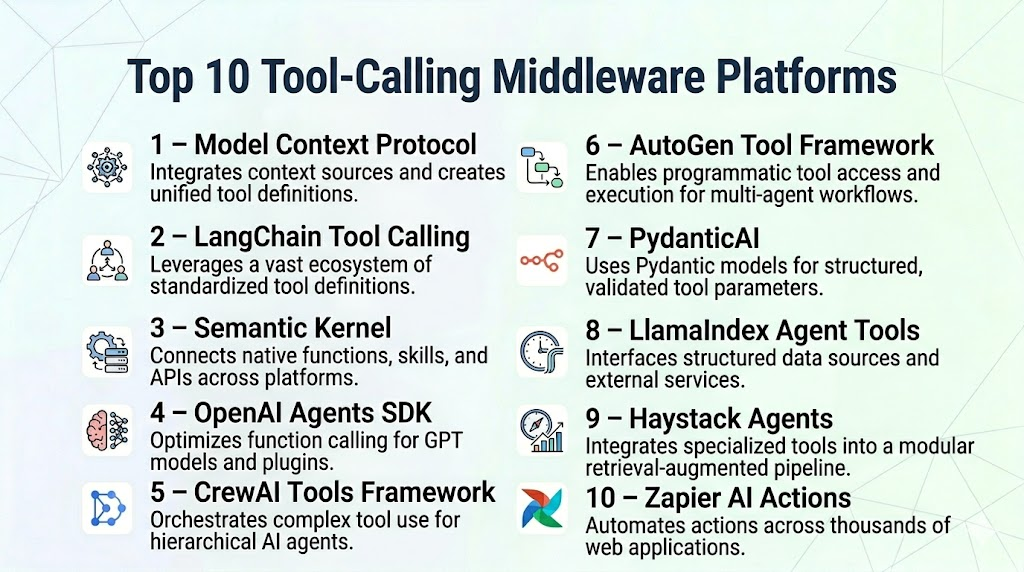
Top 10 Tool-Calling Middleware Platforms
1- Model Context Protocol
One-line Verdict
The emerging industry standard for agent-to-tool communication.
Short Description
Model Context Protocol provides a standardized framework for connecting AI models and agents to external tools, resources, databases, APIs, and services. It enables interoperability between AI systems and enterprise infrastructure while reducing custom integration complexity.
Standout Capabilities
- Standardized tool interfaces
- Dynamic tool discovery
- Resource sharing
- Multi-vendor compatibility
- Agent interoperability
AI-Specific Depth
Designed specifically for AI-native tool communication and cross-platform interoperability.
Pros
- Growing industry adoption
- Vendor-neutral architecture
- Simplified integrations
Cons
- Ecosystem still evolving
- Standards continue to mature
Security & Compliance
Depends on implementation.
Deployment & Platforms
- Cloud
- Hybrid
- Self-hosted
Integrations & Ecosystem
Expanding ecosystem of AI providers, tools, and enterprise platforms.
Pricing Model
Open standard.
Best-Fit Scenarios
- Enterprise AI ecosystems
- Agent interoperability
- Standardized integrations
2- LangChain Tool Calling
One-line Verdict
Best for developers building complex agent applications.
Short Description
LangChain provides extensive tool-calling capabilities that allow agents to interact with APIs, databases, search engines, enterprise applications, and custom services. It remains one of the most widely adopted frameworks for AI application development.
Standout Capabilities
- Tool abstractions
- Agent integration
- Function calling
- Multi-provider support
- Workflow orchestration
AI-Specific Depth
Strong support for reasoning-based tool selection and execution.
Pros
- Large ecosystem
- Extensive documentation
- Active community
Cons
- Steeper learning curve
- Rapidly evolving architecture
Security & Compliance
Varies by deployment.
Deployment & Platforms
- Cloud
- Self-hosted
Integrations & Ecosystem
Thousands of integrations across AI and enterprise platforms.
Pricing Model
Open-source.
Best-Fit Scenarios
- Production AI agents
- RAG systems
- Enterprise AI development
3- Semantic Kernel
One-line Verdict
Best enterprise-grade middleware for tool orchestration.
Short Description
Semantic Kernel provides structured mechanisms for connecting AI models with business applications, APIs, plugins, and enterprise services. It combines orchestration, planning, and tool execution capabilities.
Standout Capabilities
- Plugin architecture
- Enterprise integration
- Planning engine
- Function calling
- Workflow orchestration
AI-Specific Depth
Designed to connect AI reasoning with enterprise execution systems.
Pros
- Enterprise-ready
- Strong governance capabilities
- Mature architecture
Cons
- More complex implementation
- Stronger focus on enterprise environments
Security & Compliance
Enterprise-grade controls available.
Deployment & Platforms
- Cloud
- Hybrid
- On-premises
Integrations & Ecosystem
Strong integration with enterprise ecosystems.
Pricing Model
Open-source.
Best-Fit Scenarios
- Enterprise AI initiatives
- Business process automation
- Regulated industries
4- OpenAI Agents SDK
One-line Verdict
Best for native OpenAI agent tool integration.
Short Description
The OpenAI Agents SDK simplifies tool integration, function execution, and workflow orchestration for applications built around OpenAI models.
Key Features
- Function calling
- Tool execution
- Workflow management
- Multi-step reasoning
- Agent orchestration
Pros
- Easy implementation
- Native model support
- Strong developer experience
Cons
- Optimized primarily for OpenAI ecosystems
- Vendor dependency considerations
Platforms / Deployment
- Cloud
- Hybrid
Security & Compliance
Depends on deployment configuration.
Integrations & Ecosystem
Supports APIs, databases, and custom tools.
Support & Community
Large developer ecosystem.
5- CrewAI Tools Framework
One-line Verdict
Best for collaborative agent tool sharing.
Short Description
CrewAI enables multiple agents to access, share, and coordinate tools while collaborating on complex objectives and workflows.
Key Features
- Shared tools
- Agent collaboration
- Task delegation
- Workflow coordination
- Tool orchestration
Pros
- Strong multi-agent support
- Easy setup
- Flexible architecture
Cons
- Smaller ecosystem than larger frameworks
- Enterprise features still evolving
Platforms / Deployment
- Cloud
- Self-hosted
Security & Compliance
Not publicly stated.
Integrations & Ecosystem
Supports major LLM providers and APIs.
Support & Community
Growing developer community.
6- AutoGen Tool Framework
One-line Verdict
Best for agent-to-agent tool collaboration.
Short Description
AutoGen supports sophisticated tool usage across multiple collaborating agents, enabling autonomous workflows and decision-making processes.
Key Features
- Agent conversations
- Tool sharing
- Multi-agent workflows
- Human oversight
- Workflow automation
Pros
- Advanced collaboration
- Flexible workflows
- Research-driven design
Cons
- Complexity for beginners
- Requires customization
Platforms / Deployment
- Cloud
- Self-hosted
Security & Compliance
Depends on deployment.
Integrations & Ecosystem
Broad AI ecosystem support.
Support & Community
Strong research community.
7- PydanticAI
One-line Verdict
Best for structured and type-safe tool execution.
Short Description
PydanticAI focuses on reliable tool execution through strong schema validation, structured outputs, and predictable agent interactions.
Key Features
- Type safety
- Structured outputs
- Tool validation
- Schema enforcement
- Error handling
Pros
- Reliable execution
- Developer-friendly
- Strong validation
Cons
- Newer ecosystem
- Smaller community
Platforms / Deployment
- Cloud
- Self-hosted
Security & Compliance
Varies by deployment.
Integrations & Ecosystem
Growing AI ecosystem support.
Support & Community
Rapidly expanding community.
8- LlamaIndex Agent Tools
One-line Verdict
Best for knowledge-centric tool integrations.
Short Description
LlamaIndex provides tool-calling capabilities optimized for retrieval, knowledge management, document processing, and enterprise search applications.
Key Features
- Retrieval tools
- Knowledge integration
- Data connectors
- Workflow orchestration
- Agent frameworks
Pros
- Strong RAG capabilities
- Extensive connectors
- Knowledge-focused design
Cons
- Less focused on general automation
- Advanced features require expertise
Platforms / Deployment
- Cloud
- Self-hosted
Security & Compliance
Depends on deployment.
Integrations & Ecosystem
Large connector ecosystem.
Support & Community
Active developer community.
9- Haystack Agents
One-line Verdict
Best for enterprise search and retrieval workflows.
Short Description
Haystack enables AI agents to leverage search systems, retrieval pipelines, and external tools for enterprise knowledge applications.
Key Features
- Search orchestration
- Tool integration
- RAG workflows
- Agent support
- Knowledge pipelines
Pros
- Strong retrieval capabilities
- Enterprise-ready architecture
- Open-source flexibility
Cons
- Search-focused orientation
- Smaller ecosystem than LangChain
Platforms / Deployment
- Cloud
- Self-hosted
Security & Compliance
Enterprise deployment controls available.
Integrations & Ecosystem
Strong knowledge management integrations.
Support & Community
Established open-source community.
10- Zapier AI Actions
One-line Verdict
Best for business application connectivity.
Short Description
Zapier AI Actions allows agents to interact with thousands of business applications through prebuilt integrations and workflow automation capabilities.
Key Features
- Application integrations
- Workflow automation
- Tool marketplace
- API connectivity
- Business process automation
Pros
- Massive integration catalog
- Easy deployment
- Low-code experience
Cons
- Less control than developer frameworks
- Enterprise customization limitations
Platforms / Deployment
- Cloud
Security & Compliance
Business-grade controls available.
Integrations & Ecosystem
Thousands of business applications supported.
Support & Community
Large automation community.
Comparison Table
| Tool | Best For | Open Source | Enterprise Ready | Agent Support |
|---|---|---|---|---|
| Model Context Protocol | Standardization | Yes | Yes | Excellent |
| LangChain Tool Calling | Agent Development | Yes | Yes | Excellent |
| Semantic Kernel | Enterprise AI | Yes | Yes | Excellent |
| OpenAI Agents SDK | OpenAI Ecosystem | Partial | Yes | Excellent |
| CrewAI | Multi-Agent Systems | Yes | Moderate | Excellent |
| AutoGen | Agent Collaboration | Yes | Moderate | Excellent |
| PydanticAI | Structured Execution | Yes | Moderate | Good |
| LlamaIndex | Knowledge Agents | Yes | Yes | Good |
| Haystack Agents | Enterprise Search | Yes | Yes | Good |
| Zapier AI Actions | Business Automation | No | Yes | Moderate |
Evaluation & Scoring Table
| Tool | Core | Ease | Integrations | Security | Performance | Support | Value | Total |
|---|---|---|---|---|---|---|---|---|
| MCP | 9.8 | 8.8 | 9.5 | 9.0 | 9.0 | 8.8 | 9.5 | 9.2 |
| LangChain | 9.6 | 8.4 | 9.8 | 8.8 | 9.2 | 9.4 | 9.2 | 9.2 |
| Semantic Kernel | 9.3 | 8.2 | 9.2 | 9.4 | 9.1 | 9.0 | 8.8 | 9.0 |
| OpenAI Agents SDK | 9.1 | 9.2 | 8.8 | 8.7 | 9.0 | 9.2 | 8.9 | 9.0 |
| CrewAI | 8.9 | 9.0 | 8.5 | 8.4 | 8.7 | 8.8 | 9.0 | 8.8 |
| AutoGen | 9.0 | 8.3 | 8.7 | 8.5 | 8.8 | 8.9 | 8.8 | 8.7 |
| PydanticAI | 8.8 | 8.9 | 8.2 | 8.9 | 8.8 | 8.4 | 9.0 | 8.7 |
| LlamaIndex | 8.9 | 8.7 | 9.0 | 8.5 | 8.8 | 8.8 | 8.8 | 8.8 |
| Haystack | 8.7 | 8.5 | 8.6 | 8.8 | 8.7 | 8.6 | 8.7 | 8.7 |
| Zapier AI Actions | 8.5 | 9.5 | 9.8 | 8.6 | 8.4 | 9.2 | 8.8 | 8.8 |
Which Tool-Calling Middleware Is Right for You?
For Enterprise AI Platforms
Choose Model Context Protocol, Semantic Kernel, or LangChain for governance, scalability, and interoperability.
For Multi-Agent Architectures
Choose CrewAI or AutoGen for collaborative tool sharing and orchestration.
For Knowledge Applications
Choose LlamaIndex or Haystack for retrieval-focused workflows.
For Structured Agent Development
Choose PydanticAI for type-safe and predictable execution.
For Business Automation
Choose Zapier AI Actions for rapid integration with business systems.
Frequently Asked Questions
1- What is Tool-Calling Middleware for Agents?
Tool-calling middleware acts as a bridge between AI agents and external systems, allowing agents to safely access tools, APIs, databases, applications, and services. It manages execution, authentication, and communication between AI models and operational systems.
2- Why is tool calling important for AI agents?
Without tools, AI agents are limited to reasoning based on their training data and current context. Tool calling enables agents to retrieve live information, execute actions, automate workflows, and interact with enterprise systems in real time.
3- What is the difference between function calling and tool calling?
Function calling typically refers to invoking predefined operations within an application, while tool calling is broader and may include APIs, databases, workflows, services, enterprise applications, and external systems.
4- What is Model Context Protocol?
Model Context Protocol is an open standard designed to simplify communication between AI models and external tools. It promotes interoperability and reduces the need for custom integrations across AI ecosystems.
5- Which platform is best for enterprise deployments?
Semantic Kernel, LangChain, and Model Context Protocol implementations are often strong choices for enterprise environments due to their scalability, governance capabilities, and integration flexibility.
6- Can multiple agents share the same tools?
Yes. Platforms such as CrewAI and AutoGen allow multiple agents to access shared tools and collaborate on complex workflows while maintaining coordination and context.
7- How important is security in tool-calling systems?
Security is critical because agents may access sensitive enterprise systems and data. Authentication, authorization, auditing, and governance controls should be evaluated carefully before deployment.
8- Do these platforms support human approvals?
Many modern agent frameworks support human-in-the-loop workflows, allowing approvals, reviews, and intervention before critical actions are executed.
9- Are tool-calling platforms suitable for low-code users?
Some platforms, such as Zapier AI Actions, offer low-code or no-code experiences. Others are designed primarily for developers and require programming knowledge.
10- What should organizations prioritize when selecting a tool-calling middleware platform?
Organizations should focus on interoperability, security, scalability, observability, ecosystem maturity, governance controls, and compatibility with their existing AI infrastructure and business systems.
Conclusion
Tool-calling middleware has become a foundational layer for production AI agents. As organizations move from simple conversational AI toward autonomous systems capable of executing real-world actions, reliable tool integration becomes essential. Model Context Protocol is emerging as a major interoperability standard, while LangChain and Semantic Kernel continue to lead in enterprise adoption. CrewAI and AutoGen excel in collaborative agent environments, and Zapier AI Actions simplifies business application connectivity. The most successful deployments typically start with a small set of high-value integrations, establish strong governance and security controls, and gradually expand toward more sophisticated agent-driven automation. Organizations evaluating these platforms should prioritize interoperability, scalability, observability, and security to build sustainable AI ecosystems that can evolve with rapidly changing agent technologies.
