Introduction
WebAssembly WASM Runtimes and Toolchains help developers build, compile, run, secure, and deploy WebAssembly applications across browsers, servers, cloud platforms, edge environments, and embedded systems. WebAssembly started as a high-performance browser technology, but it has now become a strong foundation for portable, sandboxed, and language-neutral application execution.
For modern engineering teams, WASM matters because it enables fast startup, secure isolation, near-native performance, and cross-platform portability. It is especially useful for edge computing, plugin systems, serverless workloads, AI inference, developer tooling, blockchain systems, and secure extension platforms. WASM also supports multiple programming languages, making it attractive for teams that want flexibility without being locked into one runtime environment.
Real World Use Cases
- Running secure plugins inside SaaS platforms
- Deploying lightweight serverless workloads
- Building edge computing applications
- Running high-performance browser applications
- Creating portable developer tools across operating systems
- Executing AI inference workloads in isolated environments
- Supporting blockchain smart contracts and decentralized applications
- Embedding sandboxed logic inside enterprise applications
Evaluation Criteria for Buyers
- Runtime performance and startup speed
- Language support and toolchain maturity
- Security sandboxing and isolation
- WASI support and standards alignment
- Cloud, edge, and serverless deployment options
- Developer experience and debugging tools
- Ecosystem and community adoption
- Integration with Kubernetes and CI/CD pipelines
- Support for component model and interoperability
- Enterprise support and long-term roadmap
Best for: platform engineering teams, cloud-native developers, edge computing teams, DevOps teams, security-focused software teams, AI infrastructure teams, blockchain developers, and companies building extensible application platforms.
Not ideal for: teams building simple CRUD applications without portability, sandboxing, plugin, performance, or cross-platform requirements. Traditional containers or standard language runtimes may be easier when WASM-specific benefits are not needed.
Key Trends in WebAssembly WASM Runtimes and Toolchains
- WASM is moving beyond browsers into servers, cloud, edge, and embedded systems.
- WASI is becoming a key standard for secure system interface access.
- The WebAssembly Component Model is improving interoperability between languages.
- Edge computing platforms are adopting WASM for fast startup and lightweight execution.
- Serverless WASM is gaining attention because of its portability and sandboxing.
- Security teams are using WASM for isolated plugin execution and policy engines.
- Kubernetes integrations are improving through WASM-focused runtimes and shims.
- AI inference workloads are increasingly exploring WASM for portable execution.
- Developer tooling is improving with better debugging, packaging, and observability.
- Enterprises are evaluating WASM as a complement to containers, not always a replacement.
How We Selected These Tools
The tools in this list were selected based on practical adoption, runtime maturity, developer usefulness, and ecosystem relevance.
- Runtime performance and production readiness
- Support for WASI and modern WebAssembly standards
- Developer experience and documentation quality
- Language compatibility and build tool support
- Cloud, edge, and serverless deployment fit
- Security model and sandboxing capabilities
- Integration with Kubernetes, CI/CD, and platform engineering workflows
- Community activity and enterprise adoption signals
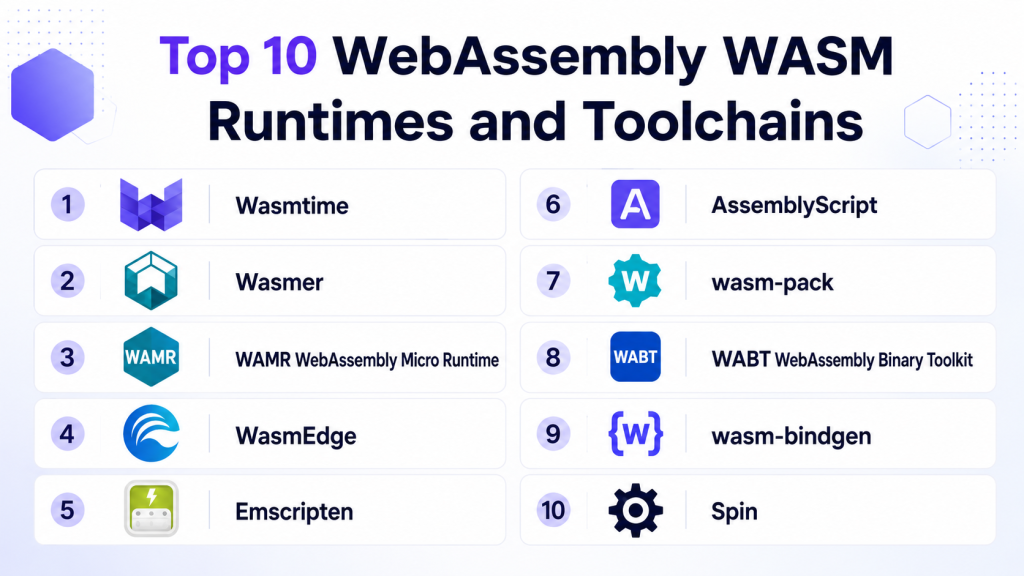
Top 10 WebAssembly WASM Runtimes and Toolchains
1- Wasmtime
Short description:
Wasmtime is a widely used WebAssembly runtime designed for secure, fast, and standards-aligned execution outside the browser. It is built by the Bytecode Alliance ecosystem and is commonly used for server-side WASM, embedded applications, and platform engineering use cases. Wasmtime supports WASI and focuses heavily on security, correctness, and performance. It is suitable for teams building secure plugin systems, serverless platforms, edge workloads, and portable application execution layers.
Key Features
- Fast WebAssembly execution
- Strong WASI support
- Secure sandboxing model
- Embeddable runtime architecture
- Support for multiple host languages
- Component model alignment
- Suitable for server and edge workloads
Pros
- Strong standards alignment
- Trusted open-source ecosystem
- Good fit for secure production workloads
Cons
- Requires WASM knowledge for advanced use
- Ecosystem can feel complex for beginners
- Operational tooling depends on implementation
Platforms / Deployment
- Linux / Windows / macOS
- Cloud / Self-hosted / Hybrid
Security & Compliance
- Secure sandboxing
- Capability-based access through WASI
- Enterprise compliance depends on deployment
- Not publicly stated for specific certifications
Integrations & Ecosystem
Wasmtime integrates well with modern WASM and cloud-native development workflows.
- Rust
- C
- Python embedding
- WASI
- Kubernetes through runtime integrations
- Component model tooling
Support & Community
Strong open-source community, active standards involvement, and broad developer ecosystem support.
2- Wasmer
Short description:
Wasmer is a general-purpose WebAssembly runtime designed to run WASM modules across servers, desktops, cloud environments, and embedded systems. It focuses on portability and developer accessibility while supporting multiple execution backends. Wasmer is often used for running WASM applications outside the browser, building plugin systems, and experimenting with portable application packaging. It is a strong option for teams needing flexibility across different deployment targets.
Key Features
- Cross-platform WASM runtime
- Multiple compiler backend support
- WASI support
- Package and registry ecosystem
- Embeddable runtime support
- CLI-based developer workflow
- Suitable for cloud and local environments
Pros
- Flexible runtime architecture
- Good cross-platform portability
- Developer-friendly tooling
Cons
- Advanced use cases may require tuning
- Enterprise governance depends on implementation
- Smaller ecosystem than container platforms
Platforms / Deployment
- Linux / Windows / macOS
- Cloud / Self-hosted / Hybrid
Security & Compliance
- WASM sandboxing
- WASI capability controls
- Not publicly stated for broad enterprise certifications
Integrations & Ecosystem
Wasmer supports multiple programming and deployment workflows.
- Rust
- C/C++
- Python
- JavaScript
- WASI
- Package registry workflows
Support & Community
Active open-source community with commercial ecosystem support available around Wasmer tooling.
3- WAMR WebAssembly Micro Runtime
Short description:
WAMR, also known as WebAssembly Micro Runtime, is a lightweight WASM runtime designed for embedded systems, IoT devices, edge computing, and constrained environments. It is developed with efficiency and small footprint in mind, making it suitable for environments where traditional runtimes are too heavy. WAMR supports multiple execution modes and is often used in industrial, embedded, and edge-native use cases.
Key Features
- Lightweight runtime footprint
- Embedded and IoT support
- WASI support
- Interpreter and ahead-of-time modes
- Low memory usage
- Edge deployment support
- C API for embedding
Pros
- Excellent for constrained environments
- Strong embedded systems fit
- Efficient memory usage
Cons
- Less beginner-friendly than general runtimes
- Smaller high-level tooling ecosystem
- Requires embedded development expertise
Platforms / Deployment
- Linux / Windows / macOS / Embedded systems
- Self-hosted / Edge / Hybrid
Security & Compliance
- WASM sandboxing
- Capability-based execution options
- Compliance depends on deployment environment
Integrations & Ecosystem
WAMR integrates well with embedded and edge runtime environments.
- C/C++
- IoT systems
- Edge devices
- WASI
- Embedded operating systems
Support & Community
Strong technical community for embedded and edge use cases, with active open-source development.
4- WasmEdge
Short description:
WasmEdge is a high-performance WebAssembly runtime designed for cloud-native, edge, serverless, and AI workloads. It is commonly used where fast startup, portability, and secure sandboxing are important. WasmEdge supports WASI and includes features relevant to cloud-native deployment patterns. It is also known for interest in AI inference, microservices, and lightweight container alternatives.
Key Features
- High-performance WASM runtime
- WASI support
- Cloud-native deployment focus
- Serverless workload support
- AI inference use cases
- Kubernetes ecosystem integrations
- Lightweight execution model
Pros
- Strong edge and cloud-native focus
- Good performance characteristics
- Useful for serverless experimentation
Cons
- Ecosystem still maturing compared with containers
- Requires WASM deployment knowledge
- Some advanced features may need specialized setup
Platforms / Deployment
- Linux / Windows / macOS
- Cloud / Edge / Self-hosted / Hybrid
Security & Compliance
- WASM sandboxing
- Capability-based controls
- Not publicly stated for broad certifications
Integrations & Ecosystem
WasmEdge integrates with cloud-native and edge computing workflows.
- Kubernetes
- Docker-related workflows
- Rust
- JavaScript
- WASI
- AI inference frameworks
Support & Community
Active open-source community with strong focus on cloud-native and edge scenarios.
5- Emscripten
Short description:
Emscripten is one of the most important WebAssembly toolchains for compiling C and C++ applications to WASM. It is widely used for browser-based applications, games, simulations, visualization tools, and performance-heavy workloads. Emscripten enables existing native codebases to run in web environments and remains a foundational tool for WebAssembly adoption in frontend and browser use cases.
Key Features
- C and C++ to WebAssembly compilation
- Browser runtime support
- JavaScript integration
- WebGL and web API support
- Porting support for native applications
- Optimization tooling
- Large compatibility ecosystem
Pros
- Excellent for porting C/C++ applications
- Mature and widely adopted
- Strong browser-based WASM support
Cons
- Build configuration can be complex
- Primarily focused on browser workflows
- Debugging may require specialized knowledge
Platforms / Deployment
- Linux / Windows / macOS
- Browser / Cloud build environments
Security & Compliance
- Browser sandboxing when deployed in web environments
- Security depends on application implementation
- Not publicly stated for certifications
Integrations & Ecosystem
Emscripten is deeply connected with browser and native-code compilation workflows.
- C/C++
- LLVM
- JavaScript
- WebGL
- Browser APIs
- Game engines
Support & Community
Large developer community, mature documentation, and strong adoption in web performance projects.
6- AssemblyScript
Short description:
AssemblyScript is a TypeScript-like language that compiles to WebAssembly. It is useful for JavaScript and TypeScript developers who want to build WASM modules without learning Rust or C++. AssemblyScript offers a familiar syntax while enabling performance-oriented WebAssembly development. It is commonly used for browser modules, blockchain-related workloads, and lightweight WASM components.
Key Features
- TypeScript-like syntax
- WebAssembly compilation
- JavaScript interoperability
- Lightweight runtime model
- Good developer experience for JS teams
- Suitable for browser and server WASM
- Package ecosystem compatibility
Pros
- Familiar for TypeScript developers
- Lower learning curve than Rust or C++
- Good for lightweight WASM modules
Cons
- Not identical to full TypeScript
- Smaller ecosystem than Rust
- Advanced performance tuning may require WASM knowledge
Platforms / Deployment
- Web / Linux / Windows / macOS
- Cloud / Browser / Self-hosted
Security & Compliance
- WASM sandboxing
- Security depends on runtime and host environment
- Not publicly stated for certifications
Integrations & Ecosystem
AssemblyScript fits naturally into JavaScript and TypeScript workflows.
- npm ecosystem
- JavaScript
- TypeScript-like development
- Browser APIs
- WASM runtimes
Support & Community
Active developer community with strong appeal for JavaScript and TypeScript teams.
7- wasm-pack
Short description:
wasm-pack is a toolchain utility for building and packaging Rust-generated WebAssembly modules. It simplifies the workflow of compiling Rust code into WASM packages that can be used in JavaScript and web applications. wasm-pack is especially valuable for teams using Rust for performance-sensitive browser modules, developer tools, or reusable WebAssembly libraries.
Key Features
- Rust to WebAssembly packaging
- npm package generation
- JavaScript interoperability
- Build automation
- Testing workflow support
- Browser and bundler compatibility
- Developer-friendly CLI
Pros
- Excellent Rust WASM workflow
- Simplifies packaging and distribution
- Strong fit for web performance use cases
Cons
- Rust knowledge required
- Mostly focused on Rust ecosystem
- Not a full runtime solution
Platforms / Deployment
- Linux / Windows / macOS
- Browser / Cloud / Local development
Security & Compliance
- Security depends on generated module and runtime
- WASM sandboxing support
- Not publicly stated for certifications
Integrations & Ecosystem
wasm-pack integrates closely with Rust and JavaScript toolchains.
- Rust
- Cargo
- npm
- Webpack
- Vite
- JavaScript bundlers
Support & Community
Strong Rust community adoption and practical documentation for web-focused WASM projects.
8- WABT WebAssembly Binary Toolkit
Short description:
WABT is a toolkit for working directly with WebAssembly binaries and text formats. It provides command-line tools for converting, inspecting, validating, and debugging WASM modules. WABT is especially useful for compiler developers, security researchers, runtime engineers, and teams that need low-level visibility into WebAssembly modules.
Key Features
- WASM binary inspection
- Text format conversion
- Module validation
- Disassembly tools
- Debugging utilities
- Low-level WASM analysis
- Command-line workflow
Pros
- Excellent for low-level WASM work
- Useful for debugging and validation
- Lightweight and focused toolset
Cons
- Not intended for general application development
- Requires WebAssembly internals knowledge
- No high-level application framework
Platforms / Deployment
- Linux / Windows / macOS
- Local / Self-hosted
Security & Compliance
- Helps validate WASM modules
- Security depends on usage and runtime
- Not publicly stated for certifications
Integrations & Ecosystem
WABT fits into compiler, runtime, and debugging workflows.
- WASM binaries
- WAT text format
- CI validation workflows
- Compiler pipelines
- Runtime testing
Support & Community
Strong technical community among WebAssembly engineers and tooling developers.
9- wasm-bindgen
Short description:
wasm-bindgen is a key tool for connecting Rust-generated WebAssembly modules with JavaScript. It helps developers create bindings between WASM and browser or JavaScript environments. wasm-bindgen is widely used in Rust WASM projects where seamless interaction with JavaScript APIs is required. It is especially valuable for browser apps, performance-sensitive frontend logic, and reusable WASM libraries.
Key Features
- Rust and JavaScript binding generation
- Browser API interoperability
- Type-safe interface generation
- WebAssembly module integration
- JavaScript package compatibility
- Developer workflow automation
- Strong Rust ecosystem support
Pros
- Essential for Rust WASM web apps
- Strong JavaScript interoperability
- Improves developer productivity
Cons
- Rust-specific workflow
- Requires understanding of JS and WASM boundaries
- Not a runtime or full deployment platform
Platforms / Deployment
- Linux / Windows / macOS
- Browser / Cloud / Local development
Security & Compliance
- Security depends on implementation and runtime
- WASM sandboxing support
- Not publicly stated for certifications
Integrations & Ecosystem
wasm-bindgen is tightly connected with Rust and web development workflows.
- Rust
- Cargo
- JavaScript
- Browser APIs
- wasm-pack
- npm
Support & Community
Strong Rust WASM community support and widely used in production Rust web workflows.
10- Spin
Short description:
Spin is a developer framework for building and running WebAssembly-based serverless applications. It focuses on simplifying WASM application development for cloud and edge environments. Spin is useful for developers who want to build lightweight services, HTTP applications, background jobs, and event-driven workloads using WebAssembly. It provides a higher-level developer experience compared with lower-level runtimes.
Key Features
- Serverless WASM application framework
- HTTP application support
- Component-based development
- Cloud and edge deployment focus
- Developer-friendly CLI
- Multi-language support
- Lightweight runtime model
Pros
- Strong developer experience
- Good fit for serverless WASM applications
- Simplifies cloud and edge development
Cons
- More specialized than general WASM runtimes
- Ecosystem still developing
- May not fit traditional enterprise app patterns
Platforms / Deployment
- Linux / Windows / macOS
- Cloud / Edge / Self-hosted / Hybrid
Security & Compliance
- WASM sandboxing
- Capability-based access patterns
- Compliance depends on deployment environment
Integrations & Ecosystem
Spin integrates with modern WASM and serverless development workflows.
- WASI
- Rust
- JavaScript
- Python
- HTTP services
- Cloud deployment platforms
Support & Community
Growing developer community with strong interest from cloud-native and serverless teams.
Comparison Table
| Tool Name | Best For | Platform Supported | Deployment | Standout Feature | Public Rating |
|---|---|---|---|---|---|
| Wasmtime | Secure server-side WASM | Linux, Windows, macOS | Cloud / Self-hosted / Hybrid | Standards-aligned runtime | N/A |
| Wasmer | Portable WASM execution | Linux, Windows, macOS | Cloud / Self-hosted / Hybrid | Cross-platform runtime flexibility | N/A |
| WAMR WebAssembly Micro Runtime | Embedded and IoT workloads | Linux, Windows, macOS, Embedded | Self-hosted / Edge / Hybrid | Lightweight embedded runtime | N/A |
| WasmEdge | Edge and serverless WASM | Linux, Windows, macOS | Cloud / Edge / Hybrid | Cloud-native WASM execution | N/A |
| Emscripten | C and C++ to WASM | Linux, Windows, macOS | Browser / Cloud build | Native code porting | N/A |
| AssemblyScript | TypeScript-style WASM development | Web, Linux, Windows, macOS | Browser / Cloud / Self-hosted | Familiar syntax for JS teams | N/A |
| wasm-pack | Rust WASM packaging | Linux, Windows, macOS | Browser / Cloud / Local | Rust to npm workflow | N/A |
| WABT | WASM inspection and debugging | Linux, Windows, macOS | Local / Self-hosted | Binary toolkit utilities | N/A |
| wasm-bindgen | Rust and JavaScript bindings | Linux, Windows, macOS | Browser / Cloud / Local | Rust-JS interoperability | N/A |
| Spin | WASM serverless applications | Linux, Windows, macOS | Cloud / Edge / Hybrid | Serverless WASM framework | N/A |
Evaluation & Scoring of WebAssembly WASM Runtimes and Toolchains
| Tool Name | Core 25% | Ease 15% | Integrations 15% | Security 10% | Performance 10% | Support 10% | Value 15% | Weighted Total |
| Wasmtime | 10 | 8 | 9 | 10 | 9 | 9 | 9 | 9.1 |
| Wasmer | 9 | 8 | 8 | 8 | 9 | 8 | 8 | 8.4 |
| WAMR WebAssembly Micro Runtime | 8 | 6 | 7 | 8 | 9 | 7 | 9 | 7.8 |
| WasmEdge | 9 | 8 | 8 | 8 | 9 | 8 | 8 | 8.4 |
| Emscripten | 9 | 7 | 9 | 7 | 9 | 9 | 9 | 8.5 |
| AssemblyScript | 8 | 8 | 8 | 7 | 8 | 7 | 9 | 8.0 |
| wasm-pack | 8 | 8 | 8 | 7 | 8 | 8 | 9 | 8.1 |
| WABT | 8 | 6 | 7 | 8 | 8 | 8 | 9 | 7.7 |
| wasm-bindgen | 8 | 8 | 8 | 7 | 8 | 8 | 9 | 8.1 |
| Spin | 8 | 8 | 8 | 8 | 8 | 8 | 8 | 8.0 |
These scores are comparative and should be interpreted based on use case. Runtime-heavy teams may prioritize performance, security, and WASI support. Frontend teams may value language compatibility and JavaScript integration more. Edge and serverless teams should focus on startup speed, deployment simplicity, and operational tooling.
Which WebAssembly WASM Runtime or Toolchain Is Right for You?
Solo / Freelancer
Independent developers building experiments, browser modules, or small performance-focused tools may prefer AssemblyScript, wasm-pack, wasm-bindgen, or Emscripten. These tools provide practical developer workflows without requiring full platform engineering infrastructure. Rust developers will usually benefit from wasm-pack and wasm-bindgen, while JavaScript developers may find AssemblyScript easier to adopt.
SMB
Small and mid-sized engineering teams should choose tools based on deployment goals. Wasmtime and Wasmer are good choices for secure runtime execution, while Emscripten is ideal for porting C and C++ applications to the web. Spin can help teams explore serverless WASM without building every runtime layer manually.
Mid-Market
Mid-market teams often need stronger operational consistency, security, and integration with existing infrastructure. Wasmtime, WasmEdge, and Wasmer are strong runtime choices for server-side or edge workloads. Teams building developer platforms may combine these runtimes with CI/CD workflows, Kubernetes integrations, and internal platform tooling.
Enterprise
Enterprises should prioritize governance, standards alignment, security isolation, and long-term ecosystem maturity. Wasmtime is a strong fit for secure server-side execution, while WasmEdge is useful for edge and cloud-native workloads. WAMR is valuable for embedded and constrained environments. Emscripten remains important for large native-code migration projects.
Budget vs Premium
Many WASM runtimes and toolchains are open source, making them attractive from a licensing perspective. However, budget planning should include engineering time, runtime maintenance, security reviews, observability setup, and production support. Commercial support may be important for mission-critical enterprise deployments.
Feature Depth vs Ease of Use
Low-level tools like WABT offer deep inspection and debugging but require WebAssembly expertise. Higher-level tools like Spin provide easier application development for serverless use cases. Emscripten and wasm-pack offer strong workflows but depend heavily on the source language and target environment.
Integrations & Scalability
Wasmtime, WasmEdge, and Wasmer are strong runtime options for scalable backend and edge workloads. Emscripten, wasm-pack, and wasm-bindgen are better suited for language-specific development pipelines. Enterprises should validate Kubernetes, CI/CD, observability, and security integrations before production rollout.
Security & Compliance Needs
Security-focused teams should evaluate sandboxing, WASI capability controls, module validation, dependency management, runtime isolation, and supply chain security. WASM provides strong isolation potential, but secure deployment still depends on configuration, host permissions, runtime updates, and governance practices.
Frequently Asked Questions
1. What is WebAssembly WASM?
WebAssembly is a portable binary instruction format designed to run code efficiently across different environments. It enables applications written in languages like Rust, C, C++, and AssemblyScript to run in browsers, servers, edge platforms, and embedded systems.
2. What is a WASM runtime?
A WASM runtime executes WebAssembly modules outside or inside supported environments. Server-side runtimes like Wasmtime, Wasmer, and WasmEdge allow teams to run WASM workloads securely beyond the browser.
3. What is a WASM toolchain?
A WASM toolchain helps developers compile, package, inspect, debug, or integrate WebAssembly modules. Examples include Emscripten, wasm-pack, wasm-bindgen, and WABT.
4. Is WebAssembly only for browsers?
No. WebAssembly is now widely used beyond browsers in server-side applications, edge computing, serverless platforms, plugin systems, embedded devices, and secure sandboxed execution environments.
5. What is WASI?
WASI stands for WebAssembly System Interface. It provides a standardized way for WASM modules to access system-like capabilities securely, such as files, networking, and clocks, depending on runtime permissions.
6. Which WASM runtime is best for server-side workloads?
Wasmtime, Wasmer, and WasmEdge are strong choices for server-side WASM. The best option depends on performance needs, standards alignment, integrations, deployment model, and team expertise.
7. Which tool is best for compiling C or C++ to WebAssembly?
Emscripten is one of the most mature toolchains for compiling C and C++ code to WebAssembly. It is especially useful for browser-based applications, games, simulations, and native-code migration projects.
8. Which tool is best for Rust and WebAssembly?
wasm-pack and wasm-bindgen are widely used for Rust-to-WebAssembly workflows. Wasmtime is also a strong runtime choice when executing WASM modules outside the browser.
9. Is WASM a replacement for containers?
WASM is not always a direct replacement for containers. It can complement containers by offering faster startup, smaller footprints, and stronger sandboxing for certain workloads, especially serverless, edge, and plugin use cases.
10. What common mistakes should teams avoid with WASM?
Teams should avoid adopting WASM only for hype, ignoring runtime permissions, underestimating tooling complexity, skipping observability planning, and failing to validate whether WASM truly improves the target workload.
Conclusion
WebAssembly WASM Runtimes and Toolchains are becoming an important foundation for secure, portable, and high-performance application execution across browsers, servers, edge platforms, and embedded systems. Tools like Wasmtime, Wasmer, WasmEdge, and WAMR provide runtime options for different deployment needs, while Emscripten, AssemblyScript, wasm-pack, wasm-bindgen, and WABT support language compilation, packaging, debugging, and integration workflows. The best choice depends on whether your team is building browser applications, serverless services, internal plugin systems, embedded workloads, or cloud-native platforms. Buyers and engineering leaders should shortlist tools based on runtime performance, WASI support, language compatibility, security isolation, and integration maturity. A practical next step is to test one runtime and one toolchain with a real workload, validate deployment and debugging workflows, then scale adoption only after confirming operational fit.
