Introduction
The digital landscape is changing at breakneck speed. While DevOps has helped us master “velocity,” the industry is now facing a massive challenge: how to stay fast without becoming vulnerable. In modern engineering, security can no longer be a final hurdle at the end of a project. It must be woven into the very fabric of development.
This is the era of DevSecOps. The DevSecOps Certified Professional (DSOCP) is a flagship program for engineers and managers in India and globally who want to bridge the gap between high-speed delivery and ironclad security. This guide provides a deep-dive into the certification, expanding on every phase of the journey.
Expanding the Horizon: Why DevSecOps Now?
In the old days, security was like a locked gate around a building. Today, because we use the cloud, microservices, and serverless technology, the “building” is everywhere. Every developer push can potentially open a new door for attackers.
The DSOCP program shifts the focus from manual security audits to Security as Code. This means policies are automated, tests are continuous, and security is everyone’s responsibility, not just one department’s.
What is the DevSecOps Certified Professional (DSOCP)?
What it is
The DSOCP is an elite, advanced-level certification that focuses on the “Shift Left” philosophy. It provides the technical framework to integrate security into Continuous Integration (CI) and Continuous Deployment (CD) pipelines. This ensures that security testing is not a bottleneck but an automated, repeatable, and transparent part of the process.
Who should take it
- Software Engineers: Who want to write code that is inherently secure and understand how to patch vulnerabilities before they reach production.
- DevOps Engineers: Who need to build automated “security guardrails” that protect the infrastructure without slowing down the release cycle.
- Security Analysts: Who want to move away from manual checklists and learn how to engineer automated security solutions.
- IT Managers: Who need to understand the risk profile of their cloud-native delivery systems and lead teams toward a security-first culture.
Skills you’ll gain (Expanded)
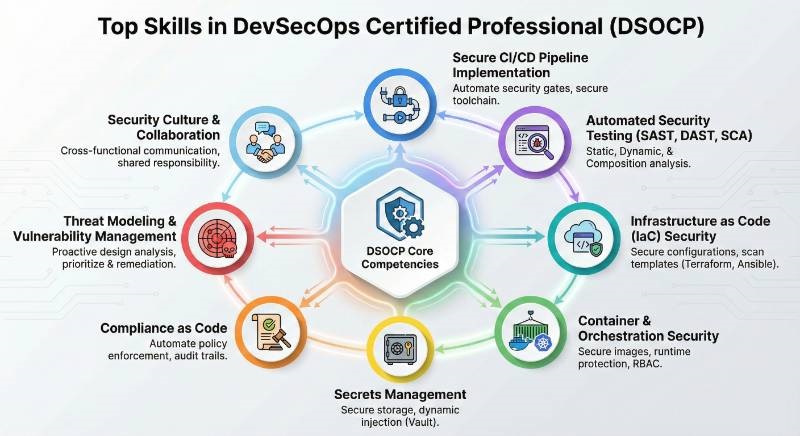
- Static Analysis (SAST): Learning to use automated tools to scan source code for flaws like hardcoded secrets or insecure logic before the code is even compiled.
- Dynamic Analysis (DAST): Testing the application while it is running to find vulnerabilities that only appear in a live environment, such as SQL injection or broken authentication.
- Software Composition Analysis (SCA): Checking third-party libraries and open-source packages for known vulnerabilities. Since most modern apps are 80% open-source, this is a critical skill.
- Container Hardening: Moving beyond basic Docker usage to securing images, scanning for malware, and managing Kubernetes security policies (RBAC, Network Policies).
- Secret Management: Implementing centralized vaults (like HashiCorp Vault) to ensure that API keys, passwords, and certificates are never stored in plain text.
- Compliance Automation: Translating legal and regulatory requirements (like GDPR, HIPAA, or PCI-DSS) into automated code checks that run with every build.
Real-world projects you should be able to do after it
- The “Kill-Switch” Pipeline: Design a CI/CD pipeline that automatically terminates a deployment if a critical vulnerability is detected in a new library.
- Automated Cloud Auditing: Set up a system that scans your entire AWS or Azure environment for misconfigurations—like open S3 buckets—and auto-remediates them.
- Zero-Trust Kubernetes: Build a microservices environment where every service must prove its identity before communicating, ensuring that even if one service is hacked, the rest remain safe.
Detailed Preparation Plans
The 7-14 Day Specialist Sprint
This is for the engineer who is already comfortable with Jenkins and Kubernetes. Focus 100% on the security-specific toolchain. Spend your days practicing with Snyk, SonarQube, and Checkov. Learn the exact syntax for writing security policies in Terraform and how to trigger scans from your pipeline.
The 30-Day Professional Deep-Dive
- Weeks 1-2 (The Logic): Master the “Shift Left” theory. Learn how to perform manual security audits so you understand exactly what the automated tools are looking for.
- Weeks 3-4 (The Automation): Build three distinct pipelines—one for a web app, one for a containerized service, and one for cloud infrastructure. Integrate different scanners into each and learn how to handle “False Positives.”
The 60-Day Career Transition Path
This is for those new to the field. Spend the first 20 days on Linux, Networking, and the OWASP Top 10 (the list of most common web attacks). Spend the next 20 days learning the “DevOps” basics (Git, Jenkins, Docker). Spend the final 20 days following the “Deep-Dive” plan above to add the “Sec” layer to your skills.
Certification Summary Table
| Track | Level | Who it’s for | Prerequisites | Skills Covered | Recommended Order |
| DSOCP | Advanced | Engineers/Managers | DevOps Basics | SAST/DAST, Vault, K8s Sec | 1 |
| Master in DevOps | Expert | Senior Engineers | Linux & Git | CI/CD, Cloud, IaC | 1 or 2 |
| SRE | Expert | Ops Engineers | Admin Experience | SLOs, SLIs, Reliability | 2 |
| FinOps | Advanced | Managers/Leads | Cloud Basics | Cost Optimization, ROI | 3 |
Choose Your Path: 6 Specialized Learning Paths
1. The DevOps Path
The bedrock of modern IT. It focuses on the culture of collaboration and the core tools that automate the software lifecycle.
2. The DevSecOps Path (DSOCP Focus)
The security-first approach. You learn how to make safety a standard part of the developer experience, ensuring that “security” is never a reason for a delayed release.
3. The SRE (Site Reliability Engineering) Path
Focuses on the “Post-Deployment” world. You use software engineering to ensure that systems are not just fast, but highly reliable and scalable.
4. The AIOps/MLOps Path
The frontier of operations. You learn to use AI to predict system failures and how to secure the specific pipelines used to train and deploy Machine Learning models.
5. The DataOps Path
Focuses on the data pipeline. You bring DevOps speed and DevSecOps security to data ingestion, ensuring data is clean, private, and accessible.
6. The FinOps Path
The financial management of the cloud. You learn how to balance performance and security with the actual cost of running cloud resources.
Role → Recommended Certifications Mapping
| If your role is… | Your recommended path is… |
| DevOps Engineer | DSOCP → Certified Kubernetes Security Specialist (CKS) |
| Security Analyst | DevOps Foundation → DSOCP |
| Platform Engineer | Master in DevOps Engineering (MDE) → DSOCP |
| Cloud Engineer | DSOCP → Cloud Security Specialty (AWS/Azure) |
| Software Engineer | DSOCP (Focus on Secure Coding and SAST) |
| Engineering Manager | Master in DevOps (MDE) → DSOCP |
Top Institutions for DevSecOps Certified Professional (DSOCP) Training
Selecting the right partner for your certification journey is essential. These institutions are recognized for their deep technical expertise and hands-on approach to security automation.
- DevOpsSchool DevOpsSchool is a premier global leader in DevOps and DevSecOps education. They provide a high-level, 100+ hour curriculum that focuses on real-world security challenges and enterprise-grade automation. Their trainers are industry veterans who help students master complex tools like SonarQube, Snyk, and Vault in a live, project-based environment.
- Cotocus Cotocus is widely respected for its “Project-First” learning methodology. They specialize in helping engineers bridge the gap between theory and practice by requiring students to complete multiple secure pipeline projects. Their training is designed to make you job-ready by focusing on the specific security toolchains used by top-tier tech companies.
- Scmgalaxy Scmgalaxy is one of the largest community-driven platforms for DevOps and build engineering. They offer extensive technical resources, detailed tutorials, and expert-led certification prep specifically for the DSOCP track. Their vast community forums provide lifetime support for troubleshooting and career networking in the security space.
- BestDevOps BestDevOps focuses on professional-grade training tailored for both individuals and corporate teams. They offer high-impact courses that simplify complex DevSecOps concepts into practical, manageable steps. Their curriculum is updated frequently to reflect the most in-demand tools and security methodologies in the current market.
- DevSecOpsSchool This institution is laser-focused on the security pillar of the software lifecycle. They provide the most detailed deep-dives into “Compliance as Code” and advanced vulnerability management. It is the ideal choice for professionals who want to move away from general operations and become dedicated security automation specialists.
- SreSchool SreSchool approaches security through the lens of system reliability and high availability. They teach that a system cannot be truly reliable if it is not secure, focusing on hardening production environments and managing incident responses. Their training is perfect for operations-minded engineers who want to secure massive, distributed systems.
- AIOpsSchool AIOpsSchool is at the cutting edge, teaching professionals how to use Artificial Intelligence and Machine Learning to detect security threats. They focus on the future of “intelligent” infrastructure, where AI helps automate the detection of anomalies and potential breaches in real-time.
- DataOpsSchool DataOpsSchool brings the rigor of DevSecOps to the world of data engineering and analytics. They focus on securing data pipelines and ensuring that sensitive information is handled according to global privacy standards during automated processing. This is a critical institution for anyone working with big data or cloud-based data warehouses.
- FinOpsSchool FinOpsSchool helps you understand the financial impact of your security decisions. They teach professionals how to choose and scale security tools effectively without overspending on cloud resources. Their training ensures that your security strategy aligns with both technical requirements and business budget goals.
General FAQs (Strategic & Career Focused)
1. How difficult is the DevSecOps Certified Professional (DSOCP) exam? The DSOCP is considered an advanced-level certification. It is more challenging than a standard DevOps course because it requires you to understand both the “how” of automation and the “why” of security. However, for those with a background in Linux and CI/CD, the curriculum is structured to make mastery achievable.
2. What is the total time commitment required for preparation? On average, most professionals spend between 4 to 8 weeks preparing. This typically involves about 10–12 hours of study and lab work per week. If you are already working in a DevOps role, you may be able to accelerate this timeline.
3. Are there any absolute prerequisites before enrolling? You should have a strong grasp of Linux command-line operations and Git version control. Additionally, a basic understanding of CI/CD concepts (like Jenkins or GitLab) is highly recommended. You don’t need to be a security expert, but you should know how web applications generally function.
4. What is the recommended sequence for learning the tools? I always recommend starting with SAST (Static Analysis) and SCA (Dependency Scanning), as these are easiest to integrate. Next, move into Container Security (Docker/K8s), and finally master DAST (Dynamic Analysis) and Secrets Management (Vault). This sequence follows the logical “Shift Left” progression.
5. What is the market value of being a DSOCP-certified professional? The value is significant. DevSecOps is currently one of the fastest-growing niches in IT. Certified professionals often command salaries 20-30% higher than standard DevOps engineers because they solve a critical business problem: reducing risk without sacrificing speed.
6. What are the primary career outcomes after certification? You will be qualified for elite roles such as DevSecOps Architect, Security Automation Engineer, Senior Cloud Security Specialist, and Lead Platform Engineer. It also opens doors to leadership positions like Head of DevSecOps.
7. Is the certification recognized globally? Yes. Major MNCs in India, the United States, and Europe recognize the DSOCP from providers like DevOpsSchool. Security automation is a global standard, and these skills are highly transferable across borders.
8. Can a Software Developer benefit from this certification? Absolutely. Developers who understand security automation are becoming “Full-Stack” in the truest sense. It allows you to write higher-quality code and reduces the back-and-forth with security auditors.
9. How much coding or scripting knowledge is needed? You don’t need to be a heavy coder, but you must be comfortable with YAML (for configuration) and basic Bash or Python scripting. This is necessary for writing the “code” that automates your security tools.
10. Does the certification expire or require renewal? To keep up with the rapidly evolving threat landscape, it is recommended to refresh your knowledge or earn advanced credits every 2-3 years. Most practitioners choose to move into cross-track certifications like SRE or MDE.
11. Is hands-on practice mandatory for passing? Yes. You cannot “read” your way to being a DevSecOps professional. The certification requires you to prove you can actually configure tools, fix broken pipelines, and manage security incidents in a lab environment.
12. Why choose DSOCP over a general Security certification like CISSP? While CISSP is great for high-level management and policy, the DSOCP is a technical implementation certification. It teaches you how to actually build the automated systems that enforce security policies in real-time.
DevSecOps Certified Professional (DSOCP) Specific FAQs
1. Which security tools are specifically covered in the DSOCP curriculum? The curriculum focuses on industry-standard tools including SonarQube for code quality, Snyk or Trivy for container scanning, OWASP ZAP for dynamic testing, and HashiCorp Vault for secrets management.
2. Does the DSOCP cover Kubernetes security? Yes, a significant portion of the program is dedicated to hardening Kubernetes clusters, implementing Network Policies, and ensuring that containerized workloads are running securely.
3. What is the “Shift Left” philosophy mentioned in the course? “Shift Left” refers to the practice of moving security testing earlier in the software development lifecycle. Instead of testing for bugs at the end, you test them the moment the code is written.
4. Will I learn how to manage secrets and API keys? Definitely. One of the core modules focuses on eliminating hardcoded secrets. You will learn how to use a centralized vault to inject credentials into your applications dynamically and securely.
5. Does the certification include “Compliance as Code”? Yes. You will learn how to automate the auditing process, ensuring that your infrastructure meets regulatory standards (like GDPR or PCI) automatically with every deployment.
6. Is the exam proctored and what is the format? The exam is typically an online-proctored test. It combines scenario-based multiple-choice questions with practical tasks that test your ability to troubleshoot security issues in a pipeline.
7. Are the labs provided, or do I need my own infrastructure? Providers like DevOpsSchool provide fully managed cloud labs. You can access these from any standard browser, so you don’t need a powerful computer to practice.
8. Where can I find the most up-to-date syllabus for enrollment? You can find all official details, including the most recent tool updates and registration links, at the Official DSOCP Certification Page.
Conclusion
The DevSecOps Certified Professional (DSOCP) is more than just a credential; it is a fundamental shift in how we approach the future of software engineering. By moving away from the old model of “security as a barrier” and embracing “security as an enabler,” this program empowers you to lead at the intersection of speed and safety. Achieving this mastery ensures that you are not just keeping up with the industry but are actively shaping a world where high-velocity deployment and ironclad security work in perfect harmony.