Upgrade & Secure Your Future with DevOps, SRE, DevSecOps, MLOps!

We spend hours on Instagram and YouTube and waste money on coffee and fast food, but won’t spend 30 minutes a day learning skills to boost our careers.
Master in DevOps, SRE, DevSecOps & MLOps!

Learn from Guru Rajesh Kumar and double your salary in just one year.

Get Started Now!

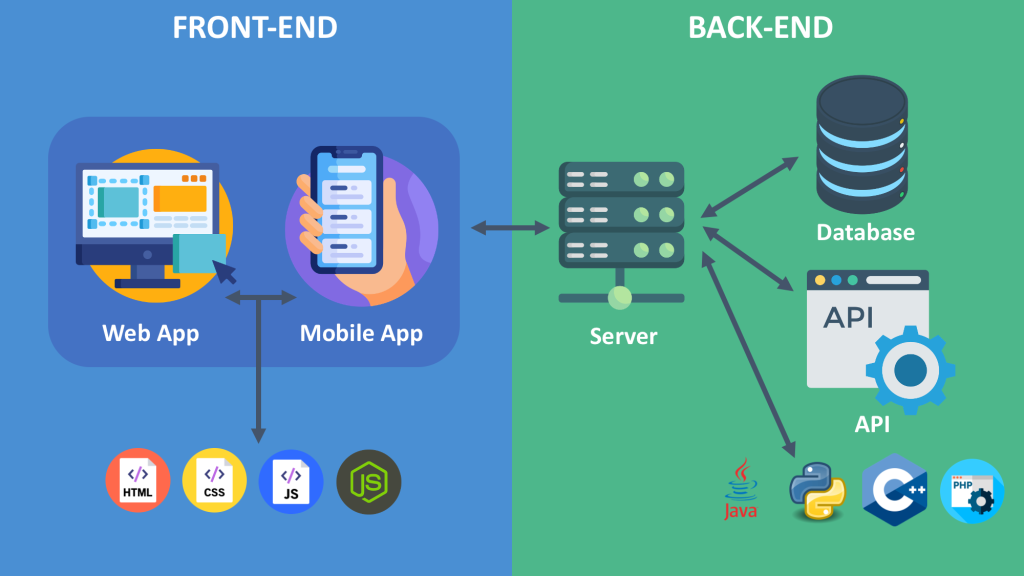
Explanation of front-end, back-end, and APIs?

Frontend

The front-end is the part of a website that users interact with directly. This includes everything you see and can click on, such as the menus, buttons, text, images, and videos. Front-end developers use programming languages like HTML, CSS, and JavaScript to create the visual elements and interactive features of a website.

Backend

The back-end is the part of a website that users don’t see directly. It’s where all the data processing and logic happens. The back-end is responsible for storing data, managing databases, and handling server-side logic. Backend developers use programming languages like Python, Java, Ruby, and PHP to build and maintain the back-end of a website.

API

An API (Application Programming Interface) acts as a messenger between the front-end and back-end. It allows the front-end to make requests to the back-end for data or to perform actions. The back-end then responds to these requests and sends back the data or performs the requested action. APIs are essential for building complex web applications because they allow different parts of the application to communicate with each other.

Here’s an analogy to understand these concepts better: Imagine a restaurant. The front-end is the dining room where customers sit and order food. The back-end is the kitchen where the chefs prepare the food. The API is the waiter who takes the customer’s order to the kitchen and brings back the food.

Thanks for visiting

Related Posts

Top 10 Federated Learning Platforms

Introduction Federated Learning Platforms enable organizations to collaboratively train AI and machine learning models across multiple decentralized data sources without moving or exposing raw data. In plain Read More

Read More

Comparing Heart Surgery Options, Costs, and Leading Hospitals

INTRODUCTION When dealing with complex cardiovascular conditions, choosing the right medical institution is one of the most critical health decisions you will ever make. The quality of Read More

Read More

Top 10 AI ESG Data Extraction Tools: Features, Pros, Cons & Comparison

Introduction AI ESG Data Extraction Tools use artificial intelligence, machine learning, natural language processing (NLP), document intelligence, and automation technologies to collect, extract, classify, and organize environmental, Read More

Read More

Top 10 AI Carbon Accounting Automation Tools: Features, Pros, Cons & Comparison

Introduction AI Carbon Accounting Automation Tools use artificial intelligence, machine learning, natural language processing, data automation, and sustainability analytics to help organizations measure, track, calculate, and report Read More

Read More

Top 10 AI Smart Meter Anomaly Detection Tools: Features, Pros, Cons & Comparison

Introduction AI Smart Meter Anomaly Detection Tools use artificial intelligence, machine learning, pattern recognition, and advanced analytics to identify unusual energy consumption behaviors, meter faults, fraud patterns, Read More

Read More

Top 10 AI Building Energy Optimization Tools: Features, Pros, Cons & Comparison

Introduction AI Building Energy Optimization Tools use artificial intelligence, machine learning, IoT sensors, predictive analytics, and automation to help buildings reduce energy consumption, improve operational efficiency, and Read More

Read More
Subscribe
Notify of
guest
0 Comments
Oldest
Newest Most Voted
0
Would love your thoughts, please comment.x
()
x