Upgrade & Secure Your Future with DevOps, SRE, DevSecOps, MLOps!

We spend hours on Instagram and YouTube and waste money on coffee and fast food, but won’t spend 30 minutes a day learning skills to boost our careers.
Master in DevOps, SRE, DevSecOps & MLOps!

Learn from Guru Rajesh Kumar and double your salary in just one year.

Get Started Now!

What are the different types of Moodle activities and resources?

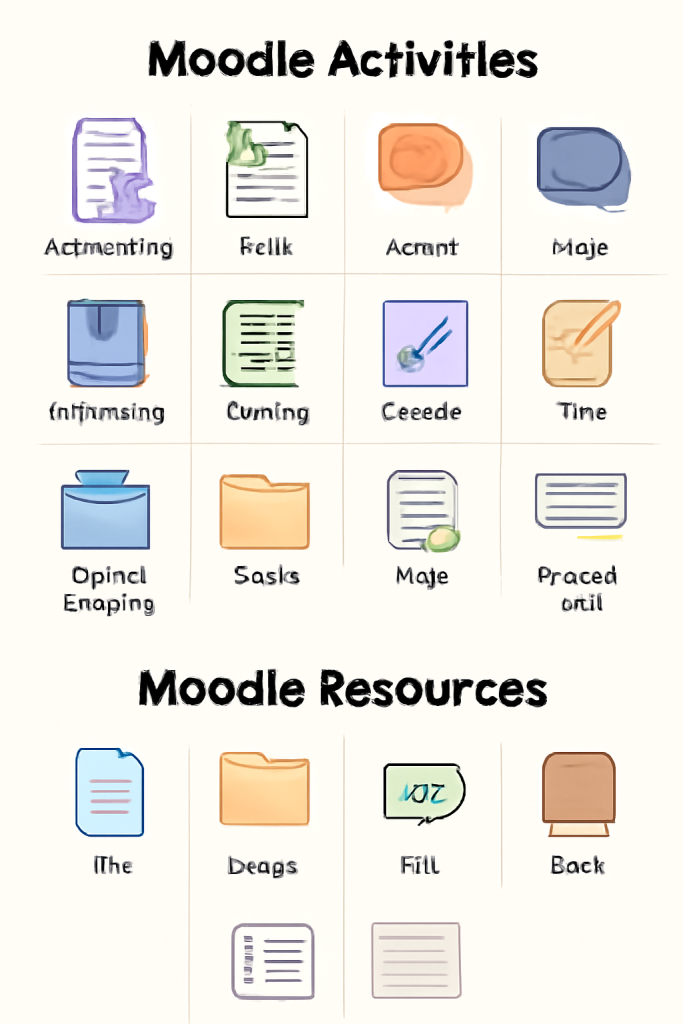
Moodle offers a variety of activities and resources to enhance online learning. Below is a breakdown of the different types:

Moodle Activities (Interactive Elements)

Activities are interactive tools that engage students and facilitate collaboration, assessment, and feedback. Key activities include:

  1. Assignments
  • Allows students to submit work (files or text) for grading.
  • Types: File submissions, text entries, offline assignments.

2. Quiz

    • Enables timed or untimed assessments with various question types (MCQ, short answer, etc.).
    • Supports automated grading and feedback.

    3. Forum

      • Facilitates discussions among students and teachers.
      • Types: Q&A, standard forums, single discussion threads.

      4. Choice

        • A simple poll or single-question survey for quick feedback.

        5. Lesson

          • Delivers content in a branching format with quizzes and conditional navigation.

          6. Workshop

            • Peer assessment activity where students evaluate each other’s work.

            7. Glossary

              • Collaborative dictionary where users can add and define terms.

              8. Wiki

                • A collaborative writing space where users co-create content.

                9. Database

                  • Allows users to create, search, and share a collection of entries (e.g., research papers, book reviews).

                  10. H5P

                  • Integrates interactive content like videos with quizzes, flashcards, and games.

                  11. Chat

                  • Real-time text-based discussions between participants.

                  12. SCORM Package

                  • Imports externally created e-learning content compliant with SCORM/AICC standards.

                  13. Survey

                  • Predefined questionnaires (e.g., COLLES, ATTLS) for course feedback.

                  14. External Tool (LTI)

                  • Integrates third-party learning tools (e.g., Turnitin, YouTube, Quizlet).

                    Moodle Resources (Static Content)

                    Resources are non-interactive materials that deliver content to students. Key resources include:

                    1. File
                    • Uploads documents (PDF, Word, PowerPoint, etc.) for students to download.

                    2. Folder

                      • Organizes multiple files in a single directory.

                      3. Label

                        • Adds text, images, or multimedia to break up sections on a course page.

                        4. Page

                          • Creates a web page with formatted text, images, and embedded media.

                          5. URL

                            • Links to external websites or online resources.

                            6. Book

                              • Multi-page resource with chapters for structured reading.

                              7. IMS Content Package

                                • Uploads IMS-compliant learning materials.

                                Key Differences

                                FeatureActivitiesResources
                                InteractivityYes (students engage)No (static content)
                                GradingOften gradableNot gradable
                                PurposeCollaboration, assessment, feedbackContent delivery

                                These tools allow instructors to create dynamic and engaging e-learning experiences in Moodle. Would you like details on setting up any specific activity or resource?

                                Related Posts

                                Top 10 Federated Learning Platforms

                                Introduction Federated Learning Platforms enable organizations to collaboratively train AI and machine learning models across multiple decentralized data sources without moving or exposing raw data. In plain Read More

                                Read More

                                Comparing Heart Surgery Options, Costs, and Leading Hospitals

                                INTRODUCTION When dealing with complex cardiovascular conditions, choosing the right medical institution is one of the most critical health decisions you will ever make. The quality of Read More

                                Read More

                                Top 10 AI ESG Data Extraction Tools: Features, Pros, Cons & Comparison

                                Introduction AI ESG Data Extraction Tools use artificial intelligence, machine learning, natural language processing (NLP), document intelligence, and automation technologies to collect, extract, classify, and organize environmental, Read More

                                Read More

                                Top 10 AI Carbon Accounting Automation Tools: Features, Pros, Cons & Comparison

                                Introduction AI Carbon Accounting Automation Tools use artificial intelligence, machine learning, natural language processing, data automation, and sustainability analytics to help organizations measure, track, calculate, and report Read More

                                Read More

                                Top 10 AI Smart Meter Anomaly Detection Tools: Features, Pros, Cons & Comparison

                                Introduction AI Smart Meter Anomaly Detection Tools use artificial intelligence, machine learning, pattern recognition, and advanced analytics to identify unusual energy consumption behaviors, meter faults, fraud patterns, Read More

                                Read More

                                Top 10 AI Building Energy Optimization Tools: Features, Pros, Cons & Comparison

                                Introduction AI Building Energy Optimization Tools use artificial intelligence, machine learning, IoT sensors, predictive analytics, and automation to help buildings reduce energy consumption, improve operational efficiency, and Read More

                                Read More
                                Subscribe
                                Notify of
                                guest
                                0 Comments
                                Oldest
                                Newest Most Voted
                                0
                                Would love your thoughts, please comment.x
                                ()
                                x