Introduction
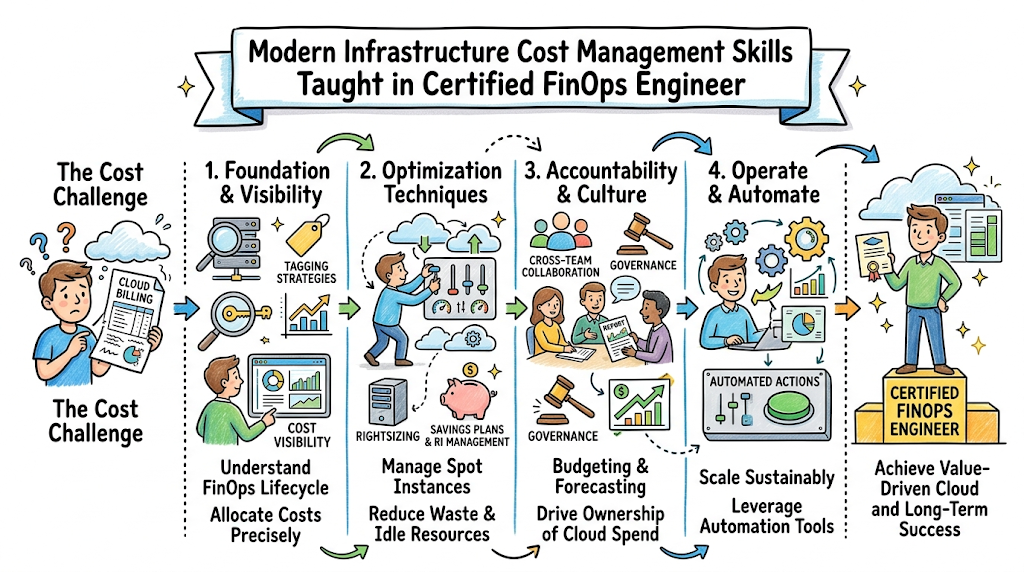
In the modern landscape of cloud-native infrastructure, the ability to manage costs is just as critical as the ability to manage performance or security. The Certified FinOps Engineer is a specialized credential designed to bridge the gap between engineering execution and financial accountability. This guide is crafted for professionals who want to move beyond basic cloud management and into the realm of strategic cost optimization. By leveraging the resources at FinOpsSchool, engineers and managers can gain the skills necessary to navigate complex billing environments and drive real business value through architectural efficiency.
This guide serves as a comprehensive roadmap for navigating the various certification levels and understanding their impact on your career. Whether you are a DevOps engineer looking to “shift left” on costs or a manager trying to stabilize a spiraling cloud budget, the following sections will provide clarity on the best learning paths. We will explore how this certification maps to real-world roles and why it has become an essential part of the platform engineering toolkit in the current global market.
What is the Certified FinOps Engineer?
The Certified FinOps Engineer is a professional standard that focuses on the technical and operational aspects of cloud financial management. It exists to address the growing complexity of variable cloud spending, where traditional static budgeting no longer applies to dynamic, auto-scaling environments. Instead of focusing solely on theoretical accounting, this certification emphasizes production-focused learning, teaching engineers how to build cost-aware architectures that scale efficiently.
In an enterprise setting, this credential represents an engineer’s ability to align technical decisions with business objectives. It covers the mechanics of cloud billing, the implementation of automated cost guardrails, and the optimization of resources across multi-cloud environments. By mastering these principles, professionals can ensure that their engineering workflows are not only high-performing but also fiscally sustainable, fitting perfectly within the modern DevOps and SRE frameworks.
Who Should Pursue Certified FinOps Engineer?
This certification is primarily intended for technical professionals who have a direct impact on cloud consumption, such as DevOps engineers, Cloud Architects, and Site Reliability Engineers. These roles often hold the keys to the infrastructure, making them the most effective frontline for cost management. Additionally, Security and Data engineers benefit greatly, as their domains often involve high-volume data movement and storage costs that require specialized financial oversight.
Beyond individual contributors, Engineering Managers and technical leaders should pursue this credential to better understand how to lead cross-functional teams. It provides a common language for engineers to communicate with finance and procurement departments, reducing friction during budget reviews. In both the Indian and global markets, this certification is increasingly requested by hiring managers looking for senior talent who can manage large-scale cloud budgets with precision.
Why Certified FinOps Engineer is Valuable Today and Beyond
The value of this certification lies in the massive industry shift toward permanent cloud-native operations, where waste is often the biggest hurdle to profitability. As organizations move past initial migration phases, they are entering a period of refinement where every dollar spent must be justified by performance or revenue. This certification ensures that a professional stays relevant by mastering the economic principles that remain constant even as tools and cloud providers evolve.
Enterprise adoption of the FinOps framework is accelerating because it provides a proven method for maximizing return on time and infrastructure investment. By becoming a specialist in this field, you demonstrate a commitment to long-term architectural health rather than just short-term troubleshooting. This expertise creates a significant career moat, as companies are willing to pay a premium for engineers who can systematically reduce operational overhead while maintaining system reliability.
Certified FinOps Engineer Certification Overview
The certification program is delivered through a structured curriculum that combines technical deep dives with operational strategy. It is hosted on a specialized platform that provides learners with the tools and data sets needed to simulate real-world billing scenarios. The assessment approach is practical, focusing on a candidate’s ability to analyze cloud usage, identify anomalies, and recommend architectural changes that result in immediate financial improvement.
Ownership of the certification process ensures that the content is regularly updated to reflect changes in how cloud providers like AWS, Azure, and Google Cloud handle billing. The program is structured into logical blocks that allow professionals to build their knowledge incrementally, starting from basic visibility and moving toward complex automation. This modularity makes it accessible for busy engineers who need to balance their learning with daily production responsibilities.
Certified FinOps Engineer Certification Tracks & Levels
The certification is divided into three distinct levels: Foundation, Professional, and Advanced. The Foundation level is designed to establish a baseline of terminology and the core lifecycle of FinOps, making it accessible to those new to the field. It focuses on the “Inform” phase, ensuring that everyone in the organization can understand where the money is going and why.
The Professional and Advanced levels move into the “Optimize” and “Operate” phases, requiring a deeper technical understanding of infrastructure automation. These tracks allow for specialization, where an engineer can focus on specific areas like Kubernetes cost management, serverless optimization, or multi-cloud governance. This tiered approach ensures that as your career progresses from a junior engineer to a principal architect, there is a relevant certification level to validate your expertise.
Complete Certified FinOps Engineer Certification Table
| Track | Level | Who it’s for | Prerequisites | Skills Covered | Recommended Order |
| FinOps Core | Foundation | Beginners, Analysts | Basic Cloud Literacy | Terminology, Lifecycle | 1st |
| FinOps Engineering | Professional | DevOps, SREs | 2 Years Cloud Exp | Automation, Rightsizing | 2nd |
| FinOps Architecture | Advanced | Principal Engineers | Professional Cert | Governance, Multi-cloud | 3rd |
| Cloud Economics | Specialist | Managers, Leads | Foundation Cert | Unit Economics, ROI | Optional |
| Container FinOps | Specialist | Platform Engineers | K8s Knowledge | Pod-level allocation | Optional |
Detailed Guide for Each Certified FinOps Engineer Certification
Certified FinOps Engineer – Foundation
What it is
This level provides a comprehensive introduction to the FinOps framework, covering the essential phases of Inform, Optimize, and Operate. It validates that a candidate understands the basics of cloud billing and the cultural shifts required for success.
Who should take it
It is ideal for junior engineers, finance partners, and procurement specialists who are working in cloud-heavy environments for the first time. It is also a great starting point for senior managers who need a high-level overview of cost management strategies.
Skills you’ll gain
- Mastery of the FinOps Lifecycle and its core principles.
- Ability to interpret cloud bills and identify major cost drivers.
- Understanding of the “iron triangle” of cloud: Speed, Cost, and Quality.
- Knowledge of tagging strategies for resource allocation and visibility.
Real-world projects you should be able to do
- Create a basic visibility dashboard for a single cloud account.
- Conduct a basic audit of “zombie” resources that are no longer in use.
- Facilitate a monthly cost review meeting between engineering and finance.
Preparation plan
- 7-14 Days: Review the official core terminology and the FinOps handbook.
- 30 Days: Spend time navigating various cloud billing consoles to see data in real-time.
- 60 Days: Participate in community forums to understand common industry challenges.
Common mistakes
- Focusing too much on technical tools while ignoring the cultural and organizational aspects.
- Memorizing definitions without understanding how they apply to a live production environment.
Best next certification after this
- Same-track option: Certified FinOps Engineer – Professional.
- Cross-track option: Cloud Digital Leader or Practitioner level.
- Leadership option: ITIL 4 Foundation for service management.
Certified FinOps Engineer – Professional
What it is
The Professional level focuses on the technical implementation of cost optimization and automation. It validates an engineer’s ability to build and maintain systems that automatically enforce financial policies.
Who should take it
This is designed for DevOps engineers, SREs, and Cloud Architects who have at least two years of experience managing production infrastructure. Candidates should be comfortable with scripting and infrastructure-as-code.
Skills you’ll gain
- Advanced rightsizing techniques for compute, storage, and database services.
- Implementation of automated “shut-off” policies for non-production environments.
- Management of commitment-based discounts like RIs and Savings Plans.
- Building complex cost-allocation models for containerized workloads.
Real-world projects you should be able to do
- Develop a Terraform-based policy that prevents the deployment of expensive resource types.
- Set up an automated alerting system for cost spikes at the project level.
- Implement a lifecycle management policy for S3/Object storage to reduce long-term costs.
Preparation plan
- 7-14 Days: Deep dive into cloud billing APIs and data export formats like CUR.
- 30 Days: Practice writing scripts to automate resource cleanup and monitoring.
- 60 Days: Review complex case studies involving multi-account and multi-region billing.
Common mistakes
- Over-optimizing for cost at the expense of system performance or reliability.
- Failing to account for data egress costs when designing multi-region architectures.
Best next certification after this
- Same-track option: Certified FinOps Engineer – Advanced.
- Cross-track option: Certified Kubernetes Administrator (CKA).
- Leadership option: Certified Cloud Security Professional (CCSP).
Choose Your Learning Path
DevOps Path
The DevOps path focuses on integrating cost as a primary metric within the CI/CD pipeline. Engineers learn to provide immediate feedback to developers regarding the financial impact of their code changes before they hit production. This path involves mastering tools that can parse infrastructure-as-code files to estimate costs. The goal is to create a “cost-aware” development culture where efficiency is treated with the same importance as code quality.
DevSecOps Path
In the DevSecOps path, the emphasis is on the financial implications of security and compliance configurations. Professionals learn how to optimize the costs of security logging, data retention, and high-availability security appliances. This path ensures that the organization remains secure and compliant without incurring unnecessary financial bloat. It is particularly valuable for those working in highly regulated industries like finance or healthcare where data costs are naturally high.
SRE Path
Site Reliability Engineers focus on the delicate balance between system uptime and cloud expenditure. This path teaches engineers how to define Service Level Objectives (SLOs) that take cost into account, avoiding the trap of “over-provisioning for safety.” SREs learn to build cost-resilient systems that can automatically scale down during low-traffic periods. The focus is on operational excellence where performance and cost are optimized in tandem.
AIOps Path
The AIOps path explores the use of machine learning to predict cloud spend and detect billing anomalies. Engineers learn to implement intelligent systems that can forecast future budget requirements based on historical usage patterns. This path is ideal for those looking to automate the “Inform” phase of FinOps using advanced data science techniques. It allows for a more proactive approach to cost management compared to traditional reactive methods.
MLOps Path
MLOps professionals face unique challenges due to the high cost of specialized hardware like GPUs and the massive data sets required for training models. This path focuses on optimizing the training and deployment lifecycle of machine learning models to maximize resource utilization. Engineers learn how to choose the most cost-effective instances for inference and how to manage data pipelines to minimize egress fees. It is a critical path for any organization investing heavily in AI.
DataOps Path
The DataOps path addresses the soaring costs of modern data warehouses and big data processing. Professionals learn to optimize query performance and storage strategies in platforms like Snowflake, BigQuery, or Redshift. This involves mastering partitioning, clustering, and data lifecycle management to ensure that data insights are cost-effective. As data volumes grow, the skills gained in this path become essential for maintaining a sustainable data strategy.
FinOps Path
This is the dedicated path for those who want to become full-time FinOps practitioners or lead a FinOps Center of Excellence. It covers the full spectrum of the framework, from technical optimization to high-level cultural change and organizational design. Professionals in this path learn how to bridge the gap between the CFO’s office and the engineering floor. It is designed for those who want to be the primary strategic driver of cloud value within their organization.
Role → Recommended Certified FinOps Engineer Certifications
| Role | Recommended Certifications |
| DevOps Engineer | FinOps Foundation, FinOps Professional |
| SRE | FinOps Professional, SRE Specialist |
| Platform Engineer | FinOps Professional, Advanced Level |
| Cloud Engineer | FinOps Foundation, Professional Level |
| Security Engineer | FinOps Foundation, DevSecOps Path |
| Data Engineer | FinOps Foundation, DataOps Path |
| FinOps Practitioner | Foundation, Professional, and Advanced |
| Engineering Manager | FinOps Foundation, Economics Specialist |
Next Certifications to Take After Certified FinOps Engineer
Same Track Progression
After completing the initial levels, the natural next step is to move toward the Advanced or Architect level within the FinOps domain. This involves moving from individual resource optimization to managing global, multi-cloud governance and policy enforcement. Staying within this track allows you to become a subject matter expert who can lead large-scale financial transformations. This deep specialization often leads to high-level roles like Head of Cloud Infrastructure or Principal FinOps Architect.
Cross-Track Expansion
Expanding your skills into related areas like Kubernetes (CKA) or Cloud Security (CCSP) makes your FinOps knowledge much more impactful. Understanding the financial mechanics of a Kubernetes cluster, for example, allows you to implement pod-level cost allocation that is highly accurate. This combination of “breadth and depth” makes an engineer incredibly versatile and valuable to any tech-forward organization. It allows you to solve problems that sit at the intersection of different technical silos.
Leadership & Management Track
For those aiming for executive roles, moving into the leadership track with certifications like PMP or specialized management training is a wise move. The FinOps background provides a quantitative foundation that is highly respected by C-level executives. It proves that you understand the business side of technology, which is a key requirement for roles like CTO or Director of Engineering. This track is about leveraging your technical financial knowledge to drive broad organizational strategy.
Training & Certification Support Providers for Certified FinOps Engineer
DevOpsSchool
DevOpsSchool is a leading provider of technical training that specializes in the practical application of modern infrastructure methodologies. Their approach to FinOps training is built on years of experience in the DevOps and SRE fields, ensuring that the content is relevant to current engineering challenges. They offer a blend of instructor-led sessions and hands-on labs that simulate real-world production environments. The curriculum is designed to help students not just pass the exam, but to implement cost-saving measures as soon as they return to their jobs. With a focus on community support and continuous learning, DevOpsSchool provides a robust platform for professionals in India and beyond to master cloud economics. Their instructors are seasoned practitioners who bring a wealth of industry knowledge to every session, making the learning experience both engaging and deeply informative for students at all levels.
Cotocus
Cotocus focuses on high-end technical consulting and training for specialized cloud-native domains. Their FinOps training programs are tailored for enterprises and senior professionals who need to manage complex, large-scale cloud footprints. They emphasize the engineering side of cost management, focusing on architectural patterns that lead to long-term efficiency. Cotocus provides a deep dive into automation and policy-as-code, which are essential skills for the modern FinOps Professional. Their training methodology is highly interactive, involving case studies from real enterprise migrations and optimization projects. By choosing Cotocus, learners gain access to a network of experts who are at the forefront of cloud financial management trends. Their commitment to excellence ensures that every participant leaves with a clear, actionable roadmap for improving their organization’s cloud financial health and operational agility.
Scmgalaxy
Scmgalaxy is a comprehensive resource hub and training center for professionals in the software configuration and DevOps space. They have integrated FinOps into their vast library of tutorials and courses, recognizing its critical role in the modern software delivery lifecycle. Their training is designed to be accessible and thorough, providing a solid foundation for those new to the field while offering advanced modules for experienced engineers. Scmgalaxy places a strong emphasis on the tools and technologies that drive FinOps, such as billing APIs and cloud-native monitoring services. Their community-driven approach allows students to learn from the experiences of others, fostering a collaborative environment. For professionals looking for a wealth of supplementary material and a supportive learning community, Scmgalaxy is an excellent choice for pursuing their FinOps certification goals.
BestDevOps
BestDevOps provides streamlined and results-oriented training for individuals and teams looking to quickly upskill in the latest cloud technologies. Their FinOps certification courses are structured to be efficient, focusing on the most important concepts and skills needed for exam success and career growth. They use a practical, lab-based approach that ensures students can apply what they learn in real-time. BestDevOps is known for its clear explanations and simplified teaching style, making complex financial concepts easy for engineers to grasp. They offer a range of flexible learning options, including online bootcamps and self-paced modules, to suit different schedules. By focusing on the core essentials of cloud financial management, BestDevOps helps professionals achieve their certification goals without unnecessary fluff, making them a popular choice for busy engineers.
Devsecopsschool.com
Devsecopsschool.com is a specialized platform that focuses on the intersection of security, development, and operations. Their FinOps training is unique because it highlights the financial impact of security decisions and how to optimize security spending in the cloud. They teach students how to build secure architectures that are also cost-effective, a balance that is often difficult to achieve. The curriculum includes hands-on exercises in managing the costs of security logging, encryption, and compliance monitoring. For security professionals who want to broaden their impact, this school provides the tools to communicate the value of security investments in financial terms. Their mission is to create well-rounded engineers who can protect the organization’s assets while also protecting its bottom line, making their training highly relevant in today’s budget-conscious security landscape.
Sreschool.com
Sreschool.com is dedicated to the discipline of Site Reliability Engineering, where reliability and efficiency are the top priorities. Their FinOps curriculum is deeply technical, focusing on how SREs can build cost-awareness into their monitoring and incident response workflows. They teach students how to use data to make informed decisions about resource allocation and how to automate the remediation of cost-inefficient infrastructure. The training at Sreschool.com is designed for those who want to see how FinOps fits into a high-availability, high-scale production environment. Their instructors are experienced SREs who have managed some of the world’s most demanding cloud architectures. By focusing on the “Reliability vs. Cost” trade-off, Sreschool.com provides a specialized perspective that is essential for platform engineers who are responsible for maintaining large-scale distributed systems.
Aiopsschool.com
Aiopsschool.com sits at the cutting edge of infrastructure management, focusing on the use of artificial intelligence to optimize IT operations. Their FinOps modules explore how machine learning can be applied to cloud billing data to find savings that human analysts might miss. Students learn to build and deploy AI models that can predict future spending and identify cost anomalies in real-time. This is a forward-looking training center that prepares engineers for the future of automated, intelligent cloud management. The curriculum is challenging and requires a good understanding of both data science and cloud architecture. For engineers who want to be at the forefront of the AIOps revolution, this school offers a unique and highly valuable learning path that bridges the gap between AI and cloud economics.
Dataopsschool.com
Dataopsschool.com addresses the specific and often high costs associated with modern data engineering and analytics. Their FinOps training is specifically designed for data engineers and architects who work with massive datasets and expensive data warehousing platforms. They provide detailed guidance on how to optimize query performance, manage data storage costs, and implement effective data lifecycle policies. The training focuses on creating financial transparency for data projects, allowing teams to justify their spend based on the business value delivered. Dataopsschool.com helps professionals master the nuances of data-specific billing models, such as those used by Snowflake and BigQuery. Their practical approach ensures that data teams can reduce their operational costs without sacrificing the speed or quality of their insights, making it an essential resource for any data-driven organization.
Finopsschool.com
Finopsschool.com is the primary specialized institution for the Certified FinOps Engineer program. As the hosting site for this certification, they provide the most direct and comprehensive path to mastery in this field. Their entire platform is dedicated to the FinOps framework, offering a wealth of resources including certification exams, community forums, and expert-led training modules. They focus on fostering a global community of practitioners who are dedicated to the principles of cloud financial management. Finopsschool.com is the definitive source for the latest updates to the FinOps curriculum and industry standards. By choosing this platform, learners are ensuring they receive the most authoritative and up-to-date education possible. It is the central hub for anyone looking to build a long-term career in FinOps, providing both the technical skills and the professional network needed to succeed.
Frequently Asked Questions (General)
- How much technical experience is needed for the Foundation exam?
Minimal technical experience is required for the Foundation level. It is designed to be accessible to anyone working in a cloud environment, including finance and business roles, provided they have a basic understanding of cloud concepts.
- Can this certification help in landing a job in the Indian market?
Yes, the Indian IT sector is seeing a massive surge in cloud adoption, and companies are actively looking for professionals who can manage these costs. It is a significant differentiator on a resume for any cloud-related role.
- How does FinOps differ from traditional IT cost cutting?
FinOps is about value realization and continuous optimization rather than just cutting budgets. It is a cultural practice that involves collaboration between engineering, finance, and business teams to make informed data-driven decisions.
- Is the exam proctored and taken online?
Most versions of the exam are proctored and can be taken online from your home or office, provided you meet the technical and environmental requirements specified by the testing platform.
- What is the typical salary impact of becoming a Certified FinOps Engineer?
While results vary, professionals with this certification often command higher salaries because they possess a rare combination of technical and financial skills that are in high demand across the enterprise.
- How often should I recertify to stay current?
It is generally recommended to recertify every two to three years. Cloud billing models and tools change rapidly, and staying current ensures your skills remain relevant to the latest industry standards.
- Does the certification cover multi-cloud strategies?
Yes, the Professional and Advanced levels specifically address the challenges of managing costs across multiple cloud providers like AWS, Azure, and Google Cloud simultaneously.
- Are there any free resources to start learning FinOps?
Many training providers offer introductory blogs, webinars, and community forums where you can learn the basics for free before committing to a formal certification path.
- Can a manager with no coding skills pass the Professional level?
It would be difficult, as the Professional level involves technical tasks like scripting and API integration. Managers without coding skills are better suited for the Foundation and Economics specialist tracks.
- What are the most common tools covered in the training?
The training covers cloud-native tools like AWS Cost Explorer and Azure Cost Management, as well as third-party platforms and open-source tools for container cost tracking.
- Is the certification valuable for freelancers?
Absolutely, freelancers can use this certification to offer “Cost Optimization as a Service” to their clients, providing immediate and measurable value that justifies their consulting fees.
- How does FinOps align with the SRE philosophy?
FinOps treats “cost” as a service level indicator. Just as SREs manage for reliability and latency, they use FinOps principles to manage for financial efficiency and budget adherence.
FAQs on Certified FinOps Engineer
- What is the strategic advantage of having a FinOps Engineer on a technical team?
From a strategic perspective, a FinOps Engineer provides the visibility needed to make “buy vs. build” decisions with high accuracy. They allow technical leaders to understand the true cost of an application throughout its lifecycle, enabling more precise ROI calculations for new features. This leads to a more disciplined engineering culture where resources are allocated based on data rather than guesswork.
- How does this certification address the challenge of “shadow IT” and unallocated costs?
The certification focuses heavily on governance and tagging policies that bring shadow IT into the light. You will learn how to implement automated discovery tools that identify unmanaged resources and assign them to the correct cost centers. This ensures that every department is accountable for its own cloud consumption, preventing the “surprise” bills that often plague large organizations.
- Can the FinOps framework be applied to private cloud or on-premise environments?
While primarily designed for public cloud, the principles of unit economics and resource accountability can certainly be adapted for private clouds. The certification teaches you how to create a “chargeback” or “showback” model that works regardless of the underlying infrastructure, providing a consistent financial view across a hybrid cloud estate.
- What role does automation play in the Professional level of the certification?
Automation is a core pillar of the Professional level. Candidates are expected to know how to use CLI tools and SDKs to automate the identification and remediation of waste. This includes creating scripts that automatically rightsize underutilized instances or move infrequently accessed data to cheaper storage tiers based on real-time usage metrics.
- How does the exam test a candidate’s ability to handle multi-cloud billing data?
The exam often uses scenarios where a candidate must normalize data from different cloud providers to create a single source of truth. This involves understanding the different billing cycles, discount structures, and data export formats used by various vendors, and how to consolidate them into a unified report for business stakeholders.
- How does FinOps influence the decision-making process for Engineering Managers?
FinOps provides managers with the quantitative data needed to prioritize engineering tasks. For example, if the data shows that a specific microservice is costing significantly more than its peers, a manager can prioritize a refactoring project to improve its efficiency. It turns cost management into a proactive part of the engineering roadmap.
- Is there a focus on container-specific cost allocation in the curriculum?
Yes, because containers and Kubernetes are the standard for modern infrastructure, a significant portion of the technical training is dedicated to this area. You will learn how to use tools to provide granular visibility into cluster costs, allowing you to see exactly how much each namespace or deployment is costing the organization.
- How does the “Operate” phase ensure long-term financial sustainability?
The Operate phase focuses on establishing a continuous feedback loop between engineering and finance. It teaches you how to set up recurring cost reviews and how to integrate financial guardrails into the standard operating procedures of the engineering team. This ensures that cost optimization is not a one-time event but a permanent part of the organizational culture.
Final Thoughts: Is Certified FinOps Engineer Worth It?
In my years of observing the evolution of cloud infrastructure, I have seen many trends come and go, but the need for financial efficiency is permanent. Earning the Certified FinOps Engineer credential is a clear signal that you are a modern professional who understands the business reality of technology. It transitions you from being someone who just builds systems to someone who builds systems that are sustainable, scalable, and profitable.
From a mentor’s perspective, I highly recommend this path for anyone who feels that their technical skills are hitting a ceiling. Adding financial expertise to your engineering toolkit opens doors to leadership and strategic roles that are otherwise difficult to reach. It is a challenging but rewarding journey that will fundamentally change how you view cloud architecture and your role within the enterprise. The investment in this certification is not just about a badge; it is about gaining the mastery needed to lead in the next era of cloud computing.
