Introduction
The Certified FinOps Professional has become a vital asset for engineering teams and financial leaders aiming to manage cloud spending effectively. In the modern era of cloud-native infrastructure, the ability to balance technical performance with financial accountability is no longer optional. This guide is designed for professionals who want to move beyond basic cost tracking and implement a culture of real-time cloud optimization. By following the standards set by FinOpsSchool, practitioners can bridge the gap between engineering velocity and fiscal responsibility. This roadmap helps cloud engineers, SREs, and managers make informed career decisions that drive significant value for their organizations.
What is the Certified FinOps Professional?
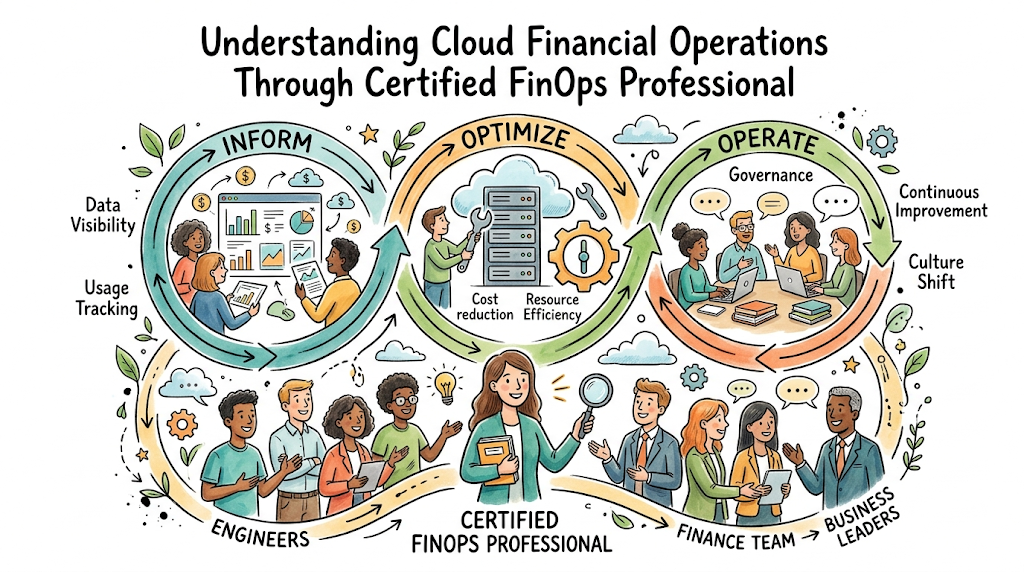
The Certified FinOps Professional is a specialized designation that validates an individual’s expertise in the financial management of cloud services. It focuses on the variable spend model of public cloud providers, moving away from traditional fixed budgeting toward dynamic, consumption-based economics. The certification emphasizes the “Inform, Optimize, and Operate” lifecycle, ensuring that costs are visible and managed throughout the entire software development process. It exists to provide a common language and framework for engineering, finance, and business teams to collaborate on cloud efficiency.
Who Should Pursue Certified FinOps Professional?
This certification is ideal for cloud architects, site reliability engineers, and DevOps professionals who manage large-scale cloud environments. Engineering managers and financial analysts also benefit greatly, as it provides the tools needed to forecast spending and track the return on cloud investments. Beginners looking to enter the cloud field can use this as a differentiator, while senior leaders use it to implement governance at an enterprise scale. In major tech hubs like India and across the global market, this certification is a key requirement for leadership roles in platform engineering.
Why Certified FinOps Professional is Valuable and Beyond
As companies continue to scale their cloud presence, the demand for experts who can eliminate cloud waste is at an all-time high. This certification ensures long-term career relevance by focusing on the core principles of cloud economics rather than just specific vendor tools. It helps professionals stay valuable even as cloud platforms evolve, because the fundamental need to optimize spend remains constant. Organizations are increasingly looking for leaders who can prove that cloud investments are driving business growth, making this certification a high-impact career move.
Certified FinOps Professional Certification Overview
The program is delivered through a structured learning path that covers everything from basic terminology to advanced enterprise cost allocation. It is hosted on a platform that emphasizes practical, real-world application over theoretical knowledge. Candidates are assessed on their ability to analyze billing data, implement tagging strategies, and drive cultural shifts within their teams. The certification provides a comprehensive understanding of how to manage shared costs and unit economics in complex, multi-tenant environments.
Certified FinOps Professional Certification Tracks & Levels
The certification path is divided into several levels to accommodate different stages of professional growth. The Foundation level introduces the core concepts and phases of the FinOps lifecycle. The Professional level dives deeper into automation, forecasting, and advanced optimization techniques. Specialist tracks are also available for those focusing on specific areas like governance or container-based environments. These tracks allow individuals to build a personalized learning journey that aligns with their current role and future career aspirations.
Complete Certified FinOps Professional Certification Table
| Track | Level | Who it’s for | Prerequisites | Skills Covered | Recommended Order |
|---|---|---|---|---|---|
| FinOps Core | Foundation | Beginners, Finance | None | Lifecycle, Pillars | 1 |
| FinOps Core | Professional | Senior Engineers | Foundation | Unit Economics, KPI | 2 |
| Strategy | Specialist | Architects, Leads | Professional | Governance, Automation | 3 |
| Leadership | Expert | Directors, CTOs | Professional | Change Management | 4 |
Export to Sheets
Detailed Guide for Each Certified FinOps Professional Certification
Certified FinOps Professional – Foundation
What it is
This level validates the basic understanding of the FinOps framework and the fundamental shift from capital expenditure to operational expenditure. It ensures that the candidate can effectively communicate the value of FinOps to various stakeholders within the organization.
Who should take it
It is designed for junior cloud engineers, procurement specialists, and project managers who are new to cloud financial management. It is the best starting point for anyone who needs to understand how cloud billing works at a fundamental level.
Skills you’ll gain
- Understanding of cloud consumption models.
- Knowledge of the six pillars of FinOps.
- Ability to navigate the Inform, Optimize, and Operate phases.
- Basic resource tagging and allocation techniques.
Real-world projects you should be able to do
- Create a simple cost-visibility dashboard for a project.
- Identify and report on unallocated cloud spending.
- Implement a basic tagging policy for a cloud account.
Preparation plan
- 7–14 days: Study the core terminology and framework definitions.
- 30 days: Analyze sample billing reports to understand data structures.
- 60 days: Typically not required for this level unless new to cloud.
Common mistakes
- Focusing only on technical tools without understanding the cultural aspects.
- Neglecting the finance-side terminology of cloud management.
Best next certification after this
- Same-track option: Certified FinOps Professional – Practitioner
- Cross-track option: Cloud Provider Associate Certification
- Leadership option: FinOps for Product Owners
Certified FinOps Professional – Professional
What it is
This certification validates the practitioner’s ability to implement complex optimization strategies and manage cloud spend at an enterprise scale. It proves that you can automate cost-saving measures and drive data-driven decision-making across multiple teams.
Who should take it
Senior SREs, Platform Engineers, and Cloud Leads who have hands-on experience in managing large-scale cloud budgets should pursue this. It is intended for those who are responsible for the financial efficiency of their infrastructure.
Skills you’ll gain
- Advanced cost allocation and shared cost strategies.
- Implementation of automated commitment-based discounts.
- Measuring unit economics and cloud-spend efficiency.
- Development of automated cost-anomaly detection systems.
Real-world projects you should be able to do
- Design a system for automated cleanup of idle cloud resources.
- Build a dashboard that connects technical metrics to business revenue.
- Manage enterprise-wide commitment plans and savings strategies.
Preparation plan
- 7–14 days: Review advanced allocation and commitment-tracking methods.
- 30 days: Work with real datasets to practice optimization scenarios.
- 60 days: Deep dive into organizational policy automation and leadership.
Common mistakes
- Failing to account for hidden costs like data egress and shared services.
- Not involving finance teams early enough in the optimization process.
Best next certification after this
- Same-track option: Certified FinOps Professional – Expert
- Cross-track option: Kubernetes Administration (CKA)
- Leadership option: FinOps Certified Instructor
Choose Your Learning Path
DevOps Path
The DevOps path focuses on making cost a primary metric within the software delivery pipeline. Engineers learn to provide developers with immediate feedback on the cost implications of their code changes. This path emphasizes the integration of cost-tracking tools into CI/CD workflows. By mastering these skills, DevOps professionals ensure that the infrastructure remains scalable and cost-effective as it grows.
DevSecOps Path
The DevSecOps path integrates financial accountability with security and compliance standards. It teaches practitioners how to implement cost-saving policies that do not compromise the security of the environment. This involves using policy-as-code to enforce both budget limits and security guardrails. It is essential for teams that need to maintain high security while optimizing cloud consumption.
SRE Path
Site Reliability Engineers focus on the intersection of system reliability and financial cost. This path involves managing the trade-offs between redundancy for high availability and the associated infrastructure spend. SREs learn to use FinOps data to drive capacity planning and rightsizing initiatives. The goal is to build resilient systems that operate within strict financial parameters.
AIOps Path
The AIOps path explores the use of artificial intelligence to automate cloud financial management. Professionals learn to implement AI-driven tools that predict future spending and identify cost anomalies in real-time. This path is focused on using data science to manage the complexities of modern, distributed cloud systems. It enables teams to perform micro-optimizations that would be impossible for human analysts to manage manually.
MLOps Path
MLOps professionals focus on the significant costs related to machine learning model training and inference. This path covers strategies for optimizing GPU and TPU usage and managing large data pipelines efficiently. Practitioners learn to attribute machine learning costs to specific business outcomes or models. It is a critical specialization for companies heavily invested in large-scale data science and AI applications.
DataOps Path
The DataOps path addresses the financial management of large data warehouses and data processing workloads. It teaches engineers how to optimize query performance and manage data lifecycle costs to reduce cloud bills. This involves choosing the right storage tiers and processing engines for specific data tasks. It is vital for data engineers who need to manage massive datasets in a cost-effective manner.
FinOps Path
The dedicated FinOps path is for those who want to lead a FinOps Center of Excellence. It focuses on driving the overall strategy for cloud financial management across the entire organization. This includes training teams, setting enterprise-wide policies, and managing vendor relationships. It is the ideal path for professionals who want to make FinOps their primary career focus and drive large-scale cultural change.
Role → Recommended Certified FinOps Professional Certifications
| Role | Recommended Certifications |
|---|---|
| DevOps Engineer | Foundation, Professional |
| SRE | Professional, SRE Specialist |
| Platform Engineer | Professional, Governance Track |
| Cloud Engineer | Foundation, Practitioner |
| Security Engineer | Governance Track, DevSecOps Specialist |
| Data Engineer | DataOps Track, Foundation |
| FinOps Practitioner | Professional, Expert Leadership |
| Engineering Manager | FinOps for Managers, Foundation |
Export to Sheets
Next Certifications to Take After Certified FinOps Professional
Same Track Progression
Once the Professional level is achieved, practitioners should look toward Expert levels that focus on strategic leadership. These advanced certifications cover complex topics like global governance and managing FinOps during corporate transitions. This path is designed for those who want to influence the highest levels of technical and financial strategy within their company.
Cross-Track Expansion
Broadening your expertise into platform engineering or cloud-specific architecture is a great way to complement your FinOps skills. Understanding how services like Kubernetes manage resources at a granular level allows for more effective cost-optimization strategies. This combination of financial and technical mastery makes you an invaluable asset to any cloud-native organization.
Leadership & Management Track
For those looking to move into executive roles, transitioning to management-focused certifications is a logical next step. This involves moving from hands-on optimization to overseeing the people and processes that drive financial efficiency. A strong background in FinOps provides the data-driven foundation needed to lead large technical departments successfully.
Training & Certification Support Providers for Certified FinOps Professional
DevOpsSchool
DevOpsSchool offers specialized training programs that focus on the practical application of FinOps within a modern engineering environment. Their courses are designed to help professionals master the tools and cultural shifts required for successful cloud financial management. They provide a hands-on approach that prepares students for the challenges of managing large-scale cloud budgets. Their curriculum is updated regularly to reflect the latest industry trends and best practices.
Cotocus
Cotocus provides high-level consulting and training services for technical professionals aiming to excel in FinOps. They offer personalized learning paths that help individuals and teams achieve their certification goals efficiently. Their instructors are experienced practitioners who bring deep industry insights into the classroom. Cotocus emphasizes a strategic approach to FinOps, ensuring that students can drive meaningful business value after completing their training.
Scmgalaxy
Scmgalaxy is a comprehensive resource hub for DevOps and FinOps professionals. They offer a wide range of tutorials, documentation, and community support for those preparing for certifications. Their focus on knowledge-sharing helps practitioners understand the real-world complexities of cloud spend management. Scmgalaxy is an excellent platform for staying updated on new tools and community-driven optimization strategies.
BestDevOps
BestDevOps focuses on career mentorship and technical training for aspiring cloud leaders. Their FinOps modules are designed to be intensive and results-oriented, helping candidates pass their exams with confidence. They provide practical labs and mock exams that simulate the actual certification environment. BestDevOps is known for its strong community and the high success rate of its students in the professional market.
Devsecopsschool.com
Devsecopsschool.com specializes in the intersection of security and cost management. They teach professionals how to implement secure cloud-spending policies and use automation to maintain compliance. Their training is essential for engineers working in regulated industries where financial and security risks are closely linked. They offer a unique perspective on FinOps that prioritizes infrastructure integrity and cost-efficiency.
Sreschool.com
Sreschool.com focuses on the operational excellence of cloud systems, including their financial sustainability. Their training programs teach SREs how to integrate cost as a core component of system reliability. They cover advanced topics like capacity planning and performance optimization from a FinOps perspective. Sreschool.com is the ideal choice for engineers who want to manage reliable systems at the lowest possible cost.
Aiopsschool.com
Aiopsschool.com leads the way in teaching AI-driven operations and financial management. Their courses explore how artificial intelligence can be used to solve the most difficult cloud-spending challenges. They provide technical training on automated forecasting and anomaly detection tools. This platform is perfect for professionals who want to lead the next wave of automated cloud financial operations.
Dataopsschool.com
Dataopsschool.com focuses on the financial management of large-scale data infrastructures. They offer specialized training for data engineers who need to optimize storage and compute costs for big data workloads. Their curriculum covers practical strategies for reducing query costs and managing data lifecycle policies. This provider is essential for anyone handling significant data budgets in the cloud.
Finopsschool.com
Finopsschool.com is the primary authority for the Certified FinOps Professional program. They offer the most comprehensive and direct path to achieving certification through official curriculum and assessment standards. As the core provider, they ensure that all training is aligned with the global standards of the FinOps framework. They are the go-to resource for anyone looking for the most authoritative and recognized certification in this field.
Frequently Asked Questions (General)
- How difficult is the Certified FinOps Professional exam?
The exam is considered moderately challenging because it requires a mix of technical, financial, and organizational knowledge. It focuses on how you apply the framework to real scenarios.
- Is there a requirement for cloud experience before taking the exam?
While not strictly required for the Foundation level, having at least six months of cloud experience is highly beneficial. The Professional level definitely requires hands-on experience.
- How long does the certification stay active?
The certification is usually valid for two years, after which you need to renew it to stay current with the fast-moving cloud industry.
- Is the exam available online?
Yes, the exam is typically delivered through an online proctored system, making it accessible to professionals globally.
- What kind of questions are on the exam?
The questions are mostly multiple-choice and scenario-based, testing your ability to choose the best optimization or allocation strategy in a given situation.
- Can non-engineers benefit from this certification?
Absolutely. Finance professionals and procurement officers find it invaluable for understanding the technical drivers of cloud bills.
- How much study time is required for the Professional level?
Most candidates spend about four to six weeks of intensive study to prepare for the Professional exam, depending on their background.
- Does this certification cover multi-cloud environments?
Yes, the principles taught are cloud-agnostic and apply to AWS, Microsoft Azure, Google Cloud Platform, and others.
- What is the passing score for the exam?
The passing score is generally around 75%, but this can vary depending on the specific version of the exam being taken.
- Are there practice tests available?
Yes, most training providers and the official hosting site offer practice exams to help you gauge your readiness.
- How does this certification help with career growth?
It prepares you for senior roles like Cloud Financial Manager or FinOps Lead, which are high-demand positions in the current market.
- Can I retake the exam if I do not pass the first time?
Yes, there is a retake policy that typically allows for another attempt after a mandatory waiting period and payment of a fee.
FAQs on Certified FinOps Professional
- What makes the Certified FinOps Professional different from cloud architect exams?
While architect exams focus on how to build systems, the FinOps certification focuses on the financial impact of those systems. It teaches you how to manage the ongoing cost of what you have built rather than just the initial deployment.
- Does the certification focus heavily on specific tools?
No, it focuses on the framework and best practices that are applicable across any set of tools. While specific tools might be mentioned, the goal is to teach you the principles of optimization and accountability.
- How does the certification address the “Phase” model?
It deeply explores the Inform (visibility), Optimize (cost reduction), and Operate (cultural alignment) phases. You will learn how to move your organization through these stages to achieve full cloud maturity.
- Why is cultural change such a big part of the curriculum?
FinOps is as much about people as it is about data. The certification teaches you how to motivate engineers to care about costs and how to help finance teams understand technical scalability.
- Is there a focus on container and Kubernetes costs?
Yes, the Professional track includes strategies for managing shared resources in containerized environments. This is critical for modern teams using microservices architectures.
- How does the certification help with forecasting?
It provides models for predicting future spend based on historical data and upcoming business initiatives. This helps engineering teams avoid budget surprises at the end of the month.
- What is the role of “Unit Economics” in the exam?
Unit economics is a major topic, focusing on the cost per business unit. You will learn how to show that while cloud spend might be increasing, the cost per customer or transaction is actually decreasing.
- Does the program cover commitment strategies like Savings Plans?
Yes, it covers how to manage Reserved Instances and Savings Plans across an entire organization to maximize discounts while maintaining enough flexibility for changing workloads.
Final Thoughts: Is Certified FinOps Professional Worth It?
In a world where cloud costs can easily spiral out of control, having the skills to manage that spend is a superpower. The Certified FinOps Professional is a high-value investment for any engineer or manager who wants to lead in the cloud era. It moves you from being a technical implementer to a business strategist who understands how infrastructure drives profit. As a mentor, I have seen this certification open doors to leadership roles that were previously inaccessible to pure technical staff. It provides the data-driven mindset and the common language needed to align an entire company around the goal of cloud efficiency. If you want to future-proof your career and deliver tangible value to your organization, this certification path is the most practical way to achieve it. It is not just about saving money; it is about making sure that every dollar spent on the cloud is an investment in your company’s growth.
