Introduction
Drug discovery platforms are software systems that accelerate the identification, design, simulation, and optimization of novel therapeutic compounds.
They help research teams integrate biological, chemical, and clinical data to discover leads, test hypotheses, and prioritize drug candidates.
These platforms combine computational modeling, machine learning, bioinformatics, and laboratory data to improve R&D productivity and reduce time to candidate selection.
Selecting the right drug discovery platform enhances target validation, compound screening, predictive modeling, and decision‑making across discovery programs.
Real‑world use cases:
- Pharmaceutical companies screening chemical libraries for hits
- Biotech start‑ups optimizing lead molecules with AI models
- Academic labs studying target biology and pathway interactions
- Contract research organizations (CROs) providing discovery services
- Multi‑disciplinary R&D teams integrating omics and structure data
Key buyer evaluation criteria:
- Computational chemistry and molecular modeling
- AI/ML‑assisted prediction and scoring
- Integration with experimental data and LIMS
- Visualization and interactive dashboards
- Collaboration and knowledge management
- Scalability and cloud support
- Regulatory traceability and audit logs
- Interoperability with bioinformatics tools
- Ease of use and onboarding
Best for: Drug R&D teams, computational chemists, bioinformaticians, CROs, biotech companies, and pharmaceutical discovery units.
Not ideal for: Organizations without medicinal chemistry or biological discovery needs.
Key Trends in Drug Discovery Platforms
- AI‑assisted hit discovery, de‑novo design, and generative chemistry
- Integration of multi‑omics datasets and systems biology
- Cloud‑native platforms with scalable high‑performance computing (HPC)
- Predictive toxicology and ADME modeling
- Workflow automation and experiment logging
- Collaboration tools for cross‑site discovery teams
- APIs for biophysical and screening instrument integration
- Interoperability with ELN and LIMS systems
- Visualization of chemical space and molecular interactions
- Subscription and pay‑per‑use pricing models
How We Selected These Tools (Methodology)
- Adoption by industry and academic discovery teams
- Breadth of features covering simulation, modeling, and data integration
- Use of AI/ML and predictive analytics
- Security and compliance for regulated research
- Interoperability with discovery workflows and instruments
- Scalability across computational infrastructure
- Usability and learning curve for scientists
- Support, documentation, and active user communities
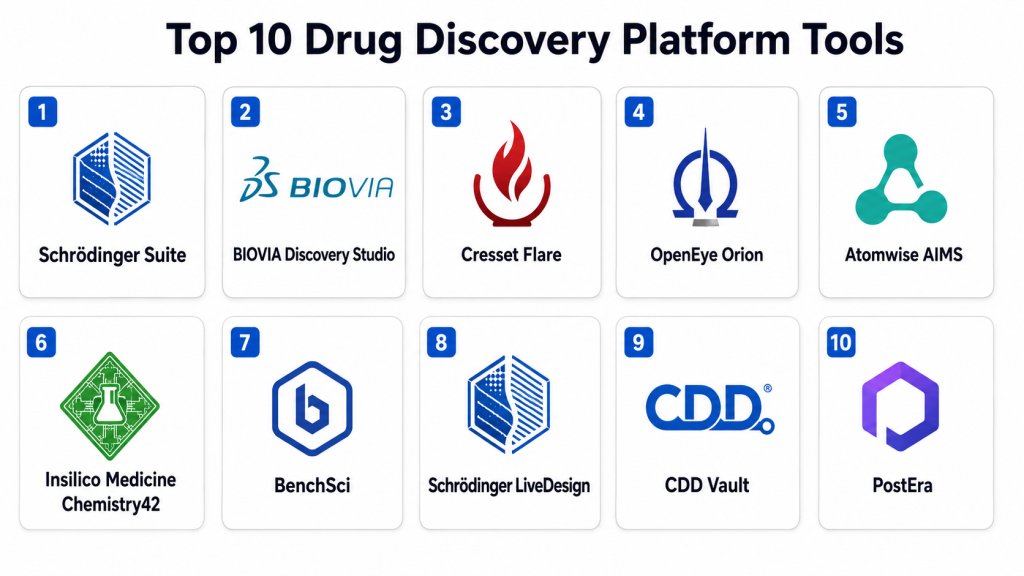
Top 10 Drug Discovery Platform Tools
#1 — Schrödinger Suite
Short description:
Schrödinger Suite is an integrated computational platform for drug design and modeling.
It provides molecular simulations, predictive scoring, and compound optimization.
Supports structure‑based design, quantum mechanics, and free‑energy calculations.
Ideal for teams focused on advanced computational chemistry.
Key Features
- Physics‑based molecular modeling
- Free energy perturbation (FEP+)
- Docking and virtual screening
- Quantum mechanics/molecular mechanics (QM/MM)
- Predictive ADME/Tox tools
Pros
- Highly accurate physics‑based models
- Extensive toolset for lead optimization
- Strong industry reputation
Cons
- Premium pricing
- Steeper learning curve
Platforms / Deployment
- Web / Desktop (Windows/Linux/macOS)
- Cloud / On‑premises
Security & Compliance
- Encryption and access controls
- Regulatory traceability features
Integrations & Ecosystem
- APIs for data exchange
- Integrates with ELN and bioinformatics tools
- Cloud HPC support
Support & Community
- Vendor support and training
- Documentation and tutorials
- Active user community
#2 — BIOVIA Discovery Studio
Short description:
BIOVIA Discovery Studio is a comprehensive platform for modeling, QSAR, and data analysis.
Supports structure‑activity relations, docking, and screening workflows.
Offers chemical informatics and predictive toxicology modules.
Ideal for pharma and biotech discovery teams seeking end‑to‑end capabilities.
Key Features
- QSAR and predictive modeling
- Protein and ligand docking
- Simulation and scoring engines
- Cheminformatics libraries
- Data visualization
Pros
- Extensive tool coverage
- Strong enterprise support
- Integrated data environment
Cons
- Higher TCO (total cost of ownership)
- Complex for novice users
Platforms / Deployment
- Web / Desktop
- Cloud / On‑premises
Security & Compliance
- Access control and audit logs
- Regulatory compliance features
Integrations & Ecosystem
- ELN/LIMS connectors
- APIs for workflows
- Analytics pipelines
Support & Community
- Training and certification
- Vendor documentation
- Customer forums
#3 — Cresset Flare
Short description:
Cresset Flare is a molecular modeling and visualization platform.
It combines structure‑based design with ligand‑centric scoring.
Enables interactive visualization of interactions and chemical space.
Ideal for medicinal chemists and structure‑based design projects.
Key Features
- Molecular interaction visualization
- Field‑based scoring and similarity
- Docking and pose prediction
- Predictive ADME modules
Pros
- Excellent visual tools
- Intuitive interface for chemists
- Cloud and desktop options
Cons
- Focused on modeling; limited workflow automation
- Smaller ecosystem
Platforms / Deployment
- Desktop / Web
- Cloud / On‑premises
Security & Compliance
- Encryption controls
- Regulatory logging: Not publicly stated
Integrations & Ecosystem
- API support
- Connects to data systems
- Visualization pipelines
Support & Community
- Documentation and tutorials
- Responsive vendor support
#4 — OpenEye Orion
Short description:
OpenEye Orion is a cloud platform for molecular design and simulation.
Offers high‑performance computing and cheminformatics services.
Supports screening, optimization, and scoring workflows.
Ideal for teams needing scalable cloud computation.
Key Features
- Cloud‑native simulations
- Cheminformatics toolkit
- Conformer generation and scoring
- Distributed virtual screening
Pros
- Cloud scalability
- HPC performance
- Modern workflows
Cons
- Cloud dependency
- Licensing cost
Platforms / Deployment
- Web
- Cloud
Security & Compliance
- Cloud encryption and controls
- Regulatory compliance: Varies
Integrations & Ecosystem
- APIs for workflow scripting
- Integrates with ELN and LIMS
- Data export connectors
Support & Community
- Vendor support
- User documentation
- Examples and guides
#5 — Atomwise AIMS
Short description:
Atomwise AIMS uses AI‑driven models for virtual screening and hit discovery.
Predicts binding and prioritizes candidates.
Integrates biological and chemical features into scoring.
Ideal for teams focused on AI‑assisted hit discovery.
Key Features
- Deep learning scoring models
- Virtual screening pipelines
- Predictive binding prediction
- Hit ranking and prioritization
Pros
- State‑of‑the‑art AI models
- Fast screening performance
- Cloud‑native platform
Cons
- Black‑box models may limit interpretability
- Requires curated data for best results
Platforms / Deployment
- Web
- Cloud
Security & Compliance
- Encryption, access control
- Regulatory compliance: Not publicly stated
Integrations & Ecosystem
- API access
- Integrates with screening data
- Analytics dashboards
Support & Community
- Vendor support
- Documentation
#6 — Insilico Medicine Chemistry42
Short description:
Chemistry42 is an AI‑powered generative chemistry platform.
Designs novel molecules with optimized properties.
Combines generative models and predictive scoring.
Ideal for early hit generation and design diversity.
Key Features
- Generative design engines
- Property optimization
- Predictive scoring
- Multi‑objective design workflows
Pros
- Innovation via generative models
- Supports diverse design strategies
- Rapid candidate proposals
Cons
- Requires data science involvement
- Interpretation challenges
Platforms / Deployment
- Web
- Cloud
Security & Compliance
- Encryption
- Regulatory compliance: Not publicly stated
Integrations & Ecosystem
- API support
- Integrates with external datasets
- Data visualization
Support & Community
- Vendor support
- Tutorials
#7 — BenchSci
Short description:
BenchSci uses AI to extract biological signals from literature and datasets.
Supports assay choice, reagent selection, and target validation.
Provides actionable insights for drug discovery teams.
Ideal for biology‑driven discovery decisions.
Key Features
- Literature‑derived evidence mapping
- Target validation insights
- Assay and reagent recommendations
- Data visualization
Pros
- Strong biological context
- Reduces experimental guesswork
- Easy to use
Cons
- Focused on biology data, not compound modeling
- Data coverage depends on literature
Platforms / Deployment
- Web
- Cloud
Security & Compliance
- Encryption
- Compliance: Not publicly stated
Integrations & Ecosystem
- API
- Connects to lab data
- Search interfaces
Support & Community
- Vendor support
- Documentation
#8 — Schrödinger LiveDesign
Short description:
Schrödinger LiveDesign is a collaborative research platform.
Combines design, data, and analytics across teams.
Supports compound prioritization, scoring, and visualization.
Ideal for distributed discovery teams and collaborative design.
Key Features
- Collaborative dashboards
- Compound scoring and ranking
- Predictive analytics
- Data integration across projects
Pros
- Facilitates team coordination
- Intuitive visualization
- Integrates simulation results
Cons
- Requires Schrödinger infrastructure
- Premium cost
Platforms / Deployment
- Web
- Cloud
Security & Compliance
- Encryption and access logs
- Regulatory traceability
Integrations & Ecosystem
- ELN/LIMS connectivity
- Reporting APIs
- Analytics pipelines
Support & Community
- Vendor support
- Training and documentation
#9 — CDD Vault
Short description:
CDD Vault is a cloud platform for chemical and biological data management.
Supports structure storage, SAR exploration, and collaboration.
Includes reporting and analytics tools.
Ideal for small to medium discovery teams.
Key Features
- Compound and assay data management
- Structure searching and SAR analysis
- Collaboration workspaces
- Reporting and dashboards
Pros
- Easy to adopt
- Strong data organization
- Cloud accessible
Cons
- Modeling features limited
- Not as predictive as physics/AI engines
Platforms / Deployment
- Web
- Cloud
Security & Compliance
- Encryption and access control
- Regulatory compliance basics
Integrations & Ecosystem
- API access
- ELN/LIMS connections
Support & Community
- Vendor support
- Tutorials and forums
#10 — PostEra
Short description:
PostEra is an AI‑augmented platform for medicinal chemistry planning.
Focuses on reaction optimization and synthetic feasibility.
Integrates AI prediction with cheminformatics.
Ideal for chemists optimizing synthetic pathways.
Key Features
- Reaction optimization models
- Synthetic feasibility scoring
- AI‑assisted route suggestions
- Compound prioritization
Pros
- Focus on synthesis strategy
- Improves medicinal chemistry decisions
- Cloud‑based
Cons
- Not a full discovery suite
- Requires chemistry expertise
Platforms / Deployment
- Web
- Cloud
Security & Compliance
- Encryption
- Compliance: Not publicly stated
Integrations & Ecosystem
- API access
- Synthesizability workflows
Support & Community
- Vendor support
- Documentation
Comparison Table (Top 10)
| Tool Name | Best For | Platform(s) | Deployment | Standout Feature | Public Rating |
|---|---|---|---|---|---|
| Schrödinger Suite | Advanced computational chemistry | Web/Desktop | Cloud/On‑prem | Physics‑based modeling | N/A |
| BIOVIA Discovery Studio | End‑to‑end discovery | Web/Desktop | Cloud/On‑prem | QSAR & predictive modeling | N/A |
| Cresset Flare | Medicinal chemists | Web/Desktop | Cloud/On‑prem | Visualization & scoring | N/A |
| OpenEye Orion | Cloud HPC simulations | Web | Cloud | Cloud simulation engines | N/A |
| Atomwise AIMS | AI hit discovery | Web | Cloud | AI‑driven screening | N/A |
| Chemistry42 | Generative design | Web | Cloud | Generative molecular design | N/A |
| BenchSci | Biology insight | Web | Cloud | Literature extraction insights | N/A |
| Schrödinger LiveDesign | Collaborative discovery | Web | Cloud | Real‑time collaboration | N/A |
| CDD Vault | Data organization | Web | Cloud | SAR & data management | N/A |
| PostEra | Synthesis planning | Web | Cloud | Reaction optimization | N/A |
Evaluation & Scoring
| Tool | Core (25%) | Ease (15%) | Integrations (15%) | Security (10%) | Performance (10%) | Support (10%) | Value (15%) | Weighted Total |
|---|---|---|---|---|---|---|---|---|
| Schrödinger Suite | 10 | 7 | 8 | 8 | 9 | 8 | 6 | 8.3 |
| Discovery Studio | 9 | 7 | 8 | 8 | 8 | 7 | 6 | 7.8 |
| Cresset Flare | 8 | 8 | 7 | 7 | 8 | 7 | 7 | 7.6 |
| OpenEye Orion | 8 | 7 | 8 | 7 | 9 | 7 | 7 | 7.7 |
| Atomwise AIMS | 9 | 8 | 7 | 7 | 8 | 7 | 7 | 7.8 |
| Chemistry42 | 9 | 7 | 7 | 7 | 8 | 7 | 7 | 7.7 |
| BenchSci | 7 | 9 | 7 | 6 | 7 | 7 | 8 | 7.4 |
| LiveDesign | 8 | 8 | 8 | 8 | 8 | 7 | 6 | 7.7 |
| CDD Vault | 7 | 9 | 7 | 7 | 7 | 7 | 8 | 7.5 |
| PostEra | 8 | 8 | 6 | 7 | 7 | 7 | 8 | 7.3 |
Interpreting Scores: Scores offer comparative insight into how each platform performs across core drug discovery needs, ease of use, integrations, security, performance, support, and value.
Which Drug Discovery Platform Is Right for You?
Computational Chemistry & Physics‑Based Modeling
Choose Schrödinger Suite or BIOVIA Discovery Studio for deep molecular modeling and physics‑based design.
AI‑Driven Discovery
Atomwise AIMS and Chemistry42 excel in AI‑assisted hit discovery and design generation.
Visualization & Medicinal Chemistry
Cresset Flare and CDD Vault provide intuitive visualization and SAR tools for chemists.
Cloud Compute & Scalability
OpenEye Orion and Schrödinger LiveDesign deliver scalable cloud simulation and collaboration.
Biology‑Centric Decisions
BenchSci helps teams extract insights from biomedical literature and datasets.
Synthetic Planning
PostEra supports synthetic route optimization and feasibility scoring.
Frequently Asked Questions (FAQs)
1. What pricing models do drug discovery platforms use?
Pricing varies — from subscription for cloud SaaS to perpetual desktop licenses, often with compute credits or tiered usage.
2. How difficult is implementation?
Some platforms are plug‑and‑play cloud tools; others require computational chemistry expertise and configuration.
3. Do these tools support integration with lab data?
Yes. Many provide APIs, ELN/LIMS integrations, and connectors to screening and assay data pipelines.
4. Are AI models reliable for discovery predictions?
AI models aid prioritization and scoring, but experimental verification remains essential for validation.
5. Can small biotech use these platforms?
Yes, scaled cloud tools and SaaS offerings make drug discovery tech accessible for smaller teams.
6. How do platforms differ in computational focus?
Physics‑based tools emphasize accuracy; AI platforms prioritize speed and pattern recognition.
7. Do these systems support collaboration?
Many (like LiveDesign) provide shared dashboards, project tracking, and team annotations.
8. Are regulatory traceability and audit logs supported?
Enterprise platforms include audit trails and traceability; junior tools vary by feature.
9. What data types are supported?
Most tools handle chemical structures, biological targets, assay outcomes, and multi‑omics datasets.
10. Is high‑performance computing necessary?
For large simulations and screening, HPC or cloud compute is recommended but not always required.
Conclusion
Selecting the right drug discovery platform depends on your research focus, team size, and technological maturity. Computational chemistry engines like Schrödinger and BIOVIA excel in accuracy and modeling depth, while AI‑driven tools like Atomwise and Chemistry42 accelerate hit discovery and design. Visualization platforms and data managers support medicinal chemists with SAR insights, while collaborations thrive on cloud‑native orchestration tools. A thoughtful pilot evaluation, integration planning, and workflow alignment ensure your chosen platform drives biological insight, reduces development cycles, and strengthens decision‑making throughout discovery.
