Introduction
Data and model lineage in AI pipelines refers to the ability to track and visualize the full lifecycle of data and models—from raw data ingestion, through transformations, feature engineering, training, evaluation, deployment, and ongoing inference. In simple terms, it answers: “Where did this model come from, what data shaped it, and how did it evolve over time?”
lineage has become a core requirement for AI systems because pipelines are no longer linear. Modern AI systems include RAG pipelines, agentic workflows, multi-model routing, continuous training loops, and real-time feature updates, all of which make traceability critical.
Organizations now rely on lineage for:
- Debugging model failures in production
- Auditing AI decisions for compliance
- Tracking dataset versions used in training
- Understanding feature drift and data quality issues
- Reproducing models for experimentation
- Ensuring explainability in regulated industries
- Managing RAG retrieval sources and grounding quality
- Supporting continuous training and retraining loops
To evaluate lineage systems effectively, buyers should assess:
- End-to-end pipeline traceability
- Dataset versioning and feature tracking
- Model version lineage and registry integration
- Support for real-time and batch pipelines
- RAG and vector database lineage support
- Observability depth (logs, traces, metrics)
- Integration with ML/LLMOps stacks
- Governance and audit readiness
- Scalability across distributed systems
- Ease of visualization and debugging
Best for: AI/ML engineers, data platform teams, MLOps/LLMOps engineers, and enterprises running production-scale AI systems with compliance or debugging needs.
Not ideal for: early-stage prototypes, single-model applications, or small-scale experiments without production deployment.
What’s Changed in Data/Model Lineage
- Shift from batch lineage → real-time lineage tracking
- Inclusion of LLM prompts, responses, and tool calls in lineage graphs
- Integration with agent-based workflows and autonomous systems
- Deep lineage for RAG pipelines (chunks, embeddings, retrieval sources)
- Automated model retraining lineage loops
- Increased focus on data drift-to-model drift traceability
- Lineage spanning multi-cloud and hybrid environments
- Policy-driven lineage for regulatory compliance (audit-ready AI)
- Integration of feature stores with lineage graphs
- Support for vector DB lineage tracking
- Observability merging with lineage (metrics + trace + data flow)
- Rise of explainability-driven lineage dashboards
Quick Buyer Checklist
- Can you trace a prediction back to raw data?
- Does it support dataset versioning and snapshots?
- Can you track feature transformations end-to-end?
- Does it integrate with model registry tools?
- Does it support LLM prompts and outputs in lineage?
- Can it track RAG retrieval sources and embeddings?
- Does it support real-time streaming pipelines?
- Are lineage graphs queryable and visualizable?
- Does it integrate with CI/CD and ML pipelines?
- Can you audit changes across time (time-travel lineage)?
- Is it cloud, hybrid, or self-hosted friendly?
- Does it support multi-team collaboration and RBAC?
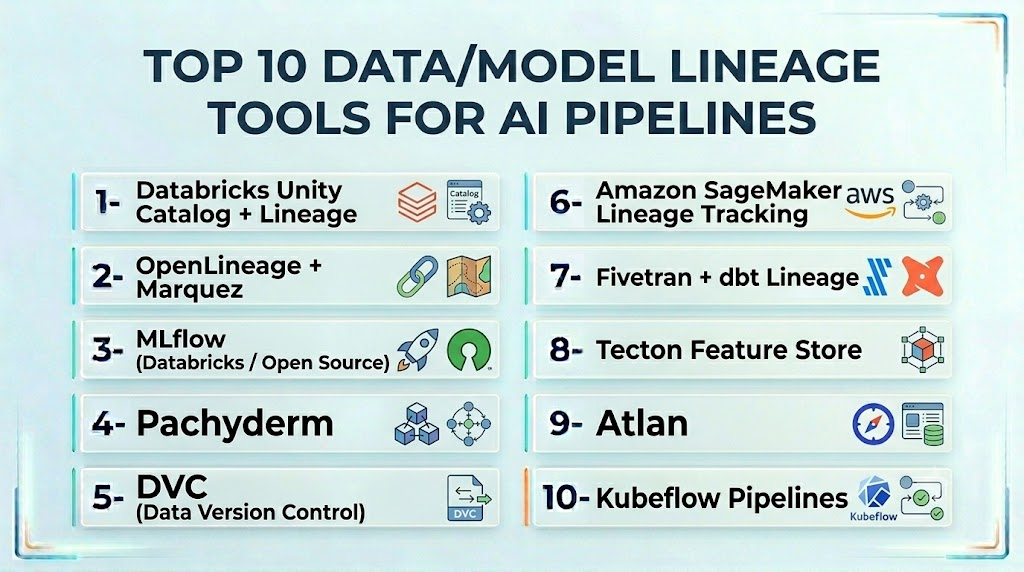
Top 10 Data/Model Lineage Tools for AI Pipelines
1- Databricks Unity Catalog + Lineage
One-line verdict: Best for enterprise-scale unified data + AI lineage in lakehouse architectures.
Short description:
Databricks Unity Catalog provides end-to-end lineage across datasets, features, notebooks, and ML models in a unified governance layer. It is widely used in data-heavy enterprises running ML and AI pipelines.
Standout Capabilities
- End-to-end data + model lineage tracking
- Table, feature, and model dependency graphs
- Integration with MLflow model registry
- Cross-workspace lineage visibility
- Automated lineage capture from pipelines
- Fine-grained access control and governance
- Support for batch and streaming pipelines
AI-Specific Depth
- Model support: MLflow-managed models + custom models
- RAG integration: Supports lakehouse + vector workflows
- Evaluation: MLflow evaluation tracking integration
- Guardrails: Governance policies via Unity Catalog
- Observability: Lineage + metrics + logs integration
Pros
- Strong unified data + AI governance
- Excellent lineage visualization
- Enterprise scalability
Cons
- Complex ecosystem dependency
- Requires Databricks adoption
Security & Compliance (Only if known)
Enterprise RBAC, audit logs, and data governance controls; certifications vary by deployment.
Deployment & Platforms
Cloud + hybrid lakehouse environments
Integrations & Ecosystem
- MLflow
- Apache Spark
- Delta Lake
- BI tools
- CI/CD pipelines
Pricing Model
Not publicly stated (enterprise usage-based)
Best-Fit Scenarios
- Enterprise data platforms
- ML + AI unified pipelines
- Regulated analytics environments
2- OpenLineage + Marquez
One-line verdict: Best open standard for vendor-neutral lineage tracking across data pipelines.
Short description:
OpenLineage is an open standard for lineage collection, while Marquez is a reference implementation for storing and visualizing lineage graphs.
Standout Capabilities
- Open lineage standard for interoperability
- Cross-tool lineage tracking
- DAG-based pipeline visualization
- Integration with Airflow and Spark
- Metadata-driven lineage capture
- Multi-system compatibility
AI-Specific Depth
- Model support: External ML system integration
- RAG integration: Limited but extensible
- Evaluation: Not built-in
- Guardrails: Not available
- Observability: Pipeline-level lineage only
Pros
- Vendor-neutral and flexible
- Strong ecosystem adoption
- Works across multiple tools
Cons
- Requires engineering setup
- Limited AI-specific features
Security & Compliance
Varies / N/A
Deployment & Platforms
Self-hosted or cloud deployment
Integrations & Ecosystem
- Apache Airflow
- Spark
- dbt
- Kubernetes pipelines
- Data warehouses
Pricing Model
Open-source
Best-Fit Scenarios
- Multi-tool data ecosystems
- Custom AI pipelines
- Platform engineering teams
3- MLflow (Databricks / Open Source)
One-line verdict: Best for model lifecycle lineage and experiment tracking.
Short description:
MLflow provides experiment tracking, model registry, and basic lineage capabilities for machine learning workflows.
Standout Capabilities
- Experiment tracking with full history
- Model registry with version lineage
- Reproducibility tracking
- Parameter and metric logging
- Pipeline integration support
AI-Specific Depth
- Model support: ML models + LLM fine-tuning workflows
- RAG integration: Limited
- Evaluation: Experiment-level evaluation tracking
- Guardrails: Not available
- Observability: Training-level lineage
Pros
- Widely adopted standard
- Strong experiment tracking
- Easy integration with ML pipelines
Cons
- Limited full pipeline lineage
- Weak real-time tracing
Security & Compliance
Varies / N/A
Deployment & Platforms
Cloud or self-hosted
Integrations & Ecosystem
- Databricks
- PyTorch
- TensorFlow
- Airflow
- CI/CD tools
Pricing Model
Open-source + enterprise options
Best-Fit Scenarios
- ML experimentation
- Model version tracking
- Research environments
4- Pachyderm
One-line verdict: Best for data versioning and reproducible ML pipelines.
Short description:
Pachyderm provides data versioning, pipeline orchestration, and lineage tracking built on containerized workflows.
Standout Capabilities
- Git-like data versioning system
- Container-based pipeline execution
- Full pipeline reproducibility
- Automated lineage tracking
- Scalable distributed processing
AI-Specific Depth
- Model support: Custom ML pipelines
- RAG integration: Limited
- Evaluation: External integration required
- Guardrails: Not available
- Observability: Pipeline-level tracking
Pros
- Strong reproducibility guarantees
- Excellent data versioning
- Kubernetes-native architecture
Cons
- Steep learning curve
- Not LLM-focused
Security & Compliance
Varies / N/A
Deployment & Platforms
Self-hosted (Kubernetes-based)
Integrations & Ecosystem
- Kubernetes
- CI/CD pipelines
- Data tools
Pricing Model
Open-source + enterprise
Best-Fit Scenarios
- Reproducible ML pipelines
- Data version control needs
- Kubernetes-native teams
5- DVC (Data Version Control)
One-line verdict: Lightweight and developer-friendly data and model versioning tool.
Short description:
DVC enables Git-like versioning for datasets, models, and pipelines, making it popular among ML engineers.
Standout Capabilities
- Git-based data versioning
- Pipeline dependency tracking
- Cloud storage integration
- Lightweight reproducibility
- Experiment tracking support
AI-Specific Depth
- Model support: ML models
- RAG integration: Limited
- Evaluation: External tools required
- Guardrails: Not available
- Observability: Basic pipeline tracking
Pros
- Simple and lightweight
- Developer-friendly
- Strong reproducibility
Cons
- Limited enterprise governance
- No real-time lineage
Security & Compliance
Varies / N/A
Deployment & Platforms
Local + cloud storage integration
Integrations & Ecosystem
- Git
- S3/GCS/Azure storage
- ML frameworks
Pricing Model
Open-source
Best-Fit Scenarios
- Small to mid ML teams
- Experiment tracking
- Dataset versioning
6- Amazon SageMaker Lineage Tracking
One-line verdict: Best for AWS-native ML lineage and pipeline tracking.
Short description:
SageMaker Lineage tracks data, features, training jobs, and models across AWS ML pipelines.
Standout Capabilities
- Automated lineage capture
- Training job tracking
- Feature and dataset tracing
- Model registry integration
- AWS-native monitoring
AI-Specific Depth
- Model support: SageMaker + BYO models
- RAG integration: AWS ecosystem dependent
- Evaluation: Basic tracking
- Guardrails: AWS policy controls
- Observability: CloudWatch integration
Pros
- Deep AWS integration
- Scalable infrastructure
- Strong automation
Cons
- AWS lock-in
- Limited cross-platform support
Security & Compliance
IAM-based access control, encryption (AWS-managed)
Deployment & Platforms
Cloud (AWS only)
Integrations & Ecosystem
- SageMaker
- S3
- CloudWatch
- Lambda
Pricing Model
Usage-based
Best-Fit Scenarios
- AWS ML pipelines
- Enterprise production models
- Scalable AI workloads
7- Fivetran + dbt Lineage
One-line verdict: Best for ELT pipelines with strong transformation lineage visibility.
Short description:
Fivetran combined with dbt provides end-to-end data pipeline and transformation lineage across modern data stacks.
Standout Capabilities
- Automated data ingestion lineage
- Transformation dependency graphs
- dbt model tracking
- Warehouse-level lineage visibility
- ELT pipeline automation
AI-Specific Depth
- Model support: External ML pipelines
- RAG integration: Indirect support
- Evaluation: Not available
- Guardrails: Not available
- Observability: Data pipeline-level
Pros
- Strong ELT visibility
- Easy integration with warehouses
- Automated lineage capture
Cons
- Not ML-native
- Limited AI-specific features
Security & Compliance
Not publicly stated
Deployment & Platforms
Cloud-based
Integrations & Ecosystem
- Snowflake
- BigQuery
- Redshift
- dbt
Pricing Model
Usage-based
Best-Fit Scenarios
- Data warehouse pipelines
- Analytics engineering
- ELT-heavy systems
8- Tecton Feature Store
One-line verdict: Best for feature-level lineage in real-time ML systems.
Short description:
Tecton provides a feature store with lineage tracking for real-time and batch ML feature pipelines.
Standout Capabilities
- Feature-level lineage tracking
- Real-time + batch feature pipelines
- Feature reuse and versioning
- Low-latency feature serving
- Data transformation tracking
AI-Specific Depth
- Model support: ML models
- RAG integration: Limited
- Evaluation: Feature-level metrics
- Guardrails: Not available
- Observability: Feature-level monitoring
Pros
- Strong real-time feature lineage
- High-performance serving
- Production-ready
Cons
- Complex setup
- Enterprise-focused
Security & Compliance
Enterprise-grade controls (varies)
Deployment & Platforms
Cloud + hybrid
Integrations & Ecosystem
- ML pipelines
- Data warehouses
- Streaming systems
Pricing Model
Enterprise subscription
Best-Fit Scenarios
- Real-time ML systems
- Feature-heavy pipelines
- Production AI systems
9- Atlan
One-line verdict: Best modern data catalog with strong lineage visualization.
Short description:
Atlan provides a collaborative data workspace with lineage tracking, metadata management, and governance features.
Standout Capabilities
- Visual lineage graphs
- Metadata cataloging
- Collaboration features
- Data asset tracking
- Policy management
AI-Specific Depth
- Model support: External ML systems
- RAG integration: Limited
- Evaluation: Not available
- Guardrails: Policy-based governance
- Observability: Metadata-level tracking
Pros
- Excellent UI/UX
- Strong collaboration features
- Easy adoption
Cons
- Not ML-native
- Limited AI evaluation features
Security & Compliance
RBAC, audit logs (enterprise features)
Deployment & Platforms
Cloud-based
Integrations & Ecosystem
- Data warehouses
- BI tools
- ETL tools
Pricing Model
Enterprise subscription
Best-Fit Scenarios
- Data governance teams
- Analytics organizations
- Metadata-heavy ecosystems
10- Kubeflow Pipelines
One-line verdict: Best open-source ML pipeline orchestration with lineage support.
Short description:
Kubeflow Pipelines provides Kubernetes-native ML workflow orchestration with lineage tracking across steps.
Standout Capabilities
- DAG-based ML pipelines
- Kubernetes-native execution
- Experiment tracking
- Pipeline reproducibility
- Component-based workflows
AI-Specific Depth
- Model support: ML models
- RAG integration: Limited
- Evaluation: External integration required
- Guardrails: Not available
- Observability: Pipeline-level tracking
Pros
- Fully open-source
- Highly scalable
- Kubernetes-native
Cons
- Complex setup
- Requires DevOps expertise
Security & Compliance
Varies / N/A
Deployment & Platforms
Self-hosted (Kubernetes)
Integrations & Ecosystem
- Kubernetes
- ML frameworks
- CI/CD tools
Pricing Model
Open-source
Best-Fit Scenarios
- Custom ML platforms
- Kubernetes environments
- Advanced ML engineering teams
Comparison Table
| Tool Name | Best For | Deployment | Model Flexibility | Strength | Watch-Out | Public Rating |
|---|---|---|---|---|---|---|
| Databricks Unity Catalog | Enterprise lineage | Cloud/Hybrid | Multi-model | Unified governance | Complexity | N/A |
| OpenLineage | Vendor-neutral lineage | Self-host | Multi-tool | Flexibility | Setup effort | N/A |
| MLflow | Model tracking | Cloud/self-host | ML models | Experiment tracking | Limited lineage | N/A |
| Pachyderm | Data versioning | Self-host | ML pipelines | Reproducibility | Learning curve | N/A |
| DVC | Lightweight ML | Local/cloud | ML models | Simplicity | Limited scale | N/A |
| SageMaker | AWS ML lineage | Cloud | Multi-model | AWS integration | Lock-in | N/A |
| Fivetran + dbt | ELT pipelines | Cloud | Data pipelines | ETL lineage | Not ML-native | N/A |
| Tecton | Feature lineage | Cloud/hybrid | ML features | Real-time features | Complex setup | N/A |
| Atlan | Data catalog | Cloud | Data systems | UI/UX | Limited ML depth | N/A |
| Kubeflow | ML pipelines | Self-host | ML models | Kubernetes scale | Complexity | N/A |
Scoring & Evaluation (Transparent Rubric)
| Tool | Core | Reliability/Eval | Guardrails | Integrations | Ease | Perf/Cost | Security/Admin | Support | Weighted Total |
|---|---|---|---|---|---|---|---|---|---|
| Databricks | 9.5 | 9 | 8 | 9.5 | 7 | 9 | 9 | 8 | 9.0 |
| OpenLineage | 8 | 7 | 5 | 9 | 8 | 8 | 7 | 7 | 7.4 |
| MLflow | 8.5 | 8 | 5 | 8 | 9 | 8 | 7 | 8 | 7.8 |
| Pachyderm | 8.5 | 8 | 6 | 8 | 6 | 8.5 | 7 | 7 | 7.6 |
| DVC | 8 | 7.5 | 5 | 7.5 | 9 | 8 | 7 | 7 | 7.4 |
| SageMaker | 9 | 8.5 | 8 | 9 | 8 | 9 | 9 | 8 | 8.7 |
| Fivetran + dbt | 8.5 | 8 | 5 | 9 | 8 | 8 | 8 | 8 | 7.9 |
| Tecton | 9 | 8.5 | 7 | 8.5 | 7 | 8.5 | 8.5 | 8 | 8.4 |
| Atlan | 8 | 7.5 | 6 | 8.5 | 9 | 8 | 8 | 8 | 7.8 |
| Kubeflow | 8.5 | 8 | 6 | 8 | 6 | 9 | 7.5 | 7 | 7.7 |
Which Data/Model Lineage Tool Is Right for You?
Solo / Freelancer
Use DVC or MLflow for lightweight versioning and reproducibility without infrastructure overhead.
SMB
MLflow and Atlan provide a balance of usability and lineage visibility.
Mid-Market
OpenLineage and Tecton offer scalable pipeline tracking and feature-level governance.
Enterprise
Databricks and AWS SageMaker dominate due to deep governance, compliance, and scalability.
Regulated industries (finance/healthcare/public sector)
Databricks, Tecton, and SageMaker provide audit-ready lineage and compliance controls.
Budget vs premium
- Budget: DVC, MLflow, OpenLineage
- Premium: Databricks, Tecton, SageMaker
Build vs buy
- Build: Kubeflow + OpenLineage stack
- Buy: Databricks, SageMaker, Atlan
Common Mistakes & How to Avoid Them
- Treating lineage as optional metadata
- Not versioning datasets consistently
- Ignoring feature-level tracking
- Missing RAG pipeline traceability
- No integration with model registry
- Poor visibility into data transformations
- Lack of real-time lineage updates
- Overcomplicating tooling stack early
- Not tracking prompt and LLM outputs
- Ignoring cross-cloud lineage challenges
- No audit-ready logging for compliance
- Weak integration between ML and data teams
- Assuming lineage tools auto-configure correctly
FAQs
1. What is data lineage in AI pipelines?
It is the tracking of data flow from raw ingestion through transformations, training, and model deployment.
It ensures reproducibility, transparency, and debugging capability.
2. Why is model lineage important?
Model lineage helps identify how a model was trained, what data influenced it, and how it evolved.
This is critical for compliance, debugging, and trust in AI systems.
3. How is AI lineage different from traditional data lineage?
AI lineage includes models, features, prompts, and inference outputs.
Traditional lineage only tracks data movement across systems.
4. Do lineage tools support LLMs?
Yes, modern tools increasingly track prompts, responses, embeddings, and RAG pipelines.
However, depth of support varies across platforms.
5. Can lineage tools track real-time pipelines?
Some platforms like Tecton and Databricks support real-time lineage tracking.
Others are primarily batch-oriented.
6. Is open-source lineage enough for enterprises?
It can be, but often requires significant engineering effort.
Enterprise tools provide compliance, governance, and automation layers.
7. What is feature lineage?
Feature lineage tracks how ML features are created, transformed, and used in training and inference.
It is essential for real-time ML systems.
8. Do lineage tools help with debugging?
Yes, they help trace errors back to data sources, transformations, or model versions.
This reduces time-to-resolution for production issues.
9. What is RAG lineage?
RAG lineage tracks retrieval sources, embeddings, and generated outputs in LLM pipelines.
It ensures grounding and traceability of generated responses.
10. Are lineage tools expensive?
Costs vary widely from open-source to enterprise SaaS pricing.
Enterprise-grade tools are typically usage-based or subscription-based.
11. Can I build my own lineage system?
Yes, using OpenLineage, MLflow, and custom logging pipelines.
However, maintenance and scalability can become complex.
12. How does lineage help with compliance?
It provides audit trails showing how data and models were used.
This is critical for regulated industries and AI accountability.
Conclusion
Data and model lineage has evolved into a foundational pillar of modern AI systems. As pipelines become more complex—with agents, multi-model routing, and real-time inference—lineage ensures transparency, trust, and control.
The best solution depends on your environment: enterprises benefit from Databricks or SageMaker, developers rely on MLflow and DVC, while platform teams often choose OpenLineage or Kubeflow for flexibility.
IGovernance
