Introduction
Experiment tracking platforms are tools that help AI and machine learning teams record, compare, and manage every run of a model training process. This includes tracking datasets, parameters, code versions, metrics, artifacts, and outputs so teams can reproduce results and improve models systematically.
experiment tracking has become a core part of LLMOps and MLOps workflows, especially because AI systems are now highly iterative, multi-model, and often involve continuous fine-tuning, RAG pipelines, and agent-based architectures. Without structured tracking, teams quickly lose visibility into what actually improved model performance.
Modern experiment tracking platforms are used for:
- Tracking model training runs and hyperparameters
- Comparing model performance across experiments
- Logging datasets, embeddings, and prompts
- Managing model versioning and reproducibility
- Supporting LLM fine-tuning and evaluation cycles
- Debugging failed training runs
- Auditing AI experiments for compliance
- Collaborating across data science and ML teams
To evaluate these tools effectively, buyers should focus on:
- Experiment reproducibility and versioning depth
- Support for ML + LLM workflows
- Integration with training frameworks (PyTorch, TensorFlow, etc.)
- Dataset and artifact tracking
- Visualization and comparison dashboards
- Scalability for large-scale runs
- Collaboration and team features
- Model registry support
- RAG and embedding tracking capabilities
- Cost, hosting, and deployment flexibility
Best for: ML engineers, data scientists, AI research teams, and enterprises building production-grade AI/LLM systems.
Not ideal for: small hobby projects, static ML models, or teams not running iterative training workflows.
What’s Changed in Experiment Tracking
- Shift from ML-only tracking → LLM + agent experiment tracking
- Native support for prompt experiments and evaluation runs
- Integration with RAG pipelines and vector embeddings
- Automatic capture of training + inference + feedback loops
- Real-time experiment dashboards instead of batch logs
- Stronger focus on cost tracking per experiment (tokens + compute)
- Built-in evaluation harnesses for hallucination and accuracy
- Versioning of datasets, prompts, and fine-tuning configs
- Multi-model experiment comparison (routing-aware experiments)
- Integrated human feedback labeling systems
- Stronger governance and auditability for enterprise AI
- Cloud + hybrid experiment reproducibility across environments
Quick Buyer Checklist
- Does it support ML + LLM experiment tracking?
- Can it log datasets, embeddings, and prompts?
- Is model versioning built-in or external?
- Does it integrate with training frameworks?
- Can it track RAG experiments and retrieval outputs?
- Does it support real-time dashboards?
- Is collaboration (team sharing, comments) supported?
- Does it track cost (GPU, tokens, API usage)?
- Can it compare experiments visually?
- Does it integrate with CI/CD or MLOps pipelines?
- Is it cloud, hybrid, or self-hosted?
- Does it support reproducibility across environments?
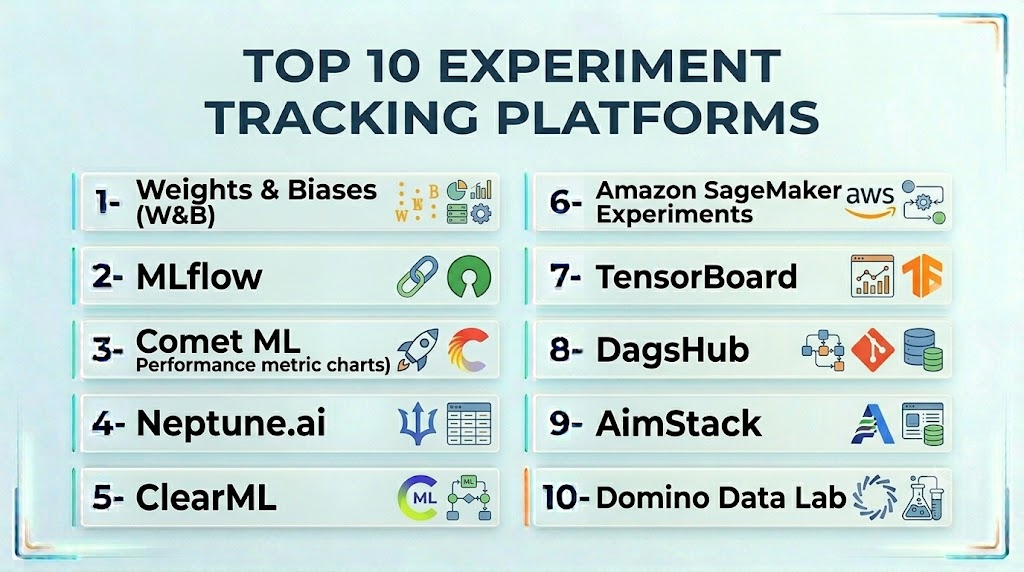
Top 10 Experiment Tracking Platforms
1- Weights & Biases (W&B)
One-line verdict: Best all-in-one experiment tracking platform for ML and LLM workflows.
Short description:
Weights & Biases is one of the most widely adopted experiment tracking tools used for logging, visualizing, and comparing machine learning experiments. It supports deep integration with training frameworks and is increasingly used for LLM evaluation and fine-tuning workflows.
Standout Capabilities
- Real-time experiment tracking dashboards
- Model performance comparison tools
- Dataset and artifact versioning
- Hyperparameter sweep automation
- Collaboration and team workspaces
- Visualization of training metrics
- Model registry integration
- LLM evaluation support
AI-Specific Depth
- Model support: ML models + LLM fine-tuning workflows
- RAG integration: Partial support via artifact logging
- Evaluation: Strong experiment + LLM evaluation tools
- Guardrails: Not available
- Observability: Training + evaluation metrics dashboards
Pros
- Extremely mature ecosystem
- Excellent visualization tools
- Strong framework integrations
Cons
- Can become expensive at scale
- Requires setup for advanced workflows
Security & Compliance
RBAC, SSO, audit logs available in enterprise plans; certifications not fully publicly stated.
Deployment & Platforms
Cloud, hybrid, and enterprise self-hosted options
Integrations & Ecosystem
- PyTorch
- TensorFlow
- Hugging Face
- CI/CD pipelines
- MLflow interoperability
Pricing Model
Freemium + usage-based + enterprise tiers
Best-Fit Scenarios
- Deep learning teams
- LLM fine-tuning workflows
- Research + production ML teams
2- MLflow
One-line verdict: Best open-source experiment tracking standard for ML pipelines.
Short description:
MLflow is a widely used open-source platform for tracking experiments, packaging models, and managing lifecycle workflows in ML systems.
Standout Capabilities
- Experiment tracking and logging
- Model registry and versioning
- Reproducibility across runs
- Parameter and metric tracking
- Pipeline integration support
- Artifact storage management
AI-Specific Depth
- Model support: ML models + LLM fine-tuning (basic)
- RAG integration: Limited
- Evaluation: Experiment-level metrics tracking
- Guardrails: Not available
- Observability: Training-focused logs
Pros
- Open-source and widely adopted
- Easy integration with ML frameworks
- Strong reproducibility support
Cons
- Limited visualization compared to modern tools
- Weak native LLM support
Security & Compliance
Varies / N/A
Deployment & Platforms
Self-hosted or cloud
Integrations & Ecosystem
- Databricks
- PyTorch
- TensorFlow
- Kubernetes
- Airflow
Pricing Model
Open-source + enterprise offerings
Best-Fit Scenarios
- ML engineering teams
- Research environments
- Pipeline-based ML workflows
3- Comet ML
One-line verdict: Strong experiment tracking and model monitoring for production ML teams.
Short description:
Comet ML provides experiment tracking, visualization, and model management tools with strong support for production workflows.
Standout Capabilities
- Experiment comparison dashboards
- Model performance tracking
- Dataset versioning support
- Real-time logging
- Hyperparameter optimization support
- Collaboration tools
AI-Specific Depth
- Model support: ML + LLM workflows
- RAG integration: Limited support
- Evaluation: Experiment-level evaluation tools
- Guardrails: Not available
- Observability: Metrics + logs
Pros
- Strong visualization capabilities
- Easy to integrate
- Good collaboration features
Cons
- Less flexible than open-source stacks
- Limited deep LLM tooling
Security & Compliance
Enterprise security features available; specifics vary
Deployment & Platforms
Cloud + hybrid
Integrations & Ecosystem
- PyTorch
- TensorFlow
- Hugging Face
- Jupyter notebooks
Pricing Model
Freemium + enterprise tiers
Best-Fit Scenarios
- Production ML teams
- Model comparison workflows
- Collaborative AI projects
4- Neptune.ai
One-line verdict: Best for structured metadata tracking and ML experiment organization.
Short description:
Neptune.ai is an experiment tracking platform focused on organizing metadata, logs, and ML experiments in structured dashboards.
Standout Capabilities
- Structured experiment logging
- Metadata organization system
- Model comparison dashboards
- Dataset tracking support
- Lightweight integration APIs
- Team collaboration features
AI-Specific Depth
- Model support: ML + limited LLM support
- RAG integration: Limited
- Evaluation: Experiment metrics tracking
- Guardrails: Not available
- Observability: Training logs and metrics
Pros
- Clean UI and organization
- Lightweight and fast
- Strong metadata handling
Cons
- Limited advanced AI features
- Not deeply LLM-native
Security & Compliance
Not publicly stated
Deployment & Platforms
Cloud + self-hosted options
Integrations & Ecosystem
- PyTorch
- TensorFlow
- Scikit-learn
- CI pipelines
Pricing Model
Freemium + paid tiers
Best-Fit Scenarios
- Structured ML experimentation
- Research teams
- Small-to-mid ML teams
5- ClearML
One-line verdict: End-to-end MLOps platform with strong experiment tracking and automation.
Short description:
ClearML combines experiment tracking, orchestration, and model deployment capabilities in a unified MLOps platform.
Standout Capabilities
- Full experiment lifecycle tracking
- Pipeline orchestration
- Model registry integration
- Auto logging of ML runs
- Dataset versioning
- Remote execution support
AI-Specific Depth
- Model support: ML + LLM workflows
- RAG integration: Limited support
- Evaluation: Experiment tracking + metrics
- Guardrails: Not available
- Observability: Full pipeline logs
Pros
- End-to-end MLOps platform
- Strong automation features
- Open-source friendly
Cons
- UI complexity
- Requires setup effort
Security & Compliance
Varies / N/A
Deployment & Platforms
Cloud + self-hosted
Integrations & Ecosystem
- Kubernetes
- CI/CD pipelines
- ML frameworks
- Cloud storage
Pricing Model
Open-source + enterprise tiers
Best-Fit Scenarios
- Full ML pipeline automation
- Enterprise ML teams
- Scalable experiment workflows
6- Amazon SageMaker Experiments
One-line verdict: Best for AWS-native experiment tracking at scale.
Short description:
SageMaker Experiments provides tracking and comparison of ML experiments within the AWS ecosystem.
Standout Capabilities
- Experiment grouping and tracking
- Training job comparison
- Integration with SageMaker pipelines
- Automatic logging of metrics
- Dataset and model linkage
AI-Specific Depth
- Model support: SageMaker + BYO models
- RAG integration: AWS ecosystem dependent
- Evaluation: Basic metrics tracking
- Guardrails: AWS policies
- Observability: CloudWatch integration
Pros
- Strong AWS integration
- Scalable infrastructure
- Automated logging
Cons
- AWS lock-in
- Limited visualization flexibility
Security & Compliance
AWS IAM, encryption, audit logging
Deployment & Platforms
Cloud (AWS only)
Integrations & Ecosystem
- SageMaker
- S3
- CloudWatch
- Lambda
Pricing Model
Usage-based
Best-Fit Scenarios
- AWS ML workloads
- Enterprise production systems
- Scalable training pipelines
7- TensorBoard
One-line verdict: Lightweight visualization tool for deep learning experiments.
Short description:
TensorBoard is a visualization tool originally built for TensorFlow that tracks metrics, graphs, and training progress.
Standout Capabilities
- Training metric visualization
- Graph visualization
- Histogram tracking
- Embedding visualization
- Simple experiment monitoring
AI-Specific Depth
- Model support: Deep learning models
- RAG integration: Not supported
- Evaluation: Basic metric tracking
- Guardrails: Not available
- Observability: Training-only
Pros
- Lightweight and fast
- Easy to use
- Free and widely adopted
Cons
- Limited experiment management
- Not suitable for LLM workflows
Security & Compliance
Varies / N/A
Deployment & Platforms
Local + cloud setups
Integrations & Ecosystem
- TensorFlow
- PyTorch (via plugins)
- Python ML stack
Pricing Model
Open-source
Best-Fit Scenarios
- Deep learning training visualization
- Small ML teams
- Research experiments
8- DagsHub
One-line verdict: Best Git-based ML experiment tracking and collaboration platform.
Short description:
DagsHub combines Git-based versioning with experiment tracking and collaboration for ML teams.
Standout Capabilities
- Git-based experiment tracking
- Dataset versioning
- Model tracking
- Collaboration tools
- CI/CD integration
- Reproducible pipelines
AI-Specific Depth
- Model support: ML models
- RAG integration: Limited
- Evaluation: Experiment-based metrics
- Guardrails: Not available
- Observability: Pipeline logs
Pros
- Strong Git integration
- Easy reproducibility
- Collaboration-friendly
Cons
- Limited advanced AI tooling
- Smaller ecosystem
Security & Compliance
Not publicly stated
Deployment & Platforms
Cloud-based
Integrations & Ecosystem
- GitHub
- ML frameworks
- CI/CD tools
Pricing Model
Freemium + paid tiers
Best-Fit Scenarios
- Git-based ML workflows
- Collaborative data science teams
- Reproducible experiments
9- AimStack
One-line verdict: Emerging open-source LLM experiment tracking and observability tool.
Short description:
AimStack focuses on lightweight tracking and observability for LLM and ML experiments.
Standout Capabilities
- Lightweight experiment logging
- LLM observability dashboards
- Open-source architecture
- Fast setup and deployment
- Metric tracking system
AI-Specific Depth
- Model support: ML + LLM experiments
- RAG integration: Limited
- Evaluation: Basic experiment metrics
- Guardrails: Not available
- Observability: Lightweight tracing
Pros
- Simple and fast
- Open-source flexibility
- LLM-friendly design
Cons
- Limited enterprise features
- Smaller ecosystem
Security & Compliance
Varies / N/A
Deployment & Platforms
Self-host or cloud
Integrations & Ecosystem
- Python ML stack
- LLM frameworks
- APIs
Pricing Model
Open-source
Best-Fit Scenarios
- LLM experiment tracking
- Startup ML teams
- Lightweight observability
10- Domino Data Lab
One-line verdict: Enterprise-grade platform for regulated ML experiment tracking and governance.
Short description:
Domino Data Lab provides enterprise MLOps capabilities including experiment tracking, governance, and reproducibility.
Standout Capabilities
- Enterprise experiment tracking
- Model lifecycle management
- Reproducible ML workflows
- Governance and compliance tools
- Collaboration features
- Infrastructure management
AI-Specific Depth
- Model support: ML + LLM workflows
- RAG integration: Limited
- Evaluation: Enterprise-level tracking
- Guardrails: Policy-based controls
- Observability: Full lifecycle monitoring
Pros
- Strong enterprise governance
- Scalable architecture
- Secure collaboration
Cons
- High complexity
- Enterprise-focused pricing
Security & Compliance
RBAC, audit logs, enterprise security controls
Deployment & Platforms
Cloud + hybrid + on-prem
Integrations & Ecosystem
- Kubernetes
- Data warehouses
- CI/CD tools
- ML frameworks
Pricing Model
Enterprise subscription
Best-Fit Scenarios
- Regulated industries
- Enterprise ML platforms
- Large-scale AI operations
Comparison Table
| Tool Name | Best For | Deployment | Model Support | Strength | Watch-Out | Public Rating |
|---|---|---|---|---|---|---|
| W&B | Deep learning + LLM tracking | Cloud/Hybrid | ML + LLM | Visualization | Cost scaling | N/A |
| MLflow | Open-source tracking | Self-host | ML models | Standardization | Limited UI | N/A |
| Comet ML | Production ML teams | Cloud/Hybrid | ML + LLM | Collaboration | LLM depth | N/A |
| Neptune.ai | Structured tracking | Cloud | ML models | Organization | Limited AI depth | N/A |
| ClearML | Full MLOps | Cloud/Self-host | ML + LLM | Automation | Complexity | N/A |
| SageMaker | AWS ML workflows | Cloud | ML models | AWS integration | Lock-in | N/A |
| TensorBoard | DL visualization | Local/Cloud | Deep learning | Simplicity | No lifecycle mgmt | N/A |
| DagsHub | Git ML workflows | Cloud | ML models | Git integration | Small ecosystem | N/A |
| AimStack | LLM tracking | Self-host | ML + LLM | Lightweight | Early-stage tool | N/A |
| Domino Data Lab | Enterprise ML | Hybrid | ML + LLM | Governance | Cost/complexity | N/A |
Scoring & Evaluation (Transparent Rubric)
| Tool | Core | Reliability/Eval | Guardrails | Integrations | Ease | Perf/Cost | Security/Admin | Support | Weighted Total |
|---|---|---|---|---|---|---|---|---|---|
| W&B | 9.5 | 9 | 7 | 9 | 8 | 8 | 8 | 9 | 8.7 |
| MLflow | 8.5 | 8 | 6 | 8.5 | 9 | 8 | 7 | 8 | 7.9 |
| Comet ML | 8.5 | 8 | 6 | 8 | 8 | 8 | 8 | 8 | 8.0 |
| Neptune.ai | 8 | 7.5 | 6 | 8 | 9 | 8 | 7 | 7 | 7.6 |
| ClearML | 9 | 8 | 7 | 8.5 | 7 | 8 | 8 | 8 | 8.1 |
| SageMaker | 9 | 8 | 7 | 9 | 8 | 9 | 9 | 8 | 8.6 |
| TensorBoard | 7.5 | 6 | 4 | 7 | 9 | 9 | 6 | 7 | 7.1 |
| DagsHub | 8 | 7 | 5 | 8 | 9 | 8 | 7 | 7 | 7.4 |
| AimStack | 7.5 | 7 | 5 | 7 | 9 | 8 | 7 | 7 | 7.3 |
| Domino Data Lab | 9 | 9 | 8 | 9 | 6 | 8 | 9 | 9 | 8.5 |
Which Experiment Tracking Platform Is Right for You?
Solo / Freelancer
TensorBoard or AimStack provides lightweight tracking without infrastructure complexity.
SMB
MLflow, Neptune.ai, or Comet ML offer balanced tracking and collaboration.
Mid-Market
Weights & Biases or ClearML support scaling experiment workflows and LLM integration.
Enterprise
Domino Data Lab or SageMaker Experiments are best for governance and scale.
Regulated industries (finance/healthcare/public sector)
Domino Data Lab and W&B Enterprise offer strong auditability and compliance readiness.
Budget vs premium
- Budget: MLflow, TensorBoard, AimStack
- Premium: W&B, Domino Data Lab, SageMaker
Build vs buy
- Build: MLflow + TensorBoard + custom logging
- Buy: W&B, Domino, Comet ML
Common Mistakes & How to Avoid Them
- Not logging datasets consistently
- Ignoring experiment reproducibility
- No model version tracking
- Missing evaluation baselines
- Over-reliance on manual tracking
- Lack of collaboration workflows
- Not tracking hyperparameters
- No cost or compute tracking
- Weak integration with CI/CD pipelines
- Ignoring LLM-specific tracking needs
- Not comparing experiments systematically
- Using too many disconnected tools
- No governance or audit trails
FAQs
1. What is experiment tracking in machine learning?
Experiment tracking is the process of recording all details of ML training runs, including data, parameters, metrics, and outputs.
It helps ensure reproducibility and performance comparison.
2. Why is experiment tracking important in 2026?
Because AI systems are complex, multi-model, and iterative, tracking ensures transparency and reliability.
It also helps manage LLM experiments and RAG pipelines.
3. Do experiment tracking tools support LLMs?
Yes, modern tools now support prompt tracking, embeddings, and evaluation metrics for LLMs.
However, depth varies by platform.
4. What is the difference between MLflow and W&B?
MLflow is open-source and lightweight, while W&B offers richer visualization and collaboration features.
W&B is more enterprise-ready.
5. Can I use open-source tools for tracking?
Yes, MLflow, AimStack, and TensorBoard are widely used open-source options.
They may require more setup effort.
6. Do these tools track RAG pipelines?
Some advanced tools support RAG tracking via embeddings and retrieval logs.
Others require custom integration.
7. Are experiment tracking tools expensive?
Costs range from free open-source tools to enterprise SaaS pricing models.
Pricing often depends on usage and scale.
8. Can I switch tracking tools later?
Yes, but migration can be complex if datasets and logs are deeply integrated.
Planning early is important.
9. Do these tools integrate with CI/CD?
Most modern platforms integrate with CI/CD pipelines for automated tracking.
This enables continuous experimentation.
10. What metrics are tracked in experiments?
Common metrics include accuracy, loss, latency, cost, and custom evaluation scores.
LLM systems also track hallucination and response quality.
11. Do these tools support real-time tracking?
Some platforms like W&B and ClearML support real-time dashboards.
Others are more batch-oriented.
12. What is the biggest mistake in experiment tracking?
The biggest mistake is not logging everything consistently from the start.
This breaks reproducibility and slows debugging.
Conclusion
Experiment tracking platforms have become essential for modern AI development, especially as systems evolve into LLM-powered, multi-model, and continuously learning architectures. Without structured tracking, teams lose visibility, reproducibility, and control over model performance.
The right choice depends on your needs: MLflow for simplicity, W&B for advanced workflows, ClearML for full MLOps, and enterprise platforms like Domino or SageMaker for governance-heavy environments.
