Introduction
As AI-powered search applications continue to evolve, organizations are discovering that neither traditional keyword search nor vector search alone can consistently deliver the best results. Keyword search excels at exact matches, filtering, and precision, while vector search shines at understanding context, meaning, and semantic relationships. Hybrid Search combines both approaches, creating a powerful retrieval system that balances accuracy, relevance, and contextual understanding.
Hybrid Search (Lexical + Vector) Tooling enables organizations to merge BM25 keyword matching, metadata filtering, semantic embeddings, reranking models, and AI-driven retrieval into a unified search experience. These platforms have become foundational components for enterprise search, Retrieval-Augmented Generation (RAG), AI agents, customer support systems, legal discovery platforms, healthcare search, and e-commerce product discovery.
In modern AI systems, hybrid retrieval often produces significantly better results than purely lexical or purely semantic approaches. As a result, hybrid search has become a standard architecture pattern for production AI applications.
Real-World Use Cases
- Enterprise knowledge search
- AI-powered customer support
- RAG applications
- Legal document discovery
- Healthcare information retrieval
- E-commerce product search
- Internal company knowledge assistants
- Research and analytics platforms
Evaluation Criteria for Buyers
When evaluating hybrid search tools, consider:
- Lexical search quality
- Vector search capabilities
- Hybrid ranking algorithms
- Real-time indexing
- Scalability
- RAG compatibility
- Observability
- Security controls
- Cost optimization
- Model flexibility
- Metadata filtering
- Deployment options
Best for: Enterprises, AI engineering teams, knowledge management initiatives, customer support organizations, SaaS companies, and businesses deploying AI assistants.
Not ideal for: Small websites requiring only basic keyword search or organizations with limited search complexity.
What’s Changed in Hybrid Search Tooling
- Hybrid retrieval becoming the default search architecture
- AI-powered reranking layers improving relevance
- Agent-based retrieval workflows
- Real-time vector indexing adoption
- Multimodal retrieval support
- Advanced retrieval evaluation frameworks
- Improved observability and tracing
- Better governance controls
- Reduced retrieval latency
- Multi-model embedding support
- Vector-native search infrastructure growth
- Automated ranking optimization
Quick Buyer Checklist
Before selecting a platform:
- Supports lexical and vector retrieval
- Includes hybrid ranking capabilities
- Works with RAG architectures
- Supports vector databases
- Provides retrieval evaluation tools
- Offers observability dashboards
- Supports enterprise security controls
- Allows metadata filtering
- Supports multimodal content
- Provides flexible deployment options
- Minimizes vendor lock-in
- Supports large-scale indexing
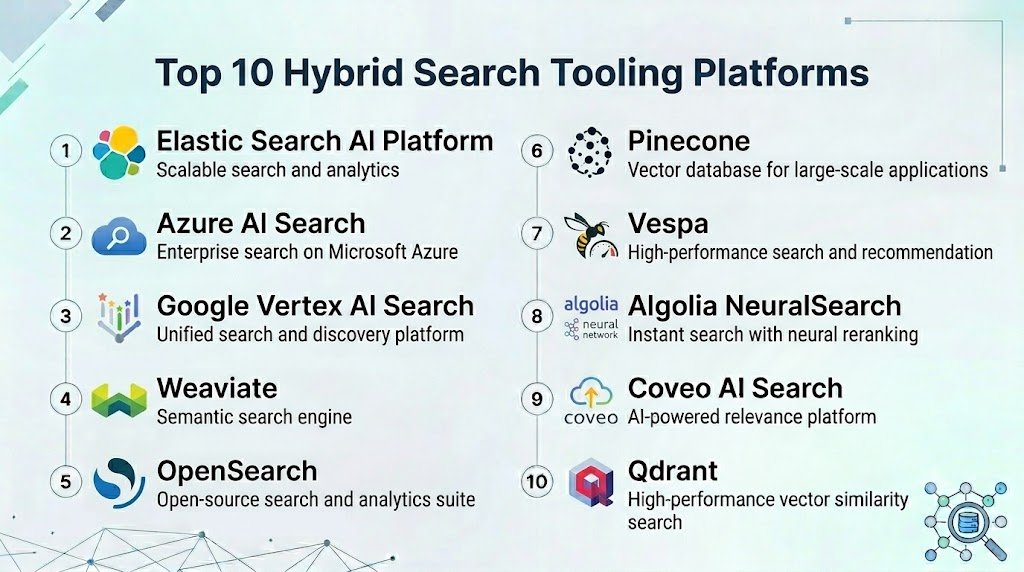
Top 10 Hybrid Search Tooling Platforms
1- Elastic Search AI Platform
One-line verdict: Best overall hybrid search platform for large-scale enterprise deployments.
Short description:
Elastic combines BM25 keyword search, vector retrieval, semantic ranking, and enterprise search capabilities into a unified platform designed for large-scale production workloads.
Standout Capabilities
- Native hybrid search
- BM25 + vector retrieval
- Semantic reranking
- Enterprise indexing
- Real-time updates
- Advanced filtering
- AI-powered relevance optimization
AI-Specific Depth
- Model support: BYO models
- RAG integration: Strong support
- Evaluation: Available through ecosystem
- Guardrails: Access controls and policies
- Observability: Comprehensive analytics
Pros
- Enterprise scalability
- Mature ecosystem
- Excellent hybrid retrieval
Cons
- Operational complexity
- Resource-intensive deployments
- Learning curve
Best-Fit Scenarios
- Enterprise search
- AI assistants
- Knowledge management
2- Azure AI Search
One-line verdict: Best for Microsoft-centric enterprises implementing AI-powered retrieval.
Short description:
Azure AI Search combines keyword retrieval, vector search, semantic ranking, and AI enrichment into a fully managed enterprise service.
Standout Capabilities
- Native hybrid retrieval
- AI enrichment
- Semantic ranking
- Enterprise security
- Vector search
- Managed infrastructure
- Azure ecosystem integration
Pros
- Enterprise-ready
- Strong governance
- Easy Microsoft integration
Cons
- Azure dependency
- Enterprise-oriented pricing
- Cloud-first approach
Best-Fit Scenarios
- Corporate search
- AI copilots
- Knowledge retrieval
3- Google Vertex AI Search
One-line verdict: Best for organizations using Google’s AI ecosystem.
Short description:
Vertex AI Search delivers hybrid retrieval across enterprise content while integrating with Google’s broader AI and machine learning infrastructure.
Standout Capabilities
- Hybrid search
- AI-powered ranking
- Multimodal retrieval
- Managed service
- Enterprise indexing
- LLM integration
- Data connectors
Pros
- Advanced AI capabilities
- Strong scalability
- Managed operations
Cons
- Google Cloud dependency
- Enterprise complexity
- Limited self-hosting
Best-Fit Scenarios
- Enterprise search
- AI assistants
- Customer support systems
4- Weaviate
One-line verdict: Best open-source hybrid search platform.
Short description:
Weaviate combines vector search, keyword retrieval, and knowledge graph concepts to create highly flexible AI search systems.
Standout Capabilities
- Hybrid search engine
- Open-source architecture
- Real-time indexing
- Knowledge graph support
- AI modules
- Flexible deployment
- Multi-tenancy
Pros
- Open-source flexibility
- Strong customization
- Excellent RAG support
Cons
- Technical complexity
- Infrastructure management
- Operational expertise required
Best-Fit Scenarios
- AI search applications
- Knowledge platforms
- Research systems
5- OpenSearch
One-line verdict: Best open-source Elastic alternative for hybrid retrieval.
Short description:
OpenSearch provides keyword search, vector search, analytics, and hybrid retrieval capabilities within a flexible open-source ecosystem.
Standout Capabilities
- Hybrid search
- Open-source platform
- Vector retrieval
- Security controls
- Analytics
- Plugin ecosystem
- Scalability
Pros
- No vendor lock-in
- Flexible deployment
- Strong community
Cons
- Operational overhead
- Optimization complexity
- Infrastructure management
Best-Fit Scenarios
- Enterprise search
- Analytics platforms
- AI retrieval systems
6- Pinecone
One-line verdict: Best vector-first platform with hybrid retrieval capabilities.
Short description:
Pinecone delivers managed vector infrastructure with hybrid retrieval features optimized for RAG and semantic search applications.
Standout Capabilities
- Managed vector search
- Hybrid retrieval
- Metadata filtering
- Real-time updates
- Scalability
- Low latency
- RAG optimization
Pros
- Easy deployment
- Excellent performance
- Minimal operations
Cons
- Vendor lock-in
- Cloud-only focus
- Less lexical customization
Best-Fit Scenarios
- AI assistants
- RAG systems
- Semantic retrieval
7- Vespa
One-line verdict: Best for advanced ranking and recommendation systems.
Short description:
Vespa combines structured search, vector retrieval, and machine learning ranking for highly demanding search applications.
Standout Capabilities
- Hybrid ranking
- Real-time serving
- Machine learning models
- Large-scale indexing
- Advanced retrieval
- Streaming updates
- Distributed architecture
Pros
- Massive scalability
- Powerful ranking
- Open-source control
Cons
- Steep learning curve
- Complex operations
- Specialized expertise needed
Best-Fit Scenarios
- Recommendation systems
- Search engines
- AI retrieval platforms
8- Algolia NeuralSearch
One-line verdict: Best for customer-facing hybrid search experiences.
Short description:
Algolia combines lexical search and semantic retrieval to enhance product discovery and customer engagement.
Standout Capabilities
- Neural retrieval
- Hybrid ranking
- Fast indexing
- Personalization
- Search analytics
- Merchandising tools
- User behavior optimization
Pros
- Easy implementation
- Excellent UX
- Fast performance
Cons
- Premium pricing
- Less flexible for custom AI
- Managed service limitations
Best-Fit Scenarios
- E-commerce search
- Product discovery
- Customer-facing applications
9- Coveo AI Search
One-line verdict: Best for customer support and workplace search.
Short description:
Coveo delivers AI-powered hybrid search and recommendations across enterprise knowledge repositories.
Standout Capabilities
- Hybrid retrieval
- AI recommendations
- Workplace search
- Customer support optimization
- Analytics
- Personalization
- Enterprise connectors
Pros
- Business-focused
- Strong personalization
- Mature platform
Cons
- Enterprise pricing
- Limited customization
- Less developer-centric
Best-Fit Scenarios
- Customer support
- Employee search
- Knowledge management
10- Qdrant
One-line verdict: Best lightweight hybrid search platform for developers.
Short description:
Qdrant provides vector search, metadata filtering, and hybrid retrieval capabilities for AI applications and RAG systems.
Standout Capabilities
- Fast vector search
- Hybrid retrieval
- Payload filtering
- Open-source
- API-first design
- Cloud and self-hosting
- Lightweight deployment
Pros
- Developer-friendly
- Cost-effective
- Easy deployment
Cons
- Smaller ecosystem
- Limited enterprise tooling
- Fewer governance features
Best-Fit Scenarios
- Startups
- AI applications
- Developer-focused projects
Comparison Table
| Tool | Best For | Deployment | Model Flexibility | Strength | Watch-Out | Public Rating |
|---|---|---|---|---|---|---|
| Elastic | Enterprise Search | Hybrid | High | Hybrid retrieval | Complexity | N/A |
| Azure AI Search | Enterprise AI | Cloud | High | Governance | Azure dependency | N/A |
| Vertex AI Search | Google AI Users | Cloud | High | AI integration | Cloud lock-in | N/A |
| Weaviate | Open-source AI | Hybrid | High | Flexibility | Complexity | N/A |
| OpenSearch | Open-source Search | Hybrid | High | Community | Operational effort | N/A |
| Pinecone | RAG Systems | Cloud | High | Performance | Vendor lock-in | N/A |
| Vespa | Large Search Platforms | Self-hosted | High | Ranking quality | Learning curve | N/A |
| Algolia | E-commerce Search | Cloud | Medium | User experience | Pricing | N/A |
| Coveo | Customer Experience | Cloud | Medium | Personalization | Enterprise focus | N/A |
| Qdrant | Developers | Hybrid | High | Simplicity | Smaller ecosystem | N/A |
Scoring & Evaluation
| Tool | Core | Reliability | Guardrails | Integrations | Ease | Performance | Security | Support | Weighted Total |
|---|---|---|---|---|---|---|---|---|---|
| Elastic | 10 | 9 | 9 | 10 | 7 | 9 | 10 | 9 | 9.2 |
| Azure AI Search | 9 | 9 | 9 | 9 | 8 | 9 | 10 | 9 | 9.0 |
| Vertex AI Search | 9 | 9 | 8 | 9 | 8 | 9 | 9 | 8 | 8.8 |
| Weaviate | 9 | 8 | 7 | 9 | 7 | 8 | 8 | 8 | 8.2 |
| OpenSearch | 8 | 8 | 8 | 8 | 7 | 8 | 9 | 8 | 8.1 |
| Pinecone | 9 | 8 | 7 | 9 | 9 | 10 | 8 | 8 | 8.7 |
| Vespa | 9 | 8 | 7 | 8 | 6 | 10 | 8 | 7 | 8.1 |
| Algolia | 8 | 8 | 7 | 8 | 10 | 9 | 8 | 8 | 8.4 |
| Coveo | 8 | 8 | 8 | 8 | 8 | 8 | 8 | 8 | 8.0 |
| Qdrant | 8 | 7 | 6 | 8 | 9 | 8 | 7 | 7 | 7.7 |
Which Hybrid Search Tool Is Right for You?
Solo / Freelancer
Qdrant and Weaviate provide affordable and flexible hybrid search capabilities.
SMB
Pinecone, Algolia, and Qdrant balance ease of use and performance.
Mid-Market
Elastic, Azure AI Search, and Vertex AI Search offer scalability and governance.
Enterprise
Elastic, Azure AI Search, and Vertex AI Search provide the strongest governance and operational maturity.
Regulated Industries
Elastic and Azure AI Search are strong options due to enterprise governance and access controls.
Budget vs Premium
Open-source platforms offer lower costs, while managed services reduce operational burden.
Build vs Buy
Build if customization and control are priorities. Buy if deployment speed and enterprise support matter more.
FAQs
1. What is hybrid search?
Hybrid search combines traditional keyword search with vector-based semantic retrieval to improve relevance.
2. Why is hybrid search important for AI applications?
It balances exact matching and contextual understanding, producing more accurate results.
3. Is hybrid search required for RAG?
While not mandatory, it often significantly improves retrieval quality.
4. What is lexical search?
Lexical search matches words and phrases directly using ranking algorithms such as BM25.
5. What is vector search?
Vector search finds semantically similar content using embeddings and similarity calculations.
6. Can hybrid search reduce hallucinations?
Yes, by improving retrieval quality and providing more relevant context to AI models.
7. What role does reranking play?
Reranking improves final result quality by refining retrieved documents.
8. Are vector databases required?
Most hybrid search systems use vector databases or vector-capable search engines.
9. Is hybrid search expensive?
Costs vary depending on infrastructure, scale, and retrieval volume.
10. Which industries benefit most?
Healthcare, legal, finance, e-commerce, customer support, and enterprise knowledge management.
11. Can hybrid search work with multimodal content?
Many modern platforms support text, images, documents, and other content types.
12. What is the biggest challenge in hybrid retrieval?
Balancing retrieval quality, latency, scalability, and operational complexity.
Conclusion
Hybrid Search tooling has become a foundational component of modern AI applications because it combines the strengths of lexical and vector retrieval into a single architecture. As organizations deploy RAG systems, AI assistants, enterprise knowledge platforms, and intelligent search experiences, hybrid retrieval consistently delivers better relevance, improved user experiences, and stronger business outcomes than either approach alone. Features such as semantic reranking, multimodal retrieval, real-time indexing, and AI observability are rapidly becoming standard requirements.
