Introduction
Data deduplication for model training refers to the process of identifying and removing duplicate or near-duplicate data from datasets used to train machine learning and AI models. This includes exact duplicates, semantic duplicates, and near-identical samples across text, images, audio, and multimodal datasets.
deduplication has become a critical step in AI pipelines because large-scale foundation models are extremely sensitive to redundant data. Duplicates can bias model behavior, inflate performance metrics, increase training cost, and reduce generalization quality. As datasets scale into billions of records, manual cleaning is impossible—deduplication tools are now essential infrastructure.
Real-world use cases include:
- Cleaning web-scale datasets for LLM pretraining
- Removing duplicate images in computer vision datasets
- Reducing redundancy in RAG knowledge bases
- Improving dataset diversity for recommendation systems
- Eliminating repeated medical or financial records for compliance and accuracy
Key evaluation criteria for buyers:
- Exact and near-duplicate detection accuracy
- Multimodal support (text, image, audio, video)
- Scalability for large datasets (TB–PB scale)
- Embedding-based semantic deduplication
- Integration with data pipelines and ML systems
- Speed and computational efficiency
- Configurable similarity thresholds
- Support for distributed processing
- Dataset versioning and lineage tracking
- API and automation support
Best for: ML engineers, data platform teams, AI research labs, and enterprises training large foundation models.
Not ideal for: Small datasets or simple rule-based systems where duplicates are easy to manage manually.
What’s Changed in Data Deduplication Tools
- Shift from exact matching to embedding-based semantic deduplication
- Use of foundation models for similarity detection
- Real-time deduplication in streaming data pipelines
- Multimodal deduplication across text, image, and video simultaneously
- Integration with vector databases for similarity search
- Distributed deduplication at petabyte scale
- Automated dataset pruning for LLM pretraining optimization
- Duplicate-aware data sampling for active learning pipelines
- Advanced clustering-based redundancy removal
- Bias reduction through duplicate-aware dataset balancing
- Cloud-native deduplication engines for large-scale AI workloads
- Continuous deduplication in data lakes and lakehouse systems
Quick Buyer Checklist
- Does it support exact and near-duplicate detection?
- Can it handle multimodal datasets?
- Does it support embedding-based similarity search?
- Is it scalable to billions of records?
- Can it integrate with ML or data pipelines?
- Does it support distributed processing?
- Is real-time deduplication available?
- Can it detect semantic duplicates (not just exact matches)?
- Does it support configurable similarity thresholds?
- Can it process streaming data?
- Does it provide dataset versioning?
- Is API automation supported?
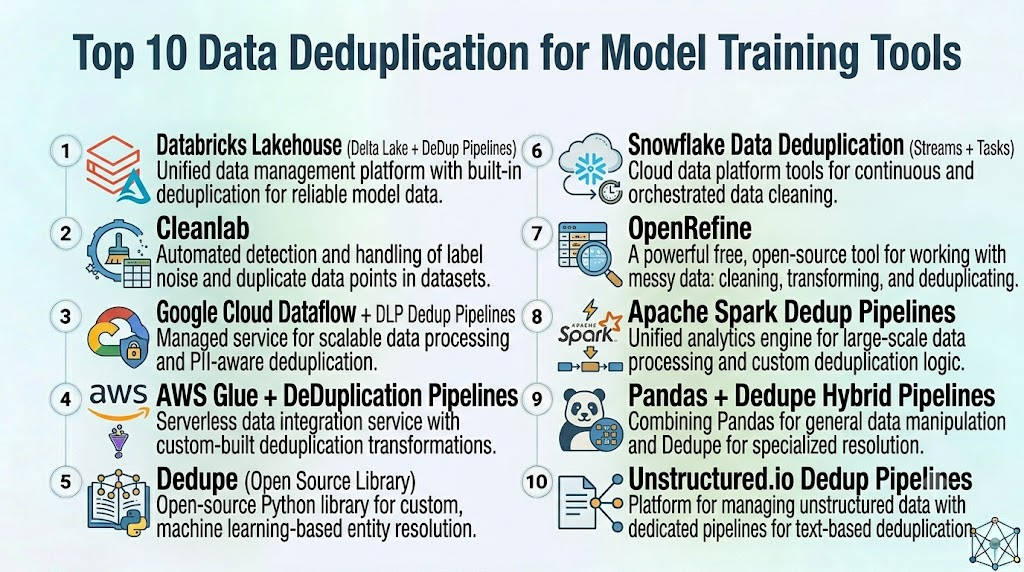
Top 10 Data Deduplication for Model Training Tools
1 — Databricks Lakehouse (Delta Lake + DeDup Pipelines)
One-line verdict: Best enterprise-scale deduplication platform integrated into lakehouse AI pipelines.
Short description:
Databricks provides scalable data deduplication capabilities through Delta Lake and Spark-based pipelines, enabling duplicate removal at massive scale for ML training datasets.
Standout Capabilities
- Distributed deduplication using Spark
- Delta Lake data versioning
- Streaming + batch dedup pipelines
- Scalable clustering-based deduplication
- Feature store integration
- Data lineage tracking
- ML-ready dataset preparation
AI-Specific Depth
- Model support: Multi-model pipelines via MLflow
- Data workflows: Batch + streaming deduplication
- Detection: Exact + clustering + embedding-based methods
- Automation: Pipeline-based dedup execution
- Observability: Full dataset lineage tracking
Pros
- Extremely scalable
- Strong enterprise integration
- Unified data + ML platform
Cons
- Requires Databricks ecosystem
- Complex setup for small teams
Security & Compliance
- Enterprise-grade IAM controls
- Data governance features included
Deployment & Platforms
- Cloud-native (AWS, Azure, GCP)
Integrations & Ecosystem
- Delta Lake
- MLflow
- Apache Spark
- Feature stores
- Data pipelines
Pricing Model
Usage-based enterprise pricing
Best-Fit Scenarios
- Large-scale LLM training datasets
- Enterprise data lakes
- Streaming AI pipelines
2 — Cleanlab
One-line verdict: Best AI-powered tool for detecting duplicates and data quality issues using model-driven signals.
Short description:
Cleanlab focuses on dataset quality improvement, including duplicate detection, mislabeled data identification, and noisy sample removal.
Standout Capabilities
- Label error detection
- Near-duplicate detection using embeddings
- Dataset quality scoring
- Noise filtering for training data
- Outlier detection
- Active data cleaning pipelines
- Model-based confidence analysis
AI-Specific Depth
- Model support: Multi-model compatible
- Data workflows: ML-driven dataset cleaning
- Detection: Embedding + confidence-based deduplication
- Automation: Semi-automated pipelines
- Observability: Data quality dashboards
Pros
- Strong AI-driven deduplication
- Improves dataset quality significantly
- Easy Python integration
Cons
- Requires ML understanding
- Not a full data platform
Security & Compliance
Not publicly stated
Deployment & Platforms
- Python library + cloud support
Integrations & Ecosystem
- PyTorch
- TensorFlow
- ML pipelines
- Data labeling tools
Pricing Model
Open-source + enterprise support
Best-Fit Scenarios
- Dataset cleaning for ML training
- LLM pretraining data optimization
- Research pipelines
3 — Google Cloud Dataflow + DLP Dedup Pipelines
One-line verdict: Best Google Cloud-native deduplication engine for large-scale structured and unstructured data.
Short description:
Google Cloud provides deduplication capabilities through Dataflow and BigQuery pipelines with support for large-scale distributed processing.
Standout Capabilities
- Distributed deduplication pipelines
- SQL-based duplicate detection
- Streaming + batch processing
- Integration with BigQuery
- Entity resolution support
- Scalable ETL pipelines
- Data transformation workflows
AI-Specific Depth
- Model support: Not model-centric
- Data workflows: Enterprise data pipelines
- Detection: Rule + SQL + clustering
- Automation: Fully pipeline-driven
- Observability: Data monitoring dashboards
Pros
- Extremely scalable
- Strong cloud integration
- Good for structured datasets
Cons
- Requires GCP ecosystem
- Less AI-native features
Security & Compliance
- Enterprise IAM controls
- Google Cloud compliance framework
Deployment & Platforms
- Google Cloud Platform only
Integrations & Ecosystem
- BigQuery
- Dataflow
- Cloud Storage
- Vertex AI pipelines
Pricing Model
Usage-based cloud pricing
Best-Fit Scenarios
- Enterprise structured datasets
- BigQuery-based ML pipelines
- Streaming data deduplication
4 — AWS Glue + DeDuplication Pipelines
One-line verdict: Best AWS-native deduplication system for data lake and ML pipelines.
Short description:
AWS Glue enables ETL-based deduplication workflows integrated with S3 and AWS ML systems.
Standout Capabilities
- ETL-based duplicate removal
- Spark-based processing
- Data catalog integration
- Streaming + batch pipelines
- Schema-based deduplication
- Data transformation jobs
- Scalable processing workflows
AI-Specific Depth
- Model support: AWS ML ecosystem
- Data workflows: ETL pipelines
- Detection: Rule + transformation-based
- Automation: Fully managed jobs
- Observability: CloudWatch integration
Pros
- Strong AWS integration
- Scalable architecture
- Flexible ETL workflows
Cons
- AWS lock-in
- Requires engineering setup
Security & Compliance
- IAM-based security controls
- AWS compliance frameworks
Deployment & Platforms
- AWS cloud-native
Integrations & Ecosystem
- S3
- Redshift
- SageMaker
- AWS Lambda
Pricing Model
Pay-as-you-go
Best-Fit Scenarios
- AWS data lakes
- ML training pipelines
- Enterprise ETL workflows
5 — Dedupe (Open Source Library)
One-line verdict: Best lightweight open-source library for probabilistic duplicate detection.
Short description:
Dedupe is a Python library designed for entity resolution and deduplication using machine learning-based similarity matching.
Standout Capabilities
- Probabilistic record linkage
- Machine learning-based deduplication
- Active learning for matching
- Custom training for similarity
- Structured data deduplication
- Entity resolution workflows
- Python-native API
AI-Specific Depth
- Model support: Custom ML models
- Data workflows: Structured datasets
- Detection: Probabilistic matching
- Automation: Semi-automated training
- Observability: Minimal logging tools
Pros
- Lightweight and flexible
- Strong entity resolution support
- Open-source
Cons
- Limited scalability for big data
- Requires manual tuning
Security & Compliance
Not publicly stated
Deployment & Platforms
- Python library
Integrations & Ecosystem
- Pandas
- SQL databases
- ML pipelines
Pricing Model
Open-source
Best-Fit Scenarios
- Small to mid-scale datasets
- Entity resolution tasks
- Research workflows
6 — Snowflake Data Deduplication (Streams + Tasks)
One-line verdict: Best cloud data warehouse-based deduplication for enterprise analytics and ML datasets.
Short description:
Snowflake provides deduplication using SQL workflows, streams, and tasks for large-scale structured data processing.
Standout Capabilities
- SQL-based deduplication
- Stream processing pipelines
- Time-travel data versioning
- Scalable query engine
- Data transformation workflows
- Structured dataset cleanup
- Automation via tasks
AI-Specific Depth
- Model support: Not model-centric
- Data workflows: Structured warehouse pipelines
- Detection: SQL-based matching
- Automation: Scheduled jobs
- Observability: Query logs and metrics
Pros
- Excellent scalability
- Easy SQL-based workflows
- Strong data governance
Cons
- Limited unstructured data support
- Requires Snowflake ecosystem
Security & Compliance
- Enterprise-grade access control
- Strong compliance framework
Deployment & Platforms
- Cloud-based (Snowflake)
Integrations & Ecosystem
- BI tools
- ML pipelines
- Data lakes
- ETL systems
Pricing Model
Usage-based warehouse pricing
Best-Fit Scenarios
- Structured enterprise datasets
- Analytics-driven ML workflows
- Data warehouse deduplication
7 — OpenRefine
One-line verdict: Best interactive tool for manual and semi-automated dataset deduplication.
Short description:
OpenRefine is a powerful open-source tool for cleaning messy datasets and identifying duplicates using clustering techniques.
Standout Capabilities
- Interactive data cleaning UI
- Clustering-based deduplication
- Faceted data exploration
- Transformation scripting
- CSV and dataset support
- Manual validation workflows
- Data reconciliation tools
AI-Specific Depth
- Model support: None
- Data workflows: Manual + structured datasets
- Detection: Clustering-based deduplication
- Automation: Limited
- Observability: Basic logs
Pros
- Easy to use
- Great for data cleaning
- Open-source
Cons
- Not scalable for large datasets
- No automation pipeline
Security & Compliance
Not publicly stated
Deployment & Platforms
- Desktop-based tool
Integrations & Ecosystem
- CSV/Excel workflows
- Data export pipelines
Pricing Model
Open-source
Best-Fit Scenarios
- Small dataset cleaning
- Research workflows
- Manual dedup tasks
8 — Apache Spark Dedup Pipelines
One-line verdict: Best distributed open-source framework for large-scale deduplication.
Short description:
Apache Spark enables distributed deduplication using scalable cluster computing for massive datasets.
Standout Capabilities
- Distributed processing engine
- Large-scale deduplication workflows
- Streaming + batch processing
- Custom similarity functions
- Clustering-based deduplication
- MLlib integration
- Scalable ETL pipelines
AI-Specific Depth
- Model support: MLlib integration
- Data workflows: Large-scale pipelines
- Detection: Rule + similarity-based
- Automation: Fully programmable pipelines
- Observability: Spark monitoring tools
Pros
- Extremely scalable
- Open-source flexibility
- Widely adopted
Cons
- Complex setup
- Requires distributed computing expertise
Security & Compliance
Depends on deployment environment
Deployment & Platforms
- Cluster-based (cloud/on-prem)
Integrations & Ecosystem
- Hadoop ecosystem
- Data lakes
- ML pipelines
Pricing Model
Open-source
Best-Fit Scenarios
- Big data ML training
- LLM dataset preprocessing
- Enterprise-scale deduplication
9 — Pandas + Dedupe Hybrid Pipelines
One-line verdict: Best lightweight hybrid approach for small-scale ML dataset deduplication.
Short description:
Combines Pandas for data manipulation and Dedupe library for probabilistic matching workflows.
Standout Capabilities
- DataFrame-based dedup workflows
- Custom similarity logic
- Lightweight ML integration
- Entity resolution support
- Fast prototyping tools
- Flexible transformation pipelines
- Simple scripting workflows
AI-Specific Depth
- Model support: Custom ML integration
- Data workflows: Small-scale datasets
- Detection: Hybrid rule + probabilistic
- Automation: Script-based
- Observability: Minimal
Pros
- Very flexible
- Easy to implement
- Great for prototyping
Cons
- Not scalable
- Requires manual tuning
Security & Compliance
Not publicly stated
Deployment & Platforms
- Local Python environment
Integrations & Ecosystem
- Pandas
- Jupyter notebooks
- ML pipelines
Pricing Model
Open-source
Best-Fit Scenarios
- Research projects
- Small dataset cleaning
- Prototype ML systems
10 — Unstructured.io Dedup Pipelines
One-line verdict: Best for deduplication in unstructured AI data pipelines.
Short description:
Unstructured.io provides data processing pipelines that include deduplication for text-heavy AI workflows like RAG and LLM training.
Standout Capabilities
- Unstructured text deduplication
- Document parsing pipelines
- Chunk-level deduplication
- Embedding-based similarity detection
- RAG pipeline integration
- API-based processing
- Data transformation workflows
AI-Specific Depth
- Model support: Embedding models
- Data workflows: LLM + RAG pipelines
- Detection: Semantic deduplication
- Automation: Pipeline-driven
- Observability: Processing logs
Pros
- Excellent for LLM workflows
- Strong text processing
- Easy API integration
Cons
- Limited structured data support
- Requires pipeline setup
Security & Compliance
Not publicly stated
Deployment & Platforms
- Cloud + API-based
Integrations & Ecosystem
- LLM pipelines
- Vector databases
- RAG systems
Pricing Model
Usage-based SaaS
Best-Fit Scenarios
- RAG dataset cleanup
- LLM pretraining pipelines
- Document processing systems
Comparison Table (Top 10)
| Tool Name | Best For | Deployment | Data Type | Strength | Watch-Out | Public Rating |
|---|---|---|---|---|---|---|
| Databricks | Big data AI | Cloud | Multimodal | Scalability | Ecosystem lock-in | N/A |
| Cleanlab | ML dataset cleaning | Hybrid | Multimodal | AI-driven dedup | ML expertise needed | N/A |
| Google Dataflow | GCP pipelines | Cloud | Structured | Distributed scale | GCP dependency | N/A |
| AWS Glue | AWS ETL workflows | Cloud | Structured | Integration | AWS lock-in | N/A |
| Dedupe | Entity resolution | Local | Structured | Probabilistic ML | Not scalable | N/A |
| Snowflake | Data warehouse | Cloud | Structured | SQL-based dedup | Limited unstructured | N/A |
| OpenRefine | Manual cleaning | Desktop | Structured | Interactive UI | No automation | N/A |
| Apache Spark | Big data dedup | Cluster | Multimodal | Distributed compute | Complexity | N/A |
| Pandas+Dedupe | Small datasets | Local | Structured | Flexibility | Not scalable | N/A |
| Unstructured.io | LLM pipelines | Cloud | Text-heavy | Semantic dedup | Limited structured | N/A |
Scoring & Evaluation (Weighted Rubric)
| Tool | Core | Accuracy | Scalability | Automation | Ease | Performance | Security | Support | Weighted Total |
|---|---|---|---|---|---|---|---|---|---|
| Databricks | 10 | 9 | 10 | 9 | 7 | 10 | 9 | 9 | 9.2 |
| Cleanlab | 9 | 9 | 9 | 8 | 8 | 8 | 8 | 8 | 8.5 |
| Google Dataflow | 10 | 9 | 10 | 9 | 7 | 9 | 9 | 9 | 9.0 |
| AWS Glue | 9 | 9 | 10 | 9 | 8 | 9 | 9 | 8 | 8.8 |
| Dedupe | 8 | 8 | 7 | 7 | 9 | 7 | 7 | 7 | 7.6 |
| Snowflake | 9 | 9 | 10 | 8 | 8 | 9 | 9 | 8 | 8.7 |
| OpenRefine | 7 | 7 | 6 | 6 | 10 | 7 | 7 | 7 | 7.0 |
| Apache Spark | 10 | 9 | 10 | 9 | 6 | 10 | 8 | 8 | 8.8 |
| Pandas+Dedupe | 7 | 7 | 6 | 6 | 9 | 7 | 7 | 7 | 7.2 |
| Unstructured.io | 8 | 9 | 8 | 9 | 8 | 8 | 8 | 8 | 8.4 |
Which Data Deduplication Tool Is Right for You?
Solo / Freelancer
OpenRefine and Pandas + Dedupe are best for small datasets and experimentation.
SMB
Cleanlab and Unstructured.io offer a good balance of automation and usability.
Mid-Market
Snowflake, AWS Glue, and Google Dataflow provide scalable structured pipelines.
Enterprise
Databricks, Apache Spark, and Snowflake dominate large-scale deduplication.
Regulated industries
Snowflake and BigQuery-based pipelines offer stronger governance.
Budget vs premium
- Budget: OpenRefine, Pandas + Dedupe
- Mid-range: Cleanlab, Unstructured.io
- Premium: Databricks, Snowflake, Spark
Build vs buy
Common Mistakes & How to Avoid Them
- Only detecting exact duplicates
- Ignoring semantic similarity
- Not scaling dedup pipelines
- Poor threshold tuning
- Removing useful near-duplicates incorrectly
- Not using embeddings for modern datasets
- Ignoring multimodal duplication
- No dataset versioning
- Not integrating with ML pipelines
- Over-cleaning datasets and losing diversity
- No monitoring of dedup effectiveness
- Running dedup only once instead of continuously
- Ignoring streaming data duplication
- Lack of reproducibility in pipelines
FAQs
1. What is data deduplication in AI?
It is the process of removing duplicate or similar data from training datasets to improve model quality.
2. Why is deduplication important for LLMs?
It prevents bias, reduces overfitting, and improves generalization in large models.
3. What types of duplicates exist?
Exact duplicates, near-duplicates, and semantic duplicates.
4. What is semantic deduplication?
It uses embeddings to detect meaning-based similarity, not just exact matches.
5. Can deduplication improve model performance?
Yes, it improves training efficiency and reduces bias.
6. Is deduplication required for all AI datasets?
Yes, especially for large-scale ML and LLM training datasets.
7. What tools are best for big data deduplication?
Databricks, Spark, and Snowflake.
8. Can deduplication be automated?
Yes, most modern tools support automated pipelines.
9. Does deduplication reduce dataset size?
Yes, sometimes significantly depending on redundancy.
10. What is the biggest challenge in deduplication?
Balancing removal of duplicates without losing important data diversity.
11. Is deduplication used in RAG systems?
Yes, to clean knowledge bases and reduce redundancy.
12. What is the future of deduplication?
It is moving toward real-time, embedding-based, multimodal deduplication systems.
Conclusion
Data deduplication is a critical step in modern AI training pipelines, especially for LLMs and large-scale multimodal systems. It improves efficiency, reduces bias, and ensures models learn from diverse and meaningful data rather than redundant patterns.
