Introduction
Data Quality & Validity tools for ML datasets are systems that help ensure machine learning data is accurate, consistent, complete, and trustworthy before it is used for training or evaluation. These platforms detect issues like missing values, label errors, schema mismatches, data drift, outliers, duplicates, and inconsistent distributions.
data quality is no longer a preprocessing step—it is a continuous AI lifecycle function. As organizations train large language models, multimodal systems, and real-time AI applications, poor-quality data directly leads to hallucinations, bias, unstable models, and costly retraining cycles.
Real-world use cases include:
- Validating training datasets for LLM pretraining pipelines
- Detecting label noise in computer vision datasets
- Monitoring data drift in production ML systems
- Ensuring consistency in financial and healthcare datasets
- Improving RAG knowledge base reliability
Key evaluation criteria for buyers:
- Data validation accuracy (schema, type, constraints)
- Support for structured and unstructured data
- Automated anomaly and outlier detection
- Data drift and distribution monitoring
- Integration with ML/MLOps pipelines
- Real-time vs batch validation capability
- Dataset versioning and lineage tracking
- Explainability of data issues
- Scalability for large datasets
- API and automation support
Best for: ML engineers, data scientists, AI platform teams, and enterprises building production-grade AI systems.
Not ideal for: Small datasets or manual analytics workflows with minimal ML usage.
What’s Changed in Data Quality Tools
- Shift from static validation rules to AI-driven data quality scoring systems
- Continuous monitoring instead of one-time dataset validation
- Integration with LLM pipelines and RAG systems
- Embedding-based anomaly detection for unstructured data
- Automated schema inference and correction suggestions
- Real-time data validation in streaming pipelines
- Deep integration with feature stores and vector databases
- Drift detection using foundation model embeddings
- Data observability replacing traditional data validation
- Self-healing data pipelines with automated correction
- Multimodal validation (text, image, audio, video)
- Governance-aware validation for compliance-heavy industries
Quick Buyer Checklist
- Does it support both structured and unstructured data?
- Can it detect schema violations automatically?
- Does it support real-time data validation?
- Can it integrate with ML pipelines and feature stores?
- Does it provide drift detection capabilities?
- Is anomaly detection AI-based or rule-based?
- Can it handle multimodal datasets?
- Does it support dataset versioning?
- Is explainability available for detected issues?
- Can it scale to large enterprise datasets?
- Does it support API-based automation?
- Does it provide data quality scoring metrics?
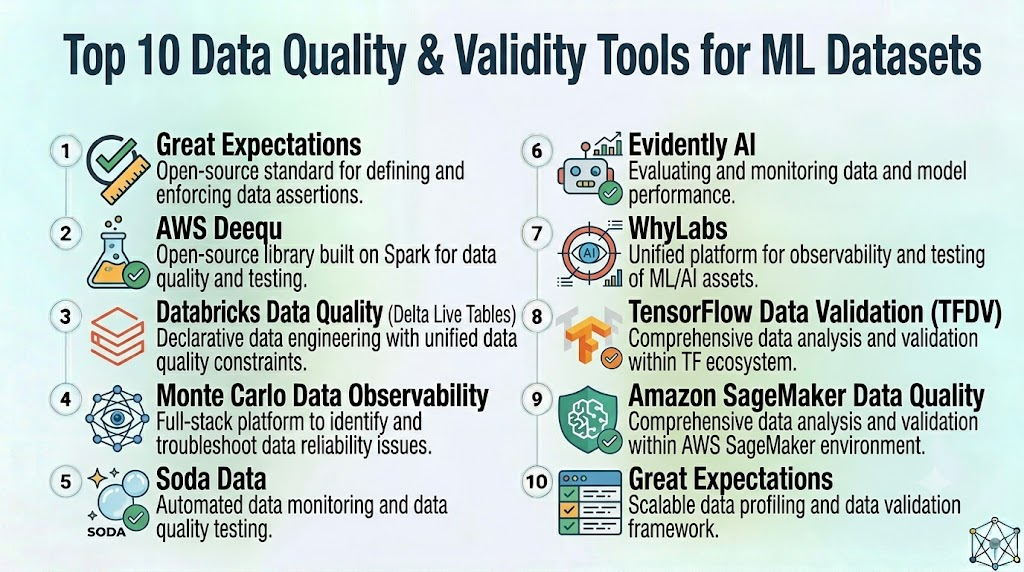
Top 10 Data Quality & Validity Tools for ML Datasets
1 — Great Expectations
One-line verdict: Best open-source framework for defining and enforcing data quality expectations in ML pipelines.
Short description:
Great Expectations helps teams define “expectations” for data quality and automatically validate datasets against them in ML workflows.
Standout Capabilities
- Rule-based data validation framework
- Automated data quality checks
- Schema and type validation
- Data profiling and reporting
- CI/CD pipeline integration
- Great Expectations Suite for testing datasets
- Custom expectation creation
AI-Specific Depth
- Model support: Not model-dependent
- Data workflows: Structured ML pipelines
- Validation: Rule + expectation-based checks
- Automation: CI/CD validation support
- Observability: Data quality reports
Pros
- Highly flexible and customizable
- Strong open-source community
- Easy integration with ML pipelines
Cons
- Requires engineering setup
- Not AI-native for unstructured data
Security & Compliance
Not publicly stated
Deployment & Platforms
- Python library
- Cloud and self-hosted deployments
Integrations & Ecosystem
- Apache Airflow
- Spark
- dbt
- ML pipelines
Pricing Model
Open-source + enterprise support
Best-Fit Scenarios
- Data validation in ML pipelines
- CI/CD dataset testing
- Structured dataset governance
2 — AWS Deequ
One-line verdict: Best scalable data quality validation framework for Spark-based big data pipelines.
Short description:
Deequ is an AWS library built on Apache Spark for defining and validating data quality constraints at scale.
Standout Capabilities
- Distributed data validation on Spark
- Constraint-based data checks
- Data profiling and metrics
- Large-scale dataset validation
- Automated anomaly detection
- Statistical validation rules
- Integration with AWS ecosystems
AI-Specific Depth
- Model support: Not model-specific
- Data workflows: Big data ML pipelines
- Validation: Constraint + statistical checks
- Automation: Spark-based automation
- Observability: Metrics reporting
Pros
- Extremely scalable
- Ideal for big data environments
- Strong AWS integration
Cons
- Requires Spark expertise
- Limited support for unstructured data
Security & Compliance
Not publicly stated
Deployment & Platforms
- Apache Spark-based
- AWS ecosystem compatible
Integrations & Ecosystem
- AWS Glue
- S3
- Spark ML pipelines
- EMR clusters
Pricing Model
Open-source
Best-Fit Scenarios
- Enterprise big data validation
- ML pipelines at scale
- AWS-based data systems
3 — Databricks Data Quality (Delta Live Tables)
One-line verdict: Best enterprise-grade data quality system integrated into lakehouse ML pipelines.
Short description:
Databricks provides built-in data quality validation and monitoring through Delta Live Tables and lakehouse architecture.
Standout Capabilities
- Streaming and batch data validation
- Schema enforcement and evolution
- Data quality rules engine
- Real-time pipeline monitoring
- Built-in anomaly detection
- Data lineage tracking
- ML-ready dataset validation
AI-Specific Depth
- Model support: MLflow integration
- Data workflows: Lakehouse pipelines
- Validation: Rule + statistical validation
- Automation: Real-time pipeline enforcement
- Observability: Full data lineage tracking
Pros
- Highly scalable
- Unified data + ML platform
- Strong real-time capabilities
Cons
- Requires Databricks ecosystem
- Complex for small teams
Security & Compliance
- Enterprise IAM controls
- Governance features included
Deployment & Platforms
- Cloud-native (AWS, Azure, GCP)
Integrations & Ecosystem
- Delta Lake
- MLflow
- Feature stores
- Spark pipelines
Pricing Model
Usage-based enterprise pricing
Best-Fit Scenarios
- Large-scale ML pipelines
- Real-time data validation
- Enterprise lakehouse systems
4 — Monte Carlo Data Observability
One-line verdict: Best AI-driven data observability platform for detecting data quality issues in production.
Short description:
Monte Carlo provides automated data observability to detect anomalies, data breaks, and quality issues in real time.
Standout Capabilities
- Automated anomaly detection
- Data pipeline monitoring
- Schema change detection
- Data freshness tracking
- Incident alerting system
- Root cause analysis tools
- Pipeline health scoring
AI-Specific Depth
- Model support: Not model-dependent
- Data workflows: Production data pipelines
- Validation: AI-driven anomaly detection
- Automation: Fully automated monitoring
- Observability: Deep pipeline visibility
Pros
- Strong real-time monitoring
- Reduces data downtime
- Easy integration with data stacks
Cons
- Premium pricing
- Limited customization for rules
Security & Compliance
Not publicly stated
Deployment & Platforms
- Cloud-based SaaS platform
Integrations & Ecosystem
- Snowflake
- BigQuery
- dbt
- Airflow
Pricing Model
Enterprise subscription
Best-Fit Scenarios
- Production ML pipelines
- Data observability systems
- Enterprise analytics platforms
5 — Soda Data
One-line verdict: Best developer-friendly data quality platform with flexible rule-based validation.
Short description:
Soda provides data quality monitoring and validation through SQL-based rules and automated checks.
Standout Capabilities
- SQL-based data quality checks
- Real-time monitoring dashboards
- Anomaly detection system
- Data profiling tools
- Pipeline integration
- Alerting system for issues
- Open-source core version
AI-Specific Depth
- Model support: Not model-specific
- Data workflows: Structured pipelines
- Validation: Rule + anomaly-based
- Automation: Pipeline integration
- Observability: Data quality dashboards
Pros
- Easy SQL-based rules
- Developer-friendly
- Flexible deployment
Cons
- Limited unstructured data support
- Requires tuning for accuracy
Security & Compliance
Not publicly stated
Deployment & Platforms
- Cloud + self-hosted
Integrations & Ecosystem
- Snowflake
- dbt
- BigQuery
- Airflow
Pricing Model
Open-source + enterprise tier
Best-Fit Scenarios
- SQL-based data pipelines
- ML dataset validation
- Data engineering workflows
6 — Evidently AI
One-line verdict: Best tool for monitoring ML data quality, drift, and dataset validity.
Short description:
Evidently AI focuses on data quality monitoring for ML models, including drift detection and dataset validation.
Standout Capabilities
- Data drift detection
- Model performance monitoring
- Dataset validation reports
- Feature distribution analysis
- ML pipeline integration
- Custom data checks
- Visualization dashboards
AI-Specific Depth
- Model support: Multi-model ML pipelines
- Data workflows: ML datasets
- Validation: Drift + statistical validation
- Automation: Monitoring pipelines
- Observability: Model + data dashboards
Pros
- Strong ML focus
- Easy integration
- Good visualization tools
Cons
- Not full enterprise governance platform
- Requires setup for large systems
Security & Compliance
Not publicly stated
Deployment & Platforms
- Python library + cloud options
Integrations & Ecosystem
- ML pipelines
- Jupyter notebooks
- Data platforms
- APIs
Pricing Model
Open-source + enterprise support
Best-Fit Scenarios
- ML model monitoring
- Dataset drift tracking
- RAG and LLM pipelines
7 — WhyLabs
One-line verdict: Best AI-native observability platform for data quality and ML monitoring.
Short description:
WhyLabs provides continuous monitoring of data quality, drift, and ML model behavior.
Standout Capabilities
- Real-time data monitoring
- Drift detection engine
- Feature-level validation
- Data quality scoring
- Anomaly detection alerts
- ML pipeline integration
- Privacy-preserving observability
AI-Specific Depth
- Model support: Multi-model pipelines
- Data workflows: Production ML systems
- Validation: Statistical + ML-based checks
- Automation: Continuous monitoring
- Observability: Full ML observability stack
Pros
- Strong real-time monitoring
- Privacy-focused architecture
- Scalable platform
Cons
- Enterprise pricing
- Requires integration setup
Security & Compliance
- Privacy-first design
- RBAC support
- Certifications: Not publicly stated
Deployment & Platforms
- Cloud-based platform
Integrations & Ecosystem
- Data pipelines
- ML systems
- Feature stores
- APIs
Pricing Model
Enterprise SaaS
Best-Fit Scenarios
- Production ML systems
- Real-time AI monitoring
- Enterprise data observability
8 — TensorFlow Data Validation (TFDV)
One-line verdict: Best open-source tool for ML dataset validation in TensorFlow pipelines.
Short description:
TFDV helps analyze, validate, and monitor ML datasets before training models.
Standout Capabilities
- Schema inference
- Data statistics generation
- Anomaly detection
- Skew and drift analysis
- Integration with TF pipelines
- Dataset comparison tools
- Visualization support
AI-Specific Depth
- Model support: TensorFlow-based models
- Data workflows: ML training datasets
- Validation: Statistical validation engine
- Automation: Pipeline integration
- Observability: Dataset reports
Pros
- Strong ML integration
- Free and open-source
- Good for TensorFlow users
Cons
- Limited outside TensorFlow ecosystem
- Less enterprise tooling
Security & Compliance
Not publicly stated
Deployment & Platforms
- Python library
Integrations & Ecosystem
- TensorFlow
- ML pipelines
- Jupyter notebooks
Pricing Model
Open-source
Best-Fit Scenarios
- TensorFlow ML pipelines
- Dataset validation workflows
- Research environments
9 — Amazon SageMaker Data Quality
One-line verdict: Best AWS-native data quality validation system for ML pipelines.
Short description:
SageMaker provides built-in data quality monitoring and validation for ML datasets in AWS environments.
Standout Capabilities
- Data validation in pipelines
- Feature drift detection
- Schema enforcement
- Automated monitoring jobs
- Data quality reports
- Integration with training workflows
- Scalable validation pipelines
AI-Specific Depth
- Model support: SageMaker models
- Data workflows: ML training pipelines
- Validation: ML + statistical checks
- Automation: Fully managed jobs
- Observability: AWS monitoring tools
Pros
- Strong AWS integration
- Scalable infrastructure
- Easy pipeline integration
Cons
- AWS lock-in
- Limited customization
Security & Compliance
- AWS enterprise security framework
- IAM-based controls
Deployment & Platforms
- AWS cloud-native
Integrations & Ecosystem
- S3
- SageMaker
- AWS Glue
- CloudWatch
Pricing Model
Usage-based AWS pricing
Best-Fit Scenarios
- AWS ML pipelines
- Enterprise data validation
- Production AI systems
10 — Great Expectations
One-line verdict: Best open-source framework for defining and enforcing dataset expectations.
Short description:
Great Expectations allows teams to define rules (“expectations”) and validate datasets against them.
Standout Capabilities
- Rule-based validation system
- Data profiling tools
- Schema validation
- CI/CD integration
- Data quality reporting
- Custom expectation creation
- Pipeline validation support
AI-Specific Depth
- Model support: Not model-dependent
- Data workflows: Structured datasets
- Validation: Rule-based checks
- Automation: CI/CD pipelines
- Observability: Validation reports
Pros
- Highly flexible
- Strong open-source ecosystem
- Easy to integrate
Cons
- Requires engineering effort
- Limited real-time monitoring
Security & Compliance
Not publicly stated
Deployment & Platforms
- Python library
- Cloud or self-hosted
Integrations & Ecosystem
- Airflow
- dbt
- Spark
- ML pipelines
Pricing Model
Open-source + enterprise support
Best-Fit Scenarios
- Data validation pipelines
- ML dataset testing
- CI/CD data workflows
Comparison Table (Top 10)
| Tool Name | Best For | Deployment | Validation Type | Strength | Watch-Out | Public Rating |
|---|---|---|---|---|---|---|
| Great Expectations | Rule-based validation | Hybrid | Rule-based | Flexibility | Setup effort | N/A |
| AWS Deequ | Big data validation | Spark | Statistical | Scalability | Complexity | N/A |
| Databricks | Lakehouse ML pipelines | Cloud | Hybrid | Unified platform | Lock-in | N/A |
| Monte Carlo | Observability | Cloud | AI-driven | Real-time alerts | Cost | N/A |
| Soda Data | SQL validation | Hybrid | Rule + anomaly | Simplicity | Limited unstructured | N/A |
| Evidently AI | ML monitoring | Hybrid | Drift-based | ML focus | Not enterprise-ready | N/A |
| WhyLabs | ML observability | Cloud | AI-driven | Real-time monitoring | Pricing | N/A |
| TFDV | TensorFlow ML | Local | Statistical | TF integration | Ecosystem limit | N/A |
| SageMaker | AWS ML pipelines | AWS cloud | Hybrid | Integration | AWS lock-in | N/A |
| Great Expectations | Data testing | Hybrid | Rule-based | Flexibility | Manual setup | N/A |
Scoring & Evaluation (Weighted Rubric)
| Tool | Core | Accuracy | Automation | Integrations | Ease | Performance | Security | Support | Weighted Total |
|---|---|---|---|---|---|---|---|---|---|
| Great Expectations | 9 | 9 | 8 | 9 | 9 | 8 | 8 | 8 | 8.6 |
| AWS Deequ | 9 | 9 | 9 | 9 | 7 | 9 | 9 | 8 | 8.8 |
| Databricks | 10 | 9 | 10 | 10 | 7 | 10 | 9 | 9 | 9.2 |
| Monte Carlo | 9 | 10 | 10 | 9 | 8 | 9 | 9 | 9 | 9.0 |
| Soda Data | 8 | 8 | 8 | 8 | 9 | 8 | 8 | 8 | 8.1 |
| Evidently AI | 8 | 9 | 8 | 8 | 8 | 8 | 8 | 8 | 8.2 |
| WhyLabs | 9 | 10 | 10 | 9 | 8 | 9 | 9 | 9 | 9.0 |
| TFDV | 8 | 8 | 7 | 8 | 9 | 8 | 7 | 7 | 7.8 |
| SageMaker | 9 | 9 | 9 | 9 | 8 | 9 | 9 | 8 | 8.8 |
| Great Expectations | 9 | 9 | 8 | 9 | 9 | 8 | 8 | 8 | 8.6 |
Which Data Quality Tool Is Right for You?
Solo / Freelancer
Great Expectations and Evidently AI provide lightweight validation capabilities.
SMB
Soda Data and Evidently AI offer balanced usability and automation.
Mid-Market
Monte Carlo, AWS Deequ, and SageMaker provide scalable validation systems.
Enterprise
Databricks, WhyLabs, and Monte Carlo dominate enterprise-grade data quality.
Regulated industries
SageMaker, Databricks, and WhyLabs provide stronger governance and compliance support.
Budget vs premium
- Budget: Great Expectations, TFDV
- Mid-range: Evidently AI, Soda Data
- Premium: Databricks, WhyLabs, Monte Carlo
Common Mistakes & How to Avoid Them
- Treating data validation as a one-time task
- Ignoring unstructured data quality
- Not monitoring drift over time
- Over-reliance on rule-based systems
- Poor integration with ML pipelines
- No dataset versioning
- Missing real-time validation
- Ignoring schema evolution
- Not tracking data quality metrics
- Lack of observability tools
- No automated alerting
- Ignoring multimodal datasets
- Overcomplicating validation rules
- Not connecting data quality to model performance
FAQs
1. What is data quality in ML?
It refers to how accurate, complete, and consistent a dataset is for training machine learning models.
2. Why is data quality important for AI?
Poor data quality leads to biased, inaccurate, and unreliable models.
3. What is data validity?
It ensures data conforms to defined rules, schemas, and expected formats.
4. What is data drift?
It occurs when data distribution changes over time, affecting model performance.
5. Can data quality tools work in real time?
Yes, many modern platforms support streaming validation.
6. Do these tools support unstructured data?
Some advanced tools support text, images, and multimodal datasets.
7. What is anomaly detection in data quality?
It identifies unusual patterns or values in datasets.
8. Are open-source tools enough?
They are useful but often require enterprise tools for scaling.
9. What industries need data quality tools most?
Finance, healthcare, retail, and AI/ML industries.
10. Can these tools integrate with ML pipelines?
Yes, most provide APIs and pipeline integrations.
11. What is dataset validation?
It is the process of checking datasets for errors, inconsistencies, or violations before training.
12. What is the future of data quality tools?
They are moving toward AI-driven, real-time, self-healing data pipelines.
Conclusion
Data Quality & Validity tools are foundational for building reliable AI systems. As datasets grow larger and more complex, ensuring clean, consistent, and validated data becomes essential for model accuracy and trustworthiness.
No single tool fits all use cases. Great Expectations and Evidently AI are ideal for flexible workflows, while Databricks, Monte Carlo, and WhyLabs dominate enterprise-scale observability and validation.
