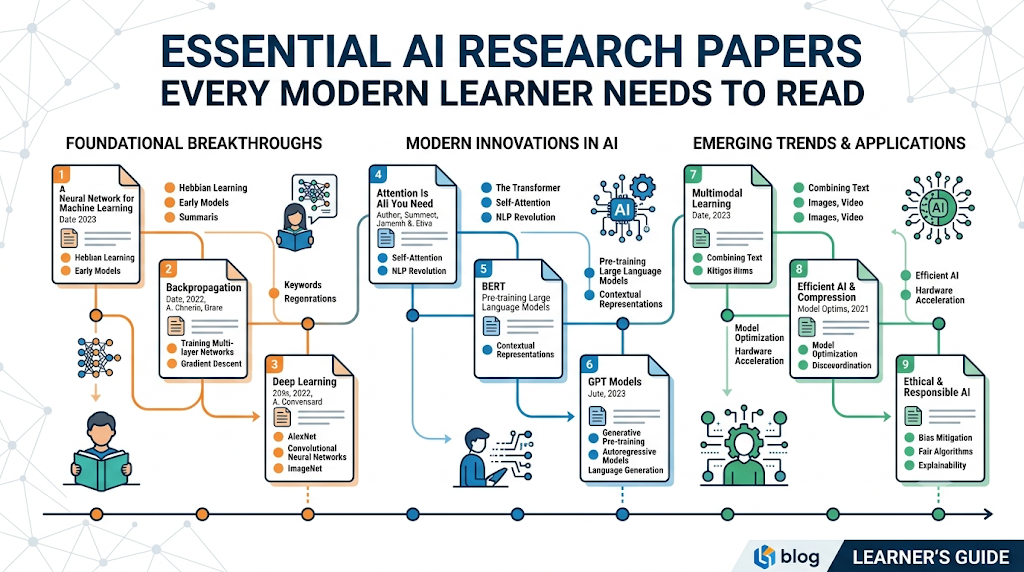
The rapid evolution of artificial intelligence can feel overwhelming. Every week, new models break benchmarks, and applications change how we live and work. However, almost every breakthrough we see today—from smart chatbots to autonomous vehicles—didn’t appear out of nowhere. They originated in academic labs and research papers. Reading these original documents is one of the single best ways to understand how modern AI works. By looking at the foundational blueprints, you see past the hype and learn the mechanics of the code. If you want to build a deep understanding of artificial intelligence, going back to the source text is the ultimate cheat code. You can explore more educational resources and deep dives directly on AIUniverse.xyz.
Why AI Research Papers Matter
Academic papers are the true fuel behind technological breakthroughs. They act as open-source blueprints for global innovation.
- Advancing AI Innovation: Research papers allow scientists to build directly on top of each other’s work instead of reinventing the wheel.
- Building Foundational Knowledge: Code frameworks change rapidly, but the core mathematical concepts and architectures found in papers remain relevant for decades.
- Solving Real-World Problems: Papers offer structural solutions to massive hurdles, such as training efficiency, image degradation, and text understanding.
- Supporting New AI Applications: Technologies like facial recognition, text generation, and automated medical diagnosis started as raw ideas in academic publications.
- Helping Learners Stay Current: Reading research keeps you ahead of the curve, exposing you to industry-shifting paradigms months before they become mainstream commercial tools.
How to Read AI Research Papers as a Beginner
Approaching an academic document can feel intimidating, especially when it is packed with complex Greek letters and dense academic jargon. The trick is realizing that you do not need to read a paper linearly like a novel. Here is a beginner-friendly approach:
- Start with the Abstract: The abstract is a quick summary. Read it to understand what the authors tried to build, how they did it, and their core findings. If it matches your interests, keep going.
- Understand the Problem: Skip to the introduction and problem statement. Figure out exactly what bottleneck in artificial intelligence the authors wanted to fix.
- Read Diagrams First: A picture is worth a thousand equations. Look closely at the structural diagrams, charts, and architectural maps. They usually give you a visual mental model of how data flows through the system.
- Focus on the Conclusion: Jump straight to the end. Read the conclusion and results section to see how well the new method performed compared to older techniques.
- Ignore Complex Mathematics Initially: Do not let long formulas stop you. Skip the heavy math on your first read. Focus entirely on the conceptual logic. You can always return to the equations once you understand the big picture.
- Read Supporting Articles if Needed: If a concept remains unclear, look for breakdown articles, YouTube explainers, or open-source code repositories that implement the paper.
Top AI Research Papers to Read
1. ImageNet Classification with Deep Convolutional Neural Networks (AlexNet)
- Publication Year: 2012
- Authors: Alex Krizhevsky, Ilya Sutskever, Geoffrey E. Hinton
- Research Problem: Computers were incredibly bad at recognizing objects inside digital images because traditional algorithms couldn’t handle complex visual patterns.
- Key Contribution: The authors built a deep Convolutional Neural Network (CNN) and trained it using Graphics Processing Units (GPUs) to accelerate computing speeds drastically.
- Why It Became Influential: It absolutely dominated the 2012 ImageNet competition, cutting the error rate in half and proving to the world that deep learning actually worked.
- Real-World Impact: This single paper ignited the modern deep learning boom, laying the groundwork for facial recognition, medical imaging, and photo tagging.
- Who Should Read It: Anyone interested in computer vision and the history of neural networks.
2. Sequence to Sequence Learning with Neural Networks (Seq2Seq)
- Publication Year: 2014
- Authors: Ilya Sutskever, Oriol Vinyals, Quoc V. Le
- Research Problem: Standard neural networks couldn’t map an input sequence of varying length (like a sentence in French) to an output sequence of a different length (like the same sentence in English).
- Key Contribution: Introduced an encoder-decoder framework using Recurrent Neural Networks (RNNs). One network reads the input into a fixed vector, and a second network decodes that vector into a new output.
- Why It Became Influential: It completely redesigned machine translation, breaking away from rigid phrase-based word matching.
- Real-World Impact: This architecture directly upgraded Google Translate, moving it closer to fluid, natural human language processing.
- Who Should Read It: Language enthusiasts and engineers building text-processing software.
3. Generative Adversarial Networks (GANs)
- Publication Year: 2014
- Authors: Ian Goodfellow et al.
- Research Problem: Neural Networks were excellent at analyzing existing data, but they struggled significantly to generate realistic new data from scratch.
- Key Contribution: Introduced a system of two competing networks: a Generator (which tries to create fake data) and a Discriminator (which tries to guess if the data is real or fake). They train together, making each other smarter.
- Why It Became Influential: It introduced an entirely new paradigm for unsupervised learning and creative AI generation.
- Real-World Impact: Enabled deepfakes, realistic digital art generation, video game upscaling, and synthetic medical data creation.
- Who Should Read It: Creative developers and researchers working on generative systems.
4. Deep Residual Learning for Image Recognition (ResNet)
- Publication Year: 2015
- Authors: Kaiming He, Xiangyu Zhang, Shaoqing Ren, Jian Sun
- Research Problem: As researchers tried to make neural networks deeper by adding more layers, the networks became incredibly difficult to train due to mathematical signals fading away (vanishing gradients).
- Key Contribution: Introduced “skip connections” (or residual blocks) that allow information to bypass certain layers, preventing mathematical signal degradation.
- Why It Became Influential: It won major vision competitions and allowed networks to scale to over 100 or even 1000 layers deep without failing.
- Real-World Impact: ResNet became the standard architectural backbone for almost all modern computer vision models.
- Who Should Read It: Computer vision engineers and deep learning students.
5. Attention Is All You Need
- Publication Year: 2017
- Authors: Ashish Vaswani et al.
- Research Problem: Older recurrent models analyzed text word-by-word, making them incredibly slow and terrible at remembering long contexts.
- Key Contribution: Abandoned recurrence entirely and introduced the Transformer architecture, which relies on a self-attention mechanism to analyze entire sentences simultaneously.
- Why It Became Influential: It represents the single biggest architectural shift in modern AI history, offering unprecedented speed and text understanding.
- Real-World Impact: The absolute foundation behind every major modern system, including ChatGPT, Claude, Gemini, and advanced search algorithms.
- Who Should Read It: Mandatory reading for anyone working in artificial intelligence.
6. BERT: Pre-training of Deep Bidirectional Transformers for Language Understanding
- Publication Year: 2018
- Authors: Jacob Devlin, Ming-Wei Chang, Kenton Lee, Kristina Toutanova
- Research Problem: AI models processed text strictly left-to-right or right-to-left, missing out on context clues that rely on looking at both sides of a word simultaneously.
- Key Contribution: Used the Transformer architecture to read sentences in both directions at once, training the model to predict hidden words in text sequences.
- Why It Became Influential: It set new records for reading comprehension and showed the immense power of fine-tuning large pre-trained models.
- Real-World Impact: Revolutionized web search engines, helping platforms like Google better understand conversational queries.
- Who Should Read It: NLP engineers and search technology developers.
7. Language Models are Few-Shot Learners (GPT-3)
- Publication Year: 2020
- Authors: Tom B. Brown et al.
- Research Problem: AI models had to be carefully retrained and fine-tuned for every single specific task you wanted them to perform.
- Key Contribution: Demonstrated that scaling up a basic Transformer model to 175 billion parameters allows it to perform completely new tasks simply by showing it a few text examples (few-shot learning).
- Why It Became Influential: It shifts the AI landscape away from narrow, task-specific models toward massive, general-purpose systems.
- Real-World Impact: Sparked the global corporate race toward generative AI software, content creation engines, and complex coding assistants.
- Who Should Read It: Business innovators, software engineers, and machine learning architects.
8. Learning Transferable Visual Models From Natural Language Supervision (CLIP)
- Publication Year: 2021
- Authors: Alec Radford et al.
- Research Problem: Computer vision models were confined to narrow categories; an image classifier trained on cats couldn’t identify a car without being fully rebuilt.
- Key Contribution: Taught an AI system to connect images with natural language descriptions, allowing it to correctly identify objects it had never explicitly seen in a targeted training set.
- Why It Became Influential: It bridged the gap between vision and language, providing a massive leap forward for multimodal systems.
- Real-World Impact: Serves as the vital matching engine behind text-to-image generators like Stable Diffusion and DALL-E.
- Who Should Read It: Developers building multimodal tools or search systems.
9. Training Language Models to Follow Instructions with Human Feedback (InstructGPT)
- Publication Year: 2022
- Authors: Long Ouyang et al.
- Research Problem: Raw base language models were excellent at completing text patterns but terrible at taking explicit commands, often generating harmful or unhelpful gibberish.
- Key Contribution: Used Reinforcement Learning from Human Feedback (RLHF) to align language model outputs with human intent and safety preferences.
- Why It Became Influential: It showed that making an AI helpful is not just about scaling its size, but about refining how it interacts with people.
- Real-World Impact: This precise alignment methodology directly enabled the release of consumer-facing tools like ChatGPT.
- Who Should Read It: Product managers, AI safety researchers, and user experience developers.
10. Segment Anything (SAM)
- Publication Year: 2023
- Authors: Alexander Kirillov et al.
- Research Problem: Isolating specific objects within images required highly customized models built on incredibly narrow datasets.
- Key Contribution: Introduced a foundation vision model capable of cut-out segmentation for absolutely any object in any image based on simple user prompts or clicks.
- Why It Became Influential: It successfully brought the flexibility of “foundation models” to the domain of computer vision.
- Real-World Impact: Upgraded automated photo editing tools, advanced robotics navigation, and simplified medical imaging analysis.
- Who Should Read It: Automation developers and image processing specialists.
Recent Breakthrough Papers to Watch
As research marches forward, several newer directions are reshaping how fields interact with large models. If you want to keep exploring the absolute cutting edge, keep an eye on these developments:
- Mamba: Linear-Time Sequence Modeling with Selective State Spaces (2023): Challenges the core dominance of Transformers by handling incredibly long text sequences much faster.
- Direct Preference Optimization (DPO, 2023): Provides a simpler mathematical approach to aligning large language models with human preferences without using unstable reinforcement learning loops.
- Scaling Laws for Autoregressive Generative Modeling: These ongoing papers continue to map out exactly how much computing power and data are needed to unlock new emergent intelligence capabilities.
Research Areas Covered
The papers listed above have fundamentally reshaped every distinct subfield of modern artificial intelligence:
- Machine Learning & Deep Learning: Shifted the industry from manually calculating feature rules to letting deep, multilayered neural networks automatically discover patterns from massive arrays of raw data.
- Natural Language Processing (NLP): Moved the field away from basic word-matching structures to models capable of contextual reading comprehension, language translation, and human-like writing.
- Computer Vision: Upgraded computers from basic pixel-edge detection to semantic understanding, giving them the ability to track, identify, and segment complex real-world video and imagery instantly.
- Reinforcement Learning: Merged game-theoretic reward structures with language generation, helping direct software behaviors toward helpful, safe, and aligned user outcomes.
- Generative & Multimodal AI: Broke down the walls between media types, giving single AI models the cross-functional capability to turn written text descriptions into highly detailed images, code blocks, or audio assets.
How These Papers Changed Modern AI
Without these structural breakthroughs, the technology we take for granted today simply wouldn’t exist.
[2012: AlexNet] ---> [2015: ResNet] ---> [2017: Transformer] ---> [2020: GPT-3] ---> [Modern GenAI]
- Better Language Understanding: Search engines now understand semantic user intent, parsing nuanced phrases rather than hunting for isolated keywords.
- Accurate Image Recognition: Doctors use computer vision architectures derived from CNNs and ResNets to spot microscopic anomalies in medical scans with expert precision.
- Sophisticated AI Assistants: Customer support bots and coding sidekicks follow instructions natively, drafting production-grade software or emails on command.
- Scientific Breakthroughs: Deep structural variants of these architectures power biological modeling platforms, solving decade-old problems like protein folding in days.
- Enterprise Automation: Systems process massive document databases, extract corporate insights, and manage complex workflows autonomously.
Top AI Research Papers at a Glance
| Paper | Year | Research Area | Major Contribution | Real-World Impact |
| AlexNet | 2012 | Computer Vision | GPU-accelerated deep CNN | Launched the modern deep learning revolution |
| Seq2Seq | 2014 | NLP / Translation | Encoder-Decoder network | Transformed digital language translation engines |
| GANs | 2014 | Generative AI | Two competing neural networks | Enabled deepfakes and advanced synthetic media |
| ResNet | 2015 | Computer Vision | Skip connections / residual paths | Standardized deep vision network architectures |
| Transformer | 2017 | Natural Language | Self-attention mechanism | The foundational architecture for all modern LLMs |
| GPT-3 | 2020 | Generative AI | Massive structural parameter scaling | Created the booming generative AI software market |
| SAM | 2023 | Computer Vision | Zero-shot image segmentation | Revolutionized image parsing and robotic sight |
Foundational AI Papers vs. Modern AI Papers
| Feature | Foundational Papers (e.g., AlexNet, ResNet) | Modern Papers (e.g., GPT-3, SAM) | Key Difference |
| Model Scope | Narrow, specialized, task-specific focus. | Broad, versatile, general-purpose systems. | Shift from specialized tools to flexible foundations. |
| Dataset Size | Thousands to millions of curated entries. | Billions to trillions of web-scale tokens. | Shift toward massive data ingestion. |
| Primary Goal | Proving neural architectures can work. | Optimizing emergent scaling and user alignment. | Shift from structural proof to scalable adaptation. |
Benefits of Reading AI Research Papers
Investing time into exploring primary academic literature delivers immense professional rewards:
- Better Technical Understanding: You learn exactly how model variables interact under the hood, freeing you from relying blindly on high-level software abstractions.
- Improved Problem-Solving: Seeing how top minds broke past massive technical limitations gives you architectural strategies to solve unique technical roadblocks at your own job.
- Accelerated Career Growth: Professionals who can understand, explain, and write new code based on recent academic literature command immense authority in the tech market.
- Future-Proofing Your Skills: Framework tools change every single year, but mastering core architectural design paradigms gives you a knowledge base that lasts a lifetime.
Common Challenges
While rewarding, reading primary literature is not without its obstacles. Recognizing these hurdles early keeps you from getting discouraged.
- Mathematical Complexity: Many papers feature dense calculus, probability distributions, and linear algebra notation that can easily intimidate beginners.
- Academic Jargon: Writers often use dense academic vocabulary to explain straightforward concepts.
- Extreme Length and Volume: Sifting through endless citations and lengthy methodology updates requires patience and strategic skimming.
- The Replication Crisis: Sometimes, papers lack open-source code or require massive industrial supercomputers to replicate, making it tough to test the findings yourself.
Best Practices for Beginners
To make your learning journey smooth, adopt these practical habits:
- Maintain a Consistent Schedule: Commit to reading just one research paper every single week. Consistency beats cramming every single time.
- Take Detailed Notes: Write down a summary of the paper in your own simple words. If you can’t explain it simply, you haven’t fully grasped the concept yet.
- Follow the Paper Trail: If a paper references a foundational concept you don’t understand, stop and read the older paper first to build up your background knowledge.
- Run Open-Source Code: Don’t just read the theory. Find corresponding implementations on GitHub, clone the repository, run the code, and tweak the parameters to watch what breaks.
Learning Resources
You don’t need a university library card to access world-class AI research. The community operates openly online:
- arXiv.org: A completely free, open-access repository where researchers upload their pre-print manuscripts before official journal publication.
- Google Scholar: A powerful search tool built to index academic literature across every imaginable subject framework.
- Major Conferences: Keep up with annual proceedings from premier events like NeurIPS, ICML, ICLR, CVPR, and ACL to see what top labs are working on.
- Papers with Code: A fantastic web platform that connects academic research documents directly to their functional open-source code repositories.
Future Trends
As you dive deeper into academic publications, you will see research transitioning toward several exciting paradigms:
- Agentic AI: Moving past simple text replies toward systems capable of planning multi-step actions, executing software commands, and managing tasks autonomously.
- Advanced Multimodal Architectures: Models designed from scratch to blend video, audio, text, and environmental robotics data seamlessly.
- Extreme Structural Efficiency: Creating lightweight mathematical architectures that run lightning-fast on basic consumer hardware without sacrificing intelligence.
- Explainable AI & Safety: Developing tools to decipher the inner decision-making paths of neural networks, ensuring large models are transparent, controllable, and secure.
FAQs
What is the single most important AI research paper to read first?
The foundational paper to read first is “Attention Is All You Need” (2017). This document introduced the Transformer architecture, which serves as the structural framework behind almost all modern language tools, search engines, and generative AI platforms.
Do I need an advanced mathematics degree to read AI research papers?
No, you do not need an advanced math degree. While papers contain heavy calculus and linear algebra formulas, you can easily grasp the core concepts by reading the text explanations, structural diagrams, and conclusions while skipping dense math sections on your first pass.
Where can I download AI research papers for free?
You can download almost all major artificial intelligence research papers completely for free on arXiv.org, an open-access archive where scientists upload their work for global review.
What does “Transformer” mean in deep learning papers?
A Transformer is a neural network design that uses a self-attention mechanism. This allows the system to look at a whole sequence of words simultaneously and weigh their contextual relationships, making it incredibly fast and efficient at language tasks.
What is the difference between a pre-trained model and a fine-tuned model?
A pre-trained model is trained on a massive, general dataset to learn basic language or visual concepts. A fine-tuned model takes that pre-trained knowledge base and undergoes extra training on a smaller, specific dataset to master a distinct task.
Why did GPUs suddenly become so important for machine learning?
GPUs (Graphics Processing Units) are built to process thousands of simple mathematical operations simultaneously. This parallel computing layout makes them vastly faster than traditional CPUs at handling the heavy matrix math required by deep neural networks.
What exactly does “zero-shot learning” mean?
Zero-shot learning refers to an AI model’s ability to successfully complete a task or identify an object that it was never explicitly trained on during its regular dataset preparation phase.
What is Reinforcement Learning from Human Feedback (RLHF)?
RLHF is an alignment method where human reviews are used to train a secondary reward system. This reward system then guides an AI model’s behavior, teaching it to be helpful, accurate, and safe when interacting with users.
How can I tell if a new AI paper is actually groundbreaking or just hype?
Look at how well the paper performs against established industry benchmarks, check if independent developers can reproduce the code on GitHub, and see if the architecture genuinely solves an open technical problem or just makes minor tweaks.
How often should a beginner try to read research papers?
A great target for a beginner is to read just one paper per week. This pace keeps you consistent without leading to burnout, giving you plenty of time to explore code implementations and explanation articles alongside your reading.
Conclusion
Stepping into the world of primary AI literature might feel challenging at first, but it is one of the most fulfilling steps you can take for your education. Reading these documents shows you how modern artificial intelligence has evolved, helping you look past marketing hype and build deep, lasting technical knowledge. Start by exploring foundational papers like AlexNet or the Transformer using strategic skimming methods. Once you understand those basic blueprints, you will be well-equipped to track today’s fast-moving breakthroughs. Grab a paper, load up a code repository, and start exploring the raw ideas behind the future of technology.
