Introduction
In today’s hyper-connected digital economy, financial transactions and data exchanges occur in milliseconds. While this acceleration has transformed global commerce, it has simultaneously opened sophisticated vectors for digital fraud. Cybercriminals no longer rely on simple credential guessing; they deploy automated bots, synthetic identity networks, adversarial machine learning models, and complex deepfake vectors to breach enterprise defenses. In this comprehensive guide published by AIUniverse.xyz, we will explore the mechanisms, architectures, algorithms, real-world case studies, and future trends of AI-powered fraud prevention. For deeper insights into emerging artificial intelligence frameworks and machine learning guides, explore our educational library at AIUniverse.xyz.
What is Fraud Detection?
Fraud detection refers to the set of policies, algorithms, processes, and technologies used by organizations to identify, prevent, and mitigate unauthorized or illegal activities designed to illicitly obtain money, assets, or sensitive data.
Fraud spans multiple dimensions across distinct domains:
- Payment & Financial Fraud: Unauthorized card usage, chargeback abuse, and wire transfer fraud.
- Identity Theft: Synthetic identity creation, account takeover (ATO), and credential stuffing.
- Application Fraud: Submitting falsified income or identity details to secure loans, insurance claims, or credit lines.
- Internal / Enterprise Fraud: Insider trading, employee embezzlement, and procurement manipulation.
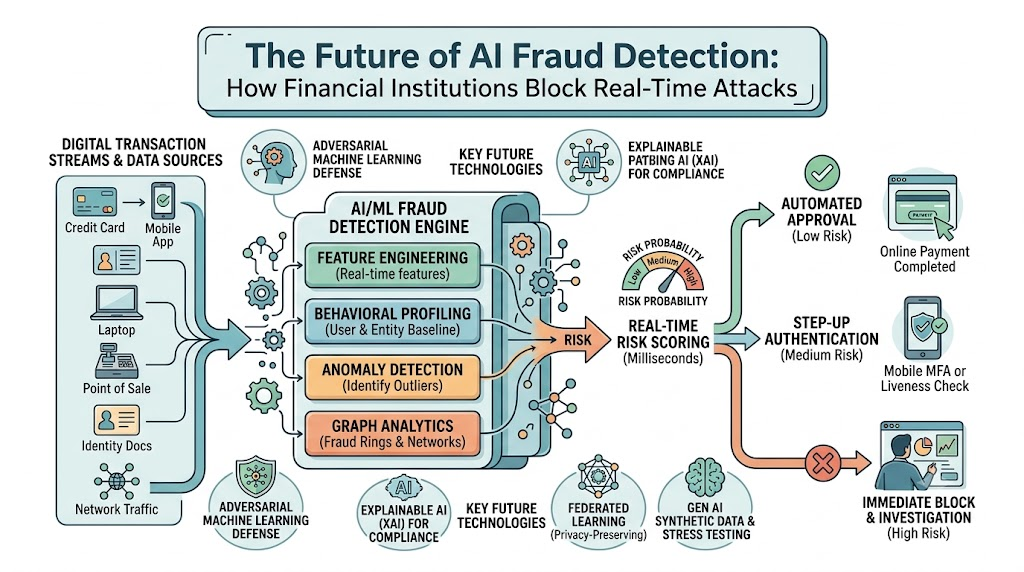
Modern fraud prevention systems operate as multi-layered security architectures that continuously ingest transactional telemetry, device fingerprints, network metadata, and contextual signals to compute a dynamic risk score before authorizing any high-value interaction.
Why Traditional Fraud Detection is No Longer Enough
For decades, institutions relied on legacy rule-based systems. These systems run conditional “IF-THEN” logic written manually by risk analysts (for example: IF transaction amount > $10,000 AND IP country != Home Country, THEN trigger alert).
While rule-based logic worked well in simpler digital environments, it exhibits critical vulnerabilities when faced with modern cybercrime.
Traditional Rule-Based Flow:
[ Transaction ] ──> [ Static "IF-THEN" Rules Engine ] ──> High False Positives & Lagging Updates

AI-Driven Fraud Detection Flow:
[ Transaction & Telemetry ] ──> [ ML / Deep Learning Models ] ──> Dynamic Risk Score (Milliseconds)
| Feature | Legacy Rule-Based Systems | AI & Machine Learning Systems |
| Detection Velocity | Reactive (rules created after fraud occurs) | Proactive (real-time anomaly identification) |
| Adaptability | Manual updates requiring weeks/months | Continuous learning & self-updating weights |
| Data Scalability | Low (struggles with high-dimensional unstructured data) | High (ingests billions of multi-modal data points) |
| False Positive Rate | High (flags legitimate non-standard users) | Low (evaluates nuanced context and behavioral baselines) |
| Pattern Recognition | Linear, single-parameter checks | Non-linear, complex multi-variable relationships |
Role of Artificial Intelligence in Fraud Detection
Artificial Intelligence transforms fraud prevention from a reactive inspection process into an adaptive predictive science. Instead of relying on static thresholds, AI models ingest historical and stream-processed data to infer risk probabilities in real time.
+-----------------------------------------------------------------------------------+
|                        AI Fraud Prevention Ecosystem                              |
+-----------------------------------------------------------------------------------+
|  [ Biometrics / CV ]      [ Transaction Streams ]      [ Unstructured Documents ] |
|  Identity Verification     Behavioral Analytics        NLP & Contract Parsing     |
+-----------------------------------------------------------------------------------+
                                      │
                                      ▼
+-----------------------------------------------------------------------------------+
|                           AI/ML Decision Engine                                   |
|   (Supervised Classifiers, Isolation Forests, Graph Neural Networks)             |
+-----------------------------------------------------------------------------------+
                                      │
                                      ▼
                      [ Real-Time Dynamic Risk Score ]
                                      │
        ┌─────────────────────────────┼─────────────────────────────┐
        ▼                             ▼                             ▼
   [ APPROVE ]               [ STEP-UP AUTH / MFA ]             [ REJECT ]
 (Low Risk < 0.15)            (Medium Risk 0.15 - 0.75)       (High Risk > 0.75)
How AI Detects Fraud Patterns
AI models do not simply read static account balances; they process holistic multidimensional context in milliseconds.
- Data Ingestion & Telemetry: Ingests IP address, device hardware fingerprints, time-of-day, location data, mouse trajectories, keystroke dynamics, and transactional histories.
- Feature Engineering: Extracts meaningful signals (e.g., velocity features like “number of unique cards attempted on device X in the past 10 minutes”).
- Model Inference: Passes features through trained ensemble algorithms to derive a risk probability score ranging from 0.00 (completely safe) to 1.00 (definitely fraudulent).
- Automated Decisioning & Step-Up Authentication:
- Score < 0.15: Automated Instant Approval.
- Score 0.15 – 0.75: Dynamic Challenge (triggers Multi-Factor Authentication or biometric check).
- Score > 0.75: Automated Rejection & Security Escalation.
Machine Learning Models Used in Fraud Detection
Modern AI security frameworks employ diverse algorithm classes tailored to specific structural properties of transactional data.
1. Decision Trees and Random Forests
Random Forests build an ensemble of decision trees to classify transactions. They handle non-linear relationships and tabular data effectively while providing high explainability.
2. Gradient Boosting Machines (XGBoost, LightGBM, CatBoost)
Gradient boosted trees represent the gold standard for structured payment fraud classification. They iteratively train weak learners on past errors, making them effective at pinpointing minute variations in payment telemetry.
3. Neural Networks and Deep Learning
Deep Autoencoders and Recurrent Neural Networks (RNNs / LSTMs) analyze sequential transaction logs, tracking context changes across extended timelines to flag account compromise.
4. Graph Neural Networks (GNNs)
GNNs map relationships between entities (e.g., shared credit card numbers, device IDs, physical addresses, phone numbers). By converting data into nodes and edges, GNNs detect organized fraud rings and syndicate networks that traditional models miss.
Supervised vs Unsupervised Learning
Fraud engine architects balance labeled historical records (supervised) with unassisted novelty detection (unsupervised).
| Criteria | Supervised Learning | Unsupervised Learning |
| Data Requirement | Requires labeled datasets (Fraud vs. Non-Fraud) | Operates on unlabeled, raw data streams |
| Primary Goal | Classify known fraud types based on past patterns | Detect unknown anomalies and zero-day fraud tactics |
| Algorithms | XGBoost, Logistic Regression, Random Forest, Neural Nets | Isolation Forests, K-Means, Autoencoders, One-Class SVM |
| Strengths | Extremely precise on known attack vectors | Discovers emergent, previously unseen fraud patterns |
| Limitations | Blind to novel, zero-day fraud attacks | Higher false positive rates requiring tuning |
Anomaly Detection Techniques
Anomalies represent statistical deviations from expected population norms. Mainstream AI architectures implement three primary mathematical frameworks for anomaly identification:
- Isolation Forests: Explicitly isolates anomalies by randomly selecting a feature and splitting the data. Unsupervised anomalies require far fewer splits to isolate than normal cluster points.
- Autoencoders: Neural network architectures trained to compress input data into a lower-dimensional latent space and reconstruct it. When presented with fraudulent data, reconstruction error spikes, signaling an anomaly.
- Density-Based Clustering (DBSCAN): Groups spatial clusters based on neighborhood density, isolating sparse points as outliers.
Behavioral Analytics and User Profiling
Static passwords and OTPs can be phished, but human behavioral nuance is nearly impossible to replicate. Behavioral analytics monitors how a user interacts with a platform rather than just what credentials they provide.
AI tracks keystroke dynamics (dwell time and flight time between keypresses), screen swipe velocities, device angle orientation, and navigation rhythms. If an account login passes password verification but exhibits automated robot-like keystrokes or an unfamiliar navigation flow, the behavioral engine triggers step-up authentication.
Natural Language Processing (NLP) in Fraud Detection
Natural Language Processing algorithms parse unstructured text streams across communications, claims, and financial transfers:
- Phishing & BEC Detection: Transformer models analyze email tone, syntax, sender history, and semantic intent to block Business Email Compromise (BEC) attacks before inbox delivery.
- Insurance Claim Text Mining: NLP engines parse handwritten physician reports, repair receipts, and police statements to detect conflicting narratives, boilerplate text reuse, or suspicious wording across separate claims.
Computer Vision for Identity Verification
Computer Vision (CV) powers modern remote Know Your Customer (eKYC) workflows:
- Document Verification: Convolutional Neural Networks (CNNs) verify government identification cards, detecting microscopic layout flaws, altered fonts, or digital tampers.
- Liveness Detection & Facial Matching: CV algorithms evaluate spatial depth, subtle involuntary muscle movements, and thermal reflectivity to ensure a live human face matches the ID photo, defeating printed photos and video replay attacks.
AI in Financial Fraud Prevention
Financial institutions deploy AI across core transactional layers to maintain trust and protect margins.
       Financial Data Pipeline
                  │
                  ▼
   [ Payment Transaction Request ]
                  │
                  ▼
  ┌───────────────────────────────┐
  │  Real-Time AI Processing      │
  │  - Device Fingerprinting      │
  │  - Behavioral Profiling       │
  │  - Cross-Account Graph Check  │
  └───────────────┬───────────────┘
                  │
                  ▼
     [ Calculated Risk Score ]
        /         │         \
       /          │          \
      ▼           ▼           ▼
   Low Risk   Med Risk    High Risk
   (Pass)      (MFA)      (Block)
AI in Banking and Digital Payments
Modern payment ecosystems run at massive scale. Credit card networks process tens of thousands of transactions per second, leaving under 100 milliseconds for fraud validation.
Graph analysis engines and gradient-boosted trees evaluate real-time transaction streams, checking card velocity, merchant Category Code (MCC) consistency, geolocation leaps, and cross-border routing mechanics to stop card-not-present (CNP) fraud instantly.
AI in E-commerce Fraud Detection
E-commerce businesses face threats beyond simple credit card theft:
- Account Takeover (ATO): Credential-stuffing bots try breached password lists. AI flags high-volume login velocity from residential proxy networks.
- Promo & Referral Abuse: Machine learning identifies single individuals creating hundreds of synthetic accounts to systematically siphon promotional discounts.
- Chargeback Fraud (“Friendly Fraud”): Predictive models track customer purchase history and delivery confirmation logs to challenge fraudulent friendly-fraud disputes automatically.
AI in Insurance Fraud Detection
Insurance fraud inflates operational costs globally. AI engines analyze complex claims data to identify suspicious patterns:
- Auto Insurance: Computer Vision algorithms analyze uploaded crash images to verify damage severity aligns with reported collision mechanics, catching pre-existing damage claims.
- Health & Property Insurance: Graph models link network entities—revealing suspicious patterns where specific auto repair shops, medical clinics, and legal representatives appear together in high-volume claim networks.
AI in Healthcare Fraud Detection
Healthcare fraud directly impacts operational efficiency and patient safety. Machine learning engines monitor billing patterns to flag operational anomalies:
- Upcoding & Phantom Billing: Unsupervised models flag providers billing for services at higher rates than normal regional averages or billing for impossible procedure combinations.
- Prescription Drug Fraud: AI monitors controlled substance distribution logs to highlight abnormal doctor-patient prescribing networks and anomalous pharmacy fulfillment spikes.
AI in Cybersecurity and Identity Protection
Cybersecurity teams deploy AI defensive layers across enterprise infrastructure:
- Zero-Day Malware Detection: Behavioral AI monitors endpoint API calls and memory allocation behaviors to identify unknown malware without relying on signature databases.
- Synthetic Identity Shielding: Deep learning networks evaluate applicant identity combinations (SSN, name, address, DOB) to identify synthetic identities fabricated by fraudsters over time.
Real-World Applications and Case Studies
Case Study 1: Global Tier-1 Commercial Bank
- Challenge: A multinational bank experienced high rates of false positives using legacy rules, frustrating legitimate cardholders and overloading risk investigation teams.
- Solution: Deployed real-time Gradient Boosted Ensemble models paired with Graph Neural Networks for cross-account relationship mapping.
- Result: Achieved a 42% reduction in false positive alerts, saved over $35 million annually in unrecovered fraud losses, and lowered model decision latency to under 40 milliseconds.
Case Study 2: E-Commerce Marketplace
- Challenge: Rapidly rising account takeover (ATO) bot attacks targeting customer loyalty points during high-volume holiday sales.
- Solution: Integrated an AI behavioral analytics platform that analyzes mouse movement mechanics, tap pressure, and device telemetry.
- Result: Successfully blocked 99.4% of automated credential-stuffing bot attempts without adding friction or CAPTCHA prompts for legitimate shoppers.
Popular AI Tools and Fraud Detection Platforms
| Platform | Primary Focus / Use Cases | Key Features | Enterprise Benefits |
| Sift | E-commerce, ATO, Payment Fraud | Dynamic ML models, global cross-merchant network signals | Reduces manual reviews, drives revenue conversion |
| SEON | Digital Footprint & Social Lookup | Open-source intelligence API, device fingerprinting | Fast deployment, granular transparent rules + ML scores |
| Feedzai | Enterprise Banking & FinTech | Real-time transaction monitoring, AutoML risk engine | Hyper-scalable processing, built for high-throughput banks |
| DataVisor | Unsupervised Anomaly Detection | Matrix profile algorithms, early fraud detection | Identifies structured attack rings before damage occurs |
| Darktrace | Enterprise Cybersecurity & Network AI | Self-learning Autonomous Response, anomaly isolation | Stops insider threats and zero-day breaches in real time |
Benefits of AI-Powered Fraud Detection
- Real-Time Decisioning: Evaluates complex risk matrices in under 100 milliseconds, preventing fraud before transactions clear.
- Massive Reduction in False Positives: Context-aware baseline profiling stops flagging legitimate customers who are simply traveling or making rare large purchases.
- 24/7 Self-Evolving Defense: Machine learning models update weights continuously, learning from new fraud vectors without waiting for manual human rule development.
- Scalability: Processes billions of daily events across disparate digital touchpoints seamlessly.
Challenges, Bias, and Ethical Considerations
While powerful, AI fraud engines introduce unique operational risks that require active governance:
+-----------------------------------------------------------------------------------+
|                           AI Fraud Engine Governance                              |
+-----------------------------------------------------------------------------------+
|   [ Explainability ]       [ Bias Mitigation ]        [ Regulatory Compliance ]   |
|   SHAP / LIME Audits       Demographic Parity         GDPR / FCRA Alignment       |
+-----------------------------------------------------------------------------------+
Model Bias and Discrimination
If training data contains historical bias, models can inadvertently penalize specific demographic groups, regions, or income brackets. Continuous fairness audits and demographic parity testing are essential.
Black-Box Problem & Explainability
Complex deep learning models can operate as “black boxes.” When a customer’s transaction or credit application is rejected, regulations like GDPR and FCRA demand explainability. Modern systems deploy SHAP (SHapley Additive exPlanations) and LIME (Local Interpretable Model-agnostic Explanations) to output clear feature-importance scores for every automated decision.
Adversarial AI
Cybercriminals actively test AI models using adversarial machine learning—injecting noise into data streams to bypass detection limits. Defending against these tactics requires continuous adversarial model training.
Best Practices for Organizations
- Adopt a Hybrid Detection Architecture: Combine the speed and governance of deterministic business rules with the predictive adaptability of AI models.
- Prioritize Explainable AI Frameworks: Ensure every model output includes audit-ready feature importance metrics.
- Continuous Retraining Pipelines: Retrain models frequently using continuous feedback loops to prevent performance degradation from shifting data trends.
- Enforce Multi-Modal Data Ingestion: Merge network, device, behavioral, financial, and identity signals into a unified data ecosystem.
Future Trends in AI-Based Fraud Prevention
- Generative AI Defenses: Generative models synthesize hyper-realistic synthetic fraud data to stress-test systems against emergent threat vectors.
- Quantum-Safe Cryptography & Detection: Preparing fraud architectures to monitor financial networks against quantum-powered encryption cracking attempts.
- Privacy-Preserving Federated Learning: Institutions train shared machine learning models collaboratively without exchanging raw, sensitive customer payment records.
Career Opportunities in AI and Fraud Analytics
The intersection of AI, risk management, and cybersecurity has created high-demand specialization roles:
- AI Fraud Risk Analyst: Translates business domain risks into statistical feature requirements for data science engineering teams.
- Machine Learning Engineer (Security / Fraud): Designs high-throughput, low-latency scoring pipelines and production models.
- Behavioral Data Scientist: Builds algorithms focused on processing human interaction mechanics and telemetry streams.
- Cybersecurity AI Specialist: Protects infrastructure against automated botnets, credential attacks, and adversarial AI exploits.
Frequently Asked Questions (10 FAQs)
How does AI improve fraud detection over traditional methods?
AI processes vast, high-dimensional datasets in real time, detecting complex non-linear patterns that manual rule-based systems miss while significantly reducing false positives.
What types of machine learning are best for fraud detection?
A combination works best: Supervised learning models (XGBoost, Random Forests) excel at detecting known fraud types, while Unsupervised learning (Isolation Forests, Autoencoders) flags emergent anomalies.
Can AI detect credit card fraud in real time?
Yes. Modern AI transaction scoring systems process credit card telemetry, device metadata, and historical baselines to issue a decision in under 100 milliseconds.
What is the role of NLP in fraud prevention?
NLP parses unstructured text across emails, invoices, and insurance claims to identify phishing attempts, fraudulent text patterns, and conflicting narratives.
How does behavioral analytics help stop account takeover (ATO)?
Behavioral analytics tracks unique user interaction mechanics—such as typing speed, swipe velocity, and cursor movements—flagging automated bots or stolen credential usage even when passwords are correct.
What is synthetic identity fraud, and how does AI combat it?
Synthetic identity fraud occurs when bad actors combine real and fake data (e.g., a real Social Security Number with a fake name) to open credit lines. AI detects these by analyzing deep entity relationship networks across disparate systems over time.
What is a false positive in fraud detection, and why is it dangerous?
A false positive occurs when a legitimate user’s transaction is incorrectly flagged as fraudulent. High false positive rates cause friction, frustrate legitimate customers, and drive lost sales.
How do organizations handle the “black box” nature of AI fraud models?
Institutions use Explainable AI (XAI) tools like SHAP and LIME. These techniques break down complex neural outputs into human-readable feature weights, providing clear justifications for every rejected transaction.
Is AI fraud detection expensive for small and medium businesses?
Not anymore. While building custom enterprise models requires significant investments, modern cloud-native SaaS platforms offer flexible API-driven AI fraud detection accessible to businesses of all sizes.
What is Federated Learning in fraud detection?
Federated Learning allows multiple financial institutions to train shared machine learning models collaboratively without revealing sensitive, proprietary customer records to one another.
Conclusion
Artificial Intelligence has transformed modern fraud detection from a reactive, manual task into an adaptive security framework. By combining Supervised Learning, Unsupervised Anomaly Detection, Behavioral Analytics, Computer Vision, and Graph Neural Networks, modern enterprises can stop complex attacks in real time while preserving frictionless experiences for legitimate users. As fraud syndicates adopt automated tools, organizations must continue innovating with robust, explainable, and ethically sound AI platforms.
