INTRODUCTION
Managing a modern digital marketing stack can quickly turn into an operational nightmare. Marketing teams and agencies often find themselves juggling half a dozen disconnected web applications—one tool for keyword research, another for backlink analysis, a third for tracking task assignments, and a separate platform for managing digital assets. This fragmented approach creates data silos, increases software subscription overhead, and wastes valuable hours copying metrics between dashboards. By consolidating critical tools into a unified workspace, agencies and in-house teams can streamline daily tasks, improve team collaboration, and maintain clear visibility over their entire digital footprint. In this comprehensive guide, you will learn how leveraging complete SEO software transforms complex search strategies into repeatable, scalable workflows.
WHAT IS AN ALL-IN-ONE DIGITAL MARKETING PLATFORM?
An all-in-one digital marketing platform is a centralized software ecosystem designed to manage, execute, and monitor multiple online marketing channels from a single interface. Instead of relying on isolated point solutions, teams utilize a unified platform to handle every phase of their campaign lifecycle.
Core Components
- Search Engine Optimization (SEO): Native applications for keyword tracking, technical site crawling, and backlink research.
- Workflow & Project Management: Built-in boards, task lists, and milestone trackers customized for marketing deliverables.
- Digital Asset Management (DAM): Centralized storage for media files, graphics, and brand guidelines with strict permission controls.
- Influencer & Outreach Portals: Tools to discover, connect with, and track external brand partners and publishers.
- Cross-Channel Reporting: Automated analytics dashboards that pull disparate data points into client-ready visual reports.
Why Businesses Need One
As digital marketing matures, operational efficiency becomes a major competitive advantage. Fragmented toolsets force teams to manage multiple logins, navigate inconsistent interfaces, and manually aggregate performance data. An integrated platform solves these friction points by providing a single source of truth for all campaign metrics and team communications.
Key Benefits
Adopting an all-in-one digital marketing platform drastically reduces software costs by eliminating redundant subscriptions. It improves cross-departmental collaboration, standardizes reporting standards across clients, and ensures that marketing insights translate directly into actionable optimization tasks without leaving the ecosystem.
SEO MANAGEMENT SOFTWARE
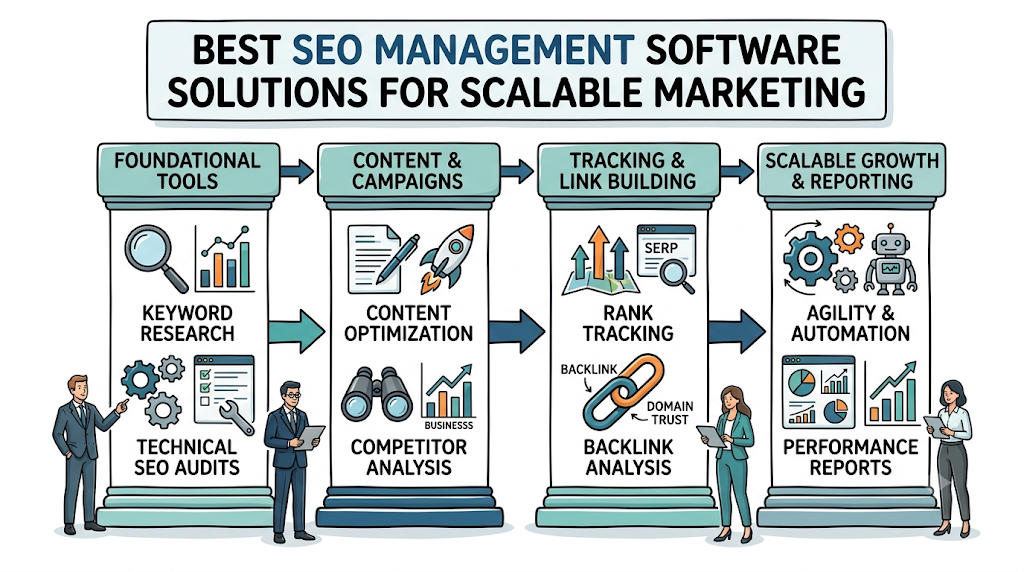
Executing a successful search strategy requires strict organization and consistent execution. Enterprise-grade SEO software provides the foundation needed to plan, implement, and track organic search campaigns with precision.
+-------------------------------------------------------------------+
|                     SEO SOFTWARE CORE WORKFLOW                    |
+-------------------+-------------------+---------------------------+
| Keyword Research  |  Campaign Planning|  Performance Monitoring   |
| Discover targets  |  Set milestones   |  Track keyword positions  |
+-------------------+-------------------+---------------------------+
                                  |
                                  v
+-------------------------------------------------------------------+
| Competitor Analysis    --->   Actionable Reporting                |
| Identify market gaps          Automated client insights           |
+-------------------------------------------------------------------+
Keyword Research and Discovery
Effective SEO begins with identifying high-intent search terms that reflect user queries. Integrated platforms feature research engines that reveal search volume, keyword difficulty, intent categorization, and related queries. Teams can group keywords into strategic clusters, aligning them directly with specific landing pages or content briefs.
Campaign Planning and Execution
Once target keywords are identified, marketing teams must translate research into structured editorial calendars. Modern SEO management software lets strategists assign target keywords directly to content creators, establish publishing deadlines, and attach optimization guidelines straight to the project workspace.
Performance Monitoring and Competitor Analysis
Search landscapes are fluid. Continuous performance monitoring allows teams to evaluate how content optimizations impact search visibility over time. Furthermore, robust competitor analysis tools allow marketers to benchmark their domain authority against industry rivals, identifying content gaps and keyword opportunities that competitors are currently exploiting.
Streamlined Client Reporting
Manual reporting is one of the most time-consuming activities for agencies. Dedicated software automates data collection, generating comprehensive visual reports that detail organic traffic trends, keyword rank movements, and domain health scores.
SEO RANK TRACKING
Understanding where your web pages stand on search engine results pages (SERPs) is vital for measuring campaign ROI. Utilizing a specialized SEO rank tracking tool provides real-time visibility into keyword performance across dynamic search environments.
Keyword Monitoring and Ranking Trends
Automated position tracking eliminates the need for manual SERP checks. Marketers can monitor daily rank fluctuations, identifying positive momentum or sudden drops caused by algorithm updates. Historical rank trend charts provide context, helping strategists evaluate whether seasonal variations or recent site changes are influencing organic traffic.
Device and Location-Based Rankings
Search results vary significantly based on user location and device type. Modern tracking systems allow teams to segment ranking data by:
- Desktop vs. Mobile: Identifying mobile-specific ranking drops or usability issues.
- Geographic Target: Tracking hyper-local search performance down to specific cities or postal codes.
- Search Features: Monitoring visibility within featured snippets, local packs, and knowledge panels.
Practical Example: E-Commerce Rank Tracking
Consider an online footwear retailer launching a campaign around “sustainable running shoes.” Using an integrated SEO rank tracking tool, the marketing team sets up daily rank tracking for 50 localized keyword variations across both mobile and desktop SERPs. When mobile rankings dip in a key metropolitan area, the team immediately detects the change and optimizes the page’s mobile page speed and local schema markup, quickly restoring top positions.
TECHNICAL SEO SITE AUDIT
Even the best-written content will fail to rank if search engine crawlers encounter technical barriers. Implementing a regular technical SEO site audit tool run ensures that your website remains fully crawlable, indexable, and technically sound.
Crawl Errors and Indexing Problems
Automated site audit crawlers scan every page of your domain to uncover technical friction points. They detect HTTP status code errors (such as 404 broken pages or 500 server errors), redirect loops, and improper usage of canonical tags or noindex directives that inadvertently block search engine bots from indexing high-value content.
Technical Performance Checklist
- Broken Links: Find and update internal and external dead links to preserve crawl budget and user experience.
- Duplicate Content: Identify identical or thin content blocks that trigger keyword cannibalization issues.
- Missing Metadata: Flag missing, duplicated, or overlength title tags and meta descriptions.
- Mobile Usability: Ensure responsive layout design, accessible touch elements, and proper viewport configurations.
- Site Speed & Core Web Vitals: Measure Largest Contentful Paint (LCP), Interaction to Next Paint (INP), and Cumulative Layout Shift (CLS).
- XML Sitemap Issues: Verify that sitemaps are cleanly structured, updated, and submitted correctly to Google Search Central.
By scheduling automated weekly site audits through a specialized technical SEO site audit tool, technical teams receive instant alerts when critical site errors emerge, allowing for proactive resolution before search rankings are impacted.
BACKLINK ANALYSIS
Backlinks remain one of the most influential off-page ranking factors used by search engine algorithms to measure domain authority, trustworthiness, and relevance. Utilizing a comprehensive backlink analysis tool allows businesses to build, monitor, and defend their link profiles.
Evaluating Referring Domains and Anchor Text
Quality outweighs quantity in modern link building. A healthy backlink profile consists of contextually relevant links originating from high-authority, diverse referring domains. Analyzing anchor text distribution ensures your profile maintains a natural balance of branded, exact-match, and long-tail anchor terms, preventing search penalty flags.
Identifying Toxic Links and Competitor Link Profiles
Invasive spam attacks or legacy low-quality link building can result in toxic backlinks that degrade search performance. Regular audit sweeps help identify toxic domains, enabling webmasters to compile disavow files efficiently. Furthermore, examining competitor link profiles reveals valuable link building opportunities, such as industry resource pages, digital PR targets, and unlinked brand mentions.
+--------------------------------------------------------------------+
|                    BACKLINK AUDIT & STRATEGY                       |
+--------------------------------------------------------------------+
| 1. Profile Discovery   --> Scan all referring domains & anchors    |
| 2. Quality Evaluation  --> Filter high-authority vs. toxic sources |
| 3. Gap Analysis        --> Cross-reference competitor link assets  |
| 4. Disavow & Outreach  --> Clean toxic links & pitch high-value site|
+--------------------------------------------------------------------+
Leveraging an enterprise backlink analysis tool streamlines this research process, giving outreach specialists actionable link targets that move search visibility metrics forward.
SEO PROJECT MANAGEMENT
Executing multi-faceted search campaigns requires seamless task coordination across SEO strategists, content creators, web developers, and PR managers. Using dedicated SEO project management software bridges the gap between high-level strategy and daily tactical execution.
Task Assignment and Milestone Management
Generic task management software often lacks the context required for specialized search operations. Dedicated marketing project systems allow managers to build structured project templates for common SEO workflows, such as content optimization sprints, site migration checklists, or technical audit remediation schedules.
Workflow Tracking and Deadline Monitoring
Centralizing tasks within an integrated platform ensures that every deliverable is tied directly to an SEO objective. Managers can track team velocity, monitor upcoming deadlines, assign subtasks, and review progress via custom kanban boards or Gantt charts.
By combining campaign management with core SEO diagnostics through tailored SEO project management software, organizations eliminate communication silos and keep technical search initiatives moving forward on schedule.
DIGITAL MARKETING WORKFLOW MANAGEMENT
Scalability in digital marketing depends entirely on operational efficiency. Applying digital marketing workflow management software standardizes creative and analytical processes, reducing approval bottlenecks and increasing output quality.
Campaign Workflows and Team Coordination
A standard marketing workflow involves multiple handoffs: a strategist performs keyword research, a writer drafts the article, a designer produces visual assets, an editor reviews tone, and a developer publishes the page. Without automated workflow management, handoffs get delayed in email threads or chat channels.
Process Automation and Productivity Gains
Workflow software automates notifications, status updates, and task assignments as items move through production stages. By integrating clear stage gates—such as requiring an SEO checklist validation before an article moves to “Ready for Publishing”—teams maintain strict quality control standards while accelerating campaign delivery timelines. Utilizing tailored digital marketing workflow management software helps organizations achieve higher output without compromising technical execution.
DIGITAL ASSET MANAGEMENT
Modern marketing campaigns rely on vast libraries of visual elements, including infographics, custom photographs, promotional videos, sales decks, and social media assets. Implementing digital asset management software for marketing teams solves file organization challenges across decentralized organizations.
+-------------------------------------------------------------------+
|                    DIGITAL ASSET LIFECYCLE                        |
+-------------------------------------------------------------------+
| Central Storage    --> Organized taxonomies & cloud repositories   |
| Version Control    --> Single source of truth for current media    |
| Access Governance  --> Custom permission tiers for internal/external|
| Rapid Discovery    --> Tag-based search for graphics & media assets |
+-------------------------------------------------------------------+
Brand Asset Control and Searchability
Searching through scattered cloud folders for the latest brand logo or custom diagram wastes precious creative time. Centralized asset repositories use structured tagging, meta descriptions, and categorical taxonomies to make every file searchable within seconds.
Version Control and Access Permissions
Using outdated graphic versions can damage brand consistency and create legal compliance issues. Dedicated digital asset management software for marketing teams provides built-in version control, ensuring that team members always access approved files. Permission controls allow administrators to grant appropriate access levels to internal staff, agency contractors, or external partners securely.
INFLUENCER MARKETING
Digital PR and influencer collaborations have become essential components of modern content distribution and link acquisition strategies. Utilizing an integrated influencer marketing marketplace connects brands with verified creators to build authoritative digital relationships.
Finding Influencers and Campaign Management
Finding brand-aligned content creators requires evaluating audience demographics, engagement metrics, and niche relevance. Integrated marketplaces allow managers to search through vetted influencer databases, pitch campaign proposals, negotiate terms, and manage creative deliverables within a single workspace.
Collaboration and Performance Tracking
Managing influencer outreach through centralized portals ensures transparency across campaign budgets, contractual deliverables, and publish dates. Marketers can track referral traffic, backlink placements, and social engagement metrics in real time using an influencer marketing marketplace, directly linking creator partnerships to broader digital marketing KPIs.
WHO SHOULD USE WIZBRAND?
WizBrand provides a tailored environment designed to solve operational challenges for diverse marketing teams and business models.
SEO Agencies
Agencies can manage dozens of client accounts from a single master portal, using standardized audit routines, automated reporting, and white-label client views to improve operational margins.
Digital Marketing Agencies
Multi-channel marketing agencies benefit from unified project management, digital asset repositories, and cross-channel tracking tools that connect search, social, and influencer initiatives.
Freelancers
Independent consultants can streamline their client deliverables—from site audits to monthly rank reports—without paying for multiple expensive software subscriptions.
In-House Marketing Teams
In-house teams gain a centralized source of truth that simplifies cross-departmental collaboration between SEO specialists, writers, designers, and web development teams.
Enterprises
Large enterprise organizations leverage granular permission structures, advanced project tracking, and robust data management tools to manage complex multi-site search operations.
Startups
Emerging businesses can launch structured, high-impact SEO campaigns rapidly using guided workflows without incurring massive initial software overhead.
Content Teams
Writers and editors utilize integrated keyword research and asset management tools to write, optimize, and publish content that aligns precisely with organic search intent.
E-commerce Businesses
Online retailers can track thousands of product page rankings across local markets while continuously monitoring technical crawl errors and toxic link profiles.
Influencers
Content creators use brand portals to discover sponsorship opportunities, submit creative deliverables for approval, and establish long-term brand partnerships.
Advertisers
Performance marketers gain complete visibility over campaign creative assets, promotional landing page performance, and overall digital marketing workflow velocity.
MANAGING MULTIPLE TOOLS VS. AN ALL-IN-ONE PLATFORM
Relying on multiple point solutions creates hidden operational friction that limits team productivity and increases software expenses.
| Operational Feature | Multiple Separate Tools | WizBrand Integrated Platform |
| SEO Rank Tracking | Isolated dashboard; manual metric export required | Native tracking integrated directly with project tasks |
| Project Management | Generic task board; no built-in SEO context | Customized marketing workflows with native SEO metrics |
| Backlink Analysis | Third-party subscription required; isolated data | Integrated link monitoring linked to outreach tasks |
| Digital Asset Management | Unorganized cloud storage folders; loose links | Tagged central asset repository with strict version control |
| Reporting & Analytics | Manual copy-pasting into spreadsheets | One-click automated visual client reports |
| Team Collaboration | Fragmented across emails, chats, and comments | Contextual comments directly inside active task boards |
Key Advantages of Integration
Consolidating your marketing stack onto a single platform eliminates “context switching”—the cognitive productivity loss that occurs when employees constantly jump between different applications. According to research published on HubSpot, streamlining software stacks significantly improves campaign speed while eliminating duplicate SaaS expenditure.
BUSINESS BENEFITS OF USING WIZBRAND
Implementing an all-in-one digital marketing ecosystem delivers tangible business value across several operational areas:
- Increased Productivity: Standardized project boards and automated notifications save team members hours of administrative work each week.
- Centralized Workflows: Strategy, creative production, asset management, and analytics exist in one unified environment.
- Accelerated Team Collaboration: Real-time task tagging and internal asset sharing eliminate approval delays between design, content, and strategy leads.
- Improved SEO Visibility: Continuous site crawling, daily position monitoring, and link management protect and grow organic search traffic.
- Reduced Software Overhead: Consolidating point solutions into a single platform subscription substantially lowers operational software costs.
- Data-Driven Decision Making: Unified analytics dashboards provide clear visibility into campaign ROI across search and outreach initiatives.
BEST PRACTICES FOR SEO & DIGITAL MARKETING MANAGEMENT
Maintaining high search engine rankings requires consistent execution and adherence to proven operational practices.
+-------------------------------------------------------------------+
|               CONTINUOUS OPTIMIZATION FLYWHEEL                   |
+-------------------------------------------------------------------+
| 1. Monitor Rankings  --> Track position shifts on daily SERPs     |
| 2. Periodic Audits   --> Run weekly technical site crawls        |
| 3. Asset Governance  --> Organize brand assets with strict tags  |
| 4. Backlink Defense  --> Audit referring domain health monthly   |
| 5. Process Review    --> Refine campaign workflows continually   |
+-------------------------------------------------------------------+
1. Monitor Rankings Regularly
Track primary target keywords daily to spot algorithmic volatility early. Analyze mobile and local SERPs alongside desktop rankings to ensure comprehensive search visibility.
2. Audit Websites Periodically
Schedule automated technical site crawls at least once per week. Address crawl errors, broken internal links, and page speed regressions before they degrade user experience or organic rankings.
3. Maintain Organized Digital Assets
Establish consistent file naming conventions and category metadata for all marketing assets. Ensure creative teams archive legacy files promptly to avoid publishing outdated brand visuals.
4. Track and Defend Your Backlink Profile
Perform monthly link audits to identify toxic link placements early. Keep a maintained disavow file and actively seek opportunities to turn unlinked brand mentions into authoritative backlinks.
5. Utilize Structured Workflows
Define standard operating procedures for every campaign type. Require mandatory SEO checks—such as title tag verification, image alt text completion, and schema validation—before content deployment.
6. Continuously Measure and Optimize
Regularly review campaign reporting dashboards against core business goals. Adjust content calendars based on performance data provided by analytics tools like Google Analytics Documentation.
COMMON DIGITAL MARKETING MISTAKES
Avoiding common operational pitfalls is critical for maximizing organic search return on investment.
Ignoring Technical SEO
Focusing solely on content creation while ignoring site speed, crawl errors, or indexing directives is a common mistake. Technical debt accumulates quickly, preventing high-quality content from achieving top rankings.
- Solution: Automate site audits and assign remediation tasks directly to web developers.
Poor Workflow Management
Managing campaigns across email threads and verbal agreements leads to missed deadlines and untracked deliverables.
- Solution: Mandate that every campaign asset move through a structured project board with explicit owners and deadlines.
Disorganized Asset Repositories
Storing brand graphics across local desktop drives leads to inconsistent branding and wasted production time.
- Solution: Implement a cloud-based digital asset management system with permission controls and search tagging.
Inconsistent Reporting and Analysis
Gathering metrics only when client reports are due prevents marketing teams from making real-time tactical adjustments.
- Solution: Set up automated live dashboards that track rank movements and domain health continuously.
FUTURE OF SEO & DIGITAL MARKETING PLATFORMS
The search engine marketing industry is evolving rapidly. Staying competitive requires understanding emergent trends that are reshaping how teams execute digital strategy.
AI-Powered Search Optimization
Artificial intelligence and machine learning algorithms continue to alter how search engines evaluate content intent and context. SEO platforms are increasingly integrating AI capabilities to assist with content clustering, intent matching, and predictive rank forecasting.
Automated Workflow Intelligence
Future platforms will place greater emphasis on process automation. System notifications will automatically create technical fix tasks, trigger outreach workflows when backlinks are lost, and assign graphic design briefs based on keyword calendar updates.
Unified Cross-Channel Reporting
As search engine results pages evolve to feature interactive AI summaries, video panels, and merchant listings, reporting platforms are transitioning toward integrated multi-touch attribution modeling, as documented across industry research from Semrush.
HOW WIZBRAND HELPS MARKETING TEAMS GROW
WizBrand empowers organizations to eliminate tool fragmentation and scale their search visibility effectively:
- SEO Management: Offers unified keyword discovery and planning modules that seamlessly connect search strategy to content execution.
- Rank Tracking: Delivers precise daily location and device-based position tracking across target search markets.
- Site Audits: Automatically crawls web properties to surface technical errors, site performance issues, and indexing obstacles.
- Backlink Monitoring: Provides complete visibility into domain backlink profiles, helping teams clean toxic links and capture outreach targets.
- Workflow Management: Streamlines task assignments, project milestones, and editorial schedules within a shared interface.
- Asset Management: Centralizes media libraries, graphics, and video content, ensuring fast searchability and version control.
- Influencer Collaboration: Connects brands with digital creators through a structured marketplace to scale digital PR and backlink campaigns.
- Reporting & Analytics: Generates client-ready visual performance reports in seconds, highlighting organic growth and campaign ROI.
FREQUENTLY ASKED QUESTIONS (FAQ)
What is an all-in-one digital marketing platform?
An all-in-one digital marketing platform is a centralized software system that consolidates multiple marketing tools—including keyword research, rank tracking, technical auditing, backlink analysis, project management, and asset storage—into a single interface. By integrating these applications, businesses eliminate data silos, reduce software subscription costs, streamline team collaboration, and accelerate campaign delivery.
What is SEO management software?
SEO management software is a platform designed to help digital marketers plan, execute, monitor, and optimize search engine campaigns. It provides native tools for keyword research, campaign planning, performance tracking, competitor analysis, and reporting. This software helps teams turn organic search data into structured tasks, ensuring consistent search optimization across web properties.
How does an SEO rank tracking tool work?
An SEO rank tracking tool automatically monitors where specific web pages rank on search engine results pages (SERPs) for target keywords. The tool queries search engines daily across different geographic locations, devices (desktop vs. mobile), and language settings, plotting rank trends over time to give teams clear visibility into campaign performance.
Why are technical SEO audits important?
Technical SEO audits are essential because they identify underlying technical issues that prevent search engine crawlers from indexing a website correctly. Audits detect broken links, crawl errors, duplicate content, improper metadata, slow page load speeds, and mobile usability flaws. Fixing these technical issues ensures search engines can efficiently crawl, evaluate, and rank site content.
What is backlink analysis?
Backlink analysis is the process of evaluating the incoming links pointing to a website from external domains. Analyzing a backlink profile helps marketers measure domain authority, assess anchor text diversity, identify toxic or spammy links, and discover quality link building opportunities by studying competitor referring domains.
How does SEO project management improve productivity?
SEO project management improves productivity by organizing complex search strategies into actionable, trackable tasks. By assigning clear owners, deadlines, and dependencies to technical fixes, content creation, and link outreach, teams avoid communication breakdowns, eliminate missed deadlines, and keep long-term search campaigns on schedule.
What is digital asset management?
Digital asset management (DAM) is a centralized system for organizing, storing, retrieving, and sharing digital files, such as images, graphics, videos, brand logos, and marketing collateral. DAM software provides file searchability, version control, and permission management, preventing creative teams from using outdated brand assets or losing media files.
What is an influencer marketing marketplace?
An influencer marketing marketplace is a digital platform that connects brands directly with content creators, bloggers, and social media influencers. It simplifies digital PR outreach by providing tools to search creator databases, negotiate campaign parameters, manage creative deliverables, track campaign performance, and build long-term publisher partnerships.
Is WizBrand suitable for agencies?
Yes, WizBrand is designed specifically to handle multi-account agency operations. Agencies can manage dozens of client domains from a master workspace, standardizing technical site audits, keyword rank tracking, digital asset libraries, and client task boards while generating automated visual reports.
How can businesses improve SEO workflows?
Businesses can improve SEO workflows by centralizing campaign planning and toolsets into a single platform. Establishing clear standard operating procedures—such as requiring automated technical audit checks, keyword mapping approvals, and structured content reviews before publishing—reduces approval delays and ensures consistent optimization standards across all published assets.
CONCLUSION
Managing digital marketing operations through multiple disconnected point solutions creates unnecessary operational friction, inflates software budgets, and degrades search performance. To maintain a competitive edge in modern search engine landscapes, businesses, agencies, and content teams need unified systems that seamlessly link research, technical optimization, asset management, and daily execution. Adopting a comprehensive platform built around complete SEO software allows organizations to transform complex search strategies into streamlined, repeatable processes. From tracking daily keyword positions and conducting technical site audits to managing backlink profiles and centralizing digital assets, an integrated workspace provides the structure required to scale organic traffic systematically.
