Introduction
In the rapidly evolving landscape of generative artificial intelligence, high-quality prompts serve as the essential instructions that convert advanced foundation models into actionable, business-critical outputs. Yet, professionals across industries face significant operational friction when attempting to capture, manage, and scale their most effective prompt instructions. Implementing a dedicated AI prompt management tool solves this challenge by transforming ephemeral prompts into structured, reusable, and version-controlled digital assets. By establishing a central repository for instructions, organizations ensure consistent tone, compliance, and quality across all generative AI applications. In this master guide, you will learn how to design structured prompt libraries, execute AI-assisted prompt optimization, analyze prompt architecture, run output evaluations, and maintain version history. You will also discover how integrating a comprehensive platform like Promptosia empowers teams to streamline AI operations, maximize LLM performance, and elevate prompt engineering into a core strategic capability.
What is an AI Prompt Management Tool?
Definition
An AI prompt management tool is a specialized software environment designed to create, organize, optimize, analyze, test, version, and share artificial intelligence prompts. Rather than treating prompt text as temporary input, a prompt management solution treats instructions as valuable intellectual property that can be cataloged, refined, and deployed systematically.
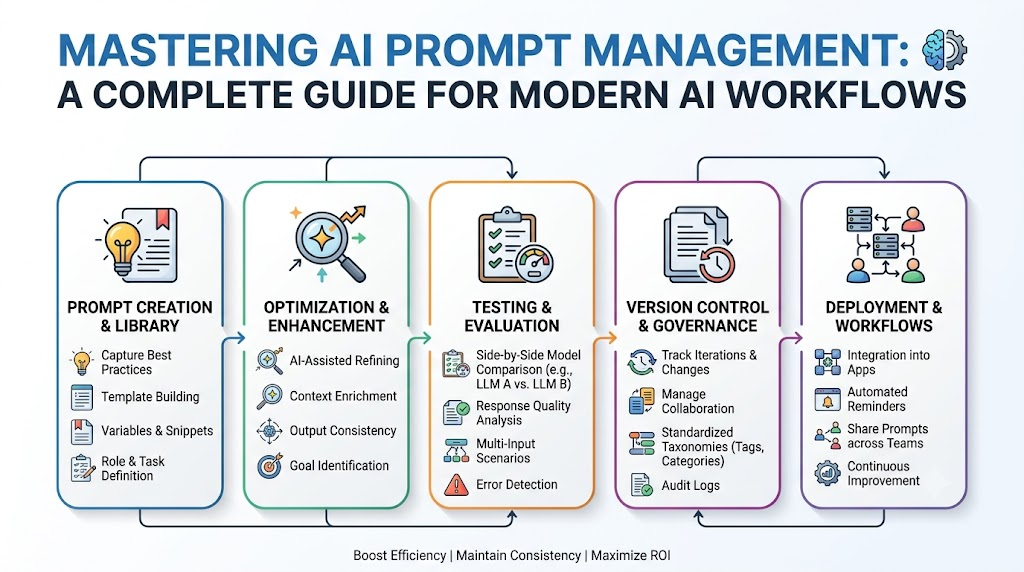
Raw Prompt Idea ──> Structured Library ──> Quality Analysis & Optimization ──> Multi-Model Testing ──> Production Deployment
Why Prompt Management Matters
Generative AI models—such as GPT-4, Claude, Gemini, and open-source architectures—are highly sensitive to input phrasing, context framing, and parameter constraints. Small variations in word choice can drastically alter accuracy, tone, and safety compliance. Centralized prompt management establishes operational governance, ensuring that proven instructions are easily accessible, benchmarked, and maintained across teams.
Common Prompt Challenges
- Prompt Fragmentation: High-performing prompts get buried in local files or conversational threads.
- Inconsistent Quality: Different team members construct variable prompts for identical tasks, yielding conflicting results.
- Lack of Attribution & Context: Users lose track of why a prompt was written, which variables it requires, or which model version it targets.
- Trial-and-Error Iteration: Teams spend excessive time tweaking instructions through manual guesswork rather than systematic testing.
Benefits of Organized Prompt Libraries
Transitioning to an organized AI prompt library speeds up execution, enforces brand standards, simplifies onboarding, and creates a repository of institutional knowledge. Users can search curated collections, clone tested templates, and focus on strategic execution rather than prompt drafting. Learn more about building structured collections by exploring the Promptosia Prompt Library.
Understanding Prompt Engineering
What Prompt Engineering Is
Prompt engineering is the strategic discipline of designing, refining, and structuring text inputs to guide generative AI models toward accurate, contextually relevant, and safe outputs. It bridges human intent and machine execution. Using an advanced prompt engineering platform transforms this discipline from an informal trial-and-error process into an engineering methodology.
+-----------------------------------------------------------------------+
|                         STRUCTURED PROMPT                             |
+-----------------------------------------------------------------------+
| [System Role / Persona] -> You are an expert FinTech Content Writer   |
| [Context / Background]  -> Target audience consists of SMB CFOs       |
| [Core Instructions]     -> Draft a guide on accounts receivable       |
| [Dynamic Variables]     -> {PrimaryKeyword}, {TargetWordCount}        |
| [Constraints]           -> Avoid passive voice; enforce AP style      |
| [Output Formatting]     -> Use clear Markdown headings and lists      |
+-----------------------------------------------------------------------+
Core Components of an Effective Prompt
According to framework documentation from OpenAI Documentation and Anthropic Documentation, high-performing enterprise prompts consist of six structural elements:
- Role & Persona: Defines the specialized perspective, authority, and tone the model should adopt.
- Context: Establishes necessary background information, domain parameters, and target audience expectations.
- Instructions: Clear, action-oriented directives detailing the precise tasks the model must execute.
- Variables: Placeholders (
{variable_name}) that make static prompts adaptable for multi-use scenarios. - Output Formatting: Explicit structural instructions (e.g., JSON schemas, Markdown tables, bulleted lists).
- Constraints: Rules defining boundaries, negative constraints (what not to do), and safety protocols.
Building an Organized AI Prompt Library
A central AI prompt organizer categorizes raw text into structured assets. To ensure high usability, an organized prompt library relies on clear taxonomy, dynamic fields, and search capabilities.
Central Prompt Repository
  ├── Categories (Engineering, Marketing, Legal, Product)
  │    └── Tags (Python, SEO, Compliance, Release-Notes)
  ├── Variable Schemas ({Customer_Name}, {Product_SKU}, {Code_Snippet})
  └── Search & Metadata Index (Full-Text Search, Model Compatibility)
- Taxonomic Categories: Group prompts by operational department, such as Engineering, Content Strategy, Legal Compliance, and Customer Support.
- Granular Tags: Apply functional tags (e.g.,
#Python,#GSTR-1,#ColdEmail,#Refactoring) to facilitate fast discovery. - Dynamic Variables: Replace static text with flexible parameter inputs to handle diverse use cases efficiently.
- Full-Text Search: Enable fast indexing across titles, full instructions, variable definitions, and tags.
- Prompt Collections: Bundle related prompts into logical sequences, such as an end-to-end Content Creation Lifecycle or Software Release Process.
AI Prompt Optimization
Unstructured or vague instructions often yield ambiguous, off-target, or low-quality AI outputs. Leveraging a dedicated AI prompt optimizer helps refine raw ideas into structured, high-performing prompts.
Optimization Techniques
- Clarifying Intent: Eliminating ambiguous phrases and substituting them with concise, actionable imperatives.
- Enhancing Contextual Boundaries: Supplying background parameters that prevent model hallucination.
- Formatting Directives: Enforcing structural guidelines to ensure clean downstream parsing.
Before and After Optimization
Unoptimized Prompt (Vague):
“Write a python function to check if a string is a palindrome and make it good.”
Optimized Prompt (Structured):
“Act as a Senior Python Developer. Write a Python 3.12 function named
is_palindromethat checks if an input string is a palindrome. Ignore spaces, punctuation, and letter casing. Include comprehensive type hints, detailed docstrings following Google format, runtime complexity ($O(n)$ time, $O(1)$ auxiliary space), and four unit test cases using pytest.”
AI Prompt Analysis
Before deploying prompts to production workflows, developers and teams must understand their underlying structural characteristics. An AI prompt analyzer breaks down complex text into its core components—a process known in Promptosia as identifying Prompt DNA.
Raw Instruction Block ──> AI Prompt Analyzer ──> Prompt DNA Profile:
                                                    ├── Target Role
                                                    ├── Primary Goal
                                                    ├── Required Variables
                                                    ├── Tone & Style
                                                    └── Risk/Safety Assessment
Key Elements of Prompt DNA
- Primary Goal: Identifies the precise objective the prompt aims to accomplish.
- Variable Detection: Maps mandatory dynamic inputs required before execution.
- Output Expectations: Evaluates whether structural rules (JSON, Markdown, CSV) are clearly defined.
- Target User Persona: Pinpoints the ideal user, skill level, or job function for the instruction.
- Safety & Risk Assessment: Identifies potential security concerns, such as system prompt leaks, unintended bias, or risky code execution instructions.
Analyze your prompt architecture instantly using the Promptosia Prompt Analyzer.
Prompt Quality Checking
A reliable prompt quality checker uses systematic benchmarks to evaluate prompt readiness, eliminating the need to rely on subjective guesswork.
+------------------------------------------------------------------+
|                   PROMPT QUALITY EVALUATION SCORE                |
+------------------------------------------------------------------+
| Metric                 Score (0-100)  Evaluation Focus           |
+------------------------------------------------------------------+
| Clarity                    92/100     Directness of instructions |
| Contextual Depth           88/100     Background guidance        |
| Output Specification       95/100     Structure and formatting   |
| Reusability                90/100     Variable implementation    |
| Safety Boundaries          85/100     Guardrails & constraints   |
| Practical Value            94/100     Real-world utility         |
+------------------------------------------------------------------+
| OVERALL QUALITY SCORE:     91 / 100                              |
+------------------------------------------------------------------+
By scoring prompts across these dimensions, creators can instantly spot structural gaps—such as missing variables or weak guardrails—and improve prompt performance before release.
Version Control for AI Prompts
When refining prompts for complex workflows, even minor adjustments to phrasing, formatting, or system constraints can significantly impact model outputs. Relying on manual file management makes it difficult to track what changed, why it changed, or how to restore a previously working version. A dedicated prompt version control tool manages instructions with the same rigor as source code.
v1.0 (Initial Draft) ──> v1.1 (Added Context) ──> v2.0 (Variables & Guardrails)
        │                       │                             │
        └── (Diff Analysis) ────┴── (Rollback Capability) ────┘
- Audit Traversal: Review exact line-by-line diffs between successive iterations.
- Instant Rollbacks: Revert to previous, stable iterations if updated model versions yield regressions.
- Collaboration History: Identify which team member edited specific variables, instructions, or guardrails.
- Experiment Tracking: Document performance notes alongside version milestones.
Track and manage historical prompt iterations seamlessly using Promptosia Version History.
Testing AI Prompts
Deploying prompts without testing can lead to unexpected errors, broken formatting, or model hallucinations in production environments. Using a specialized AI prompt testing tool lets developers benchmark performance across multiple model APIs side by side.
                      ┌──> OpenAI GPT-4o ───> Output A ┐
Input + Test Inputs ──┼──> Anthropic Claude ─> Output B ┼──> Side-by-Side Comparison
                      └──> Google Gemini ───> Output C ┘
Testing Methodologies
- Multi-Model A/B Testing: Send identical variables to multiple models concurrently to compare output quality, latency, and cost.
- Consistency Verification: Run identical prompts across multiple passes to verify structural reliability.
- Community Evaluation (Prompt Duels): Compare prompt variants head-to-head to let user votes establish performance benchmarks.
Run live multi-model comparisons directly on the Promptosia Prompt Testing Hub.
Reusable AI Prompt Templates
Relying on reusable AI prompt templates allows teams to scale operations without writing instructions from scratch for every new task. Below are practical, production-ready templates designed for core business functions:
1. Software Engineering: Automated Code Review
Act as a Principal Staff Engineer. Review the provided {language} code snippet:
{code_snippet}

Evaluate the code across four dimensions:
1. Syntax & Correctness
2. Performance Optimization & Complexity
3. Security Vulnerabilities (OWASP Top 10)
4. Readability & Maintainability

Provide suggested revisions inside clean markdown code blocks with clear explanations for each change.
2. Marketing Strategy: Data-Driven Content Brief
Act as an Enterprise SEO Strategist. Create a detailed blog content outline targeting the primary keyword "{primary_keyword}" for an audience of {target_audience}.

Include:
- An H1 optimized for search intent
- 5 structural H2 sections covering semantic secondary keywords: {secondary_keywords}
- Key takeaway bullet points for each section
- A meta description under 160 characters
3. Enterprise Operations: Executive Meeting Summarizer
You are an Executive Operations Assistant. Summarize the following meeting transcript:
{transcript_text}

Format the summary into three sections:
1. Key Decisions Made (Bulleted list)
2. Action Items (Assigned Person | Task Description | Due Date)
3. Open Questions Requiring Follow-Up
Promptosia for Different User Types
Different professionals require distinct prompt structures to streamline their daily workflows. Promptosia supports a wide range of specialized operational use cases:
Writers & Content Creators
Organize long-form blogging frameworks, social media copy generators, and narrative outlines into searchable collections while keeping tone and style consistent.
Developers & Software Engineers
Store code generation prompts, API specification builders, refactoring rules, and bug diagnostic workflows alongside test cases and version histories.
Marketers & Agencies
Maintain centralized brand voice guidelines, ad copy frameworks, SEO brief templates, and email sequences across multiple client workspace accounts.
Researchers & Academics
Manage complex synthesis prompts, literature review extraction templates, and methodology verification frameworks while ensuring strict academic formatting constraints.
Educators & Students
Build structured tutoring prompts, lesson plan generators, automated quiz builders, and study guide engines with customizable difficulty levels.
Enterprise Businesses & Operations Teams
Enforce brand standards, automate customer support response templates, streamline internal documentation, and safeguard corporate data compliance.
Best Practices for Prompt Management
To maximize the value of your prompt engineering workflows, follow these proven industry standards:
- Centralize Storage Immediately: Move prompts out of personal notes, scratchpads, and local files into a single, shared repository.
- Implement Parameter Variables: Use flexible placeholders (
{variable_name}) instead of hardcoding static details to maximize template reusability. - Standardize Naming Schemes: Use clear, action-oriented titles (e.g.,
Python - Security Vulnerability Scanner v2) to make discovery fast and intuitive. - Conduct Multi-Model Testing: Test prompts across multiple LLM providers before deploying them to production workflows.
- Track Iterations with Version Control: Save clear version entries whenever updating context parameters, instructions, or guardrails.
- Review Quality Scores: Run automated quality checks to identify missing guardrails, unclear context, or weak output formatting.
Common Prompt Engineering Mistakes
Avoiding these common pitfalls helps maintain high operational performance across your generative AI workflows:
- Vague Directives: Providing open-ended requests (e.g., “Write a report”) without specifying target roles, depth, structural layouts, or constraints.
- Omitting Dynamic Variables: Hardcoding specific names, dates, or values directly into prompts limits reusability across different use cases.
- Ignoring Model Guardrails: Failing to define clear boundary limits increases the risk of off-target responses or model hallucinations.
- Skipping Version Tracking: Modifying production prompts without keeping historical backups makes it difficult to revert when performance issues arise.
- Overlooking Formatting Rules: Failing to specify exact output structures (such as JSON, Markdown, or tables) leads to inconsistent data formats.
Comparison Table: Manual Storage vs. Promptosia
| Capability | Manual Prompt Storage (Notes/Spreadsheets) | Promptosia Platform |
| Organization & Discovery | Unstructured, fragmented across local files | Structured taxonomy with categories, tags, and full-text search |
| Version History | Manual file copies with no diff tracking | Automated versioning with line-by-line diff comparisons |
| Structural Analysis | Manual reading with subjective review | Automated Prompt DNA breakdown (Goals, Variables, Safety) |
| Quality Evaluation | Ad-hoc guesswork without standard benchmarks | Multi-dimensional quality scoring across clarity and safety |
| Multi-Model Testing | Copying text manually into different chat interfaces | Built-in A/B testing across leading model APIs |
| Team Collaboration | Isolated silos with limited knowledge sharing | Public and private Prompt Passports for easy sharing |
The Future of Prompt Engineering
As artificial intelligence continues to evolve, prompt engineering is shifting from an informal skill to a structured, systems-driven discipline:
- AI-Assisted Optimization Engines: Systems will automatically refine, test, and adapt prompts in real time based on user feedback and model updates.
- Prompt Standardization Protocols: Industry frameworks will establish standardized schemas for sharing context, variables, and safety guardrails across AI systems.
- Integrated Prompt Assets: Organizations will manage prompts alongside source code, API contracts, and database schemas as core technical infrastructure.
- Marketplaces and Public Passports: Verified prompt creators will distribute tested, scoring-validated prompt assets through public libraries.
How Promptosia Helps Users Build Better Prompts
Promptosia provides an end-to-end management platform designed to elevate prompt workflows:
Save Asset ──> Analyze DNA ──> Quality Score ──> Optimize & Test ──> Version & Publish
- Centralized Prompt Library: Store, organize, tag, and search your entire prompt repository in one secure location.
- AI-Powered Optimizer: Refine rough ideas into structured, high-performing prompts with explicit context, roles, and variables.
- Prompt DNA Analysis: Extract structural insight including target roles, input parameters, output formats, and risk profiles.
- Multi-Dimensional Quality Scores: Evaluate clarity, context, reusability, output structure, and safety bounds.
- Comprehensive Version Control: Maintain complete iteration histories, track changes line by line, and restore earlier versions whenever needed.
- Prompt Passports & Public Sharing: Publish verified, scored prompts to build public creator portfolios and share assets across teams.
- Interactive Prompt Duels: Participate in community-driven A/B evaluations to identify high-performing prompt variants.
Learn more about platform capabilities on the Promptosia About Page.
Frequently Asked Questions (FAQ)
What is an AI prompt management tool?
An AI prompt management tool is a dedicated software platform that helps creators, developers, and teams organize, optimize, analyze, test, version, and share AI prompts. Instead of saving prompts in scattered notes or chat histories, a prompt management tool turns instructions into structured, reusable digital assets with variable inputs, version histories, and quality benchmarks.
Why should I save and organize my AI prompts?
Saving and organizing prompts creates a reliable repository of proven instructions, saving time and ensuring consistent AI outputs. Centralizing prompts prevents rework, streamlines onboarding, improves team collaboration, and ensures high quality across recurring tasks like coding, writing, and research.
What is prompt engineering?
Prompt engineering is the strategic process of designing, refining, and structuring text inputs to guide generative AI models toward accurate, relevant, and high-quality outputs. It involves establishing roles, providing context, defining variables, specifying output formats, and applying safety constraints to get optimal results from LLMs.
How does an AI prompt optimizer work?
An AI prompt optimizer analyzes simple or unorganized prompts and refines them into structured, high-performing instructions. It fills in missing details—such as system roles, background context, dynamic variables, formatting directives, and safety guardrails—improving output accuracy while cutting down on manual tweaking.
Why is version control important for AI prompts?
Prompts often require tweaking to keep up with model updates, changing requirements, or new edge cases. Version control tracks line-by-line changes over time, allowing teams to compare outputs, audit edits, and instantly roll back to earlier iterations if updates cause unexpected issues.
What is an AI prompt analyzer and Prompt DNA?
An AI prompt analyzer evaluates the underlying structural components of a prompt. In Promptosia, this structural analysis is called Prompt DNA. It breaks down the prompt’s primary goal, required variables, target persona, expected output structure, and potential risk levels, giving users a clear view of how the prompt works.
How does a prompt quality checker evaluate prompts?
A prompt quality checker uses standardized metrics—such as clarity, contextual depth, output specification, reusability, safety boundaries, and practical value—to score a prompt. This diagnostic score highlights specific areas for improvement before prompts are used in production.
What are reusable AI prompt templates?
Reusable AI prompt templates are standardized instructions that use dynamic variables (such as {Customer_Name} or {Code_Snippet}) instead of hardcoded values. These templates let users run identical prompt logic across different inputs, making workflows faster and more consistent.
Can teams collaborate on shared prompt libraries?
Yes, modern prompt management platforms support team collaboration through shared workspaces, permissions, public or private Prompt Passports, and clear version histories. This ensures every team member uses approved, up-to-date prompts that align with brand and compliance standards.
Who benefits most from using Promptosia?
Promptosia benefits anyone who uses generative AI regularly—including software engineers, content creators, digital marketers, researchers, educators, enterprise teams, and AI professionals. It helps users turn scattered prompts into organized, reusable digital assets that streamline daily workflows.
Conclusion
Managing generative AI prompts effectively has become an essential capability for modern digital workflows. Relying on unorganized chat histories, scattered spreadsheets, and manual guesswork leads to inconsistent outputs and wasted time. Implementing an end-to-end AI prompt management tool provides the structure needed to capture, optimize, test, version, and scale your best prompt instructions reliably. By taking advantage of central repositories, AI-driven optimization, Prompt DNA structural analysis, multi-model testing, and version histories, organizations transform simple text inputs into valuable, reusable technical assets. Adopting systematic prompt engineering standards empowers creators, developers, and enterprise teams to achieve predictable, high-quality results from generative AI models.
