Last updated: 28 November 2026
AI talent is hard to come by because demand has spread across many kinds of jobs faster than people can build the matching skills. “AI talent” also covers very different abilities, from using a chatbot safely to building and running models in production.
The fix is rarely a single hiring push. It combines clearer role design, training existing staff, hiring on demonstrated skill, rebuilding entry-level pathways and widening access to education. This article explains the causes of the AI talent gap and what each group can do about it.
What the latest data shows about the AI talent gap
ManpowerGroup’s 2026 Talent Shortage Survey, released in February 2026, polled 39,063 employers in 41 countries during October 2025. Overall, 72% reported difficulty filling roles, slightly down from 74% a year earlier.
The notable change was at the top of the list. AI model and application development (named by 20%) and AI literacy (19%) became the hardest skills to find globally. Engineering also stood at 19%, so AI leads a crowded field rather than dwarfing every other shortage.
Job advertisements point the same way. Lightcast data published alongside the 2026 Stanford AI Index shows that about 2.5% of US job postings in 2025 mentioned AI skills, up 55% on the year before. Mentions of agentic AI skills (systems that plan and carry out multi-step tasks) rose from 0.06% to 0.23% of postings.
The pressure is wider than AI. In the World Economic Forum’s Future of Jobs Report 2025, 63% of employers identified skills gaps as a major barrier to business transformation over 2025 to 2030.
Read these figures with care. Surveys capture what employers say they struggle with, and postings capture what they ask for. Neither directly counts how many qualified people are missing.
Why AI talent is so hard to come by
1. One label hides several different jobs
A research scientist who designs model architectures, an engineer who connects a language model to company data, and an analyst who uses AI tools well are not interchangeable. A job ad that asks for all three narrows the candidate pool to almost nobody.
2. Demand has moved beyond the IT department
Lightcast’s earlier research found that most AI job postings sit outside IT roles, and that this share has been rising. Marketing, finance, operations and other teams now want people who combine domain knowledge with AI fluency. Few training routes were built to produce that mix.
3. Production skills take time to learn
Building a demo is much easier than running a dependable system. Production work needs software engineering, data pipelines, cloud infrastructure, testing, monitoring and security. In the Lightcast data, Python was the most requested specialised skill in US AI postings, and deployment-oriented skills such as Amazon Web Services and scalability have shown some of the fastest long-term growth.
Tools and methods also change quickly. A course or job description can age within a year or so, which makes “years of experience” a weak filter for newer techniques.
4. Training supply is uneven
OECD research published in 2024 examined course catalogues in Australia, Germany, Singapore and the United States. Only 0.3% to 5.5% of the training courses analysed included AI content. The OECD also noted that existing AI programmes lean towards advanced skills, while most workers mainly need a general understanding of AI.
That snapshot predates much of the recent activity, so current supply may differ. The underlying distinction still matters: specialist training and broad literacy need separate plans.
5. The entry-level pipeline is under strain
The 2026 Stanford AI Index reports that employment among software developers aged 22 to 25 has fallen by nearly 20% since 2024, while headcount for older colleagues grew. It describes similar patterns in other highly AI-exposed work, such as customer support.
This creates a risk. Senior AI engineers usually start as junior practitioners. If organisations stop hiring and developing beginners, today’s savings can become tomorrow’s shortage.
6. Specialists are concentrated, and mobility is shifting
AI work clusters in particular places. The same Stanford report says the United States still has more AI researchers and developers than any other country, but the number of AI scholars moving there has dropped 89% since 2017, including an 80% fall in the most recent year measured.
Immigration costs and rules add uncertainty. In the US, a September 2026 proclamation extended a $100,000 fee on certain new H-1B visa petitions through 21 September 2027. However, court orders currently block the fee, and as of late November 2026 it is not being collected.
A federal court in Massachusetts vacated (set aside) the policy implementing the fee on 8 June 2026, and the First Circuit appeals court refused to suspend that ruling on 24 July. On 30 September, a federal court in California also ruled against the fee, including the extension, and blocked its enforcement.
Appeals are still pending. A December 2025 district court ruling in Washington, D.C., had upheld the original proclamation, and it is on appeal too. The position could change, so employers should check current official guidance before planning around it.
Match the gap to the right solution
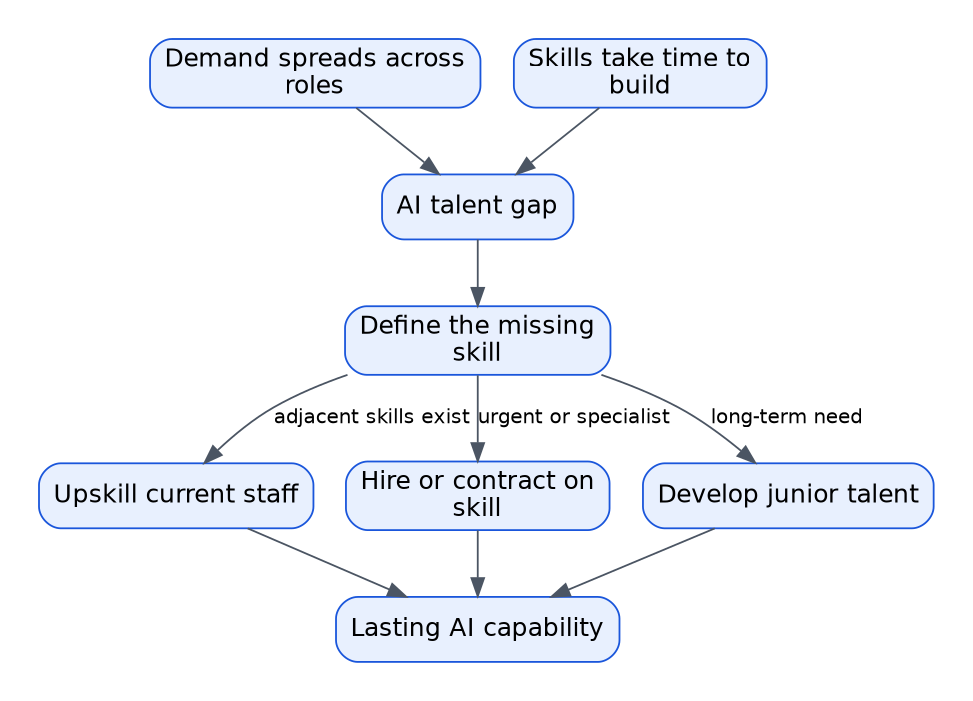
Before opening a vacancy, decide which capability is actually missing. The table below is a practical starting framework, not an industry standard.
| Capability needed | Typical work | Best first move | Main risk |
|---|---|---|---|
| AI literacy | Using approved tools, checking outputs, protecting data | Role-based training for existing staff | Generic videos with no practice |
| Domain-plus-AI | Redesigning workflows, judging output quality | Upskill subject experts and pair them with engineers | No time set aside to learn |
| AI application engineering | Integrating models, retrieval, evaluation, deployment | Retrain strong software and data engineers; hire a lead if needed | Stopping at prototypes |
| Model development and research | Training, adapting and studying models | Targeted hiring or research partnerships | Hiring researchers for integration work |
| Short-term specialist need | Audits, architecture reviews, one-off builds | Contractors with a planned handover | Knowledge leaves with them |
What can be done to fill the gap
What employers can do
Write narrower, honest job descriptions
List the problems the person will solve in the first six to twelve months. Separate must-have skills from learnable ones. Remove tool requirements that a capable engineer could pick up on the job.
Train the people you already have
Upskilling and reskilling was the most common response in the ManpowerGroup survey, cited by 27% of employers. Others included schedule flexibility (20%), higher wages (19%), location flexibility (18%) and new talent pools (18%).
Good programmes protect learning time, use real internal problems, assign mentors and finish with a working deliverable. Course completion alone does not show that someone can do the work.
Hire for demonstrated skill
A study by Bone, Ehlinger and Stephany analysed about 11 million UK job vacancies. Mentions of university degree requirements in AI roles fell 15% between 2018 and 2023, and AI skills carried a 23% wage premium in data running to mid-2024. This shows a shift in how employers advertise and pay, not proof that every hiring method works equally well.
Use a short, relevant work sample scored against a written rubric. For example, ask candidates to find the failure modes in a small retrieval system and explain how they would measure improvement.
Rebuild junior pathways
Offer apprenticeships, internships or rotations with named supervisors. Give beginners tasks such as building evaluation datasets, reviewing model outputs and writing tests. Ask them to explain AI-generated code, because Stanford notes early evidence that heavy reliance on AI may slow skill development.
Keep the people you develop
Create visible technical career paths, review pay when skills grow, and give staff worthwhile problems with usable data and computing resources. Reduce dependence on any single expert through documentation and shared ownership.
What individuals can do
- Start from your strength. An accountant, nurse or developer can add AI skills to existing expertise.
- Learn foundations that outlast tools: data quality, basic statistics, evaluation, privacy and, for technical roles, Python and software practice.
- Build one small project end to end, and record what failed and how you measured results.
- Read several current job ads for your target role and note which requirements recur.
What educators and governments can do
- Offer short, accessible AI literacy courses alongside advanced specialist programmes.
- Co-design curricula with employers and fund work-based learning.
- Support teachers. Stanford reports that four in five US high school and college students use AI for schoolwork, while only half of middle and high schools have AI policies.
- Help small firms and mid-career workers who lack training budgets.
- Make routes for skilled migrants predictable.
Regulation is part of the picture in the European Union. Article 4 of the AI Act was amended by Regulation (EU) 2026/1744, in force since 27 July 2026. Providers and deployers of AI systems must now take measures to support AI literacy among relevant staff, without having to guarantee a specific level for any individual. Seek legal advice on what this means for your organisation.
Hands-on exercise: map your own skills gap
List the capabilities a project needs, the number of people required at working level, and how many you have. The names and numbers below are hypothetical. This Python code has not been tested here.
# capability: (people_needed, people_ready, people_trainable)
skills = {
    "AI literacy":        (40, 12, 28),
    "Data pipelines":     (3, 2, 2),
    "Model evaluation":   (2, 0, 1),
    "Deployment and ops": (2, 1, 0),
}

for name, (need, ready, trainable) in skills.items():
    gap = max(need - ready, 0)
    train = min(gap, trainable)
    external = gap - train
    print(f"{name}: gap={gap}, train={train}, hire_or_contract={external}")
Then ask three questions about each gap:
- What evidence shows that someone counts as “ready”?
- Can training finish before the project needs the skill?
- Who will mentor the learners, and is their time budgeted?
If the answer to the second question is no, use a contractor or new hire as a bridge, and make knowledge transfer part of the assignment.
Common mistakes to avoid
- The unicorn job ad: one person expected to cover research, engineering, product and governance.
- Degree or brand filtering by habit: excluding capable candidates before seeing their work.
- Training without application: new skills fade if daily work never uses them.
- Hiring before data is ready: specialists cannot deliver much without access, ownership and a defined problem.
- Measuring activity only: track time to fill roles, skills demonstrated, projects shipped and retention, not just course sign-ups.
FAQ
Is there really an AI talent shortage?
Employer surveys and posting data show strong, rising demand and real hiring difficulty. The severity varies by role, region and seniority, and some difficulty comes from unrealistic requirements. Treat single global “unfilled jobs” totals cautiously unless the method is clear.
Do you need a PhD to work in AI?
Not for many roles. Research positions often expect advanced study, while application, data and operations work may value demonstrated engineering ability. Requirements differ by employer.
Is it better to hire or to upskill?
Usually both. Upskill where you have strong adjacent skills and enough time. Hire or contract where nobody can guide the work or the deadline is close.
Where should a small business start?
Pick one workflow, train the people who know it best, set rules for data and output checking, and buy specialist help only for the parts they cannot safely handle.
Will AI tools remove the need for AI talent?
Tools can lower the effort for some tasks, but someone still has to choose problems, check results, manage risk and keep systems running. The mix of skills needed is likely to keep changing, so review your skills map regularly.