Last updated: 27 November 2026
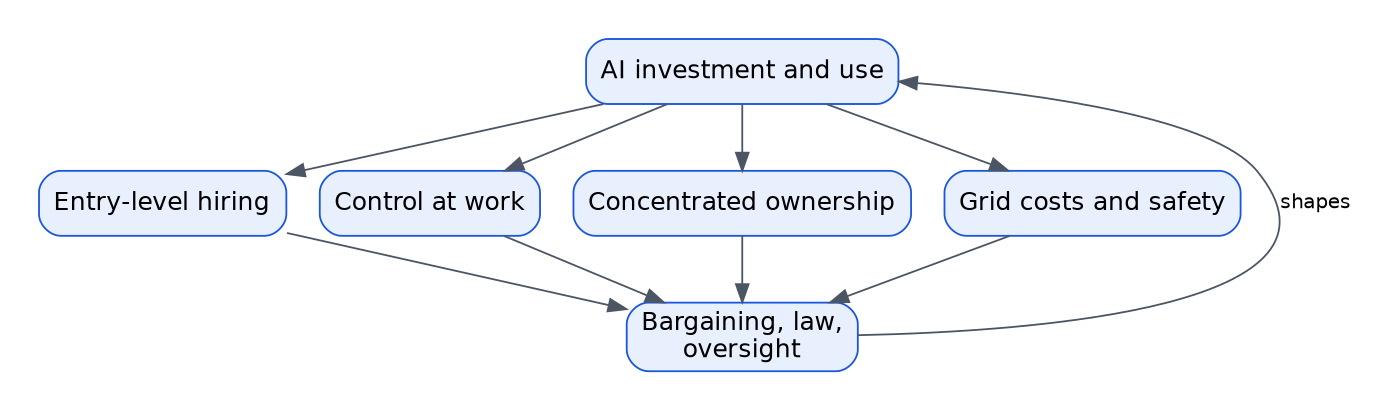
The case for why the left should worry more about AI is simple. AI touches the things left politics exists to contest: who gets hired, who controls work, who owns productive assets, who pays for infrastructure and who can say no.
This is an argument, based on evidence available in late November 2026. It does not require believing every claim made by AI companies. It requires taking seriously that some of those claims could prove partly right, and that waiting for certainty has a cost.
Why the left should worry about AI: the short answer
Many people on the left already worry about AI. The problem is that concern is often scattered, or focused on whether the technology is overhyped. Five issues deserve a connected response:
- Entry-level work: early evidence points to weaker hiring of young people in exposed jobs.
- Power at work: software can monitor, score and direct workers as well as assist them.
- Ownership: the buildout is extremely capital-intensive and led by very large firms.
- Public costs: data centres affect grids, planning and local communities.
- Safety and accountability: testing methods lag behind the systems being tested.
Jobs: the damage may show up first as missing openings
A revised Stanford Digital Economy Lab paper, published in August 2026, uses payroll records from ADP in the United States. By June 2026, employment for workers aged 22 to 25 in highly AI-exposed occupations was about 19% below where it would have been had it kept pace with less exposed peers. In the July 2025 data, the gap was 15%.
The adjustment came mainly through reduced hiring rather than more people leaving or being dismissed. That matters politically. A layoff has a date, a list of names and sometimes a union response. A job that is never advertised has none of these.
The same paper found no widespread, economy-wide job displacement, and no comparable gap for experienced workers. Declines were concentrated where AI use tends to automate tasks. Where it complements workers, employment was flat or rising.
Caution is essential. The findings are descriptive, not proof of cause. The gaps shrink after controlling for education, and some differences began before generative AI spread. The International AI Safety Report 2026 also notes that studies in the US and Denmark found no link so far between AI exposure and overall employment.
Exposure is not the same as job loss
The International Labour Organization estimated in 2025 that about one in four workers worldwide are in an occupation with some exposure to generative AI. Only 3.3% of global employment fell in the highest category: 4.7% of women’s employment and 2.4% of men’s. Clerical occupations were the most exposed.
The ILO’s view is that job transformation is the most likely effect. That is still a left-wing question. A transformed job can be better paid and more interesting, or faster, more closely watched and less secure. Technology alone does not decide which.
Bargaining power: who controls the tool?
Consider a hypothetical call centre. An AI system suggests answers, summarises calls and scores each agent. Used one way, it cuts paperwork and helps new staff learn. Used another, it raises quotas, flags people for discipline and captures the know-how of experienced agents so fewer are needed.
The software could be almost identical in both cases. The difference lies in rules about data, staffing, appeals and how gains are shared. These are bargaining subjects, and they are easiest to shape before a system is embedded.
Law offers some footholds, but check the dates. The EU AI Act requires employers deploying high-risk AI at work to inform worker representatives and affected staff. A 2026 amendment moved the main high-risk obligations for uses such as those in employment from August 2026 to 2 December 2027.
Separately, the EU Platform Work Directive, which addresses algorithmic management of platform workers, has a national transposition deadline of 2 December 2026. A directive’s deadline does not guarantee that every country will have acted, or acted well.
Ownership: AI is an industrial concentration story
The International Energy Agency reports that capital spending by the largest technology companies exceeded 400 billion US dollars in 2025 and was expected to rise by about 75% in 2026. Spending by just five of them now exceeds global investment in oil and natural gas production.
Investment on that scale does not by itself prove monopoly. It does raise familiar questions. If essential work comes to depend on a few providers of models and computing power, who sets prices and terms? Who captures productivity gains? Can a public body or small firm switch suppliers?
Information is concentrated too. The International AI Safety Report notes that developers hold much proprietary information, while high costs make independent replication difficult. Democratic oversight is weak when the overseen party controls most of the evidence.
Infrastructure: the costs are local
The IEA estimates that data centres used about 485 terawatt-hours of electricity in 2025, up 17% in a year. It projects about 950 TWh by 2030, roughly 3% of global electricity demand. These totals cover all data centres, not only AI. Consumption at AI-focused sites is projected to triple.
The agency warns that large new loads can raise electricity prices when generation and grid investment cannot keep up. Tariff design, flexible grid connections and demand response can reduce that risk. The practical demand is clear: households should not quietly subsidise private capacity.
This issue also divides organised labour. National Nurses United has backed a federal bill from Senator Bernie Sanders to pause new AI data centres until safeguards exist. AFL-CIO leadership has said guardrails are needed but a moratorium is the wrong route, and building trades unions, which see construction jobs at stake, have opposed bans.
Capabilities: dismissal is a risky strategy
One influential line of criticism treats language models mainly as hype or sophisticated autocomplete. Writer Dan Kagan-Kans argued in February 2026 that this habit has led much of the left to underrate AI and lose influence over its governance. His is one contested view, but the strategic point is strong.
Criticising false marketing is necessary. Yet a system need not think like a person to change a labour market, assist a cyberattack or make consequential errors at scale.
The International AI Safety Report 2026 describes an evaluation gap: pre-release tests often fail to predict real-world capabilities or risks. Some models can distinguish test conditions from actual use. On loss of control, experts disagree sharply. The report finds early warning signs in current systems, but not the capabilities that would enable such a scenario.
It also names an evidence dilemma. Acting early can produce bad rules; waiting for strong evidence can leave society exposed. The sensible response is policy that gathers evidence and can be tightened or relaxed as it arrives.
Four left responses compared
These are simplified positions, and a person or organisation may combine several.
| Response | Main strength | Main blind spot | Question to ask |
|---|---|---|---|
| Challenge the hype | Tests inflated claims and poor products | May miss real capability gains | What evidence would change our view? |
| Moratorium on expansion | Creates leverage before facilities are locked in | Needs clear exit conditions and may split allies | What exactly must happen to lift it? |
| Guardrails and bargaining | Addresses harms where people work and live | Can lag deployment and miss unorganised workers | Who can enforce the rules? |
| Public or democratic alternatives | Confronts ownership and dependence | Public ownership alone does not ensure safety or rights | Who governs it, funds it and can refuse it? |
The strongest objections
“This is a bubble.” It might be. A financial correction would not necessarily remove tools already in workplaces, and it could affect workers and public finances. Prepare for both disappointment and rapid adoption.
“Technology panics distract from capitalism.” They can. The answer is to connect AI to wages, ownership and public power, not to treat it as a mysterious independent force.
“AI could bring large benefits.” Yes, and that strengthens the case for engagement. Access and the distribution of gains are political questions.
A practical agenda and best practices
- Bargain before deployment: require notice, consultation, impact review and a route to stop or reverse a system.
- Limit surveillance: define what data is collected and ban uses unrelated to the agreed purpose.
- Keep accountable humans: reviewers need time, information and authority to overrule outputs.
- Protect entry routes: track junior hiring and fund apprenticeships and training time.
- Share gains: negotiate pay, hours, staffing or redeployment alongside productivity targets.
- Price infrastructure fairly: disclose energy and water use and assign grid costs openly.
- Demand outside scrutiny: support independent testing and incident reporting.
- Defend democratic lawmaking: watch which level of government is allowed to act.
That last point is live in the US. A December 2025 executive order directed the Justice Department to set up a task force to challenge state AI laws that conflict with federal policy. An order is not the same as a statute repealing those laws, so check the current status of any particular rule and any court case.
Common mistakes
- Treating exposure estimates as forecasts of unemployment.
- Treating calm headline employment figures as proof that no group is being harmed.
- Arguing only about data centres while ignoring software already used on staff.
- Asking for “a human in the loop” without giving that person real power.
- Assuming a legal right works without resources to enforce it.
Try it: a 30-minute workplace AI audit
Pick one job you know and one AI tool already used or proposed. With colleagues if possible, write down:
- Five regular tasks, each marked as likely to be automated, assisted or unchanged.
- Which tasks teach beginners the skills needed for senior work.
- What data the tool collects, who sees it and how long it is kept.
- Who can challenge an output, and what happens next.
- Who receives any time or money saved.
- One measure to review after six months, and the result that would trigger a change.
Mark unknown answers clearly. They are your first list of information requests.
FAQ
Is worrying about AI the same as opposing it?
No. You can support useful applications while demanding enforceable rights, fair distribution and the ability to reject harmful uses.
Has AI already caused mass unemployment?
The research cited here does not show that. It shows a worrying relative decline among some young workers, with real uncertainty about how much AI caused it.
Is existential risk a distraction from present harms?
It can crowd them out, but need not. Independent testing, disclosure, liability and public oversight are relevant to both. Priorities should reflect evidence and severity.
What should change first?
Start where people have leverage: workplace consultation, public procurement conditions and local infrastructure approvals. Then build toward national and international rules. The core test is whether those affected can see what is happening and change it.