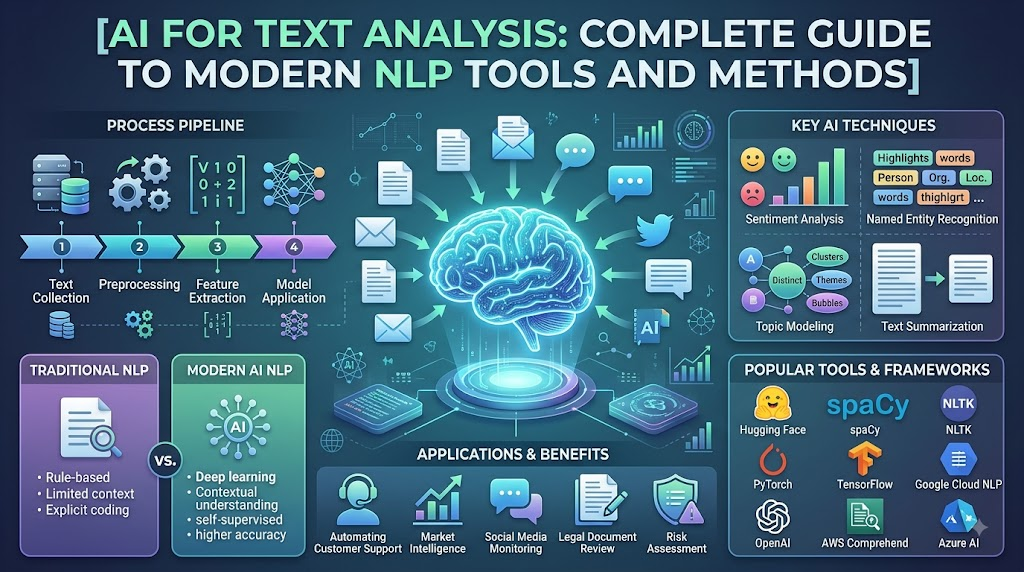
Every single day, organizations around the globe generate staggering amounts of written information. From customer emails, product reviews, and social media posts to internal policy documents, support tickets, survey responses, quarterly reports, live chat logs, and academic research papers, unstructured text is everywhere. While this data holds immense value, manually reading, categorizing, and interpreting millions of words is practically impossible for human teams. It takes too long, costs too much, and introduces inevitable human error. This is where AI for text analysis changes the game. By combining artificial intelligence, natural language processing (NLP), and machine learning, systems can read, organize, summarize, and extract critical intelligence from massive text archives in seconds. For additional learning materials, tutorials, and applied guides on artificial intelligence, visit AIUniverse.xyz.
What Is AI for Text Analysis?
At its core, AI for text analysis (also referred to as text mining or text analytics) refers to computer systems that automatically process, interpret, organize, and derive insights from written human language.
Rather than treating text as a static string of characters, an AI system analyzes language structure, semantic context, statistical patterns, and entity relationships to understand what the text actually means.
┌─────────────────────────────────────────────────────────────┐
│                    ARTIFICIAL INTELLIGENCE                   │
│   (Broad field of creating smart, autonomous machines)      │
│  ┌───────────────────────────────────────────────────────┐  │
│  │                   MACHINE LEARNING                    │  │
│  │       (Systems learning patterns from raw data)       │  │
│  │  ┌─────────────────────────────────────────────────┐  │  │
│  │  │           NATURAL LANGUAGE PROCESSING           │  │  │
│  │  │   (Bridging human language and computers)       │  │  │
│  │  │  ┌───────────────────────────────────────────┐  │  │  │
│  │  │  │               TEXT ANALYSIS               │  │  │  │
│  │  │  │ (Applied extraction, classification &     │  │  │  │
│  │  │  │  sentiment discovery from written text)   │  │  │  │
│  │  │  └───────────────────────────────────────────┘  │  │  │
│  │  └─────────────────────────────────────────────────┘  │  │
│  └───────────────────────────────────────────────────────┘  │
└─────────────────────────────────────────────────────────────┘
- Artificial Intelligence (AI): The umbrella discipline focused on building systems capable of performing tasks that traditionally require human intelligence.
- Machine Learning (ML): A branch of AI where models learn statistical patterns directly from data rather than relying exclusively on hand-crafted rules.
- Natural Language Processing (NLP): A specialized field of AI and computational linguistics that allows computers to read, interpret, and generate human languages.
- Text Analysis: The practical, domain-specific application of NLP and ML techniques to solve concrete tasks like sentiment scoring, entity extraction, categorization, and summarization.
How AI Text Analysis Works
Processing natural language requires a structured engineering pipeline. Because computers understand numbers rather than raw human words, text must be cleaned, structured, and converted into mathematical representations before machine learning models can process it.
[1. Text Collection] ──► [2. Cleaning & Preprocessing] ──► [3. Linguistic Analysis]
                                                                   │
                                                                   ▼
[6. Human Validation] ◄── [5. AI Model Analysis] ◄── [4. Vector Embedding]
- Text Collection: Aggregating raw, unstructured text from varied sources like databases, APIs, customer support platforms, web scrapes, PDFs, or communication logs.
- Text Cleaning: Stripping out noise that adds no analytical value, including HTML tags, unwanted symbols, broken characters, and duplicated entries.
- Preprocessing: Standardizing the text. Common steps include lowercasing, tokenization (splitting text into individual words or sub-words), stop-word removal (filtering words like “the” and “is”), and lemmatization (reducing words to their root dictionary form, such as “running” to “run”).
- Linguistic Analysis: Parsing the grammatical structure of the sentence, determining parts of speech (nouns, verbs, adjectives), and tracking phrase boundaries.
- Feature Representation (Embeddings): Converting cleaned words and sentences into numerical vectors. Modern systems use dense mathematical embeddings that map words with similar meanings close together in multi-dimensional vector spaces.
- AI Model Processing: Feeding these numerical vectors into specialized machine learning, deep learning, or large language models to execute target tasks such as classification, extraction, or clustering.
- Analysis & Output: Generating human-readable scores, labels, structured tables, or summaries based on the model’s inferences.
- Human Review: Verifying edge cases, auditing for bias or hallucination, and applying domain expertise before acting on critical findings.
The quality of the input data directly dictates the reliability of the output. If a dataset contains poorly formatted text, extreme skew, or conversational noise, the resulting AI analysis will reflect those flaws.
Key AI Techniques for Text Analysis
Modern text analytics relies on several core techniques, each designed to solve a specific linguistic challenge.
                           Core AI Techniques
                                   │
  ┌───────────────┬────────────────┼───────────────┬───────────────┐
  ▼               ▼                ▼               ▼               ▼
Classification  Sentiment        Entity        Topic & Keyphrase Summarization
  & Filtering   Analysis       Extraction       Extraction      & Similarity
1. Sentiment Analysis
Sentiment analysis determines the emotional tone and polarity behind a piece of writing—typically categorizing it as positive, negative, or neutral. Advanced models can also detect fine-grained emotions like frustration, satisfaction, urgency, or delight.
- Product Reviews: Identifying customer sentiment regarding specific features (for example: “The display is gorgeous, but the battery life is terrible”).
- Support Feedback: Spotting upset users in support queues so their issues can be escalated quickly.
- Social Media: Measuring broader public reaction to product launches or brand announcements.
Sentiment models can struggle with nuanced language like sarcasm (“Oh great, another delay”), domain-specific slang, mixed opinions within a single sentence, or idioms that carry non-literal meanings.
2. Text Classification
Text classification organizes unstructured documents into predefined categories. Supervised algorithms learn these classifications by reviewing labeled training sets.
- Spam Filtering: Classifying incoming emails as authentic communication or unwanted spam.
- Ticket Routing: Sorting incoming IT helpdesk tickets into hardware, software, billing, or network issue buckets.
- Document Categorization: Automatically filing internal files into legal, human resources, finance, or marketing directories.
3. Named Entity Recognition (NER)
NER locates and classifies key information in text into predefined categories without requiring manual search rules.
"Satya Nadella [PERSON] visited London [LOCATION] on October 15 [DATE] to announce Microsoft's [ORGANIZATION] new Azure AI Studio [PRODUCT]."
Common entity types include:
- People: Names of individuals, authors, executives, or historical figures.
- Organizations: Companies, agencies, non-profits, and educational institutions.
- Locations: Cities, countries, facilities, and geographic coordinates.
- Dates & Times: Calendar dates, timestamps, and project durations.
- Products & Codes: Commercial items, model numbers, currency amounts, and tracking codes.
4. Topic Modeling
Topic modeling is an unsupervised learning approach that uncovers abstract themes running across large, unorganized collections of documents. Algorithms like Latent Dirichlet Allocation (LDA) and modern embedding-based clusterers group documents based on co-occurring vocabulary patterns, helping teams map major themes across thousands of articles or survey responses.
5. Text Summarization
Summarization condenses long documents into concise overviews while preserving key information:
- Extractive Summarization: Selects and pulls the most important sentences directly from the source text, like highlighting passages with a digital marker.
- Abstractive Summarization: Uses deep learning and language models to understand the overall context and rewrite key points in fresh, natural sentences—mirroring how a human summarizer works.
6. Keyword and Keyphrase Extraction
This technique identifies the most representative words and multi-word terms within a document. By evaluating term frequency, position, and contextual importance, algorithms like TF-IDF, RAKE, and KeyBERT generate instant topic tags and index keywords for extensive reports.
7. Text Similarity & Semantic Search
Instead of matching exact keywords, semantic similarity measures how close two texts are in conceptual meaning using high-dimensional vector embeddings.
For example, a semantic search system understands that “How do I fix a leaking faucet?” and “Guide to repairing a dripping tap” describe the same problem, returning the correct troubleshooting guide even though the exact words differ.
8. Information Extraction
Information extraction converts unstructured text into organized, structured databases. It extracts specific data points—such as vendor names, invoice totals, line items, and due dates from raw email receipts—and organizes them into standardized tables ready for ERP systems.
Traditional NLP vs. Modern AI Text Analysis
Text analytics has evolved from rigid, rule-based matching into dynamic, context-aware artificial intelligence.
| Area | Traditional NLP Approaches | Modern AI Approaches |
| Text Processing | Hardcoded rules, regular expressions, dictionary lookups, and basic token matching. | Deep neural networks, transformers, and dense vector embeddings. |
| Context Understanding | Shallow; analyzes words independently (Bag of Words) or in small fixed windows ($N$-grams). | Deep; captures bidirectional context, long-range dependencies, and implied meaning. |
| Classification | Linear models (Naive Bayes, Logistic Regression, SVM) using manual feature engineering. | Deep learning models and fine-tuned transformers with automated feature extraction. |
| Summarization | Primarily extractive, piecing together existing sentences verbatim. | Primarily abstractive, producing coherent, rephrased summaries. |
| Semantic Similarity | Keyword overlap, character distance (Levenshtein), and statistical counts (TF-IDF). | Dense vector embeddings capturing semantic relationships and intent. |
| Scalability | Fast and lightweight on modest hardware, but rigid across edge cases. | Computationally intensive; scales effectively across vast multi-domain datasets. |
| Adaptability | Low; requires manual rule updates and custom dictionaries for new vocabularies. | High; transfers learned linguistic patterns to new domains with minimal retraining. |
| Human Oversight | Heavy upfront effort to build and maintain specialized rules. | Shifted toward continuous evaluation, output auditing, and alignment checking. |
While modern deep learning excels at nuance, traditional techniques remain valuable today. Simple regex rules, dictionary lookups, and TF-IDF models are fast, inexpensive to run, and well-suited for straightforward tasks where full contextual awareness is unnecessary.
The Role of Machine Learning in Text Analysis
Machine learning shifts text processing away from static, rule-based systems toward statistical models that discover language patterns directly from data.
Machine Learning Approaches for Text
  ├── Supervised Learning (Labeled Data)
  │     ├── Support Vector Machines (SVM)
  │     ├── Logistic Regression
  │     └── Naive Bayes Classifiers
  │
  ├── Unsupervised Learning (Unlabeled Data)
  │     ├── K-Means Document Clustering
  │     └── Latent Dirichlet Allocation (LDA) Topic Models
  │
  └── Semi-Supervised Learning
        └── Small Labeled Datasets + Massive Unlabeled Text Embeddings
Learning Paradigms
- Supervised Learning: Models train on labeled datasets (such as 10,000 support emails labeled by issue category) to predict labels for new text. Common algorithms include Support Vector Machines (SVM), Logistic Regression, and fine-tuned neural networks.
- Unsupervised Learning: Algorithms organize unlabeled text by finding natural groupings, making it useful for topic discovery, document clustering, and anomaly detection.
- Semi-Supervised Learning: Combines a small core of labeled text with a vast collection of unlabeled data, reducing the manual effort required to prepare training sets.
Word and Sentence Embeddings
A major milestone in ML-driven text analysis was the development of vector representations like Word2Vec, GloVe, FastText, and transformer-based sentence encoders.
These algorithms convert words into long lists of numbers that capture relationships mathematically. In an embedding space, words with related meanings share similar coordinates, allowing models to recognize that “physician” and “doctor” belong in the same conceptual category.
The Role of Large Language Models (LLMs)
Modern Large Language Models have transformed text analysis by serving as broad, highly capable language engines. Rather than training a separate model for every individual task, teams can use general-purpose foundation models to process text across multiple applications:
- Zero-Shot & Few-Shot Classification: Categorizing text without extensive custom training sets.
- Dynamic Abstractive Summarization: Tailoring executive briefs, bulleted takeaways, or simplified overviews to specific reading levels.
- Open Information Extraction: Converting raw paragraphs into structured JSON schemas, tables, or database rows using direct prompts.
- Conversational Question Answering: Searching through reference manuals or corporate wikis to answer user questions with accurate citations.
                   LLM Text Processing Lifecycle
                                 │
     ┌───────────────────────────┴───────────────────────────┐
     ▼                                                       ▼
[ Strengths ]                                          [ Vulnerabilities ]
 • Complex context understanding                        • Hallucinated facts
 • Multi-step logical reasoning                         • Context window limits
 • Dynamic format conversion (JSON/Markdown)             • Training bias
 • Multilingual translation & synthesis                 • Data privacy risks
                                 │
                                 ▼
                     [ Human-in-the-Loop Review ]
Working with Limitations
While LLMs handle complex context well, production teams must manage several well-known failure modes:
- Hallucinations: Generating plausible-sounding facts, citations, or data points that are entirely incorrect.
- Context Constraints: Processing limits that can truncate or lose focus over very long documents.
- Systemic Bias: Reflecting cultural, demographic, or social biases present in their training data.
- Inconsistent Outputs: Producing slightly different structures or answers from identical inputs over time.
- Data Privacy: Sending proprietary text to external APIs can raise compliance and intellectual property concerns without strict data agreements.
Because of these risks, critical workflows—such as financial audits, legal discoveries, and medical evaluations—should always include human verification steps.
Categories of AI Tools for Text Analysis
Instead of searching for a single all-in-one solution, organizations typically combine tools across several specialized categories based on their engineering needs:
                            Tool Ecosystem
                                  │
  ┌───────────────┬───────────────┼───────────────┬───────────────┐
  ▼               ▼               ▼               ▼               ▼
Open-Source      Cloud ML        Managed        Intelligent       Enterprise
Libraries          APIs         Analytics       Document AI       BI & Search
(spaCy/NLTK)   (AWS/GCP/Azure)  Platforms       (OCR Engines)    (Tableau/Elastic)
1. Open-Source NLP Libraries
- What They Do: Provide pre-built algorithms, tokenizers, POS-taggers, and basic models for custom development.
- Representative Technologies: spaCy, NLTK, Hugging Face Transformers, Gensim, Stanza.
- Best For: Software engineers, machine learning researchers, and data science teams building custom pipelines.
- Key Considerations: Requires Python expertise, custom hosting, and ongoing infrastructure maintenance.
2. Cloud Machine Learning & LLM APIs
- What They Do: Offer scalable language modeling, sentiment analysis, entity extraction, and text generation via cloud API endpoints.
- Representative Platforms: Google Cloud Natural Language, AWS Comprehend, Azure AI Language, OpenAI API, Anthropic Claude API.
- Best For: Application developers and engineering teams looking to add text processing capabilities without training base models from scratch.
- Key Considerations: Incurs usage-based API costs, requires reliable internet connectivity, and demands strict data-privacy reviews.
3. Dedicated Text Analytics & Social Listening Platforms
- What They Do: Turn customer feedback, reviews, and social media mentions into visual dashboards and trend reports.
- Representative Categories: Brand monitoring suites, customer experience analytics platforms, survey analytics engines.
- Best For: Marketing professionals, brand managers, and customer support leads.
- Key Considerations: Often comes with higher subscription costs and less flexibility for custom, non-marketing data tasks.
4. Intelligent Document Processing (IDP) Systems
- What They Do: Combine Optical Character Recognition (OCR) with NLP to extract structured fields from scanned PDFs, invoices, forms, and physical contracts.
- Best For: Finance departments, logistics teams, legal groups, and compliance teams.
- Key Considerations: Parsing accuracy can drop on low-resolution scans, non-standard layouts, or degraded documents.
Popular Text Analysis Techniques at a Glance
| Technique | Primary Purpose | Example Use Case |
| Sentiment Analysis | Identifies emotional tone and polarity in text. | Tracking customer sentiment across product reviews. |
| Text Classification | Categorizes documents into predefined classes. | Filtering spam and routing support tickets automatically. |
| Named Entity Recognition | Locates people, organizations, dates, and locations. | Extracting vendor names and amounts from invoices. |
| Topic Modeling | Discovers hidden thematic structures across text archives. | Mapping emerging research themes in scientific literature. |
| Text Summarization | Condenses lengthy text into concise summaries. | Generating executive briefs from 50-page financial reports. |
| Keyword Extraction | Identifies the most representative terms in a document. | Generating content tags and metadata for search indexing. |
| Text Similarity | Measures semantic closeness between text segments. | Powering semantic search and matching FAQ responses. |
| Information Extraction | Converts unstructured text into structured database records. | Pulling contractual deadlines and clauses into ERP tables. |
Real-World Applications
                       Enterprise Applications
                                  │
  ┌─────────────────┬─────────────┴─────┬─────────────────┐
  ▼                 ▼                   ▼                 ▼
Customer         Corporate           Social           Academic
Feedback         Documents           Media            Research
Analysis         Analysis          Monitoring        Discovery
1. Customer Feedback Analysis
Customer support and product teams often receive more feedback than they can read manually. AI text analytics pipelines help by:
- Sorting support tickets by issue type and urgency so critical incidents get handled first.
- Grouping customer reviews to highlight recurring complaints about bugs, checkout errors, or shipping delays.
- Tracking net sentiment over time to measure how users respond to product updates and UI redesigns.
2. Business Document Analysis
Organizations handle thousands of formal documents daily. AI streamlines document analysis across several areas:
- Contracts & Agreements: Scanning vendor agreements to highlight expiration dates, indemnity obligations, and non-standard terms.
- Invoicing: Pulling line-item breakdowns, tax details, and payment terms directly from unstructured PDFs.
- Compliance Checks: Scanning internal memos and communication records to flag potential regulatory issues.
Important Note: AI document parsing should support human reviewers rather than replace professional legal, financial, or compliance audits.
3. Social Media Text Monitoring
Social media feeds generate high-velocity, real-time text streams. Marketing and PR teams use AI text analysis to:
- Monitor brand sentiment during marketing campaigns and product launches.
- Spot emerging PR crises early by flagging sharp spikes in negative mentions.
- Track industry topics and community discussions to identify changing consumer interests.
Because social media language includes slang, hashtags, sarcasm, and emojis, models operating here need regular updates to maintain accuracy.
4. Research and Knowledge Discovery
Academic researchers, market analysts, and intelligence teams use text analytics to navigate massive libraries of scientific papers and industry reports:
- Grouping thousands of papers by shared methodologies and research topics.
- Finding connections across disciplines that might otherwise go unnoticed.
- Generating plain-language summaries of technical papers to speed up literature reviews.
Hypothetical Workflow: Processing Customer Reviews
To see these components working together, consider this hypothetical scenario of an online electronics retailer receiving 25,000 product reviews every week.
[25,000 Raw Reviews Received]
               │
               ▼
┌────────────────────────────────────────────────────────┐
│ 1. Text Preprocessing (Clean HTML, remove duplicates)  │
└────────────────────────────────────────────────────────┘
               │
               ▼
┌────────────────────────────────────────────────────────┐
│ 2. Sentiment Engine (Scores: 70% Pos, 10% Neu, 20% Neg) │
└────────────────────────────────────────────────────────┘
               │
               ▼
┌────────────────────────────────────────────────────────┐
│ 3. Entity & Topic Extraction (Isolate negative 20%)    │
│    • 62% cite: "Bluetooth Connection Dropout"          │
│    • 24% cite: "Late Delivery / Carrier Delay"         │
└────────────────────────────────────────────────────────┘
               │
               ▼
┌────────────────────────────────────────────────────────┐
│ 4. Abstractive Summarizer (Generate weekly digest)     │
└────────────────────────────────────────────────────────┘
               │
               ▼
┌────────────────────────────────────────────────────────┐
│ 5. Human Quality & Engineering Triage                  │
│    • QA checks sample outputs for accuracy             │
│    • Firmware team investigates Bluetooth drops        │
└────────────────────────────────────────────────────────┘
- Collection: 25,000 raw reviews flow into the system from marketplace portals and feedback forms.
- Cleaning & Standardization: Automated scripts strip out broken HTML tags, remove duplicate reviews, and normalize the text.
- Sentiment Scoring: A classification model scores each review, finding 70% positive, 10% neutral, and 20% negative sentiment.
- Topic & Entity Isolation: The system filters for the 20% negative reviews. Topic models and entity extractors find that 62% of these mention “Bluetooth disconnect” or “pairing failure.”
- Summarization: An LLM reads the clustered Bluetooth complaints and generates a three-sentence summary describing the issue.
- Human Review & Action: The customer experience lead reviews the summary alongside sample reviews, validates the issue, and shares a clear bug report with the hardware firmware team.
This automated pipeline reduces hundreds of hours of manual reading to a concise, actionable report, allowing the product team to address the underlying issue right away.
Benefits, Challenges, and Best Practices
Major Benefits
- High-Volume Processing: Analyzes millions of words in minutes without manual bottlenecks.
- Consistent Classification: Applies classification rules uniformly across large datasets, avoiding the drift common in manual reviews.
- Pattern Discovery: Surfacing subtle linguistic trends and emerging topics that human readers might overlook across scattered files.
- Faster Information Access: Speeds up internal workflows by helping teams find and extract relevant facts across large document stores.
Challenges to Plan For
- Linguistic Ambiguity: Human language is full of double meanings, irony, and culturally specific idioms that trip up statistical models.
- Data Privacy: Using third-party cloud models on sensitive text requires clear data handling agreements and proper anonymization.
- Model Drift: As business terms, slang, and user language change over time, older models lose accuracy if they aren’t retrained.
- Hallucinations: Generative models can invent details when summarizing or answering questions from reference documents.
                         Implementation Best Practices
                                       │
  ┌────────────────────────┬───────────┴────────────┬────────────────────────┐
  ▼                        ▼                        ▼                        ▼
Clear Objectives        Quality Data           Model Fit            Human Oversight
Define specific tasks   Clean, balance, &      Match tool scale     Audit outputs &
and success metrics.    validate text sets.    to actual need.      keep human-in-the-loop.
Best Practices for Teams
- Define Clear Goals: Start with a specific, well-defined problem (such as “Route Tier-1 support tickets”) rather than a broad, vague ambition.
- Focus on Data Quality: Clean your input datasets carefully. Eliminating duplicate entries, broken text, and mismatched labels improves output accuracy across all model types.
- Choose the Right Model Scale: Use simple, lightweight models for straightforward classification tasks, reserving large language models for complex contextual reasoning and summarization.
- Keep Humans in the Loop: Set up review processes for high-impact decisions, using AI to assist human experts rather than replace them.
- Protect Sensitive Information: Anonymize personally identifiable information (PII) before feeding text into third-party cloud APIs.
- Track Accuracy Over Time: Continuously evaluate your models against fresh data samples to catch accuracy drops and concept drift early.
How to Choose an AI Text Analysis Tool
Selecting the right tool depends on your team’s specific requirements, budget, and technical experience:
Decision Framework:
• Non-Technical Team / Standard Reports? ──► Managed SaaS / BI Dashboards
• Deep Customization / Data Stays Local? ──► Open-Source NLP (spaCy / Hugging Face)
• Rapid Prototyping / Complex Reasoning? ──► Foundation LLM APIs (OpenAI / Claude / Cloud NLP)
• Invoices, Forms & Scanned PDFs?        ──► Dedicated Intelligent Document Processing (IDP)
- Core Task: Are you handling simple document classification, open-ended research summarization, or structured PDF invoice extraction?
- Data Volume & Speed: Do you need real-time streaming analytics (e.g., live chat), or will daily batch processing suffice?
- Language Support: Does your workload require multilingual processing, or are you working exclusively in one language?
- Security & Privacy: Does your industry require on-premise hosting (HIPAA, GDPR), or are enterprise-grade cloud APIs acceptable?
- Engineering Resources: Does your team have the Python expertise to build and maintain custom pipelines, or do you need a no-code dashboard?
Educational Resources at AIUniverse.xyz
Navigating artificial intelligence, machine learning architectures, and natural language processing requires continuous learning. As AI methodologies evolve, understanding both the underlying theory and practical implementation is essential for students, developers, and technology leaders.
┌─────────────────────────────────────────────────────────────┐
│                       AIUniverse.xyz                        │
│                 (Educational AI Ecosystem)                  │
├──────────────────────────────┬──────────────────────────────┤
│  • Natural Language Processing│  • Generative AI Frameworks  │
│  • Practical Machine Learning│  • MLOps & Production Tools  │
│  • AI Tool Reviews & Guides │  • Applied Business AI Use   │
└──────────────────────────────┴──────────────────────────────┘
AIUniverse.xyz serves as a dedicated educational knowledge base designed to make modern AI accessible, practical, and clear. Readers can explore in-depth guides, conceptual breakdowns, tool analyses, and structured learning tracks covering:
- Foundational NLP, tokenization, and vector representation techniques.
- Applied machine learning and deep learning pipelines.
- Modern Large Language Model implementation patterns and prompt engineering.
- Practical MLOps, AIOps, and enterprise AI workflows.
Whether you are an aspiring data analyst building your first classification model or a technology leader evaluating enterprise AI tools, exploring the educational materials on AIUniverse.xyz helps bridge the gap between theoretical machine learning and real-world software implementation.
Future Trends in AI Text Analysis
The field of text analytics continues to advance rapidly, with several emerging developments reshaping how organizations interact with language data:
- Multimodal Document Understanding: Models that analyze layout, images, tables, and typography alongside written text in a single pass.
- Retrieval-Augmented Generation (RAG): Architectures that connect language models directly to private vector databases, grounding answers in verified source documents to minimize hallucinations.
- Domain-Specific Small Models: Compact, efficient language models trained on specialized legal, financial, or medical texts that match the performance of massive general models at lower computational cost.
- Autonomous AI Agents: Systems that not only read and categorize text but can also take follow-up actions—like responding to emails, updating databases, or triggering support workflows.
Frequently Asked Questions
What is AI text analysis?
AI text analysis is the practice of using artificial intelligence, machine learning, and natural language processing to automatically read, organize, extract, and derive insights from unstructured text data like reviews, emails, and documents.
How does AI analyze text?
AI breaks text down into tokens, cleans the noise, converts words into mathematical vectors (embeddings), and processes those vectors with machine learning models to identify patterns, sentiment, entities, and topics.
What is NLP text analysis?
NLP text analysis is the application of natural language processing techniques—such as part-of-speech tagging, entity recognition, and semantic parsing—to help computers interpret the grammar, context, and meaning of human language.
What are the main techniques used in text analysis?
The primary techniques include sentiment analysis, text classification, named entity recognition (NER), topic modeling, extractive and abstractive summarization, keyword extraction, semantic similarity matching, and information extraction.
What is sentiment analysis?
Sentiment analysis is an AI technique that detects the emotional tone and polarity of a text, categorizing it as positive, negative, or neutral, with advanced models identifying specific emotions like frustration or satisfaction.
How do LLMs help with text analysis?
Large Language Models (LLMs) bring broad contextual understanding to text analysis, handling diverse tasks like abstractive summarization, complex classification, question answering, and unstructured data conversion with minimal custom training.
What tools are used for AI text analysis?
Teams commonly use open-source libraries (spaCy, Hugging Face, NLTK), cloud APIs (Google Cloud Natural Language, AWS Comprehend, Azure AI Language, OpenAI), dedicated social listening suites, and specialized document processing tools.
Can AI analyze large amounts of text?
Yes. One of the main advantages of AI text analysis is its ability to process millions of documents, reviews, or chat logs in minutes, maintaining consistent classification rules without manual fatigue.
What are the limitations of AI text analysis?
Core limitations include difficulty with sarcasm and nuanced idioms, potential demographic biases in training data, context window boundaries, data privacy concerns, and hallucinations in generative models.
How can beginners learn AI text analysis?
Beginners should start by learning Python basics, fundamental statistics, data cleaning techniques, and standard NLP libraries like NLTK or spaCy, before moving on to vector embeddings, transformer models, and platforms like AIUniverse.
Summary
AI has transformed how organizations process text, turning massive collections of unstructured data into organized, actionable insights. By using techniques like text classification, sentiment analysis, entity extraction, topic modeling, and summarization, teams can automate manual reading tasks and spot trends that would otherwise go unnoticed. A successful text analytics pipeline relies on more than just choosing an advanced model. It requires clean input data, careful consideration of privacy and bias, realistic expectations about AI limitations, and consistent human oversight for high-stakes decisions.
