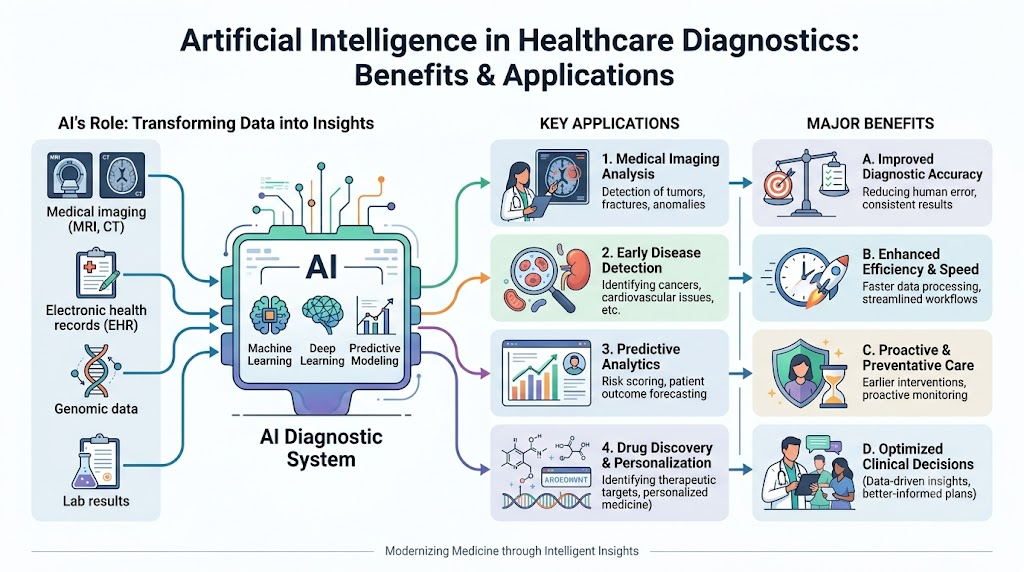
Artificial Intelligence (AI) has rapidly transitioned from theoretical computer science into the core infrastructure of modern healthcare. Today, diagnostic medicine stands at the center of this transformation. Across hospitals, imaging centers, and clinical laboratories, healthcare teams face rising patient volumes, vast amounts of digital health data, and complex diagnostic challenges. AI assists clinicians in making faster, more precise diagnostic evaluations. Crucially, AI in healthcare diagnostics is not designed to replace human medical judgment. Instead, it serves as a sophisticated clinical assistant—enhancing human expertise, reducing diagnostic error, and enabling earlier interventions. In this deep-dive guide presented by AIUniverse.xyz, we examine the technologies, workflows, real-world applications, ethical frameworks, and career pathways shaping the future of AI-powered healthcare diagnostics.
What is AI in Healthcare?
In the context of healthcare, Artificial Intelligence refers to the application of computer algorithms, statistical models, and machine learning architectures to emulate human cognitive functions in analyzing complex medical data. Rather than following rigid, pre-programmed rules, modern AI systems learn from vast datasets—including medical images, genomic sequences, pathology slides, and electronic health records (EHRs)—to recognize patterns and support clinical decisions.
AI in healthcare spans several core computational subdisciplines:
- Machine Learning (ML): Algorithms that analyze structured clinical data to identify disease patterns and predict patient outcomes.
- Deep Learning (DL): Multi-layered neural networks capable of evaluating unstructured visual data, such as radiological scans and digital histology slides.
- Natural Language Processing (NLP): Computational linguistic models that parse, extract, and structure unstructured narrative text from doctor’s notes and clinical records.
- Computer Vision: Advanced image-processing systems that detect subtle anomalies across various medical imaging modalities.
Understanding Healthcare Diagnostics
Healthcare diagnostics is the clinical discipline of identifying a disease, condition, or injury based on a patient’s symptoms, medical history, physical examinations, laboratory tests, and imaging procedures. Diagnostic accuracy is the foundation of effective medical care; a delayed or incorrect diagnosis can lead to inappropriate treatments, higher healthcare costs, or adverse patient outcomes.
Traditional diagnostic workflows generally follow a linear path:
[Patient Presentation & History]
       │
       ▼
[Clinical Assessment & Symptom Review]
       │
       ▼
[Ordering Diagnostic Tests (Imaging, Bloodwork, Pathology)]
       │
       ▼
[Manual Data Processing & Specialist Interpretation]
       │
       ▼
[Formulating Diagnosis & Treatment Plan]
While highly effective, this manual workflow faces systemic challenges:
- High Data Volume: Modern diagnostic tools generate far more data than a clinician can manually process in short consultation windows.
- Cognitive Fatigue: Radiologists and pathologists frequently review hundreds of complex scans per shift, increasing susceptibility to perceptual fatigue.
- Diagnostic Bottlenecks: Resource-constrained clinical settings often experience delays in turnaround times for laboratory and imaging interpretations.
Why AI is Transforming Medical Diagnostics
The integration of Artificial Intelligence into diagnostic medicine addresses critical bottlenecks across the healthcare continuum. AI models process millions of data points in seconds, highlighting subtle deviations that might escape human visual perception during routine reviews.
Key drivers behind the adoption of AI in healthcare diagnostics include:
- Enhanced Sensitivity: Identifying early-stage micro-calcifications, subtle tissue density changes, or subtle cellular dysplasia before symptoms manifest.
- Workflow Acceleration: Triage protocols automatically prioritize urgent, high-risk cases (such as acute intracranial hemorrhages or pulmonary emboli) to top radiologist worklists.
- Multimodal Integration: Modern diagnostic algorithms synthesize disparate data sources—combining genomic profiling, metabolic lab panels, and longitudinal imaging into unified patient risk assessments.
AI vs Traditional Diagnostic Approaches
To understand the transformative impact of digital health technologies, consider how traditional diagnostic steps compare to AI-assisted workflows:
| Feature / Aspect | Traditional Diagnostic Approach | AI-Assisted Diagnostic Approach |
| Data Processing Speed | Manual review of images, charts, and lab results; time-intensive. | Instantaneous scanning and pattern identification across massive datasets. |
| Pattern Recognition | Relies entirely on human memory, training, and individual experience. | Matches clinical features against millions of trained global patient records. |
| Workload & Triage | Sequential processing (First-In, First-Out), risking delays for critical cases. | Automated priority flagging for urgent emergency cases (e.g., acute stroke, pneumothorax). |
| Unstructured Data Use | Unstructured clinical notes are difficult to aggregate and contextualize quickly. | NLP extracts, categorizes, and maps key unstructured terms into structured clinical insights. |
| Role of Clinician | Primary evaluator responsible for data extraction, synthesis, and final diagnosis. | Primary decision-maker reviewing AI-generated flags, annotations, and structured insights. |
Machine Learning in Disease Detection
Machine Learning (ML) serves as the engine for quantitative risk stratification in disease detection. Supervised ML algorithms are trained on labeled clinical datasets containing patient demographics, physiological vital signs, biomolecular indicators, and clinical outcomes.
For example, classification models such as XGBoost, Random Forests, and Support Vector Machines (SVMs) evaluate tabular EHR data to assess the probability of conditions like sepsis, diabetic retinopathy, or acute kidney injury hours before clinical deterioration becomes overt.
In cardiovascular care, ML algorithms analyze subtle electrocardiogram (ECG) waveform variances to identify paroxysmal atrial fibrillation or early-stage heart failure, flagging high-risk individuals for proactive cardiology consults.
Deep Learning for Medical Imaging
Deep Learning (DL)—specifically Convolutional Neural Networks (CNNs) and Vision Transformers (ViTs)—has transformed image-based diagnostics. Unlike traditional machine learning, which requires human engineers to manually define visual features, deep neural networks extract spatial hierarchies of features directly from raw image pixels.
Architecture Overview of Deep Learning in Medical Imaging
[Raw Medical Image (DICOM)]
            │
            ▼
┌────────────────────────────────────────┐
│   Feature Extraction Layers (CNN/ViT)  │
│  - Edge & Contrast Detection          │
│  - Tissue Boundary Identification      │
│  - Spatial Pattern Segmentation       │
└────────────────────────────────────────┘
            │
            ▼
┌────────────────────────────────────────┐
│     Classification & Scoring Engine    │
│  - Heatmap Generation (Grad-CAM)       │
│  - Anomaly Scoring & Probability Map   │
└────────────────────────────────────────┘
            │
            ▼
[Clinician Interface: Annotated Image + Secondary Review Recommendation]
Deep learning models process complex radiological files (stored in DICOM format), applying spatial feature maps across successive layers to identify minute abnormalities that warrant immediate human review.
Computer Vision in Radiology and Pathology
Computer vision technologies apply deep learning models directly to diagnostic visual specialties:
1. Radiology AI
In diagnostic radiology, computer vision assists in analyzing Computed Tomography (CT) scans, Magnetic Resonance Imaging (MRI), Mammography, and X-rays.
- Chest X-Rays: AI algorithms scan for consolidations, nodular opacities, pleural effusions, and pneumothorax.
- Mammography: Computer Vision tools serve as a second reader in breast cancer screening, reducing false-positive callbacks while detecting occult lesions hidden within dense breast tissue.
- Neurological Imaging: CT perfusion algorithms calculate cerebral ischemic core and penumbra volumes during acute ischemic strokes, allowing stroke intervention teams to save critical brain tissue.
2. Digital Pathology
Digital pathology replaces traditional microscope slides with ultra-high-resolution Whole Slide Images (WSIs). Computer vision algorithms analyze cellular morphology, tissue architecture, and mitotic counts:
- Oncology Staging: AI pinpoints micro-metastases in lymph nodes that might be overlooked during rapid frozen-section analysis.
- Biomarker Quantification: Automated systems score HER2, PD-L1, or Ki-67 immunohistochemistry stains with high reproducibility, eliminating subjective inter-observer variability.
Natural Language Processing for Clinical Documentation
A significant portion of critical health data remains locked in unstructured narrative formats—such as discharge summaries, operative reports, progress notes, and family history logs. Natural Language Processing (NLP) unlocks this information.
Advanced NLP pipelines utilize Named Entity Recognition (NER) and Large Language Models (LLMs) tuned for medicine to:
- Synthesize Patient Histories: Automatically extract prior diagnoses, drug allergies, and family cancer histories from multi-year records to highlight risk factors prior to diagnostic orders.
- Clinical Protocol Verification: Cross-reference clinical documentation against established medical guidelines to alert doctors if a diagnostic test or follow-up scan was missed.
- Automated Coding: Convert narrative diagnostic reports into ICD-10 and CPT codes for administrative and epidemiological tracking.
Predictive Analytics in Healthcare
Predictive analytics moves healthcare from reactive care to proactive, preventative intervention. By analyzing historical longitudinal records, environmental factors, and baseline physiological data, predictive models evaluate an individual patient’s future disease trajectory.
- Readmission & Complication Modeling: Predictive algorithms identify surgical patients at elevated risk for surgical site infections, pulmonary complications, or 30-day hospital readmissions.
- Chronic Disease Trajectory: Models predict the rate of renal function decline in diabetic patients, enabling timely interventions to slow disease progression.
- Infectious Disease Surveillance: Aggregated diagnostic data allows predictive tools to track regional viral outbreaks, informing public health responses and resource distribution.
AI for Early Detection of Diseases
Early detection remains the single most effective variable in improving long-term survival rates across major oncology and degenerative diseases. AI models excel at detecting subtle pathophysiological alterations long before overt symptoms manifest:
- Oncology: AI tools detect early lung cancer nodules on low-dose CT scans, identifying asymptomatic stage-I malignancies when 5-year survival rates are highest.
- Ophthalmology: Autonomous AI systems scan retinal fundus photographs to diagnose early-stage diabetic retinopathy and age-related macular degeneration without requiring an on-site retinal specialist.
- Neurodegenerative Conditions: Machine learning evaluates speech subtle variations, gait biometrics, and functional MRI connectivity maps to detect pre-symptomatic markers of Alzheimer’s and Parkinson’s disease.
Clinical Decision Support Systems (CDSS)
A Clinical Decision Support System (CDSS) is an interactive software application that provides clinicians with real-time, evidence-based diagnostic suggestions directly within their Electronic Health Record (EHR) workspace.
Modern AI-Powered CDSS Workflow
[Patient Clinical Data Input (Vitals, Labs, Symptoms)]
                       │
                       ▼
┌────────────────────────────────────────────────────────┐
│               AI Integration Engine                   │
│  - Real-time Evidence Matching                         │
│  - Clinical Guideline Cross-Referencing                │
│  - Predictive Risk Calculation                        │
└────────────────────────────────────────────────────────┘
                       │
                       ▼
┌────────────────────────────────────────────────────────┐
│           Contextual In-Context Alert                 │
│  "High probability of early Sepsis based on WBC,       │
│   Lactate, and Temperature trend. Recommend Order Set X."│
└────────────────────────────────────────────────────────┘
                       │
                       ▼
┌────────────────────────────────────────────────────────┐
│        Physician Decision & Action Validation         │
│     [ Accept / Order ]   or   [ Override + Reason ]   │
└────────────────────────────────────────────────────────┘
The primary strength of a modern CDSS is contextual relevance. Rather than issuing passive alerts, the system offers actionable diagnostic considerations, citing underlying literature or patient-specific risk drivers to preserve physician decision-making.
AI Applications in Laboratory Diagnostics
Central diagnostic laboratories process thousands of blood, urine, tissue, and molecular samples daily. AI enhances efficiency and diagnostic precision across several lab disciplines:
- Hematology: Automated image-recognition tools analyze peripheral blood smears, rapidly classifying atypical white blood cells, blasts, and red blood cell morphological changes.
- Microbiology: AI vision systems monitor culture plates, identifying bacterial colony growth earlier than standard visual inspection and predicting antibiotic susceptibility patterns.
- Genomics & Next-Generation Sequencing (NGS): Machine learning models parse raw genomic sequences to distinguish benign genetic variants from pathogenic mutations associated with inherited disorders and targeted cancer therapies.
Wearable Devices and Remote Patient Monitoring
The expansion of consumer wearables and clinical-grade remote monitoring tools has shifted diagnostic monitoring from episodic hospital visits to continuous real-time assessment.
- Continuous Cardiac Monitoring: Smartwatches and ambulatory patches utilize photoplethysmography (PPG) and single-lead ECGs paired with AI models to detect silent atrial fibrillation, bradycardia, and ventricular ectopy.
- Metabolic Health: Continuous Glucose Monitors (CGMs) utilize predictive algorithms to anticipate glycemic spikes and hypoglycemic events before they occur.
- RPM for Heart Failure: Sensor arrays measure changes in thoracic impedance, body weight, and heart rate dynamics, alerting clinical care teams to early fluid overload in heart failure patients before emergency hospitalization is required.
Popular AI Technologies Used in Healthcare
To understand how software systems function in medical environments, here is a summary of leading AI technologies powering clinical diagnostic applications:
| Technology Name | Primary Medical Specialty | Diagnostic Capability / Purpose |
| Convolutional Neural Networks (CNNs) | Radiology, Dermatology, Pathology | High-accuracy visual pattern detection, tissue segmentation, and lesion identification in scans and slides. |
| Natural Language Processing (NLP) | Health Informatics, Administration | Parsing unstructured clinical documentation, extracting symptom entities, and streamlining EHR notes. |
| Recurrent Neural Networks (RNNs / LSTMs) | Intensive Care, Cardiology, RPM | Analyzing time-series data such as continuous ECG signals, vitals monitoring, and lab value trends. |
| Vision Transformers (ViTs) | Digital Pathology, Complex MRI | Evaluating long-range spatial context in high-resolution, multi-gigapixel whole-slide imaging. |
| XGBoost & Gradient Boosting | Clinical Decision Support Systems | Tabular risk prediction for hospital readmission, sepsis onset, and chronic disease progression. |
Real-World Healthcare Use Cases
Case 1: Accelerating Triage in Acute Ischemic Stroke
In stroke neurology, “time is brain.” When a patient presents with a suspected acute stroke, non-contrast CT scans are performed immediately. Modern AI stroke platforms process CT angiography images within 60 seconds. If a Large Vessel Occlusion (LVO) is identified, the system automatically alerts the neurointerventional surgical team on their mobile devices, cutting decision-to-treatment times significantly.
Case 2: Community Tuberculosis & Lung Screening
In low-resource global health settings, access to subspecialty radiologists is severely limited. Deploying offline edge-AI chest X-ray screening tools allows rural health workers to instantly screen patients for active Pulmonary Tuberculosis or early pulmonary lesions. Suspicious scans are prioritized for confirmatory molecular testing, expanding diagnostic access to underserved populations.
Benefits of AI in Healthcare Diagnostics
The thoughtful integration of diagnostic AI tools delivers measurable benefits across the healthcare ecosystem:
- Reduced Diagnostic Error: Serves as a reliable digital safety net, catching overlooked micro-lesions, incidental findings, and subtle pathology.
- Accelerated Turnaround Times: Reduces time-to-interpretation for diagnostic imaging and lab tests, accelerating clinical decision-making.
- Mitigation of Clinician Burnout: Automates routine visual checks and administrative documentation tasks, allowing providers to spend more direct face-to-face time with patients.
- Democratized Expertise: Delivers expert-level diagnostic support tools to community health centers and rural clinics lacking dedicated subspecialists.
- Cost Efficiency: Early disease detection reduces long-term treatment expenses and minimizes hospital stays associated with advanced disease complications.
Challenges, Risks, and Ethical Considerations
While AI offers immense promise in healthcare diagnostics, safe clinical integration requires navigating significant technical and ethical challenges:
- Algorithmic Bias & Representation: If an AI model is trained primarily on data from a single demographic or geographic cohort, its accuracy may decline when applied to diverse patient populations. Ensuring representative datasets is critical to avoiding healthcare disparities.
- The “Black Box” Problem & Explainability: Deep learning models often produce outputs without clear visual or logical explanations. Clinicians require Explainable AI (XAI) features—such as diagnostic heatmaps and confidence scores—to validate recommendations responsibly.
- Automation Bias: Over-reliance on automated tools can lead to automation bias, where clinicians blindly accept AI outputs or, conversely, ignore valid flags due to alarm fatigue.
- Liability & Malpractice: Determining legal responsibility when an AI-assisted diagnostic pipeline contributes to a missed or delayed diagnosis remains a developing legal frontier involving health systems, providers, and software vendors.
Data Privacy, Security, and Regulatory Compliance
Healthcare diagnostic tools handle sensitive Personal Health Information (PHI). Maintaining trust requires compliance with strict privacy and regulatory standards:
Data Protection Standards
- HIPAA & GDPR: AI systems must adhere to the Health Insurance Portability and Accountability Act (HIPAA) in the US and the General Data Protection Regulation (GDPR) in Europe, mandating strict data encryption, de-identification protocols, and user access controls.
- Cybersecurity Standards: Medical AI pipelines require robust protections (such as Secure Software Development Frameworks and Software Bill of Materials) to prevent data breaches or malicious manipulation.
Regulatory Oversight
Regulators such as the US Food and Drug Administration (FDA) evaluate diagnostic algorithms under the Software as a Medical Device (SaMD) framework. The FDA categorizes diagnostic AI tools based on risk, enforcing strict guidelines for validation, real-world performance monitoring, and Predetermined Change Control Plans (PCCPs) to manage algorithmic updates safely.
Human Oversight and Responsible AI
The central tenet of modern medical AI deployment is Human-in-the-Loop (HITL) architecture. Regulatory bodies and clinical societies consistently state that AI models are designed to inform, support, and assist—not to function as autonomous medical providers.
┌────────────────────────────────────────────────────────┐
│                   AI Diagnostic System                 │
│    - Rapid Pattern Analysis                            │
│    - Anomaly Detection & Heatmap Annotation            │
│    - Probabilistic Risk Scoring                        │
└───────────────────────────┬────────────────────────────┘
                            │
                            ▼
┌────────────────────────────────────────────────────────┐
│               Licensed Healthcare Clinician            │
│    - Evaluates Patient History & Physical Exam         │
│    - Reviews AI Findings & Clinical Context            │
│    - Applies Professional Judgment & Decides Care      │
└───────────────────────────┬────────────────────────────┘
                            │
                            ▼
┌────────────────────────────────────────────────────────┐
│             Final Diagnosis & Patient Consultation     │
└────────────────────────────────────────────────────────┘
By ensuring that a qualified medical professional reviews, interprets, and approves AI-generated findings, healthcare systems safeguard patient safety while leveraging machine learning performance.
Future Trends in AI-Powered Healthcare
As research accelerates, several key developments are shaping the next generation of healthcare diagnostics:
- Multimodal Generative AI: Advanced foundation models that simultaneously process clinical notes, genomic panels, pathology slides, and radiological volumes to synthesize comprehensive patient reports.
- Edge-AI Diagnostic Hardware: Ultra-compact, low-power neural processing units integrated directly into portable point-of-care ultrasound (POCUS) probes and hand-held devices for real-time offline analysis.
- Digital Twins: Constructing dynamic, computational patient models that simulate personalized disease progression and predict response to targeted diagnostic therapies.
- Federated Learning: Training diagnostic algorithms across decentralized hospital databases without transferring raw, sensitive patient records outside host institutions, protecting data privacy while advancing AI accuracy.
Career Opportunities in Healthcare AI
The convergence of artificial intelligence and medicine has created demand for specialized interdisciplinary professionals. Key emerging roles include:
- Healthcare Data Scientist: Develops and fine-tunes predictive algorithms using clinical data records and clinical trial results.
- Medical Computer Vision Engineer: Designs deep learning architectures tailored for high-resolution DICOM radiological image processing.
- Clinical Informatics Specialist: Bridges the gap between software development teams and hospital clinical workflows, ensuring smooth EHR integration.
- AI Health Ethics & Compliance Officer: Manages regulatory submissions, algorithmic bias audits, and compliance with global data protection laws.
- Medical AI Product Manager: Guides the development lifecycle of SaMD diagnostic tools from concept to clinical deployment.
Frequently Asked Questions
Q1: What is the primary role of AI in healthcare diagnostics?
AI supports clinicians by analyzing complex medical data—such as scans, bloodwork, and clinical records—to highlight potential anomalies, prioritize urgent cases, and assist in diagnostic decision-making.
Q2: Can AI replace human doctors and radiologists in diagnosis?
No. AI is designed to assist healthcare professionals, not replace them. Final clinical diagnoses, medical responsibility, and treatment plans remain under the direct authority of qualified physicians.
Q3: How does deep learning improve medical imaging?
Deep learning neural networks scan medical images at pixel levels, recognizing subtle shapes, textures, and tissue density variations that may indicate early-stage tumors, fractures, or vascular blockages.
Q4: What is a Clinical Decision Support System (CDSS)?
A CDSS is a clinical software tool that analyzes patient data within an EHR system and provides evidence-based suggestions, risk alerts, and diagnostic considerations directly to clinicians in real time.
Q5: Are AI-powered diagnostic tools approved by regulatory authorities like the FDA?
Yes. Regulators evaluate AI diagnostic tools under software-as-a-medical-device (SaMD) frameworks. Hundreds of AI-enabled medical algorithms have received clearance for clinical use.
Q6: How does AI contribute to early disease detection?
AI algorithms detect minute pathophysiological patterns in medical images, genomic data, and blood markers long before physical symptoms appear, enabling timely intervention.
Q7: What is the difference between Machine Learning and Deep Learning in healthcare?
Machine learning uses statistical models to analyze structured data like lab values and patient demographics, while deep learning uses neural networks to process unstructured visual data like CT scans and digital histology slides.
Q8: How do wearable devices utilize AI for remote patient monitoring?
Wearables collect continuous physiological data—such as heart rhythms and oxygen levels—and use AI algorithms to flag irregular patterns like atrial fibrillation or respiratory distress.
Q9: What are the primary ethical concerns regarding AI in healthcare?
Key ethical concerns include algorithmic bias across demographic groups, algorithmic transparency (“black box” issues), patient data privacy, and establishing liability in medical decisions.
Q10: How do healthcare organizations protect patient privacy when training AI models?
Organizations use strict data de-identification, encryption standards, HIPAA/GDPR compliance frameworks, and advanced methods like federated learning to protect patient identities during AI model training.
Conclusion
Artificial Intelligence is reshaping healthcare diagnostics. By functioning as a powerful digital assistant, AI empowers clinicians to analyze complex medical data faster, detect disease earlier, and optimize hospital workflows. From deep learning models in radiology to predictive risk scoring in clinical decision support, AI technology enhances medical accuracy while keeping human clinical judgment at the center of care. As regulatory frameworks mature and multimodal foundation models evolve, responsible AI integration will continue to elevate patient outcomes worldwide.
