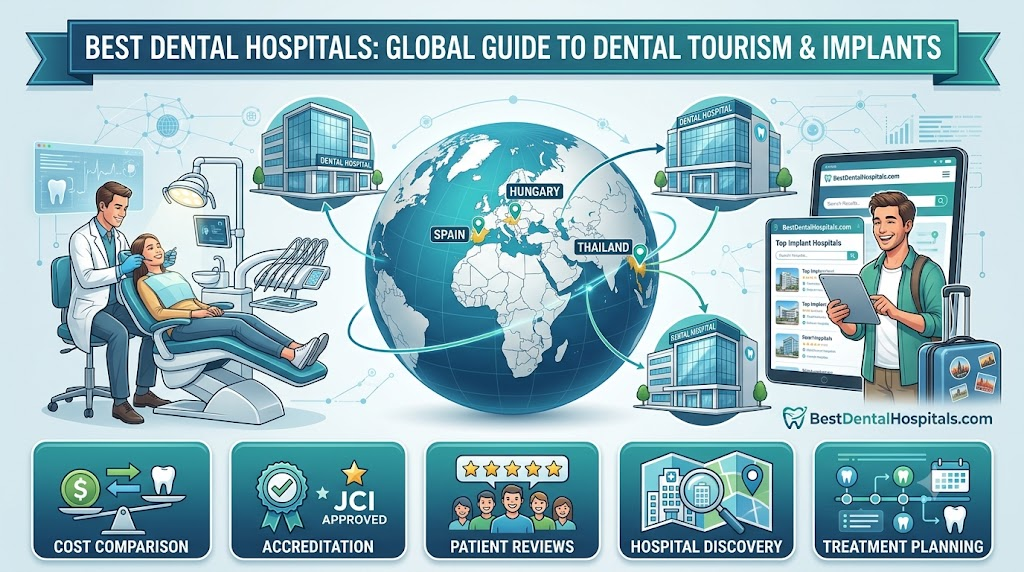
Navigating global healthcare options for major restorative work, full-mouth reconstructions, or cosmetic smile makeovers can feel overwhelming. Millions of patients every year explore international healthcare destinations to access world-class specialist dentists, advanced clinical technology, and transparent treatment pricing. Platforms like BestDentalHospitals serve as valuable discovery tools to help patients compare accredited international clinics, specialist credentials, and estimated treatment plans in one place. Selecting the right hospital requires careful research beyond headline costs. Patients must evaluate clinical accreditations, dentist credentials, sterilization standards, and long-term aftercare support.
Understanding International Dental Care & Discovery
Dental tourism refers to traveling across international borders to receive specialized oral healthcare. Historically, travel for healthcare was restricted to niche medical procedures. Today, advanced digital imaging, international clinical accreditations, and global travel logistics have made high-quality restorative dentistry accessible worldwide.
Modern international dental facilities function as comprehensive medical-dental hubs. Leading centers integrate multiple specialties under one roof, including:
- Oral and Maxillofacial Surgeons: Specialists performing complex bone grafting, sinus lifts, and surgical implant placements.
- Prosthodontists: Experts focused on restoring original teeth and fabricating crowns, bridges, and implant-supported prostheses.
- Periodontists: Oral health experts specializing in gum tissue health, bone stability, and peri-implantitis prevention.
- Endodontists & Cosmetic Specialists: Dentists dedicating their practice to root canal therapy, porcelain veneers, and aesthetic smile design.
These facilities utilize diagnostic tools like 3D Cone Beam Computed Tomography (CBCT) scans, intraoral optical scanners, and Computer-Aided Design/Computer-Aided Manufacturing (CAD/CAM) milling units. This technology allows surgical and restorative teams to coordinate precise implant placement and custom restorations efficiently.
Why Patients Seek Treatment Abroad
The decision to travel for care usually stems from a combination of financial, clinical, and accessibility factors:
                      ┌────────────────────────────────────────┐
                      │    Primary Travel Drivers              │
                      └──────────────────┬─────────────────────┘
                                         │
        ┌────────────────────────────────┼────────────────────────────────┐
        │                                │                                │
┌───────┴────────┐              ┌────────┴────────┐              ┌────────┴────────┐
│ Cost & Value   │              │ Clinical Access │              │ Service Quality │
│ Structure      │              │ & Timelines     │              │ & Experience    │
└───────┬────────┘              └────────┬────────┘              └────────┬────────┘
        │                                │                                │
  • 50–70% savings                • Direct specialist access        • Multi-lingual care
  • Multi-tooth affordability     • Reduced waiting times           • Concierge support
  • All-inclusive pricing         • Advanced technology             • Resort-style recovery
- Significant Cost Differences: Dental care pricing varies by region due to differences in local operational overhead, malpractice insurance rates, administrative costs, and real estate expenses. Patients often find that comprehensive treatments like All-on-4 implants or multi-crown restorations are significantly more affordable abroad, even after accounting for travel and lodging.
- Direct Access to Specialists: In some domestic healthcare systems, seeing a prosthodontist or oral surgeon requires long waitlists or specialized insurance referrals. Top international hospitals often offer direct access to multi-specialty teams within a single facility.
- Advanced Clinical Infrastructure: Premium international clinics invest in the latest diagnostic and surgical technology. Features like digital smile design, 3D surgical guides, and in-house dental laboratories allow for streamlined treatment timelines.
- Dedicated Patient Services: Top international centers feature dedicated travel coordinators, multi-lingual patient advocates, airport transfer services, and partner hotel arrangements to simplify the treatment experience.
How to Evaluate and Select the Best Dental Hospitals
Selecting an international healthcare provider requires thorough clinical and operational vetting. Never base a health decision solely on marketing materials or low initial prices.
                      ┌────────────────────────────────────────┐
                      │   Hospital Vetting Framework           │
                      └──────────────────┬─────────────────────┘
                                         │
       ┌──────────────────┬──────────────┴───────────────┬──────────────────┐
       │                  │                              │                  │
┌──────┴───────┐   ┌──────┴───────┐               ┌──────┴───────┐   ┌──────┴───────┐
│ Clinician    │   │ Facility     │               │ Quality      │   │ Logistics    │
│ Credentials  │   │ Standards    │               │ & Materials  │   │ & Aftercare  │
└──────┬───────┘   └──────┬───────┘               └──────┬───────┘   └──────┬───────┘
       │                  │                              │                  │
  • Board certs      • ISO / JCI                    • Known brands     • Remote checkups
  • Surgical history • Autoclave protocol           • Passport docs    • Local partner network
  • Continuous ed    • Modern CBCT                  • Batch tracking   • Emergency protocols
1. Clinical Credentials and Specialist Expertise
Verify the qualifications of the specific dentist or oral surgeon performing your procedure, rather than relying only on general clinic reputations.
- Board Certification: Confirm if clinicians hold certifications from recognized national or international boards (e.g., International Congress of Oral Implantologists, European Association for Osseointegration, or national dental boards).
- Specialization vs. General Practice: Complex surgical procedures, such as full-arch reconstructions or sinus augmentations, should be managed by experienced oral surgeons or periodontists rather than general practitioners.
- Surgical Volume: Ask about the clinician’s specific experience with your planned procedure, particularly for full-mouth reconstructions or zygomatic implants.
2. Hospital Accreditations and Infection Control
Rigorous sterilization protocols protect against cross-contamination and surgical complications.
- International Accreditations: Look for facilities certified by organizations like the Joint Commission International (JCI), ISO (such as ISO 9001 for quality management systems), or national health ministry accreditations.
- Sterilization Equipment: Reputable clinics strictly follow autoclave sterilization standards, utilize disposable surgical drapes, and maintain dedicated sterile surgical suites for invasive procedures.
3. Materials and Technology Standards
The quality of dental components directly impacts treatment longevity.
- Tier-1 Implant Systems: Ensure the clinic uses internationally recognized implant brands (e.g., Straumann, Nobel Biocare, Zimmer Biomet, Dentsply Sirona, BioHorizons). These systems offer long-term clinical research data and universally available components if maintenance is needed years later.
- Implant Passports: Quality clinics issue official documentation (an implant passport) detailing the brand, model, lot number, and serial number of every fixture inserted.
- Diagnostic Precision: Verify that the clinic uses 3D CBCT scans for surgical planning rather than relying exclusively on standard 2D panoramic X-rays.
Key Dental Treatments & Clinical Overview
Dental Implants and Full-Arch Rehabilitation
A dental implant is a titanium or zirconia post surgically anchored into the jawbone to replace a missing tooth root. Over a healing period of 3 to 6 months, the implant integrates with surrounding bone tissue through a biological process called osseointegration.
| Treatment Modality | Clinical Indication | Structural Components | Typical Treatment Timeline |
| Single Dental Implant | Individual missing tooth with adequate bone density | Single implant post, custom abutment, and ceramic crown | Stage 1: Placement. Stage 2 (3–6 mos later): Final restoration. |
| Multiple Dental Implants | Several adjacent missing teeth | Two or more implant posts supporting a multi-unit dental bridge | 2 visits spanning 3 to 6 months for complete integration. |
| All-on-4 / All-on-6 | Complete arch tooth loss or terminal dentition | 4 or 6 strategically angled implants supporting a full fixed bridge | Stage 1: Extraction, implant placement, temporary bridge. Stage 2 (4–6 mos): Permanent bridge. |
| Full Mouth Reconstruction | Complex deterioration across both upper and lower arches | Combination of implants, crowns, and potential bone grafts | Multi-stage care spanning 6 to 12 months depending on healing. |
Supplementary Surgical Procedures
When jawbone structure is insufficient to support implants, supplementary procedures may be necessary:
- Bone Grafting: Adding natural or synthetic bone material to augment deficient areas of the jaw.
- Sinus Lift (Sinus Augmentation): Elevating the sinus membrane and grafting bone underneath to create vertical height for upper back implants.
Cosmetic Dentistry Options
Cosmetic treatments focus on improving teeth appearance, alignment, and color:
- Porcelain Veneers: Thin ceramic shells bonded to the front surface of teeth to correct discoloration, gaps, or minor misalignment.
- Dental Crowns: Full-coverage caps placed over damaged or heavily filled teeth to restore shape, strength, and aesthetic appearance.
Dental Tourism Destinations Compared
Different countries specialize in specific areas of dental care based on location, pricing, and infrastructure:
| Country | Primary Market Served | Clinical Strengths | Key Considerations |
| Mexico | North America (US & Canada) | Proximity, day-trip options in border towns, extensive English support | Quality varies; thorough vetting of individual clinics is essential. |
| Thailand | Asia-Pacific, Europe, US | JCI-accredited medical centers, advanced technology, hospitality | Longer flight times for Western travelers; requires extended stays. |
| Hungary | Western Europe & UK | EU clinical standards, highly specialized prosthodontic education | Requires flight travel across Europe; peak season booking delays. |
| Turkey | Europe, Middle East, UK | High-volume cosmetic dentistry, package pricing, modern facilities | Confirm conservative treatment planning and verify implant brands used. |
| Costa Rica | North America | US-trained clinicians, high English fluency, eco-tourism appeal | Slightly higher pricing than basic options, but strong overall value. |
Dental Implant Cost Considerations
Dental treatment costs depend on several clinical and administrative factors. Never rely on generic base prices without a personalized, itemized quote based on current diagnostic imaging.
Factors Influencing Overall Treatment Cost
- Diagnostic Requirements: 3D CBCT scans, digital impressions, and surgical guide fabrication.
- Surgical Preparations: Extractions, bone grafting, ridge preservation, or sinus lift procedures.
- Implant Component Selection: Premium titanium fixtures vs. budget options, plus custom abutments.
- Restorative Materials: Acrylic vs. composite vs. solid monolithic zirconia full-arch restorations.
- Anesthesia and Sedation: Local anesthesia vs. conscious IV sedation managed by an anesthesiologist.
┌────────────────────────────────────────────────────────────────────────┐
│                   Total Cost Breakdown Components                      │
├────────────────────────────────────────────────────────────────────────┤
│ [ Diagnostics ] → CBCT Scans, X-Rays, Digital Impressions               │
│ [ Preparation ] → Extractions, Bone Grafts, Sinus Lifts                │
│ [ Surgical ]    → Implant Fixtures, Surgical Guides, Sedation          │
│ [ Prosthetic ]  → Temporary Bridge, Custom Abutments, Zirconia Crown   │
│ [ Travel/Log ]  → Flights, Accommodation, Transfers, Post-Op Care      │
└────────────────────────────────────────────────────────────────────────┘
Treatment Cost Framework
Because fees vary significantly by provider and patient needs, evaluation requires comparing domestic averages with international ranges:
| Treatment Category | Estimated Domestic Range (US/UK) | Estimated International Range | Included Cost Components |
| Single Implant (Complete) | $3,000 – $5,000 / £2,000 – £3,500 | $800 – $1,800 / €600 – €1,200 | Implant fixture, abutment, ceramic crown. |
| All-on-4 (Per Arch) | $15,000 – $30,000+ / £12,000+ | $6,000 – $12,000 / €5,500 – €10,000 | Implants, temporary restoration, final fixed bridge. |
| Full Arch Porcelain Veneers | $12,000 – $25,000 / £10,000+ | $3,500 – $8,000 / €3,000 – €7,000 | Diagnostic wax-up, prep, temporary and permanent veneers. |
Note: Estimates exclude travel, lodging, and unexpected pre-surgical bone augmentation costs. Always request a written, line-item treatment quote before traveling.
Planning Your International Dental Trip
Successful dental travel requires clear coordination between the patient, the overseas clinic, and a local dentist for follow-up care.
┌─────────────────────────────────────────────────────────────────────────┐
│                     Chronological Travel Roadmap                        │
├─────────────────────────────────────────────────────────────────────────┤
│ PHASE 1: Remote Assessment (Weeks 1–3)                                  │
│ └─ Obtain local CBCT/X-rays ➔ Submit to platform ➔ Receive treatment plan│
├─────────────────────────────────────────────────────────────────────────┤
│ PHASE 2: Trip Preparation (Weeks 4–6)                                   │
│ └─ Confirm itemized quote ➔ Book flexible travel ➔ Arrange local records│
├─────────────────────────────────────────────────────────────────────────┤
│ PHASE 3: Clinical Treatment (Week 7 / Stage 1)                          │
│ └─ Onsite examination ➔ Surgical phase ➔ Provision of temporary teeth │
├─────────────────────────────────────────────────────────────────────────┤
│ PHASE 4: Healing & Final Restoration (3–6 Months Later)                 │
│ └─ Bone integration ➔ Return visit ➔ Final fitting & adjustment         │
├─────────────────────────────────────────────────────────────────────────┤
│ PHASE 5: Long-Term Maintenance (Ongoing)                                │
│ └─ Provide docs to home dentist ➔ Routine hygiene ➔ Annual checkups     │
└─────────────────────────────────────────────────────────────────────────┘
Stage 1: Initial Research and Remote Evaluation
- Gather Existing Records: Obtain recent digital dental X-rays, panoramic images, or CBCT scans from a local provider.
- Submit for Consultation: Send diagnostic records to international hospitals to receive preliminary treatment plans.
- Compare Proposals: Evaluate proposed timelines, implant systems, surgical techniques, and itemized fee structures.
Stage 2: Pre-Travel Verification
- Request Written Guarantees: Review the clinic’s formal terms regarding component warranties, revision policies, and emergency care handling.
- Verify Scheduling: Ensure the clinic allocates enough time for pre-op exams, surgical steps, initial healing, and post-op adjustments.
- Book Flexible Travel: Purchase refundable or adjustable flight tickets and accommodations to account for potential clinical delays.
Stage 3: Onsite Treatment and Recovery
- Comprehensive In-Person Examination: Undergo thorough clinical evaluation, including a fresh 3D scan, before any irreversible procedures begin.
- Surgical and Restorative Phases: Complete planned surgical stages and receive custom temporary prostheses during the initial integration phase.
- Document Collection: Before departing, obtain full surgical records, X-rays, implant brand passports, and detailed home-care guidelines.
Dental Tourism: Benefits vs. Practical Considerations
| Category | Key Advantages | Practical Considerations & Risks |
| Financial & Value | Access to comprehensive treatments at lower overall costs. | Additional expenses for travel, accommodation, and time off work. |
| Clinical Access | Combined specialist care under one roof with modern CAD/CAM tech. | Follow-up care requires coordination with a domestic dentist or return travel. |
| Treatment Experience | Private, dedicated international patient teams and fast scheduling. | Potential language barriers if private coordinators are not present. |
| Care Continuity | Opportunity to recover in comfortable destination settings. | Complications after returning home require pre-established local support protocols. |
Expert Tips for International Dental Patients
- Compare Comprehensive Treatment Plans: Look beyond headline prices. Compare the exact number of implants, abutment types, restoration materials, and inclusion of diagnostic fees across different quotes.
- Verify Specific Implant Systems: Ensure the hospital uses well-documented, internationally recognized implant brands (such as Straumann or Nobel Biocare) rather than unbranded generic fixtures.
- Request an Implant Passport: Always receive an official document listing serial numbers and specifications for all placed surgical components.
- Plan Buffer Days: Schedule 2 to 3 extra days at your destination after major procedures to allow for post-op checks and bite adjustments before flying home.
- Confirm Domestic Follow-Up Support: Identify a qualified dentist in your home country willing to handle routine maintenance, cleanings, or adjustments for your international dental work.
Best Practices for Safe Treatment Planning
- Prioritize Comprehensive Examinations: Never undergo surgical procedures without an in-person clinical exam and modern 3D CBCT imaging.
- Maintain Medical Transparency: Disclose your full medical history, including chronic conditions, medications (especially blood thinners or bisphosphonates), allergies, and smoking habits.
- Verify Sterilization Standards: Confirm that the hospital uses automated autoclave sterilization systems and maintains dedicated sterile surgical suites.
- Clarify Revision Protocols: Ask in writing how the hospital handles complications, fixture failures, or necessary prosthetic adjustments after you return home.
- Keep Complete Medical Records: Secure digital copies of your pre-op and post-op X-rays, treatment notes, prescriptions, and lab receipts.
Common Mistakes to Avoid
❌ Error 1: Choosing purely on lowest price ──► Fix: Evaluate dentist credentials & implant brands
❌ Error 2: Rushing treatment schedules     ──► Fix: Allow full biological healing times
❌ Error 3: Skipping domestic follow-up     ──► Fix: Partner with a local dentist prior to travel
❌ Error 4: Ignoring itemized details       ──► Fix: Demand transparent, line-item quotations
- Choosing Based Solely on the Lowest Price: Selecting a clinic based on cheap headline rates often leads to hidden fees, substandard materials, or inexperienced clinicians.
- Underestimating Biological Healing Times: Rushing bone integration or skipping temporary stabilization stages increases the risk of implant failure.
- Failing to Verify Dentist Credentials: Assuming all dentists at a facility have equal expertise. Always verify your specific operator’s surgical training and credentials.
- Overlooking Travel Logistics and Rest: Scheduling strenuous tourist activities immediately after extensive oral or implant surgery.
- Not Securing Local Aftercare Options: Traveling abroad without establishing a plan for routine cleanings, maintenance, or emergency evaluations back home.
Future Trends in Global Dental Healthcare
- Digital Workflow and AI Diagnostics: 3D intraoral scanning, AI-assisted radiological interpretation, and 3D printing allow clinics to plan surgeries with precision and produce temporary restorations faster.
- Guided Implant Surgery: Computer-designed surgical templates make implant placement faster, less invasive, and more predictable.
- Tele-Dentistry and Remote Monitoring: Virtual consultations and smartphone-based recovery monitoring allow international surgical teams to track healing before patients travel for follow-up visits.
- Expanded Discovery Platforms: Centralized healthcare platforms help patients compare clinic accreditations, clinician credentials, verified reviews, and transparent pricing structures safely.
Why Use BestDentalHospitals for Healthcare Research
BestDentalHospitals serves as a global discovery platform, helping patients research and compare international dental institutions safely.
                     ┌──────────────────────────────────────────┐
                     │     BestDentalHospitals Platform         │
                     └────────────────────┬─────────────────────┘
                                          │
       ┌──────────────────┬───────────────┴───────────────┬──────────────────┐
       │                  │                               │                  │
┌──────┴───────┐   ┌──────┴───────┐                ┌──────┴───────┐   ┌──────┴───────┐
│ Accredited   │   │ Credentialed │                │ Transparent  │   │ Dedicated    │
│ Directory    │   │ Specialists  │                │ Quotes       │   │ Support      │
└──────┬───────┘   └──────┬───────┘                └──────┬───────┘   └──────┬───────┘
       │                  │                               │                  │
  • JCI / ISO / National  • Board-certified               • Line-item details • Travel logistics
  • Infection standards   • Verified case history         • No hidden fees    • Language support
- Verified Facility Profiles: Access detailed information on accredited dental hospitals, surgical suites, technology standards, and infection control practices worldwide.
- Specialist Credentials: Review clinician profiles, board certifications, and surgical experience in fields like implantology, prosthodontics, and oral surgery.
- Transparent Cost Comparisons: Compare itemized treatment plans and structural estimates to make well-informed financial decisions.
- International Patient Coordination: Discover facilities offering multi-lingual staff, travel assistance, airport transfers, and organized aftercare support.
Frequently Asked Questions
1. What defines the best dental hospitals for international patients?
Top international dental hospitals maintain international accreditations (such as JCI or ISO), employ board-certified specialists, utilize advanced 3D CBCT diagnostic imaging, and offer dedicated international patient departments. They use Tier-1 implant systems, maintain strict sterilization protocols, and provide transparent, itemized treatment plans.
2. Is traveling abroad for dental implants safe?
Yes, traveling abroad for dental work is safe when you thoroughly vet the facility and clinician. Safety depends on choosing accredited hospitals that adhere to strict hygiene standards, employ experienced oral surgeons, use proven implant brands, and perform comprehensive pre-operative 3D imaging.
3. How do I research and compare international dental hospitals?
Compare hospitals by checking clinical accreditations, verifying dentist qualifications, reviewing before-and-after case histories, confirming implant brands, and checking infection control standards. Discovery platforms like BestDentalHospitals help simplify this process by gathering verified hospital data and patient resources in one place.
4. What factors explain the cost differences for dental implants abroad?
Cost differences are primarily driven by lower real estate expenses, reduced administrative overhead, lower malpractice insurance costs, and favorable currency exchange rates in host countries. Lower prices do not necessarily reflect lower clinical quality when working with accredited, top-tier providers.
5. What are All-on-4 dental implants, and who is a candidate?
All-on-4 is a full-arch restoration technique where four strategically placed implants support a complete fixed bridge. It is designed for patients with significant tooth loss, terminal dentition, or reduced bone density who wish to avoid extensive bone grafting. Candidates require thorough clinical examination and 3D CBCT scanning.
6. How long does treatment take for full mouth dental implants abroad?
Full-mouth implant treatment usually requires two separate visits over 3 to 6 months. The initial visit (5–10 days) includes extractions, implant placement, and fitting a temporary bridge. After a 3- to 6-month healing period for bone integration, the second visit (7–10 days) involves fitting the final permanent restoration.
7. What credentials should I check before choosing an overseas implant dentist?
Verify that your dentist is board-certified in oral surgery, periodontics, or prosthodontics. Look for active memberships in international organizations such as the ICOI or EAO, and confirm extensive practical experience with your specific procedure.
8. What should be included in a transparent dental treatment quotation?
A transparent quote should list all diagnostic costs (CBCT scans, X-rays), surgical fees, implant posts, abutments, temporary prostheses, final restorations, laboratory costs, extractions, bone grafting, anesthesia, and medication. It should also outline warranty terms and revision policies.
9. How do I manage dental follow-up care after returning home?
Before traveling, secure a domestic dentist willing to handle routine cleanings, maintenance, and periodic checks for your international dental work. Obtain full clinical documentation from your treating hospital, including your X-rays, treatment notes, and implant passport.
10. Can I get a reliable dental treatment estimate before traveling?
Yes, reputable international hospitals can provide preliminary treatment plans and estimates based on recent 3D CBCT scans, panoramic X-rays, and dental records. However, final treatment plans and costs must always be confirmed during your in-person clinical examination.
11. Which countries are most popular for international dental tourism?
Popular destinations include Mexico and Costa Rica for North American travelers; Hungary, Poland, and Turkey for European patients; and Thailand for travelers from Australia, Asia, and North America. Selection should depend on clinical specialization, travel convenience, and total costs.
12. What happens if a dental implant fails or requires adjustment?
Reputable clinics offer written warranty policies detailing coverage for component replacements or necessary revisions. If adjustments are needed after returning home, contact your international patient coordinator to determine whether a local partner clinic can assist or if a return visit is required under your warranty.
13. What diagnostic tests are required before implant surgery?
Essential pre-surgical diagnostics include a 3D Cone Beam Computed Tomography (CBCT) scan to assess bone volume and density, panoramic X-rays, digital intraoral scans, and a comprehensive oral health evaluation. General health assessments or blood tests may also be needed to evaluate surgical readiness.
14. Are cosmetic dentistry treatments like veneers safe to receive abroad?
Yes, cosmetic treatments like porcelain veneers are safe when performed by experienced prosthodontists or cosmetic specialists. Ensure the clinic uses conservative preparation techniques, high-quality ceramic materials, and digital smile design technology to achieve natural-looking, long-lasting results.
15. How does BestDentalHospitals assist international patient planning?
BestDentalHospitals serves as an informational platform that helps patients research accredited dental centers, compare specialist credentials, explore treatment options, and evaluate destination pricing. It provides structured tools to request quotes and connect with international patient coordination teams.
Conclusion
Choosing international dental care for implants, full-mouth reconstructions, or cosmetic procedures offers access to world-class treatment, advanced clinical technology, and transparent pricing. However, achieving a successful outcome depends on thorough research, proper facility vetting, and clear treatment planning. Patients must focus on clinician credentials, hospital accreditations, infection control standards, and the quality of implant materials rather than headline prices alone. Establishing aftercare plans and coordinating with local dental professionals ensures long-term oral health and restoration success.
