Introduction
Modern digital marketing is moving faster than ever before. Marketers face a massive wave of data, channels, and customer expectations every single day. Managing manual campaigns across email, social media, and search engines has become nearly impossible for growing businesses. To stay competitive, businesses need to scale their workflows without losing the human touch. This is where automation becomes essential. Automated workflows allow teams to schedule posts, send bulk emails, and track user behavior automatically, saving thousands of hours of manual labor. For deep insights into the evolving landscape of artificial intelligence and digital transformation, platforms like AIUniverse provide comprehensive updates on how these advanced systems are reshaping global industries. Integrating machine learning into your workflows is no longer a luxury, but a necessity for survival.
Key Takeaways
- Intelligent Scaling: AI moves marketing automation past rigid, rule-based systems into dynamic, real-time decision engines.
- Hyper-Personalization: Machine learning models analyze behavioral data to deliver unique content, product recommendations, and emails to individuals at scale.
- Predictive Power: Using predictive analytics allows businesses to forecast customer churn, calculate lifetime value, and score leads with extreme accuracy.
- Operational Efficiency: Automating content generation, data segmentation, and ad bidding frees creative teams to focus on high-level strategy.
- Data-Driven ROI: AI-driven campaigns continuously optimize themselves through multivariate testing, leading to lower acquisition costs and higher conversion rates.
What is Marketing Automation?
Marketing automation refers to the software and technologies designed to execute repetitive marketing tasks across multiple online channels automatically. The core purpose of this technology is to streamline operational workflows, eliminate manual errors, and scale marketing efforts efficiently.
At its basic level, marketing automation handles tasks like sending out welcome emails when someone subscribes to a newsletter, publishing pre-scheduled social media posts, or moving a lead from one list to another based on an action they took. It ensures that no prospect falls through the cracks due to human forgetfulness.
To understand its value, we must compare traditional automation with modern automation systems:
| Feature | Traditional Automation | Modern Automation |
| Trigger Mechanism | Static, rule-based triggers (e.g., clicking a specific link). | Dynamic, behavior-based triggers across multiple touchpoints. |
| Data Processing | Batch processing of static customer profiles. | Real-time stream processing of active user sessions. |
| Adaptability | Requires manual adjustments when consumer habits change. | Self-optimizing systems that adjust parameters automatically. |
| Channel Integration | Siloed operations, usually limited to single channels like email. | Omnichannel orchestration connecting web, mobile, social, and offline data. |
What is AI in Marketing Automation?
AI in marketing automation is the integration of machine learning algorithms, natural language processing, and predictive modeling into standard automation workflows. Instead of just executing pre-set commands, the system learns from historical data and real-time user actions to make autonomous optimization decisions.
AI enhances automation by acting as the brain of the operation, while standard automation serves as the hands. For instance, while traditional software can automatically send an email at 9:00 AM because a human programmed it to do so, an AI-enhanced system determines the optimal delivery time for each individual recipient based on when they historically open emails.
The fundamental difference lies in flexibility and decision-making capacity:
- Rule-Based Automation: Runs on “If-This-Then-That” (IFTTT) logic. It cannot deviate from its programming. If a user’s behavior doesn’t match a predefined rule, the automation stops or sends irrelevant content.
- AI-Driven Automation: Uses probabilistic models. It looks at millions of data points to calculate the likelihood of a specific outcome and adjusts its actions dynamically without needing a marketer to rewrite the rules.
How AI Powers Marketing Automation
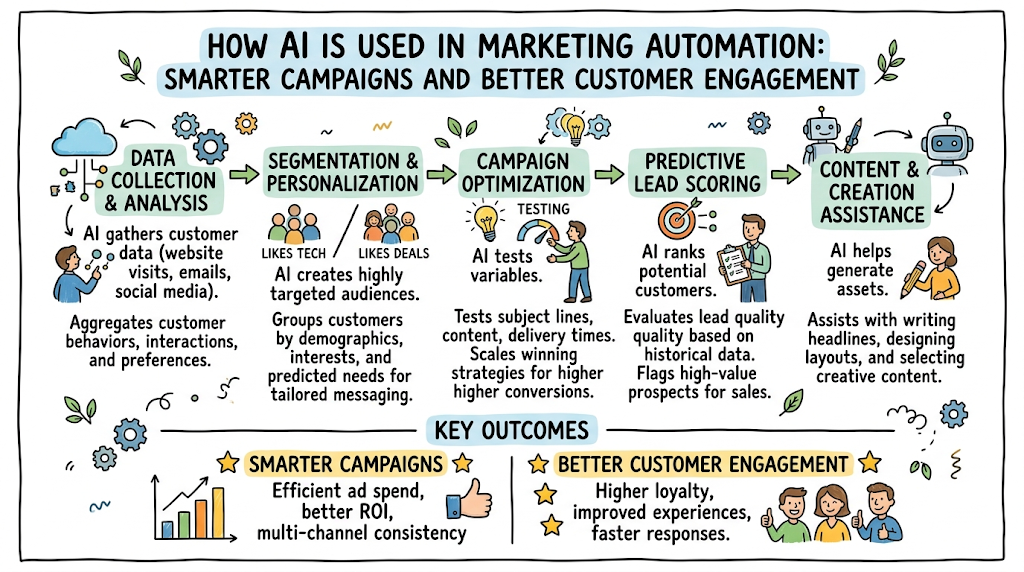
Integrating artificial intelligence transforms basic automation platforms into highly intelligent systems. By processing vast datasets instantly, AI upgrades every stage of the marketing funnel.
Data Analysis and Customer Segmentation
Advanced customer segmentation AI analyzes vast pools of structured and unstructured data to group audiences based on shared characteristics. Traditional methods segment people by basic demographics like age or location. AI goes much deeper by looking at behavioral signals, purchase intent, browsing history, and engagement patterns.
This allows the system to discover micro-segments within your audience automatically. For instance, it can isolate a group of users who browse high-ticket items on mobile devices during lunch hours but only buy when offered a discount code. These dynamic segments update automatically as user behavior changes.
Predictive Analytics
Predictive analytics marketing uses historical data to forecast future consumer actions. By applying statistical algorithms and machine learning models, marketing platforms can predict which leads are most likely to convert, which products will experience high demand, and which customers are at risk of leaving your brand.
[Historical Customer Data] + [Real-Time Behavior]
                       │
                       ▼
         [Predictive Analytics Engine]
                       │
         ┌─────────────┴─────────────┐
         ▼                           ▼
[Lead Scoring Optimization]  [Churn Prevention Triggers]
This predictive power helps marketing teams allocate their budgets efficiently. Instead of spending ad dollars on an entire audience, the platform focuses resources on prospects who show the strongest intent signals, significantly increasing return on investment.
Personalization Engines
AI-driven personalization engines deliver unique, customized experiences to every user visiting a digital asset. These engines analyze a user’s real-time mouse movements, scroll depth, click patterns, and past purchases to modify website copy, imagery, and promotional offers on the fly.
This level of personalized marketing goes far beyond adding a first name to an email subject line. It alters the layout of a landing page or changes the hero banner to match the specific interests of the individual visitor, boosting engagement and conversion rates.
Chatbots and Conversational AI
Modern conversational AI has evolved well beyond simple, menu-driven chat scripts. Natural language processing models allow chatbots to understand the context, intent, and sentiment behind a customer’s typed or spoken words.
These intelligent assistants handle complex customer service inquiries, qualify incoming leads, and guide users through product catalogs directly inside chat windows. By resolving routine issues instantly without human intervention, they keep prospects engaged while lowering customer support costs.
Recommendation Systems
Recommendation systems use collaborative and content-based filtering algorithms to suggest relevant items to consumers. These are the same systems that power major entertainment platforms and global e-commerce sites, analyzing what similar users bought or viewed to predict what a specific user will want next.
In marketing automation, recommendation systems inject personalized product grids into abandoned cart emails, dynamic retargeting ads, and post-purchase follow-ups. This ensures every recommendation is highly relevant to the individual’s current stage in the buying cycle.
Key Use Cases of AI in Marketing Automation
Applying AI to day-to-day marketing workflows yields measurable improvements across all core channels.
Email Marketing Automation
AI transforms email marketing from generic mass blasts into highly precise communication channels. Predictive algorithms calculate the ideal send time for every subscriber on a mailing list, ensuring the message arrives when they are actively checking their inbox.
Furthermore, AI platforms use natural language generation to run ongoing multivariate tests on subject lines, body copy, and calls to action. The system analyzes early performance metrics and automatically rolls out the highest-performing variation to the rest of the list, maximizing open and click-through rates.
Social Media Automation
Managing multiple social media accounts requires constant monitoring and content curation. AI social automation tools analyze audience engagement patterns to determine the best times to publish content on different networks.
These systems also monitor brand mentions and industry discussions in real time, conducting sentiment analysis to flag customer complaints before they turn into major public relations issues. Some platforms can even auto-generate short social posts from long-form blog articles, simplifying content distribution workflows.
Ad Targeting and Optimization
Paid advertising campaigns generate massive amounts of data that can be overwhelming for human media buyers to optimize manually. AI-driven campaigns solve this by managing ad placement, budget distribution, and audience bidding dynamically across networks like Google Ads and Meta.
The AI system continuously tests thousands of creative combinations, headlines, and audience variables. If it notices a particular creative is performing exceptionally well with a specific audience micro-segment, it automatically shifts budget toward that ad variant in real time, keeping customer acquisition costs as low as possible.
Customer Journey Tracking
The path from discovering a brand to making a purchase is rarely a straight line. Customers interact with brands across websites, mobile apps, emails, and offline stores. AI tracks these fragmented touchpoints and unifies them into a single customer profile.
By analyzing these complete journeys, the system identifies where users encounter friction or drop off completely. It then triggers targeted cross-channel campaigns to bring those users back, creating a smoother, more seamless customer experience.
Lead Scoring
In business-to-business (B2B) marketing, sales teams waste considerable time chasing cold prospects. AI lead scoring replaces manual, arbitrary point systems with predictive data models.
[Lead Input Data: Job Title, Company Size, Web Visits, Resource Downloads]
                                │
                                ▼
                   [AI Predictive Model Analysis]
                                │
         ┌──────────────────────┴──────────────────────┐
         ▼                                             ▼
[Score > Threshold: Route to Sales]         [Score < Threshold: Route to Nurture]
The system looks at historical sales data to find the exact characteristics and behaviors shared by customers who actually buy. It then evaluates incoming leads against these patterns, assigning an accurate score that routes high-value prospects straight to sales while sending cooler leads into automated nurturing workflows.
AI Technologies Used in Marketing Automation
Behind every smart marketing platform is a stack of advanced data science technologies working together to interpret information and execute tasks.
Machine Learning
Machine learning is the core engine powering modern marketing platforms. These algorithms process large historical datasets to find patterns without being explicitly programmed where to look. In marketing software, machine learning analyzes user actions over time to predict how audiences will respond to specific offers, messages, or design layouts.
As more interaction data enters the system, the underlying machine learning models naturally improve their accuracy. This continuous feedback loop ensures that your marketing software grows smarter and more effective the longer you use it.
Natural Language Processing (NLP)
Natural language processing bridges the gap between human language and computer code. NLP allows marketing automation systems to read, understand, and generate human written or spoken language.
- Sentiment Analysis: Evaluates customer reviews, surveys, and social comments to classify the overall mood as positive, neutral, or negative.
- Content Generation: Powering tools that write email subject lines, ad copy variants, and personalized product descriptions at scale.
- Intent Classification: Parsing incoming chat messages or email replies to determine exactly what the user is trying to accomplish.
Deep Learning
Deep learning is an advanced branch of machine learning modeled after the structure of human neural networks. It is particularly effective at processing unstructured data types like images, audio, and video files.
In marketing, deep learning models analyze visual content to understand which image styles, colors, or visual layouts drive the highest engagement in ad campaigns. It also powers advanced visual search tools, allowing customers to upload a photo and instantly find similar products within an e-commerce catalog.
Predictive Modeling
Predictive modeling uses mathematical formulas to forecast future events based on current and historical data trends. Marketers use these models to build accurate customer lifetime value ($CLV$) projections.
By calculating variables like purchase frequency, average order value, and customer acquisition costs, the model determines the long-term financial value of different customer groups. This allows marketing executives to make data-driven decisions on how much they can safely spend to acquire new customers.
Benefits of AI in Marketing Automation
Upgrading your infrastructure with artificial intelligence provides clear advantages that directly impact your company’s bottom line.
Better Targeting
AI eliminates the guesswork from audience targeting. Instead of building campaigns based on vague customer personas or broad assumptions, systems analyze direct behavioral data. This ensures your messages reach people who are actively researching your specific solutions, eliminating wasted ad spend on unengaged audiences.
Higher Conversion Rates
When your marketing campaigns are highly personalized, relevant, and delivered at the exact moment a user is ready to buy, conversion rates rise naturally. AI systems test and adjust creative elements continuously, keeping your offers perfectly aligned with user intent and maximizing total conversions.
Reduced Manual Effort
Creative marketing teams spend too many hours exporting CSV files, cleaning data, building manual email lists, and scheduling posts. AI automates these repetitive administrative tasks. This significant time savings allows your team to focus on high-level creative strategy, brand positioning, and content development.
Improved Customer Experience
Customers appreciate fast, relevant interactions. AI chatbots provide instant support around the clock, while personalization engines ensure users don’t have to wade through irrelevant offers to find what they want. This frictionless experience builds deeper brand loyalty and increases customer retention.
Real-Time Decision Making
Traditional marketing reviews happen weekly or monthly, meaning teams often respond to market changes after they happen. AI systems analyze live performance data and adjust budgets, bids, and messaging instantly. This real-time agility keeps your business highly competitive in fast-moving digital markets.
Real-World Industry Use Cases
Different industries use AI-driven marketing automation to solve distinct operational challenges and hit their unique growth targets.
E-Commerce Personalization
Retail brands use AI to create seamless shopping experiences for thousands of customers simultaneously. When a user browses an e-commerce site, the AI records their clicks, category views, and time spent on specific items.
If the user leaves without buying, the system triggers a personalized email sequence containing the exact items they viewed, complete with dynamic reviews and related product recommendations. This precise, automated follow-up recovers abandoned carts at a much higher rate than generic reminder emails.
SaaS Customer Lifecycle Automation
Software-as-a-Service (SaaS) companies rely heavily on automated user onboarding and retention workflows. When a user signs up for a free trial, AI tracking software monitors how they interact with the product.
[User Signs Up for Free Trial]
              │
              ▼
    [Monitor App Activity]
              │
      ┌───────┴───────┐
      ▼               ▼
[Active User]   [Inactive User]
      │               │
      ▼               ▼
[Send Advanced  [Send Tutorial
 Feature Tips]   & Support Help]
If a trial user fails to set up a core feature within forty-eight hours, the system automatically sends a targeted tutorial email to guide them through that specific step. Conversely, if a user explores advanced features quickly, the platform delivers an automated upgrade offer, maximizing trial-to-paid conversion rates.
Banking and Financial Marketing
Financial institutions use AI-powered automation to deliver highly secure, compliant, and hyper-relevant product offers. Because banking products must adhere to strict regulatory guidelines, AI systems scan consumer transaction patterns to identify clear life stages safely.
For instance, if a checking account holder shows an increase in savings deposits along with searches for mortgage calculators, the automation engine securely triggers educational content regarding home loans. This allows banks to cross-sell financial products while maintaining high data security and compliance standards.
Healthcare Communication Systems
Medical providers and digital health platforms use intelligent automation to manage patient communication workflows securely. Systems track appointment histories, prescription renewal timelines, and annual check-up schedules.
The AI system automatically sends personalized text or email reminders when a patient is due for a follow-up visit or medication refill. These automated systems lower patient cancellation rates and reduce administrative burdens on healthcare staff, all while complying with strict healthcare privacy regulations.
Tools Used in AI Marketing Automation
Building a modern marketing tech stack requires selecting tools that integrate smoothly and process data efficiently.
CRM Automation Platforms
Customer Relationship Management (CRM) platforms serve as the central source of truth for all customer and prospect data. Modern CRMs use integrated AI assistants to track sales interactions, analyze call sentiment, and predict pipeline revenue.
These platforms automatically update contact profiles based on web interactions, scoring leads instantly and alerting sales reps when a high-value prospect shows strong buying intent. This keeps sales and marketing teams perfectly aligned.
Email Marketing Tools
Advanced email platforms use machine learning to optimize every element of email distribution. These tools go far beyond standard scheduling, using predictive models to handle subject line generation, automated content layout matching, and individual send-time optimization. By tailoring every aspect of a broadcast to the individual subscriber, these tools maximize inbox engagement and click-through rates.
AI Analytics Platforms
Data analytics platforms process enormous flows of web and mobile traffic information to give marketers actionable insights. AI-driven analytics engines highlight unexpected shifts in web traffic, sudden changes in conversion rates, or anomalies in checkout page performance automatically. They replace slow, manual data analysis with real-time, automated insights dashboards.
Customer Data Platforms (CDPs)
Customer Data Platforms pool data from dozens of disconnected channels—including offline retail stores, mobile apps, customer service chats, and website visits—into one unified ecosystem.
The embedded AI in a CDP cleans duplicate records, resolves identity conflicts, and maintains an accurate, real-time master profile for every single customer. This clean data foundation is vital for powering external personalization and ad targeting tools.
Challenges of AI in Marketing Automation
While the benefits are significant, implementing artificial intelligence into marketing operations comes with challenges that businesses must plan for.
Data Privacy Issues
As data privacy laws like GDPR and CCPA tighten globally, businesses must be careful about how they collect, store, and process consumer data. AI systems require massive datasets to function correctly, making data transparency essential. Marketing teams must ensure their data collection methods comply with global regulations to avoid heavy financial penalties.
Integration Complexity
Plugging advanced AI tools into older, legacy marketing systems often introduces technical friction. Data silos occur when software platforms cannot communicate with one another smoothly. Overcoming these integration hurdles requires dedicated engineering resources, API development, and careful configuration to prevent data loss or corruption.
Over-Automation Risks
Relying too heavily on automated systems can make a brand feel cold, distant, and overly robotic. If a system triggers too many automated emails, push notifications, or generic chatbot replies, consumers will quickly experience message fatigue and disconnect from your brand. Maintaining a careful balance between automated efficiency and genuine human communication is crucial.
Model Bias
Artificial intelligence models learn from historical data. If that historical data contains human biases, or if the sample size is skewed, the AI will replicate those exact biases in its automated targeting and segmentation decisions. Marketers must audit their data models regularly to ensure their automated campaigns treat all audience segments fairly and accurately.
High Implementation Cost
Buying top-tier AI marketing software, training internal teams, and building custom data pipelines requires a substantial upfront financial investment. For small and mid-sized businesses, these initial implementation costs can strain budgets, making a clear projection of return on investment necessary before rolling out new systems.
Best Practices
To maximize the return on your AI investments while minimizing deployment risks, follow these core operational best practices.
- Start with Clean Data: AI models are only as good as the information you feed them. Before launching any machine learning tool, clean your databases, eliminate duplicate records, and fix broken tracking setups.
- Use Hybrid Automation: Do not hand total control over to algorithms. Combine clear, human-defined rule structures with flexible AI elements to keep your campaigns organized and on-brand.
- Focus on Personalization: Use AI capabilities to improve the customer experience. Avoid using automation just to blast out more generic content; use it to deliver deeper relevance to every individual user.
- Continuously Optimize Campaigns: Treat your AI models as evolving systems. Review performance data regularly, run independent split tests against your algorithms, and update models when market conditions shift.
Future of AI in Marketing Automation
The intersection of artificial intelligence and marketing automation is heading toward a completely autonomous, real-time operations model.
Fully Autonomous Marketing Systems
We are moving away from tools that require constant human configuration. Future platforms will likely operate as fully autonomous marketing assistants.
Humans will simply define high-level strategic goals, budget limits, and target audience profiles. The autonomous system will then build landing pages, generate copy, buy ads, and optimize cross-channel journeys entirely on its own.
Hyper-Personalization at Scale
As processing power scales, personalization will move from basic product groupings to dynamic, individual content generation. Future personalization engines will build completely unique web pages, video tutorials, and product offers for single users in real time. Every digital interface will change instantly to match the exact emotional state and intent of the visitor.
Real-Time AI Decision Engines
Next-generation decision engines will process millions of global data signals—including shifting weather patterns, local economic updates, and live stock markets—and connect them instantly to marketing systems.
[Global Data Streams: Weather, Markets, News] ──┐
                                                 ▼
                                   [Real-Time AI Decision Engine]
                                                 ▲
[Live Consumer Behavior Signals] ────────────────┘
                                                 │
                                                 ▼
                             [Instant Cross-Channel Campaign Update]
This will allow platforms to adjust global ad budgets, pricing tiers, and promotional campaigns instantly as market conditions shift, keeping companies highly responsive to real-world events.
Voice and Multimodal Marketing
With the rapid adoption of smart audio devices and advanced visual tools, future marketing systems must look beyond text and image formats. Automation platforms will optimize content for voice search queries and visual discovery models seamlessly. This will ensure brands stay highly visible across smart home devices, augmented reality tools, and voice assistants.
FAQ Section
1.What is AI in marketing automation?
AI in marketing automation is the use of machine learning, natural language processing, and data analytics to upgrade standard, rule-based marketing workflows. It enables software platforms to analyze customer behavior data, predict future trends, and optimize digital campaigns automatically in real time without needing constant human intervention.
2.How does AI improve marketing?
AI improves marketing by removing guesswork from campaign optimization. It analyzes vast sets of consumer data instantly to build accurate audience segments, personalize website experiences, optimize email send times, and adjust ad spend dynamically. This leads to higher conversion rates, lower customer acquisition costs, and improved efficiency.
3.Is AI replacing marketers?
No, AI is not replacing marketers; it is changing their operational responsibilities. AI handles repetitive, analytical, and administrative tasks like list segmentation, data entry, and basic split testing. This frees up human marketers to focus on high-level strategic planning, creative storytelling, and building authentic brand connections.
4.What tools use AI for marketing?
Many modern digital tools use AI, including advanced Customer Relationship Management (CRM) platforms, intelligent email marketing suites, Customer Data Platforms (CDPs), and programmatic advertising networks like Google Ads and Meta. These systems use embedded machine learning algorithms to maximize campaign performance automatically.
5.Is marketing automation expensive?
The cost of marketing automation varies depending on the scale and complexity of your business operations. While enterprise-level platforms require a significant upfront financial investment, many modern software providers offer scalable, tiered pricing options designed for small and mid-sized businesses, making the technology accessible to growing teams.
6.How does AI help in customer segmentation?
AI helps in customer segmentation by moving past basic demographic filters like age or geographic location. Machine learning algorithms analyze live behavioral signals, past purchase histories, web browsing habits, and cross-channel engagement patterns to group audiences into highly precise micro-segments automatically.
7.What is predictive analytics in marketing?
Predictive analytics in marketing involves using historical data, statistical algorithms, and machine learning models to forecast future customer actions. Marketers use these predictive models to calculate future customer lifetime value, spot user churn risks early, and score incoming sales leads with high accuracy.
8.Can small businesses use AI marketing tools?
Yes, small businesses can easily use AI marketing tools. Many accessible email providers, social media managers, and website analytics platforms now include built-in AI features. These tools help small teams automate time-consuming tasks, optimize limited ad budgets, and compete effectively with larger organizations.
9.What are the risks of over-automation?
The main risks of over-automation include alienating your audience, experiencing message fatigue, and losing your distinct brand voice. If a business relies too heavily on automated chat platforms and generic email sequences without human oversight, the communication can feel cold and robotic, which often drives customers away.
10.How do I start with AI marketing automation?
To start with AI marketing automation, first ensure your underlying customer databases are accurate and clean. Next, identify a single repetitive workflow to automate, such as your email onboarding series or paid ad bidding optimization. Pick a tool that fits your current needs, run structured tests, and scale your automated workflows gradually.
Conclusion
Integrating artificial intelligence into marketing automation marks a major shift in how businesses connect with their audiences. By moving past rigid, rule-based systems, AI allows companies to build highly flexible, intelligent, and scalable workflows. This transformation helps brands analyze customer behavior, predict future intent, and deliver hyper-personalized experiences across every digital channel in real time.
While challenges like data privacy management and system integration require careful planning, the benefits—including higher conversion rates, reduced manual workloads, and optimized ad spending—make adoption essential for modern growth. As these intelligent systems continue to evolve toward autonomous operation, keeping your business aligned with these technologies is vital to maintaining a competitive edge.
