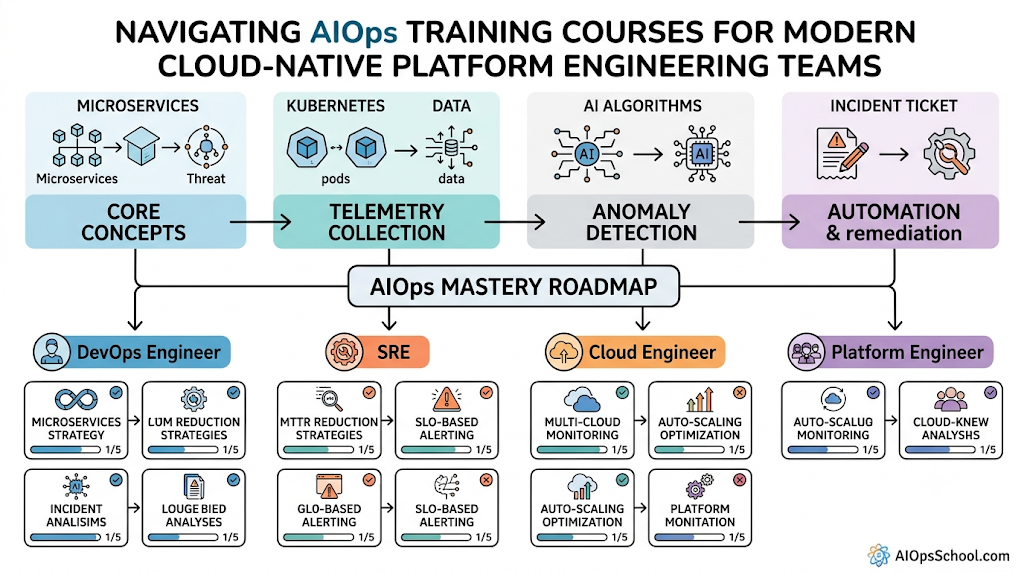
Introduction
Modern enterprise IT architecture has reached a tipping point. The rapid evolution of cloud-native infrastructure, distributed microservices, and large-scale Kubernetes clusters has made system environments too complex for human teams to monitor manually. Engineering groups face an overwhelming volume of operational noise. Every day, distributed tracing systems, logging pipelines, and infrastructure monitors generate billions of telemetry data points.The on-call incident response team is instantly buried under an avalanche of critical notifications. Because traditional monitoring tools view these systems in isolation, engineers must spent hours manually digging through logs, cross-referencing metrics, and running diagnostic scripts across multiple dashboards just to isolate the root cause. While the engineering team fights the fire, customers abandon their carts, processing queues back up, and business revenue drops. By pursuing comprehensive education through AIOpsSchool, technical professionals and enterprise teams can acquire the practical skills, industry-recognized frameworks, and deep deployment knowledge necessary to transform chaotic incident management workflows into self-healing, intelligent IT operations.
What Is AIOps?
AIOps (Artificial Intelligence for IT Operations) is the application of machine learning, big data analytics, and advanced automation to modern IT infrastructure management. It ingests diverse telemetry—including logs, metrics, traces, and events—to automatically correlate anomalies, isolate root causes, suppress alert noise, and trigger automated remediations, transforming reactive incident management into proactive, self-healing operations.
Understanding AIOps
What Is Artificial Intelligence for IT Operations?
At its core, AIOps represents the convergence of big data, machine learning, and operational workflows. It is not a single product or tool, but an overarching architecture that ingests continuous streams of telemetry data from every layer of the enterprise technology stack.
By applying specialized machine learning algorithms to this aggregated data lake, AIOps platforms can automatically discover underlying patterns, detect behavioral anomalies, and map hidden dependencies across complex infrastructure. Instead of relying on rigid, human-authored rules that break whenever an application updates, AIOps systems continuously learn the baseline behavior of your environment, adjusting dynamically to changing workloads.
Why Traditional IT Operations Are No Longer Enough
Traditional IT operations rely heavily on static thresholds and siloed monitoring applications. For example, an engineer might configure an alert to trigger if CPU utilization on a virtual machine exceeds 85% for more than five minutes. However, in a modern elastic cloud environment where containers spin up and down dynamically, static limits fail completely. They cause two major operational headaches:
- False Positives (Alert Fatigue): Transient resource spikes trigger harmless warnings, training on-call engineers to ignore critical notifications.
- False Negatives (Missed Outages): Silent degradation occurs below arbitrary thresholds, leaving teams completely unaware of systemic failures until users complain.
Furthermore, traditional monitoring tools cannot see the cross-layer relationships inherent in microservices architectures. When an underlying infrastructure layer degrades, the application layer suffers, but legacy monitoring tools treat these incidents as separate events, forcing human operators to act as human correlation engines.
How AI and Machine Learning Improve Operations
Machine learning algorithms excel at processing high-volume, high-velocity data to spot subtle signals that human analysts miss. AIOps utilizes unsupervised learning algorithms to establish dynamic baselines for normal system performance across different times of day, days of the week, or seasonal traffic peaks.
When a metric deviates from this calculated norm, the platform flags it as an anomaly. Advanced clustering algorithms then group related anomalies across different hosts and application layers into a single, cohesive incident context. This eliminates hundreds of redundant alerts and immediately directs engineering focus to the underlying root cause.
Evolution from Monitoring to Intelligent Operations
The evolutionary path of IT operations moves from simply observing individual components to orchestrating intelligent, autonomous ecosystems. While legacy monitoring tells you that a specific server is failing, modern observability helps you understand why an intricate distributed system is behaving abnormally. AIOps takes this evolutionary step even further by determining what action must be executed to resolve the issue automatically, moving teams closer to true self-healing environments.
| Traditional Operations | AIOps-Driven Operations |
| Reactive Incident Management: Teams respond after services break. | Proactive & Predictive: Systems spot anomalies before outages occur. |
| Static Thresholds: Manual, rigid rules requiring constant updates. | Dynamic Baselines: ML models adapt automatically to system changes. |
| Siloed Dashboards: Infrastructure, logs, and APM tracked separately. | Unified Telemetry: Ingests and correlates all data into one context. |
| Manual Root Cause Analysis: Hours spent hunting through log files. | Automated RCA: Graphs point instantly to the source of failure. |
| Manual Escalation: Human triage paths slow down remediation. | Automated Remediation: Runs code scripts to resolve common errors. |
In Simple Terms
Imagine driving an old car where you have to manually check the oil dipstick, look at separate gauges for engine heat, and listen closely for strange sounds. Traditional operations is like that old car. AIOps is like a modern self-driving vehicle: it monitors thousands of internal sensors simultaneously, predicts when a part is about to fail, and automatically adjusts the driving system to keep you moving safely without you turning a wrench.
Real-World Example
A global retail platform experiences a sudden 15% drop in checkout completions during a holiday sale. Instead of generating 400 independent alerts for the frontend teams, database administrators, and network engineers, the corporate AIOps platform ingests the telemetry streams, runs an event correlation algorithm, and isolates the issue to a misconfigured third-party payment gateway API timeout that occurred right after an automated deployment pipeline finished.
Why It Matters
Transitioning from traditional workflows to intelligent, AI-driven operations directly shrinks Mean Time to Resolution (MTTR) from hours to minutes. This keeps critical digital channels highly available, prevents costly service level agreement (SLA) breaches, and frees engineering teams from tedious firefighting so they can focus on shipping features.
Key Takeaways
- Traditional static thresholds cannot keep pace with dynamic, ephemeral cloud-native environments.
- AIOps breaks down data siloes by ingesting logs, metrics, traces, and events into a centralized machine learning pipeline.
- The system shifts operational teams from manual troubleshooting to high-value, automated incident response.
Why AIOps Skills Are Becoming Essential
Growth of Cloud-Native Infrastructure
Cloud-native engineering relies heavily on abstract, ephemeral building blocks. Microservices run inside containers that are continuously scheduled and destroyed across large fleets of virtual machines managed by orchestrators like Kubernetes. Because these infrastructure components may only exist for minutes or hours, traditional monitoring approaches cannot capture their lifecycles effectively. Engineers must possess the skills to configure and operate modern machine learning systems that can keep pace with this highly dynamic infrastructure.
Rise of Distributed Systems
In a monolithic application, tracking code execution paths is relatively simple. In a distributed system, a single user click might initiate a request chain that touches dozens of distinct microservices, multiple databases, third-party authentication APIs, and distributed caching layers across various cloud regions. When a request slows down, finding the exact bottleneck becomes an engineering bottleneck. Professionals who understand how to deploy AIOps tools can leverage distributed tracing data to map these complex paths automatically.
Demand for Reliability Engineering
Site Reliability Engineering (SRE) teams are tasked with maintaining strict uptime targets while scaling infrastructure efficiently. To achieve this without burning out engineers, organizations need automated systems that can handle repetitive operational tasks—often referred to as “toil.” Professionals with validated AIOps skills are highly sought after because they know how to configure automated systems to manage noise, allowing SRE teams to scale systems effectively without a linear increase in headcount.
Automation of Incident Management
The modern incident response lifecycle moves through several phases: detection, triage, isolation, escalation, and remediation. Manual execution at each phase introduces human delays. AIOps automation eliminates these bottlenecks by instantly executing diagnostics the moment an anomaly is detected, enriching tickets with precise root cause data, and automatically routing tasks to the appropriate on-call engineer.
Future of Autonomous Operations
We are moving rapidly toward a future of self-healing software ecosystems. In these environments, infrastructure does not just flag errors; it actively repairs them by provisioning additional capacity, restarting degraded container pods, rollback out buggy deployments, or clearing disk space based on predictive data models. Developing expertise in AIOps positions technology professionals at the absolute forefront of this automation movement.
In Simple Terms
As technology infrastructure grows larger and more complex, human beings can no longer manage it using spreadsheets and manual dashboards alone. Learning AIOps skills is like learning how to build and train smart assistant software that watches over these massive digital ecosystems 24/7, making sure they stay healthy and fast.
Real-World Example
An enterprise infrastructure team manages a global footprint of over 50,000 container instances. By implementing an AIOps framework, they train their systems to automatically detect early patterns of memory leakage in production microservices. The system gracefully restarts specific workloads during low-traffic windows before an out-of-memory error can crash the application stack.
Why It Matters
Acquiring skills in this domain transforms technical professionals from standard system administrators into high-value automation architects. For the enterprise, cultivating this internal talent ensures that their complex digital transformations do not collapse under the weight of operational overhead and unmanageable technical debt.
Key Takeaways
- Modern distributed systems generate too much telemetry data for human teams to analyze manually in real time.
- AIOps skills bridge the gap between software development, system reliability engineering, and practical data science.
- Engineers proficient in machine-learning-driven operations enjoy enhanced job security and command premium salaries.
AIOps Certification Explained
What Is an AIOps Certification?
An AIOps certification is an industry-recognized professional credential that validates an individual’s competency in designing, deploying, and maintaining intelligent IT operations frameworks. Unlike tool-specific certifications that only teach you how to click buttons within a proprietary software portal, a comprehensive AIOps certification validates a professional’s deep understanding of underlying machine learning workflows, telemetry collection methods, event correlation principles, and closed-loop automation strategies.
Benefits of Professional Certification
Earning a professional certification in AIOps provides substantial career advantages for both individual engineers and enterprise engineering teams:
- Structured Knowledge: It fills in critical gaps, taking professionals beyond basic logging to master comprehensive multi-signal telemetry architecture.
- Industry Validation: It offers clear proof to hiring managers and technical leaders that you understand how to implement advanced machine learning workflows within complex production environments.
- Career Advancement: It positions engineers for senior architecture roles, site reliability leadership positions, and strategic transformation tracks.
- Enterprise Capability: For organizations, supporting certified staff ensures that internal teams leverage best practices, reducing the risks associated with messy, unguided tool rollouts.
Skills Validated Through Certification
A rigorous certification program evaluates candidates across several core domains:
[Telemetry Ingestion] ──> [Anomalous Signal Detection] ──> [Topology-Based Correlation] ──> [Automated Playbook Remediation]
- Multi-Signal Ingestion: Designing pipelines that ingest logs, metrics, traces, and events at scale.
- Algorithmic Analysis: Distinguishing between supervised and unsupervised learning models for anomaly detection and capacity planning.
- Topological Mapping: Utilizing dynamic dependency graphs to track system relationships across complex architectures.
- Incident Orchestration: Setting up automated alert suppression, correlation policies, and closed-loop self-healing playbooks.
Who Should Pursue AIOps Certification?
This certification pathway is carefully designed for technology professionals tasked with safeguarding the performance, availability, and scale of modern enterprise systems:
- DevOps Engineers: Looking to embed intelligent feedback loops and automated reliability testing into continuous delivery pipelines.
- SRE Engineers: Focused on eliminating alert fatigue, maximizing error budgets, and scaling systems through advanced automation.
- Cloud & Platform Engineers: Responsible for architecting self-healing infrastructure across complex, multi-cloud environments.
- Monitoring Specialists: Evolving their skill sets from building simple legacy dashboards to designing unified AI observability platforms.
- IT Managers & Directors: Seeking a solid framework to lead organizational changes and evaluate infrastructure tools effectively.
In Simple Terms
An AIOps certification is a formal badge of honor that shows the tech industry you know how to use artificial intelligence and automated systems to keep major business websites and applications running smoothly, preventing outages before they affect customers.
Real-World Example
An enterprise migration team is moving core banking workflows to a hybrid cloud environment. To minimize operational risks, management requires their senior infrastructure engineers to earn an AIOps certification. This training ensures the team can confidently build an automated observability pipeline capable of mapping cross-cloud dependencies from day one.
Why It Matters
A structured certification program cuts through marketing hype, equipping professionals with the objective principles needed to build stable systems. It ensures that investments in advanced software platforms translate into measurable operational improvements rather than costly shelfware.
Key Takeaways
- Certification validates a deep understanding of core architectural principles over tool-specific button-clicking.
- It serves as an objective benchmark for organizations seeking trusted talent to lead modern operational transformations.
- Certified professionals are better equipped to reduce operational risks during complex enterprise cloud migrations.
AIOps Training and Courses
What Learners Typically Study
Comprehensive AIOps training programs blend practical software engineering principles, system design methodologies, and applied data science concepts into an actionable curriculum.
Machine Learning for IT Operations
Learners explore how specific mathematical models solve operational challenges. This includes studying how regression models predict future capacity constraints, how clustering algorithms group disparate events, and how unsupervised anomaly detection engines isolate unusual performance deviations without relying on human configuration.
Event Correlation
This domain focuses on reducing noise. Students learn to build correlation policies that parse millions of raw, daily events from infrastructure layers and group them by time proximity, network topology, and service dependencies into a small handful of actionable incident tickets.
Intelligent Alerting
Courses teach students how to replace static alert metrics with dynamic threshold systems. This includes training models to factor in seasonal usage patterns, automatically calculate acceptable variances, and apply statistical variance models to prevent alert noise.
Root Cause Analysis
Students learn to leverage dynamic topology mapping and causal graphs. By tracing how a failure cascades across system dependencies, the AIOps platform can pinpoint the underlying root cause rather than simply flagging downstream symptoms.
Predictive Analytics
This area teaches engineers to look forward. By analyzing historic usage patterns alongside current consumption vectors, predictive models project exactly when disk volumes will exhaust, database connections will saturate, or network bandwidth will bottle neck, prompting proactive maintenance.
Incident Automation
Learners study how to securely integrate AIOps engines with orchestration tools like Ansible, Terraform, or Kubernetes operators. This allows the system to trigger automated remediation workflows—such as running diagnostic scripts, scaling compute instances, or flushing caches—the moment a confirmed anomaly pattern is detected.
Observability
This module highlights the transition from passive monitoring to active observability. It teaches students how to design systems for high cardinality and high dimensionality data, ensuring that engineering teams can answer completely new questions about their infrastructure without deploying code patches.
OpenTelemetry
As the open-source standard for modern telemetry, OpenTelemetry is a foundational part of the curriculum. Students gain hands-on experience using the OpenTelemetry API and SDK layers to instrument applications, configure decoupled OpenTelemetry Collectors, and standardize data formats before ingestion.
Monitoring Automation
This involves treating your monitoring setups completely as code (Monitoring as Code). Learners use configuration files to automatically deploy dashboards, alerting rules, and data collection agents alongside application deployments, ensuring complete operational visibility from the very start.
In Simple Terms
AIOps training courses teach you the complete technical playbook for modern IT. You learn how to gather system health data, feed it into smart algorithms, group messy alerts into clear problems, and write code scripts that automatically fix infrastructure issues without human intervention.
Real-World Example
A mid-level systems engineer enrolls in an advanced AIOps course. For their capstone project, they use OpenTelemetry to gather telemetry from a microservices app, route it to an anomaly detection engine, and configure an automated webhook that scales up pod instances whenever predictive models spot an impending traffic surge.
Why It Matters
Structured, hands-on training saves organizations from costly trial-and-error mistakes. It transforms engineers from passive dashboard watchers into proactive automation builders who can design self-correcting software infrastructure.
Key Takeaways
- Modern AIOps education covers the entire lifecycle: from data gathering via OpenTelemetry to automated remediation code.
- Understanding applied machine learning models helps engineers configure noise-reduction and predictive alerting policies accurately.
- Training bridges the gap between pure development workflows and production system reliability goals.
AIOps Engineer Certification Path
Building deep expertise in intelligent IT operations requires a structured, step-by-step learning approach. The certification pathway breaks this journey down into manageable, progressive levels designed to take professionals from foundational concepts to advanced architecture mastery.
+-----------------------------------------------------------------+
|                         ADVANCED LEVEL                          |
|  Skills: Multi-Cloud Telemetry Architecture, Closed-Loop        |
|          Self-Healing, Enterprise Governance & Scaling          |
+-----------------------------------------------------------------+
                                ▲
                                |
+-----------------------------------------------------------------+
|                       INTERMEDIATE LEVEL                        |
|  Skills: OpenTelemetry Pipelines, Event Correlation Policies,   |
|          Root Cause Graphs, Automation Engine Webhooks          |
+-----------------------------------------------------------------+
                                ▲
                                |
+-----------------------------------------------------------------+
|                        BEGINNER LEVEL                           |
|  Skills: Core Telemetry Formats, Statistical Anomaly Detection  |
|          Basics, Standard Dashboarding & Core Architecture      |
+-----------------------------------------------------------------+
Beginner Level
The journey begins with a focus on core infrastructure telemetry concepts and modern architecture foundations. Learners master the fundamental distinctions between logs, metrics, and distributed traces. They discover how traditional monitoring tools collect data and learn the basics of statistical anomaly detection, moving away from simple fixed limits toward basic dynamic baselines.
Intermediate Level
At this stage, the focus shifts to building operational pipelines and tuning core intelligence algorithms. Engineers gain hands-on experience instrumenting code with OpenTelemetry, configuring collection pipelines, and deploying automated event correlation rules. They learn to build causal graphs that map infrastructure dependencies and connect anomaly engines directly to automated orchestration systems via secure webhooks.
Advanced Level
The highest tier focuses on large-scale enterprise strategy, multi-cloud telemetry architectures, and closed-loop self-healing systems. Certified professionals master the deployment of enterprise-wide AIOps frameworks that securely span multi-cloud architectures. They design complex automated remediation workflows that feature safe rollbacks and clear human approval gates, while establishing governance practices to manage data costs and compliance at scale.
| Level | Skills | Outcome |
| Beginner | Core telemetry formats (MELT), statistical anomaly detection basics, standard dashboard configuration, foundational AIOps architecture. | Ability to configure advanced telemetry agents, interpret baseline anomalies, and assist in managing core monitoring platforms. |
| Intermediate | OpenTelemetry pipeline engineering, event correlation policy creation, dynamic root cause graphs, automation engine webhooks. | Competency to design noise-suppression workflows, accelerate incident investigations, and deploy automated diagnostics. |
| Advanced | Multi-cloud telemetry architecture, closed-loop self-healing playbooks, enterprise data governance, scaling AI engines safely. | Capacity to lead enterprise operational transformations, architect automated infrastructure, and manage massive telemetry costs. |
In Simple Terms
Think of this certification path like learning to become an airline pilot. You start on the ground learning how flight instruments work (Beginner), move up to flying an aircraft under clear conditions using autopilot systems (Intermediate), and finally master handling complex, multi-engine jets through severe weather storms using advanced automated flight systems (Advanced).
Real-World Example
An IT consulting firm uses this structured path to upskill its engineering team. Junior staff start with Beginner training to manage basic client dashboards, mid-level staff complete Intermediate modules to build alert-filtering pipelines, and Principal Architects finish the Advanced level to design automated infrastructure platforms for global enterprise clients.
Why It Matters
A structured learning pathway prevents professionals from becoming overwhelmed by the massive scope of modern operations. It provides a clear roadmap for progressive skill building, ensuring engineers master foundational data collection before tackling complex automation tasks.
Key Takeaways
- The certification path guides engineers step-by-step from foundational data collection to advanced automated self-healing.
- Each tier delivers immediate operational value, allowing engineers to apply new skills to production systems as they learn.
- Reaching the advanced level prepares professionals to lead large-scale digital transformation initiatives.
AIOps Engineer Career Roadmap
Required Technical Skills
To build a successful career as an AIOps Engineer, you need a balanced combination of traditional systems engineering skills, modern observability practices, and a clear understanding of applied machine learning pipelines.
Linux
Linux remains the baseline operating system for modern cloud infrastructure, container runtimes, and enterprise server fleets. AIOps engineers must possess deep working knowledge of Linux internals, including system resource allocation, kernel metrics, file system management, and network stack configurations to debug underlying infrastructure errors.
Networking
Distributed microservices depend entirely on networks to communicate. Engineers must master fundamental networking concepts, including TCP/IP loops, DNS configurations, load balancing strategies, service mesh mechanics, and HTTP status codes, allowing them to accurately analyze and diagnose distributed application performance bottlenecks.
Cloud Platforms
Enterprise software runs across major public clouds like AWS, Microsoft Azure, and Google Cloud Platform. You need a solid understanding of cloud-native infrastructure components—including managed compute instances, virtual private networks, auto-scaling groups, and object storage systems—to optimize operational performance.
Kubernetes
As the global standard for container orchestration, Kubernetes is central to modern platform engineering. An AIOps engineer needs to know how to navigate Kubernetes environments, including managing pods, deployments, services, ingress controllers, and control-plane metrics, while deploying telemetry collection tools natively within clusters.
Monitoring Tools
Proficiency across industry-standard observability tools is highly valuable. Engineers should understand how to configure open-source stacks like Prometheus and Grafana for metrics collection and dashboarding, while learning how to deploy enterprise platforms such as Datadog, Dynatrace, New Relic, and Splunk to maximize platform capabilities.
Automation
Manual infrastructure management does not scale. You must master Infrastructure as Code (IaC) tools like Terraform to deploy observability stacks consistently, alongside configuration engines like Ansible and container orchestration workflows to implement automated incident responses cleanly.
Python
Python serves as the primary programming language for modern automation and applied data science workflows. AIOps engineers use Python to write custom data ingestion scripts, interact with external tool APIs, build custom automated remediation utilities, and manage telemetry pipelines efficiently.
Observability
This means moving past simple uptime checks to master the complete data framework of Logs, Metrics, Traces, and Events (MELT). You must understand how high-cardinality metadata helps slice through telemetry data, allowing you to trace complex user transactions across distributed systems.
Learning Sequence
- Master Systems & Cloud Foundations: Build a strong baseline in Linux administration, cloud network topologies, and core public cloud services.
- Learn Containerization & Kubernetes: Master Docker container concepts and learn to deploy, scale, and monitor applications inside Kubernetes environments.
- Master Core Observability Frameworks: Transition from simple uptime monitoring to deep observability, gaining hands-on experience with Prometheus, Grafana, and OpenTelemetry.
- Study Applied Machine Learning for Ops: Understand how algorithms process data, focus on anomaly detection models, clustering approaches, and predictive analytics.
- Implement Closed-Loop Automation: Connect your intelligence engines to automated execution platforms, using Python scripts and automation playbooks to fix identified system issues.
AI Observability Training
What Is AI Observability?
AI Observability represents an advanced evolution of systems monitoring. Traditional monitoring keeps track of predefined metrics and alerts you when something breaks. Observability ensures your systems output enough clear data for you to understand why an internal state went wrong, even for completely novel failure scenarios.
AI Observability enhances this approach by injecting machine learning directly into the data collection layer, letting the platform analyze high-cardinality metadata, map deep system dependencies, and isolate root causes across large distributed environments.
Why Observability Matters
In modern microservices architectures, systems fail in unpredictable ways due to complex, cascading dependencies between unrelated services. If your systems are not highly observable, engineers spend days trying to recreate production errors in test environments. AI Observability solves this problem by providing continuous, deep visibility into every single transaction path, eliminating guesswork during critical outages.
Logs, Metrics, Traces, and Events (MELT)
These four fundamental data pillars form the bedrock of comprehensive AI Observability architectures:
- Metrics: Numerical values measured over time (e.g., CPU utilization, memory consumption, request rates). They are highly efficient to store and excel at triggering initial anomaly detections.
- Logs: Timestamped text records generated by applications and infrastructure components when specific events occur. They provide granular code-level context during deep troubleshooting.
- Traces: End-to-end maps showing the journey of a single user request as it traverses various distributed microservices, highlighting the exact latency contributed by each system component.
- Events: Structured records marking specific milestones or state changes within an environment, such as a code deployment, a container restart, an auto-scaling event, or a configuration update.
OpenTelemetry Fundamentals
OpenTelemetry (OTel) is a vendor-neutral, open-source framework under the Cloud Native Computing Foundation (CNCF) that standardizes how telemetry data is generated, collected, and exported. AI Observability training ensures engineers know how to use OTel core components:
[Application Code] ──> [OTel API/SDK] ──> [OTel Collector] ──> [AIOps ML Engine]
- OTel API & SDKs: Standard tools used to instrument application code across multiple programming languages.
- OTel Collector: A high-performance, decentralized proxy agent that receives, processes, filters, batches, and routes telemetry data from applications to upstream AIOps analysis engines.
Intelligent Monitoring Systems
Intelligent monitoring systems utilize these standardized OpenTelemetry data pipelines to automatically build live topology maps of your infrastructure. This lets the platform see exactly how your databases, frontend APIs, and cloud services interact, providing the precise context needed to run accurate correlation and causal analysis algorithms.
| Feature | Legacy Monitoring | Intelligent AI Observability |
| Data Scope | Focuses mainly on simple infrastructure metrics and basic error logs. | Integrates all four data signals (MELT) into a unified context. |
| Cardinality | Struggles with high-cardinality data like unique user IDs or transaction hashes. | Handles high-cardinality metadata easily to track single user journeys. |
| Analysis Method | Relies on manual dashboard inspections and human correlation. | Applies automated machine learning models to detect subtle data deviations. |
| System Visibility | Treats infrastructure components as isolated silos. | Uses live topology maps to track real-time system dependencies. |
In Simple Terms
Legacy monitoring is like a dashboard light that glows red when your car engine overheats. AI Observability is like an advanced computer diagnostic system that tells you the engine is overheating because a specific cooling valve failed right after you shifted into fifth gear, showing you the exact history of the failure path.
Real-World Example
An e-commerce platform suffers a slow degradation in its checkout service. A legacy monitoring setup simply flags a general increase in API response times. An AI Observability platform analyzes distributed tracing data, correlates it with database query metrics, and instantly shows engineers that a recent product catalog update caused a specific SQL database lock query to run 20 times slower than usual.
Why It Matters
Building an AI Observability foundation ensures that your machine learning engines ingest clean, high-quality data. Without standardizing data collection via frameworks like OpenTelemetry, an AIOps platform cannot generate accurate insights, leading to inaccurate anomaly alerts.
Key Takeaways
- AI Observability combines traditional system telemetry with advanced machine learning analytics to explain novel system failures.
- OpenTelemetry provides the essential open-source standard needed to collect vendor-neutral telemetry data across multi-cloud setups.
- High-cardinality data analysis enables engineering teams to track specific transaction errors down to individual user requests.
AIOps for SRE and DevOps Engineers
How AIOps Supports SRE Practices
Site Reliability Engineering focuses on treating operational challenges as software engineering problems. SRE teams use core metrics like Service Level Indicators (SLIs) to measure system performance and manage strict Error Budgets—the acceptable amount of system downtime allowed over a given month.
AIOps directly supports SREs by analyzing historical performance trends to forecast when an error budget is in danger of being breached, allowing teams to pause risky feature deployments and focus on system stabilization ahead of time.
Reducing Alert Fatigue
One of the greatest operational threats to engineering organizations is alert fatigue. When on-call engineers receive dozens of non-actionable notifications every night, response times slow down, employee burnout increases, and critical infrastructure failures get missed. AIOps platforms solve this challenge by applying intelligent noise-suppression algorithms that filter out normal performance blips and consolidate hundreds of related alerts into a single, comprehensive incident file.
Improving Incident Response
When a major service interruption occurs, the incident response timeline follows an organized path. AIOps technology significantly accelerates every step of this triage process:
[Raw Alert Ingestion] ──> [Noise Suppression] ──> [Root Cause Isolation] ──> [Automated Script Execution]
- Immediate Noise Suppression: Minimizes distraction by filtering out unrelated background alerts.
- Context Enrichment: Enriches incident tickets with live performance graphs and links to recent code commits.
- Root Cause Isolation: Directs engineers straight to the root cause of the system failure.
- Automated Script Triggering: Runs diagnostic health checks automatically to cut down triage time.
Enhancing Reliability Engineering
By leveraging predictive analytics models, reliability engineers can move away from reactive troubleshooting and focus on building resilient software architectures. AIOps tools surface hidden patterns—such as recurring minor memory leaks or subtle database connection drops—that point to underlying technical debt, helping engineers refactor code before it causes a major customer-facing outage.
Supporting Continuous Delivery
Modern DevOps teams rely heavily on Continuous Integration and Continuous Delivery (CI/CD) pipelines to rapidly push out new software features. However, code updates can introduce performance regressions. By embedding AIOps into deployment workflows, the platform can automatically analyze telemetry data during canary rollouts, compare performance against historical baselines, and trigger automatic safety rollbacks if any software anomalies are detected.
Enterprise AIOps Consulting
Why Organizations Need AIOps Consulting
Implementing an enterprise-wide AIOps framework involves more than just buying a software license. It requires carefully re-architecting data structures, rethinking legacy incident response workflows, and upgrading internal engineering skills.
Enterprise consulting teams help organizations avoid common pitfalls, ensuring that investments in advanced AI operations tools deliver clear business value, reduce downtime, and drive operational efficiency.
+---------------------------------------------------------------------------------------+
|                              AIOPS MATURITY FRAMEWORK                                 |
+---------------------------------------------------------------------------------------+
|  STAGE 1: REACTIVE       │ Legacy monitoring, static alerts, manual firefighting.    |
|  STAGE 2: OBSERVABLE     │ Centralized MELT telemetry, OpenTelemetry collectors.     |
|  STAGE 3: ANALYTICAL     │ Machine learning anomaly detection, event correlation.   |
|  STAGE 4: PROACTIVE      │ Predictive capacity alerts, automated root cause data.   |
|  STAGE 5: AUTONOMOUS     │ Closed-loop self-healing infrastructure deployed.       |
+---------------------------------------------------------------------------------------+
Assessing Operational Maturity
A successful consulting engagement begins by evaluating an organization’s existing capabilities across five operational maturity stages:
- Stage 1: Reactive: Relying on basic infrastructure monitoring, fixed alert thresholds, and manual firefighting workflows during outages.
- Stage 2: Observable: Implementing centralized data pipelines to collect logs, metrics, and distributed traces using standard OpenTelemetry collectors.
- Stage 3: Analytical: Introducing machine learning models to handle automatic anomaly detection and basic event correlation tasks.
- Stage 4: Proactive: Leveraging predictive capacity alerting and automated root cause analysis to stop incidents early.
- Stage 5: Autonomous: Deploying safe, closed-loop self-healing infrastructure playbooks across core production environments.
Tool Selection Strategies
The modern software marketplace is filled with competing monitoring and AI automation tools. Professional consultants help businesses navigate this complex landscape by running objective evaluations based on current infrastructure layouts, telemetry volume budgets, and technical team skills, helping organizations select the ideal mix of open-source framework components and enterprise software platforms.
Building AIOps Roadmaps
Moving an enterprise up the operational maturity ladder requires a clear, step-by-step roadmap. Consulting teams help design these multi-phase strategies, focusing on delivering quick wins first—such as configuring automated alert noise-reduction policies—before rolling out complex automated remediation frameworks across core business systems.
Change Management Considerations
The biggest obstacle to successfully adopting AIOps is often cultural rather than technical. Traditional operations teams may worry that automation threatens their roles, or they may feel hesitant to trust machine learning alerts over manual playbooks. Consultants address these human factors through structured upskilling courses, clear team alignments, and step-by-step automation playbooks that build organizational confidence over time.
AIOps Implementation Services
Implementation Lifecycle
Bringing an AIOps framework to life across an enterprise environment requires following a rigorous, structured engineering lifecycle.
[Assessment] ──> [System Design] ──> [Tool Selection] ──> [Integration] ──> [Automation] ──> [Optimization]
Assessment
Engineers map the entire enterprise software ecosystem, identifying all active data repositories, logging pipelines, existing monitoring tools, and legacy operational workflows.
Design
Architects plan the data fabric, designing high-throughput ingestion pipelines capable of scaling to handle massive telemetry data loads while ensuring secure data transport.
Tool Selection
Teams evaluate software options, balancing open-source technologies against enterprise platforms to construct a cost-effective, high-performance toolkit tailored to business goals.
Integration
Engineers deploy OpenTelemetry agents, construct ingestion adapters, connect core cloud infrastructure, and link messaging platforms like Slack, Jira, or PagerDuty to centralize incident data.
Automation
Development teams write custom automation workflows and configure secure webhook systems, allowing the machine learning engine to instantly run remediation playbooks when verified anomalies appear.
Optimization
AIOps architects continuously tune machine learning algorithms, refine anomaly filters to eliminate remaining false positives, and expand automated playbooks to handle new operational use cases.
Continuous Improvement
Teams review performance metrics, evaluate data pipeline efficiency, upgrade infrastructure models, and roll out advanced automation updates to match evolving application requirements.
Real-World Enterprise Use Cases
Banking and Financial Services
- Operational Challenge: A core retail banking platform suffered from intermittent processing delays during high-volume trading windows, leading to transactions backing up and triggering compliance warnings.
- AIOps Solution: The bank deployed an event correlation framework that ingested multi-layer infrastructure logs alongside database metrics, mapping dependencies in real time.
- Business Outcome: The system isolated a recurring database locking issue caused by an background batch process, allowing engineers to reschedule the job and reduce peak transaction delays by 92%.
Healthcare Platforms
- Operational Challenge: An enterprise telehealth provider experienced alert fatigue across its engineering teams, with over 10,000 daily alerts overwhelming on-call staff and leading to missed critical infrastructure warnings.
- AIOps Solution: They implemented an intelligent alert noise-suppression engine that automatically filtered transient performance spikes and clustered related notifications by service dependencies.
- Business Outcome: Critical alert volume dropped by 85%, reducing Mean Time to Repair (MTTR) for major platform incidents from two hours to under seven minutes.
SaaS Companies
- Operational Challenge: A cloud-based collaboration software company faced unpredictable customer churn due to occasional microservices performance drops that eluded traditional monitoring tools.
- AIOps Solution: The engineering team integrated OpenTelemetry across their distributed applications, routing tracing data through an unsupervised machine learning anomaly detection engine.
- Business Outcome: The platform caught subtle software regressions during rolling deployment phases, triggering automatic canary rollbacks that kept application uptime above 99.99%.
Telecommunications
- Operational Challenge: A global telecom carrier faced soaring infrastructure costs and sudden call-routing drops due to unexpected, localized network traffic overloads.
- AIOps Solution: They rolled out predictive analytics and capacity modeling software across their cellular and core switching hardware environments.
- Business Outcome: The system accurately predicted network capacity demands hours in advance, allowing automated platforms to route traffic dynamically and reduce network congestion incidents by 74%.
E-Commerce Platforms
- Operational Challenge: A multinational online retailer suffered costly storefront outages during seasonal sales, with manual incident triage teams struggling to coordinate fixes during massive alerts.
- AIOps Solution: The business implemented an enterprise AIOps platform featuring automated root cause analysis linked directly to closed-loop remediation playbooks.
- Business Outcome: When database connection spikes occurred during high-traffic sales, the platform instantly detected the anomaly, identified the source, and ran an automated playbook to allocate extra memory resources, preventing site crashes.
Benefits of AIOps Adoption
Implementing a mature, machine-learning-driven operations framework delivers substantial, measurable improvements across an entire enterprise technology organization:
- Reduced Downtime: By identifying performance anomalies early, engineering teams can address underlying infrastructure risks before they cascade into disruptive outages.
- Faster Root Cause Analysis: Moving past manual log analysis, automated causal graphs point engineers directly to the source of a system failure within moments.
- Better User Experience: Keeping application latency low and service availability high ensures a smooth, reliable digital experience for end users.
- Reduced Operational Costs: Intelligent alert filtering and automated incident handling help organizations manage growing cloud infrastructure without requiring a linear increase in operations headcount.
- Improved Reliability: Shifting from a reactive posture to predictive maintenance workflows allows teams to build highly resilient systems.
- Smarter Decision-Making: Access to clear data insights on capacity trends and system dependencies helps technical leaders make informed decisions on infrastructure investments.
Common Challenges in AIOps Adoption
While the business and technical advantages of AIOps are clear, modern enterprises often encounter specific challenges during the initial implementation phases:
- Data Quality Issues: Machine learning models require clean, well-structured telemetry data to build accurate performance baselines. Splicing together unstructured logs and fragmented metrics can lead to inaccurate alerts.
- Solution: Standardize your entire data collection architecture using vendor-neutral OpenTelemetry frameworks before activating AI analytics tools.
- Tool Integration Challenges: Legacy IT environments often rely on disconnected, proprietary monitoring tools that do not natively share telemetry data with centralized analysis engines.
- Solution: Use open data APIs and flexible collection proxies to consolidate infrastructure signals into a single data lake.
- Skills Gap: Many traditional operations teams lack the modern software engineering, data pipeline management, and observability skills needed to run advanced platforms.
- Solution: Partner with experienced training platforms like AIOpsSchool to provide teams with structured, hands-on certification pathways.
- Organizational Resistance: Engineering teams may feel hesitant to trust automated incident remediation scripts, or they may worry that automated systems pose a risk to operational stability.
- Solution: Start by deploying automated workflows in “advisory mode,” letting the system recommend fixes to human engineers before turning on closed-loop automation.
- Lack of Observability Maturity: Trying to run advanced anomaly detection models on top of sparse infrastructure data often leads to poor results and inaccurate alerts.
- Solution: Focus on building a strong observability foundation first—ensuring deep visibility into metrics, logs, and distributed traces—before deploying AI tools.
Common Mistakes Professionals Make
Avoid these frequent operational pitfalls when building your skills and designing system platforms:
- Focusing Only on Tools: Assuming that simply buying an expensive platform license will automatically fix systemic operational problems without updating team processes.
- Ignoring Observability Fundamentals: Trying to deploy machine learning analytics on top of broken data pipelines that lack distributed tracing context.
- Poor Data Collection: Ingesting massive amounts of raw, unfiltered data into your platforms, leading to high storage costs and slow system performance.
- Skipping Automation Strategy: Setting up anomaly alerts without building the corresponding automation workflows or playbooks needed to resolve them.
- Lack of Continuous Learning: Relying entirely on fixed, legacy rules and ignoring updated industry practices around open-source tools like OpenTelemetry.
Future of AIOps
The field of IT operations is evolving rapidly, moving toward highly intelligent, autonomous tech environments. In the coming years, we will see the widespread adoption of Autonomous Operations, where software infrastructure dynamically configures, secures, and optimizes itself based on changing user demands without needing human direction.
AI-Driven Incident Management will advance further, leveraging Large Language Models (LLMs) to automatically generate post-incident reviews, author custom remediation code, and orchestrate complex troubleshooting steps using natural language interfaces.
Furthermore, Predictive Reliability Engineering will become a standard practice, with advanced machine learning models running continuous simulation tests against production environments to uncover hidden architectural vulnerabilities before they can cause real-world impact.
As Self-Healing Infrastructure frameworks mature across multi-cloud environments, the traditional role of on-call engineers will shift from manual firefighting to designing high-level automation policies, making professional skills in AIOps a foundational requirement for modern enterprise technology careers.
Why Learn with AIOpsSchool
Navigating the transition to AI-driven IT operations requires a structured, hands-on educational approach that balances theoretical engineering principles with practical enterprise experience. AIOpsSchool provides a comprehensive learning ecosystem designed by senior architects and reliability leaders to bridge the gap between traditional systems management and modern platform engineering.
Our Industry-Focused Curriculum is continuously updated to reflect the latest advancements in open-source frameworks, machine learning models, and cloud-native architectures. By focusing on hands-on labs, students do not just watch video lectures; they actively instrument microservices code, configure production-grade OpenTelemetry pipelines, build automated event correlation engines, and connect intelligence tools directly to closed-loop remediation playbooks.
Whether you are an individual engineer looking to earn an industry-recognized AIOps Certification to advance your career, or an enterprise engineering group seeking tailored training programs and strategic Enterprise Consulting Expertise to guide your operational transformation, AIOpsSchool delivers the deep skills, practical playbooks, and technical confidence needed to master the future of intelligent IT operations.
FAQ SECTION
1. What is AIOps Certification?
An AIOps Certification is an industry-recognized professional credential that validates an engineer’s competency in deploying machine learning, big data analytics, and advanced automation frameworks to manage modern IT operations. The certification proves you understand how to design multi-signal telemetry pipelines, build automated event correlation rules, reduce alert noise, and establish safe, automated self-healing workflows across complex enterprise environments.
2. Who should learn AIOps?
AIOps training is highly valuable for DevOps engineers, Site Reliability Engineers (SREs), cloud engineers, platform architects, monitoring specialists, and IT operations managers. Any technology professional responsible for ensuring the uptime, performance, and scalability of complex, distributed software applications or multi-cloud infrastructure will benefit significantly from acquiring these skills.
3. What skills are required for AIOps Engineers?
A successful AIOps engineer needs a balanced combination of systems engineering and automation skills. Key technical competencies include Linux systems administration, cloud network topology management, cloud-native container orchestration using Kubernetes, hands-on experience with OpenTelemetry pipelines, proficiency in scripting languages like Python, and a solid understanding of applied machine learning concepts like regression, clustering, and anomaly detection.
4. How does AIOps help DevOps teams?
AIOps supports DevOps practices by embedding intelligent automated feedback loops directly into continuous integration and deployment pipelines. It allows teams to automatically evaluate the performance impact of new software releases through canary deployments, compare system health metrics against established historical baselines, and trigger automatic safety rollbacks if any operational anomalies or performance drops are detected.
5. What is AI Observability?
AI Observability represents an advanced evolution of systems monitoring that combines traditional data collection with machine learning analytics. While legacy monitoring simply tracks if a component is up or down based on fixed rules, AI Observability collects high-cardinality metadata across metrics, logs, and traces, using intelligent algorithms to automatically map dependencies and explain why complex distributed systems fail.
6. What is OpenTelemetry?
OpenTelemetry (OTel) is an open-source, vendor-neutral framework managed by the Cloud Native Computing Foundation (CNCF) that provides a standardized set of APIs, SDKs, and tools to generate, collect, and export telemetry data. It is a critical component of modern AIOps setups because it standardizes data formatting before sending it to upstream machine learning engines.
7. How long does it take to learn AIOps?
For engineers who already possess a foundational baseline in cloud infrastructure, Linux, and basic scripting, a professional understanding of AIOps can typically be achieved within 3 to 6 months of structured learning. This journey moves from mastering telemetry data ingestion to configuring advanced machine learning models and building closed-loop remediation automation.
8. What are AIOps Implementation Services?
AIOps Implementation Services are specialized technical consulting engagements that help enterprises design, deploy, and optimize intelligent operations frameworks. These professional services guide organizations through the entire deployment lifecycle, including evaluating operational maturity, standardizing telemetry pipelines, configuring data analytics platforms, and building automated incident management workflows.
9. Is AIOps a good career choice?
Yes, pursuing a career path in AIOps is an exceptional choice for technology professionals. As enterprise systems continue to grow in scale and complexity, the industry demand for engineers who can build intelligent, automated operations frameworks is rising rapidly, making this specialized expertise highly lucrative and resilient to future tech shifts.
10. What is the future of AIOps?
The future of AIOps centers on the rise of true Autonomous Operations and self-healing infrastructure networks. Over the coming years, systems will increasingly leverage advanced large language models to auto-generate post-incident analysis reports, write custom remediation scripts, and run continuous predictive reliability testing to fix software bugs before they can cause customer-facing downtime.
FINAL SUMMARY
The traditional paradigms of enterprise IT operations are no longer sufficient to manage the scale, speed, and complexity of modern cloud-native architectures. As distributed applications generate billions of telemetry data points across ephemeral cloud environments, manual troubleshooting practices inevitably lead to alert fatigue, longer resolution times, and costly business disruptions. Transitioning to an intelligent framework driven by artificial intelligence, big data analytics, and automated incident management is no longer an optional upgrade; it has become a foundational requirement for any digital organization looking to scale securely.
