INTRODUCTION
Stepping into the world of digital currencies often feels overwhelming when you realize your funds are not held in a traditional bank account. Beginners frequently wonder where their digital assets actually go and how they can keep them safe from loss or theft. This confusion is entirely normal because digital currencies do not exist as physical coins in your pocket.
Understanding how to manage your assets securely is essential before you start exploring platforms like CryptoBlockCoins, which helps make these concepts easier to grasp. At the heart of this security lies the crypto wallet, an essential tool for anyone interacting with decentralized networks.
This guide breaks down what these digital storage tools are, how they function, and the best practices for keeping your information secure. By the end, you will have a clear, foundational understanding of how to manage your digital tools with confidence.
2. WHAT IS A CRYPTO WALLET?
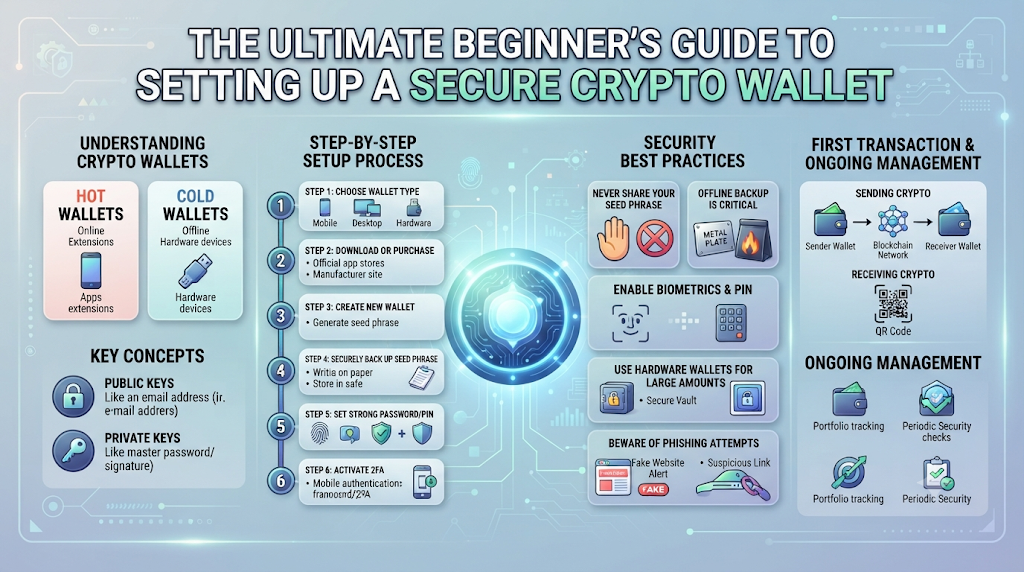
A crypto wallet is a digital tool that allows users to interact with blockchain networks, store cryptographic keys, and manage digital assets. Unlike a traditional leather wallet that holds physical cash, a crypto wallet does not actually store your coins inside a physical pouch. Instead, all cryptocurrencies reside directly on their respective blockchains.
The primary purpose of a crypto wallet is to store your public and private keys. Your public key acts like an email address that others can send funds to, while your private key acts like your secret password that authorizes transactions and proves ownership.
Anyone participating in decentralized finance or exploring Web3 technologies needs to understand these storage tools. Important terminology includes public addresses, private keys, seed phrases, and network fees. Learning these terms helps you navigate the ecosystem safely without running into common beginner pitfalls.
3. HOW DOES A CRYPTO WALLET WORK?
Understanding the underlying mechanics of digital storage helps demystify how transactions occur on public networks. While the technology involves complex cryptography, the user experience is designed to be straightforward.
- Transaction Initiation: You decide to send a digital asset to another user and enter their public address into your interface.
- Key Verification: Your wallet uses your private key to digitally sign the transaction, confirming that you authorize the transfer.
- Network Broadcast: The signed transaction is broadcast to the blockchain network, such as the Ethereum blockchain or Bitcoin network.
- Validation and Recording: Network validators verify the transaction details and record them permanently onto a decentralized ledger.
This process eliminates the need for intermediaries like traditional banks. Your crypto wallet bridges the gap between your personal device and the decentralized network, ensuring that only you control your cryptographic keys.
4. KEY COMPONENTS OF A CRYPTO WALLET
Blockchain Network
The blockchain is the underlying distributed ledger where all transactions are permanently recorded. Your storage tool simply interacts with this network to display your balances and verify transfers.
Private and Public Keys
Your public key generates your receiving address, while your private key grants absolute control over your funds. Protecting your private key is the single most important security habit you can develop.
Seed Phrases
A seed phrase is a sequence of twelve to twenty-four random words generated when you set up a new wallet. It acts as the master backup key required to recover your assets if your device is lost or damaged.
5. REAL-WORLD EXAMPLES
Imagine you want to send a small amount of Bitcoin to a friend. First, you open your software application and enter your friend’s public receiving address. You double-check the details to ensure accuracy because blockchain transactions are irreversible. Next, you approve the transfer by entering your secure PIN or password.
In another scenario, suppose you want to interact with decentralized applications within the Web3 ecosystem. Your storage application acts as a secure login credential, allowing you to connect to platforms without sharing personal passwords. This seamless connection lets you manage tokens and interact with smart contracts directly from your browser or mobile device.
6. BENEFITS AND LIMITATIONS
Benefits
- Full Control: Users retain absolute ownership of their digital assets without relying on third-party institutions.
- Global Access: Transactions can be sent and received anywhere in the world at any time.
- Privacy: Accounts do not require traditional personal identification details to create.
Limitations and Risks
- User Responsibility: There is no customer service department to reset passwords if you lose your private credentials.
- Technical Learning Curve: Beginners often find managing keys and understanding network fees challenging.
- Security Threats: Poor digital hygiene can expose users to phishing attacks or unauthorized access.
CryptoBlockCoins provides educational information only and does not provide financial or investment advice. Cryptocurrency markets can be volatile, so readers should conduct independent research and consider professional advice before making financial decisions.
7. SECURITY AND SAFETY CONSIDERATIONS
Keeping your digital assets secure requires constant vigilance and proactive habits. Because decentralized systems lack central recovery mechanisms, safety is entirely in your hands.
Always write down your seed phrase on physical paper and store it in a secure, offline location. Never store your seed phrase digitally in screenshots, cloud storage, or notes apps where hackers might access it. Be extremely cautious of phishing links, fake websites, and unsolicited messages claiming to offer support.
Hardware storage devices offer the highest level of security by keeping your private keys entirely offline away from internet-connected threats. Always verify website domains before connecting your software tools to external applications.
8. COMMON MISTAKES BEGINNERS MAKE
- Losing the Seed Phrase: Failing to write down or properly secure the backup recovery words.
- Sharing Private Credentials: Giving away private keys or seed phrases to scammers posing as customer support.
- Ignoring Transaction Details: Sending funds to incorrect addresses without verifying network compatibility.
- Using Insecure Devices: Accessing sensitive accounts on public computers or unsecured Wi-Fi networks.
- Leaving Assets on Unverified Platforms: Keeping large amounts of cryptocurrency on unfamiliar cryptocurrency exchanges instead of personal custody.
- Neglecting Software Updates: Failing to keep applications and hardware firmware updated with the latest security patches.
9. HOT WALLETS VS COLD WALLETS
| Feature | Hot Wallet (Software) | Cold Wallet (Hardware) |
|---|---|---|
| Connectivity | Connected to the internet | Kept offline |
| Convenience | High, ideal for frequent use | Lower, requires physical connection |
| Security Level | Moderate | Very High |
| Cost | Usually free | Requires purchasing a physical device |
10. STEP-BY-STEP BEGINNER GUIDE
- Research Options: Learn about different software and hardware storage tools available for beginners.
- Download or Purchase: Choose a reputable provider and download the application or purchase a hardware device from the official website.
- Set Up a New Account: Follow the setup prompts to create a strong password or PIN.
- Backup Your Seed Phrase: Carefully write down your recovery seed phrase on paper and store it securely.
- Fund Your Account: Transfer a small test amount from a cryptocurrency exchange to familiarize yourself with the process.
11. FUTURE CONSIDERATIONS
As technology evolves, digital storage tools are becoming more intuitive and secure. User experience improvements are slowly bridging the gap between complex cryptography and everyday usability.
Future developments focus on account abstraction, biometric security integration, and simpler social recovery methods that protect users from permanent asset loss. As institutional adoption grows, education around secure personal custody will remain a cornerstone of the digital asset landscape.
Frequently Asked Questions
- What is the main difference between a hot wallet and a cold wallet?
A hot wallet is connected to the internet, making it convenient for daily use, while a cold wallet is an offline physical device designed for maximum security against online threats.
- Can I lose my digital assets if my phone breaks?
Your funds are safe on the blockchain as long as you have your secret backup seed phrase, which you can use to restore your account on a new device.
- Should I share my public address with others?
Yes, your public address functions like a bank account number and is safe to share with people when you want to receive digital assets.
- Are all crypto wallets free to use?
Most software applications are free to download, though hardware devices require a one-time purchase fee, and all network transfers involve minor blockchain transaction fees.
- What happens if someone gets my private key?
Anyone who obtains your private key or seed phrase gains complete control over your funds and can transfer them without your permission.
- Do I need technical knowledge to use a crypto wallet?
Basic applications are designed with beginner-friendly interfaces that require very little technical knowledge to send and receive funds safely.
- Can a crypto wallet hold multiple different cryptocurrencies?
Many modern applications support multiple blockchain networks, allowing you to manage various coins and tokens within a single interface.
- What is a recovery seed phrase?
A seed phrase is a sequence of random words generated during setup that acts as your master key to recover access to your account.
- Are crypto wallets managed by banks?
No, self-custody tools put you in complete control, meaning no bank or financial institution manages or protects your account for you.
- How do I choose the best crypto wallet for my needs?
Consider factors like security preferences, ease of use, supported networks, and whether you plan to hold assets long-term or trade frequently.
CONCLUSION
Managing digital assets securely begins with understanding the core tools that interact with blockchain networks. A crypto wallet acts as your gateway to the decentralized ecosystem, giving you complete control over your public and private keys. By prioritizing security, safeguarding your backup phrase, and avoiding common beginner mistakes, you can navigate this space with confidence. Continue exploring educational resources to build a solid foundation of knowledge as the technology continues to evolve.
