Introduction
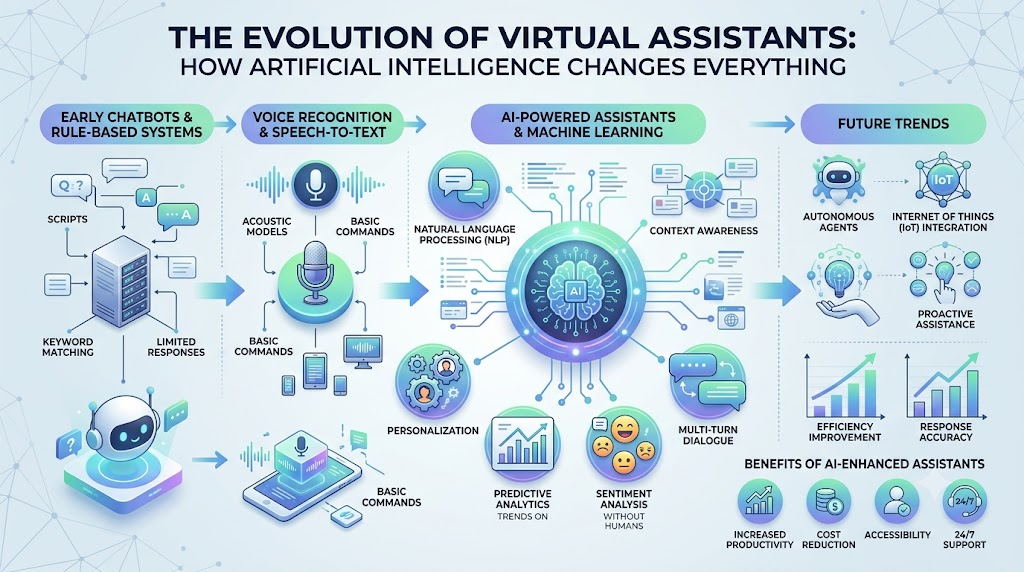
Virtual assistants have come a long way from the early days of rigid, rule-based chatbots that could only answer predefined questions. If you phrased a question slightly outside their hard-coded scripts, the interaction broke down immediately. Today, that frustrating experience has largely disappeared thanks to breakthroughs in artificial intelligence, machine learning, and natural language understanding. For comprehensive insights into emerging artificial intelligence technologies, visit AIUniverse.xyz.
Modern virtual assistants no longer just match keywords against a static database. They understand nuances, interpret slang, evaluate intent, retain context across multi-turn conversations, and autonomously execute complex multi-step workflows across diverse software ecosystems. Whether you are using a voice assistant on your smartphone to manage your smart home, interacting with an enterprise customer support agent, or relying on an internal workplace copilot to draft documentation and analyze spreadsheets, artificial intelligence serves as the cognitive engine behind it all.
This guide provides a comprehensive breakdown of how modern AI turns basic digital tools into proactive, responsive, and indispensable virtual assistants for everyday users and global enterprises alike.
What Are AI-Powered Virtual Assistants?
An AI-powered virtual assistant is an advanced software agent that relies on machine learning models, natural language processing (NLP), and semantic reasoning to understand user inputs, solve problems, and complete tasks autonomously.
Unlike traditional rule-based chatbots—which operate strictly on decision trees (“if user says X, reply with Y”)—AI-driven assistants can handle ambiguous queries, decipher messy natural speech, extract implicit parameters, and continuously learn from historical interactions.
Traditional Rule-Based Bots               Modern AI-Powered Assistants
────────────────────────────              ────────────────────────────
• Hard-coded decision trees               • Adaptive Machine Learning models
• Keyword matching only                   • Context and intent extraction
• Breaks when inputs vary                 • Handles ambiguity and dialects
• Static, manual updates                  • Continuous learning from feedback
• Single-turn interactions                • Multi-turn contextual memory
The Architectural Foundation
Modern virtual assistants rely on an integrated cognitive architecture comprising:
- Audio Processing & Speech Engines: Translating spoken phonemes into structured text and synthesizing natural-sounding acoustic output.
- Natural Language Understanding (NLU) Core: Parsing grammatical structure, identifying parts of speech, extracting named entities, and determining user intent.
- Dialogue & Context Manager: Maintaining state history across conversation turns, resolving references (such as “it” or “that”), and coordinating external API calls.
- Action & Fulfillment Layer: Interfacing with databases, web services, enterprise CRM systems, and third-party tools to fetch data or trigger operational workflows.
- Natural Language Generation (NLG): Formulating coherent, grammatically accurate, and contextually appropriate responses in real time.
How AI Improves Virtual Assistants
Artificial intelligence fundamentally transforms virtual assistants across multiple distinct layers of intelligence and operational execution.
1. Natural Language Processing (NLP) & Natural Language Understanding (NLU)
The primary interface between humans and computers is language. NLP provides the computational foundation that allows an assistant to parse sentence structures, recognize syntactic patterns, and understand semantics.
Through NLU, assistants break down messy, everyday human language into structured data. They identify:
- Tokens & Syntax: Breaking sentences into core grammatical units.
- Named Entities: Identifying dates, locations, proper names, currencies, and technical terms (e.g., recognizing that “next Tuesday at 4 PM” refers to a specific calendar timestamp).
- Sentiment & Tone: Assessing the emotional state or urgency behind a message, allowing the assistant to adapt its conversational register accordingly.
2. Machine Learning and Continuous Adaptation
Rule-based systems remain static until an engineer manually programs a new rule. In contrast, AI-powered assistants utilize supervised, unsupervised, and reinforcement learning techniques to improve their predictive accuracy over time.
When an assistant misinterprets an instruction or receives negative user feedback, machine learning algorithms use those interaction logs to retrain classification models. This ensures that the assistant gets better at parsing domain-specific terminology, regional phrasing, and complex user requests without requiring total code rewrites.
3. Deep Context Awareness
One of the most noticeable limitations of legacy software was amnesia. Every turn of a conversation began from scratch. AI solves this through dynamic context modeling.
If you ask an assistant, “What is the weather in Seattle?” followed immediately by “Will I need an umbrella there tomorrow?”, an AI-powered assistant understands that “there” refers to Seattle and “tomorrow” refers to the subsequent calendar day. The assistant preserves conversational state, memory vectors, and session parameters, creating a seamless, natural dialogue flow.
4. Personalization and Behavioral Adaptation
Every user communicates differently, maintains distinct preferences, and follows unique daily routines. AI enables virtual assistants to build secure, individual user profiles that adapt to:
- User Preferences: Preferred communication style, default measurement units, and favorite applications.
- Routine Automation: Noticing recurring habits (such as turning off specific lights at 10 PM or requesting traffic reports at 8 AM) and proactively suggesting automations.
- Contextual Framing: Customizing responses based on past choices, purchase histories, or frequent search patterns.
5. Advanced Speech Recognition and Voice Synthesis
Converting unstructured acoustic waves into digital text in noisy environments is a formidable challenge. Modern speech recognition relies on deep neural networks trained on thousands of hours of diverse speech patterns.
- Noise Filtration: Isolating primary speech from background noise, overlapping chatter, and room echo.
- Dialect and Accent Invariance: Accurately transcribing diverse accents and colloquialisms.
- Neural Text-to-Speech (TTS): Moving away from robotic, stilted voice synthesis toward natural-sounding voices with realistic pauses, inflection, rhythm, and tone modulation.
6. Intent Recognition and Disambiguation
Users rarely speak in clean algorithmic syntax. They use metaphors, fragmented sentences, and indirect requests. Intent recognition allows an assistant to discern what the user actually wants to accomplish.
User Input: "It's freezing in the living room."
  │
  ├─ Legacy Bot: "I don't understand 'freezing'."
  │
  └─ AI Assistant:
       • Parses Intent: Adjust_Temperature
       • Identifies Entity: Target_Room = "Living Room"
       • Resolves Action: Increase smart thermostat by 2°C
When an input is genuinely ambiguous—such as “Book a table at Mario’s” when two restaurants share that name—the assistant does not crash. Instead, it initiates an intelligent disambiguation prompt: “Did you mean Mario’s Trattoria on 5th Avenue or Mario’s Pizza on Main Street?”
7. AI-Powered Recommendations and Predictive Insights
Beyond responding to reactive prompts, AI elevates assistants to proactive digital partners. By analyzing behavioral data, calendar commitments, and real-time external conditions, assistants can offer predictive suggestions:
- Recommending earlier departure times when real-time traffic monitoring detects highway congestion along your usual commute route.
- Reminding enterprise users to follow up on client emails that have sat unanswered for several business days.
- Suggesting document summaries or agenda outlines ahead of scheduled meetings.
8. Automation, Tool Use, and Autonomous Task Handling
Modern virtual assistants can bridge language understanding with external tool execution. Through function calling and API integration, the assistant acts as an autonomous agent that can:
- Query external SQL databases and summarize the findings.
- Schedule calendar invites across multiple attendees with conflicting time zones.
- Generate invoices, populate CRM records, and update project management boards without requiring human copy-pasting.
Practical Real-World Use Cases
AI-powered virtual assistants are active across a wide spectrum of consumer and enterprise domains:
| Domain | Primary Application | Key AI Advantage |
| Enterprise Operations | Internal workplace copilots and knowledge assistants | Fast search across internal documentation, automated ticket resolution, meeting summaries |
| Customer Support | Tier-1 and Tier-2 automated support channels | 24/7 instant resolution, sentiment-aware escalations, dynamic troubleshooting |
| Healthcare | Patient triage, intake forms, and medication reminders | Conversational symptom logging, automated appointment booking, reduced clinical burnout |
| Financial Services | Banking assistants and fraud advisory alerts | Natural-language balance inquiries, suspicious transaction warnings, automated expense categorization |
| Smart Homes & IoT | Unified voice-controlled device management | Contextual device control, energy-saving automations, multi-room orchestration |
| Software Development | Coding copilots and CLI assistance | Real-time code completions, automated test generation, natural-language query-to-SQL translation |
Key Benefits of AI-Enhanced Virtual Assistants
The integration of artificial intelligence into virtual assistants delivers tangible advantages for individual users and organizations alike.
Benefits for Users
- Frictionless Convenience: Complex operations—like configuring smart devices or booking travel itineraries—can be managed through simple voice or text prompts.
- Instant Accessibility: Hands-free voice navigation empowers users with visual impairments, motor challenges, or busy hands to operate digital interfaces effortlessly.
- Time Savings: Repetitive administrative tasks, from drafting standardized emails to managing calendars, are handled in seconds.
- Consistent Availability: Personalized assistance is accessible 24/7 across mobile devices, desktop environments, and smart appliances.
Benefits for Businesses
- Scalable Customer Operations: Handle thousands of simultaneous customer inquiries without adding proportional headcount or suffering from response latency.
- Lower Operational Costs: Automating routine Tier-1 inquiries frees human agents to focus on complex, high-empathy customer situations.
- Actionable Interaction Analytics: Aggregate and analyze customer conversations to discover product bottlenecks, unmet user needs, and emerging market trends.
- Consistent Service Quality: Deliver uniform, accurate, and brand-aligned responses while reducing human error during routine data entry tasks.
Challenges and Limitations
Despite rapid technological progress, deploying and relying on AI-powered virtual assistants introduces several significant challenges.
1. Hallucinations and Factual Accuracy
Generative and statistical AI models can occasionally produce responses that sound confident and authoritative but are factually incorrect or logically inconsistent. In low-stakes consumer settings, this is a minor annoyance; in high-stakes fields like medicine, legal compliance, or financial accounting, unchecked hallucinations present severe risks.
2. Privacy, Security, and Data Governance
Virtual assistants require access to extensive personal and corporate data to deliver high-quality personalization. This raises essential security questions:
- Audio Interception: Ensuring that wake-word detection does not record private ambient conversations inadvertently.
- Data Transmission & Storage: Encrypting user interaction histories both in transit and at rest.
- Compliance: Adhering strictly to global privacy frameworks such as GDPR, CCPA, and industry-specific mandates like HIPAA.
3. Edge Cases and Complex Reasoning
While AI handles standard tasks efficiently, it can struggle with complex scenarios requiring deep common-sense reasoning, situational ethics, or emotional empathy. When an interaction falls outside its training distribution, an assistant can get stuck in loops or misinterpret critical user instructions.
4. Integration Complexities and Legacy Infrastructure
Connecting an AI assistant to older corporate databases, fragmented enterprise software stacks, and custom internal APIs frequently demands significant engineering effort and ongoing maintenance.
Best Practices for Implementing AI Virtual Assistants
To maximize value and mitigate operational risks, organizations and developers should follow a structured set of implementation principles:
- Define Clear Guardrails and Scopes: Establish exactly what the virtual assistant is authorized to do. Provide explicit boundaries so it avoids guessing or acting outside its designated domain.
- Implement Human-in-the-Loop Escalation: Build smooth handover protocols. When an assistant detects high user frustration, low confidence scores, or complex edge cases, it should cleanly escalate the ticket to a human specialist with full context history.
- Prioritize Data Privacy by Design: Anonymize sensitive personal data, strip personally identifiable information (PII) before model training, and give end-users clear controls to review or delete their conversational logs.
- Use Retrieval-Augmented Generation (RAG): Rather than relying solely on a model’s static parameters, connect the assistant to verified internal knowledge bases and dynamic documentation to ensure factual accuracy and grounded responses.
- Continuously Monitor and Audit Performance: Regularly evaluate conversation logs, track containment and escalation rates, and solicit user feedback to identify failure patterns and model drift.
Future Trends in AI Virtual Assistants
The landscape of virtual assistance continues to advance rapidly. Several transformative trends are actively shaping the next generation of intelligent agents:
- Autonomous Multi-Agent Systems: Instead of a single assistant trying to manage everything, specialized AI agents will collaborate behind the scenes. For example, a travel assistant will delegate flight searches, calendar scheduling, and budget calculations to distinct sub-agents before returning a unified result.
- Multimodal Interaction: Future assistants will seamlessly combine text, voice, vision, and gesture tracking. An assistant will be able to look at a broken appliance through your smartphone camera and guide you through repairs step-by-step using spoken instructions and augmented-reality overlays.
- Edge-Native AI: As lightweight, high-efficiency models mature, more AI processing will occur locally on consumer hardware rather than in the cloud. This will deliver near-zero latency, offline functionality, and significantly stronger data privacy.
- Proactive Emotional Intelligence: Future systems will better detect subtle vocal inflections and micro-patterns in phrasing to assess stress or confusion, dynamically adjusting their conversational tone and intervention speed to support the user better.
Frequently Asked Questions (FAQs)
What is the main difference between a traditional chatbot and an AI virtual assistant?
A traditional chatbot operates on static, pre-written rules and decision trees, meaning it can only answer exact phrasing it was programmed to handle.
An AI virtual assistant uses machine learning, natural language processing, and context awareness to understand varied phrasing, interpret intent, and continuously learn from interactions.
How does natural language processing improve virtual assistant accuracy?
Natural language processing enables an assistant to break down unstructured human speech into structured data.
It identifies sentence syntax, recognizes key entities (like names, locations, and dates), and extracts the underlying intent, allowing the system to comprehend colloquial language, typos, and diverse sentence structures.
Can AI virtual assistants work offline?
Most traditional virtual assistants require active cloud connections to process complex neural networks and access external databases.
However, modern advances in on-device AI and compact language models now allow select assistants to handle local tasks—such as setting alarms, launching apps, and basic voice transcription—completely offline.
What are the main privacy risks associated with AI virtual assistants?
The primary privacy concerns involve unintended audio recording, unauthorized data sharing with third parties, insecure cloud storage of chat transcripts, and potential data leakage during model training.
Adhering to strict encryption protocols and offering transparent data-deletion controls help mitigate these risks.
How do businesses benefit from deploying AI virtual assistants?
Businesses benefit through reduced customer support overhead, 24/7 instant response availability, improved customer satisfaction, and lower operational costs.
Additionally, virtual assistants can automate repetitive internal workflows and capture useful analytics on customer sentiment and demand.
What is intent recognition and why is it important?
Intent recognition is the AI process that determines the goal or purpose behind a user’s input, regardless of the specific words used.
It is vital because humans express identical requests in dozens of different ways; intent recognition maps all those variations to the correct backend action.
What is context awareness in virtual assistants?
Context awareness refers to an assistant’s ability to remember previous dialogue turns, understand implicit references (such as pronouns), and incorporate real-world variables like the user’s location, time zone, and personal preferences.
This prevents the user from having to repeat background details with every query.
What should an assistant do when it encounters an unfamiliar request?
When an AI assistant encounters a low-confidence or unfamiliar query, it should acknowledge its limitation honestly, ask clarifying questions to disambiguate the request, or smoothly route the interaction to a human operator without getting stuck in repetitive error loops.
Conclusion
Artificial intelligence has transformed virtual assistants from rigid, scripted novelty programs into sophisticated, context-aware partners that power daily productivity and modern enterprise workflows. By combining Natural Language Processing, machine learning, deep contextual memory, and autonomous tool integration, modern assistants bridge the communication gap between human intention and digital execution. As multi-agent architectures, multimodal perception, and edge computing continue to evolve, virtual assistants will become even more proactive, secure, and seamlessly integrated into our physical and digital lives. Organizations and individuals who understand and adopt these intelligent tools will unlock unprecedented levels of efficiency, responsiveness, and automation.
