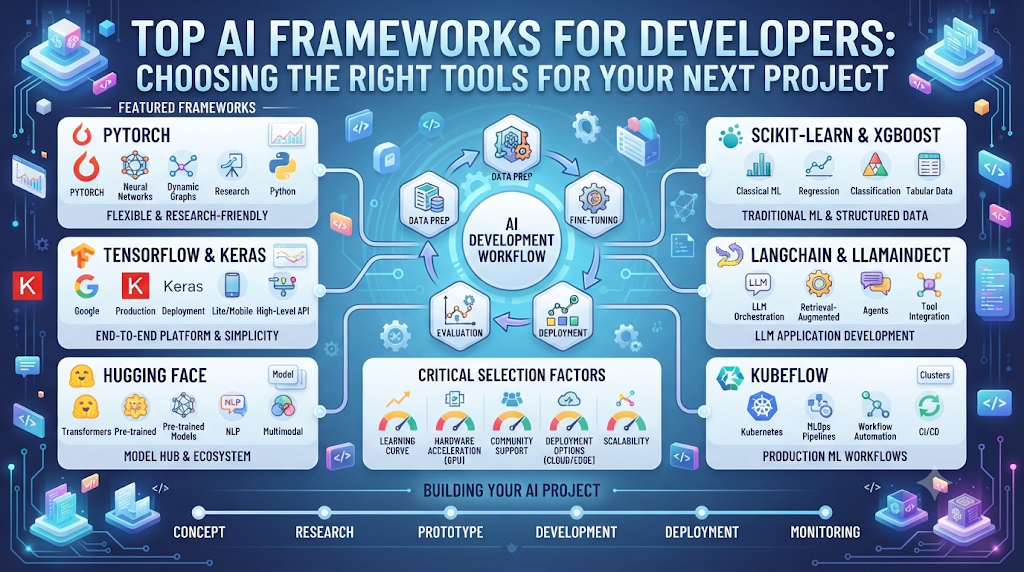
Imagine sitting down to build your first intelligent feature. You have a great idea, but before writing a single line of business logic, you are greeted by an overwhelming landscape of libraries, SDKs, and platforms—a journey you can explore further with helpful guides available on AIUniverse . Building a modern AI application is not simply about selecting a single AI model; developers also need tools for model development, data processing, training, fine-tuning, evaluation, inference, application integration, deployment, and monitoring. Because different AI frameworks solve different problems across the software stack, the best choice is not necessarily the most popular one, but rather the tool that fits your model type, development workflow, team skills, deployment environment, and long-term requirements.
What Is an AI Framework?
An AI framework provides reusable tools, APIs, libraries, and abstractions that help developers build, train, evaluate, integrate, or deploy AI systems.
Without frameworks, developers would have to write low-level mathematical operations, manual tensor calculations, and custom gradient-descent algorithms from scratch. Frameworks eliminate this boilerplate, letting you focus on solving actual application problems.
Depending on your workflow, you will encounter several categories of tools:
- Deep learning frameworks
- Machine learning libraries
- Transformer/model libraries
- LLM application frameworks
- Agent frameworks
- ML deployment frameworks
- MLOps frameworks
Why Developers Use AI Frameworks
Developers rely on specialized libraries and AI frameworks for developers because they offer massive practical advantages:
- Faster development: Write fewer lines of code to achieve complex behaviors.
- Reusable components: Use pre-built layers, optimizers, and loss functions.
- Easier experimentation: Swap out model architectures quickly.
- Hardware acceleration: Seamlessly offload heavy computations to GPUs and TPUs.
- Model training support: Built-in backpropagation and batch processing.
- Pretrained models: Access state-of-the-art architectures without training from scratch.
- Community support: Find answers, plugins, and tutorials easily.
- Production tooling: Standardized pipelines for serving and monitoring.
However, frameworks do not eliminate the need to understand AI fundamentals. Knowing how a neural network processes data or how loss functions operate remains crucial when debugging broken models.
Main Categories of AI Frameworks
To make sense of the landscape, it helps to divide tools by their primary function:
| Category | Main Purpose |
|---|---|
| Deep Learning Frameworks | Build and train neural networks |
| Classical ML Libraries | Regression, classification, clustering, preprocessing |
| Model Libraries | Use pretrained AI models |
| LLM Frameworks | Build applications around language models |
| Agent Frameworks | Build tool-using and multi-step AI agents |
| MLOps Frameworks | Manage ML workflows and deployment |
| Deployment Frameworks | Serve and scale AI models |
Note: Some modern tools bridge multiple categories, combining model hosting with application orchestration.
Top AI Frameworks for Developers
When exploring the best AI frameworks, you will notice these tools serve entirely different layers of the software stack. Let us break down the most essential tools in modern development.
PyTorch
PyTorch is a premier deep learning framework developed primarily by Meta’s AI research lab. It is commonly used for computer vision, natural language processing (NLP), and custom neural network architectures.
Developers love PyTorch because of its Python-first approach and dynamic computation graphs, which allow you to modify network behavior on the fly.
- Strengths: Intuitive debugging, highly flexible, and heavily favored in academic and corporate research.
- Limitations: Historically required extra tooling to reach production environments, though deployment pathways have matured significantly.
- Beginner suitability: Moderate. If you know basic Python and linear algebra, PyTorch feels natural.
TensorFlow
TensorFlow, developed by Google, describes itself as an end-to-end machine-learning platform. It provides tools for model development, visualization, deployment, and production workflows.
TensorFlow excels in enterprise environments where models must run across diverse platforms. Its ecosystem includes:
- TensorFlow.js: Run models directly in web browsers.
- TensorFlow Lite/LiteRT: Deploy models to mobile and edge devices.
- TensorFlow Extended (TFX): Build end-to-end production ML pipelines.
- TensorBoard: Visualize training metrics and model graphs.
Choose TensorFlow when your project requires rigid production structures and deployment across non-Python environments.
Keras
Keras is a high-level deep-learning API designed for rapid experimentation. It provides simple, consistent interfaces that make building neural networks beginner-friendly.
Current Keras supports multiple backends—including TensorFlow, JAX, and PyTorch. This means you can write clean, high-level code while retaining the performance and backend flexibility of your preferred engine. Keras is an ideal choice when you want to prototype deep learning ideas quickly without managing low-level tensor details.
JAX
JAX is a high-performance numerical computing library designed for cutting-edge machine learning research. It combines NumPy-like syntax with automatic differentiation and high-speed compilation via XLA (Accelerated Linear Algebra).
JAX is attractive for developers working on custom neural network architectures, reinforcement learning, and performance-intensive scientific computing where standard frameworks feel too restrictive.
Hugging Face Transformers
Hugging Face Transformers is a major library for working with pretrained transformer models. It supports PyTorch, TensorFlow, and JAX, providing access to thousands of pretrained models across text, vision, audio, and multimodal tasks.
It is vital to distinguish between a framework for building models from scratch (like PyTorch) and a library for using pretrained models (like Hugging Face). Hugging Face allows you to download, fine-tune, and evaluate existing state-of-the-art models with minimal code.
scikit-learn
For classical machine learning on structured or tabular data, scikit-learn remains an industry standard. It handles:
- Regression and classification
- Clustering and dimensionality reduction
- Data preprocessing and feature engineering
- Rigorous model evaluation and cross-validation
Developers do not need deep learning frameworks for every problem. For many tabular datasets, a simple random forest built with scikit-learn trains faster, uses less memory, and is easier to interpret than a deep neural network.
LangChain
LangChain is an orchestration framework designed to help developers build applications around large language models (LLMs). It provides abstractions for prompt management, model chaining, memory, and tool integration.
LangChain separates its core orchestration layer from runtimes like LangGraph (designed for complex multi-agent loops). LangChain is an application-level helper; it is not a replacement for PyTorch or TensorFlow.
LlamaIndex
LlamaIndex connects LLMs with private or domain-specific external data. If you are building Retrieval-Augmented Generation (RAG) applications, LlamaIndex offers data connectors, document ingestion pipelines, indexing tools, and efficient retrieval workflows.
XGBoost
Gradient-boosting libraries like XGBoost remain essential for structured predictive analytics, ranking, and tabular classification tasks. When performance on tabular datasets matters most, gradient boosting often outperforms neural networks.
Kubeflow
Kubeflow is designed for teams managing machine learning workflows on Kubernetes. It handles scalable training pipelines, experiment tracking, and production deployment. It is built for platform engineers and MLOps teams rather than individual developers training local scripts.
Quick Comparison Table
| Framework/Library | Best For | Learning Level | Main Strength |
|---|---|---|---|
| PyTorch | Deep learning | Intermediate | Flexibility |
| TensorFlow | Production ML | Intermediate | Broad ecosystem |
| Keras | Rapid deep learning | Beginner–Intermediate | Simplicity |
| JAX | High-performance ML research | Advanced | Numerical performance |
| Hugging Face Transformers | Pretrained models | Beginner–Advanced | Model ecosystem |
| scikit-learn | Classical ML | Beginner | Simplicity |
| LangChain | LLM applications | Intermediate | Integrations |
| LlamaIndex | RAG/data-connected AI | Intermediate | Data integration |
| XGBoost | Tabular ML | Beginner–Intermediate | Strong predictive performance |
| Kubeflow | ML workflows | Advanced | Kubernetes-based ML workflows |
Comparative Analysis: Head-to-Head
PyTorch vs. TensorFlow
- PyTorch favors flexible development, research-friendly workflows, and a Python-first experience. It is ideal for custom architectures.
- TensorFlow offers a broad enterprise ecosystem, robust production tooling, visualization tools, and multi-platform deployment options.
Keras vs. PyTorch
- Choose Keras for clean APIs, rapid experimentation, and learning deep learning concepts smoothly.
- Choose PyTorch when you need granular control over tensor operations, custom training loops, and deep architectural customization.
Hugging Face vs. Traditional AI Frameworks
- PyTorch, TensorFlow, and JAX let you define and train models from scratch.
- Hugging Face Transformers lets you leverage massive pretrained model hubs. It sits on top of PyTorch, TensorFlow, or JAX rather than replacing them.
LangChain vs. LlamaIndex
- LangChain acts as an LLM application framework, focusing on tool integration, chains, and agent workflows.
- LlamaIndex functions as a data-focused framework, specializing in document ingestion, indexing, and knowledge retrieval for RAG pipelines.
How to Choose the Right AI Framework
Selecting the right tool starts with asking the right questions about your project:
- What type of AI are you building? (Classical ML, deep learning, generative AI, RAG, or AI agents?)
- What type of data do you have? (Tabular, text, images, audio, or multimodal?)
- Do you need to train a model from scratch? (If yes, look at PyTorch, TensorFlow, Keras, or JAX.)
- Are you mainly using pretrained models? (If yes, explore Hugging Face Transformers.)
- Are you building an LLM application or agent? (Consider LangChain or LlamaIndex.)
Framework Selection by Project Type
| Project Type | Possible Starting Point |
|---|---|
| Image classification | PyTorch / TensorFlow / Keras |
| Text classification | Hugging Face / PyTorch |
| Traditional predictions | scikit-learn / XGBoost |
| LLM chatbot | Hugging Face / LangChain |
| RAG application | LlamaIndex / LangChain |
| AI agent | LangChain / agent runtime |
| ML research | PyTorch / JAX |
| Enterprise ML pipeline | TensorFlow/TFX / Kubeflow |
| Beginner deep learning | Keras |
| Multimodal application | Hugging Face ecosystem |
Modern AI Development Stack
Production AI rarely relies on a single tool. A robust architecture typically stacks multiple layers together:
Application Layer
    ↓
AI Application Framework (LangChain / LlamaIndex)
    ↓
Model / Agent Layer
    ↓
Pretrained Model Library (Hugging Face)
    ↓
ML / Deep Learning Framework (PyTorch / TensorFlow)
    ↓
Data + Compute Infrastructure (GPUs, Cloud Storage)
    ↓
Deployment + Monitoring (Kubernetes / MLOps)
Many real-world systems combine multiple frameworks cleanly. For instance, you might use scikit-learn for initial data preprocessing, PyTorch to train a custom vision model, Hugging Face for a text summarizer, LangChain to orchestrate app logic, and Docker for deployment.
Beginner Mistakes When Choosing AI Frameworks
- Choosing based only on popularity: Selecting a tool because it trends on social media rather than matching your project needs.
- Selecting an overly complex framework: Using a distributed training framework for a simple local script.
- Ignoring deployment requirements: Building a model in an experimental environment that cannot be packaged into production containers.
- Using deep learning when classical ML is sufficient: Writing complex neural networks for simple tabular spreadsheet data.
- Confusing model libraries with application frameworks: Expecting Hugging Face to manage database connections or expecting LangChain to train raw neural network weights.
Beginner Learning Roadmap
- Learn Python fundamentals: Master data structures, functions, and object-oriented programming.
- Understand basic mathematics: Brush up on linear algebra, calculus, and basic statistics.
- Learn data preprocessing: Practice cleaning and scaling datasets using Pandas and NumPy.
- Start with scikit-learn: Build your first regression and classification models on tabular data.
- Learn neural-network fundamentals: Understand forward passes, backpropagation, and activation functions.
- Choose PyTorch, TensorFlow, or Keras: Build your first custom deep learning models.
- Explore pretrained models: Experiment with Hugging Face Transformers for NLP or computer vision.
- Learn LLM application development: Build prompt pipelines and structured LLM apps.
- Explore RAG and AI agents: Connect language models to external data sources and tools.
- Learn deployment practices: Understand how to containerize and monitor AI services.
Frequently Asked Questions
What are AI frameworks for developers?
AI frameworks are software libraries and APIs that provide pre-written blocks of code, mathematical operations, and abstractions, allowing developers to build, train, and deploy machine learning models efficiently without writing low-level algorithms from scratch.
Which AI framework is best for beginners?
For classical machine learning, scikit-learn is the best starting point. For deep learning, Keras offers a beginner-friendly, high-level API before moving down to PyTorch or TensorFlow.
Is PyTorch better than TensorFlow?
Neither is universally better. PyTorch is widely favored for research, custom architectures, and flexible debugging, while TensorFlow is often chosen for enterprise production deployments and multi-platform environments.
What is Hugging Face used for?
Hugging Face provides libraries and model repositories that let developers easily download, fine-tune, and deploy pretrained transformer models for text, vision, audio, and multimodal AI tasks.
Is Keras good for learning AI?
Yes. Keras simplifies neural network creation with clean, intuitive syntax, making it an excellent tool for grasping deep learning concepts without getting bogged down in complex boilerplate code.
Conclusion
As you navigate this dynamic ecosystem, remember that there is no single AI framework that is best for every developer or every project—PyTorch and TensorFlow are strong choices for deep learning, Keras provides a higher-level experience, JAX powers numerical research, Hugging Face handles pretrained models, scikit-learn and XGBoost govern classical machine learning, and tools like LangChain, LlamaIndex, and Kubeflow bridge applications and infrastructure. Ultimately, building successful software means following a disciplined pipeline of Problem $\rightarrow$ Data $\rightarrow$ Model $\rightarrow$ Framework $\rightarrow$ Application $\rightarrow$ Deployment $\rightarrow$ Monitoring, ensuring you choose your toolset based on real engineering requirements rather than transient trends. Platforms like AIUniverse.xyz serve as educational hubs for developers looking to deepen their understanding of artificial intelligence, machine learning, and modern development tools without relying on inflated guarantees or gimmicks.
