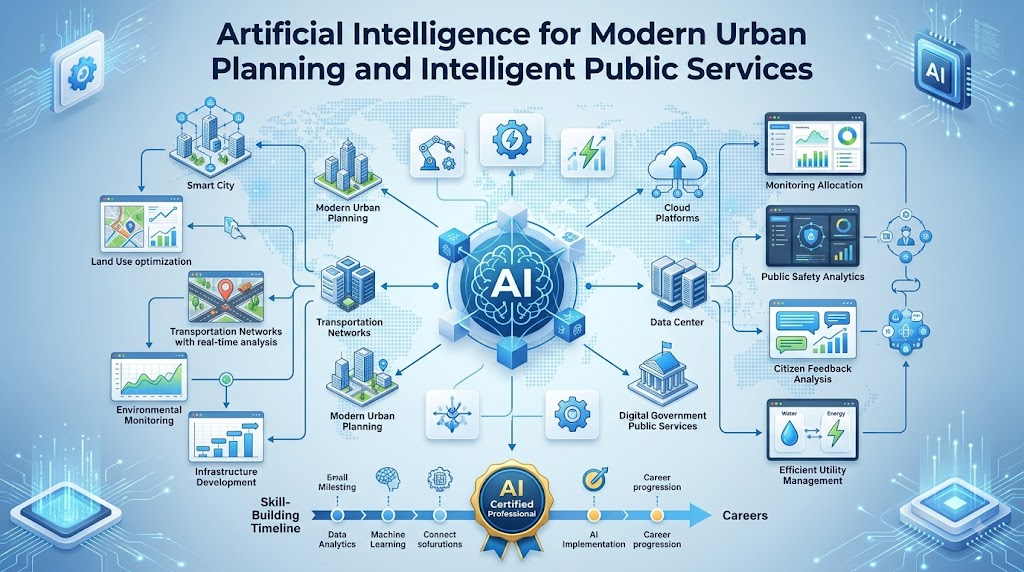
Imagine waking up in a metropolitan area where traffic signals dynamically adjust their timing based on real-time vehicle queues, public transit routes adapt to passenger density fluctuations, power grids identify electrical anomalies before blackouts occur, and localized environmental sensors map air-quality shifts block by block. These capabilities do not emerge from an isolated algorithm. They are made possible by a unified ecosystem: AI + IoT + Data + Cloud/Edge Computing + Digital Infrastructure. You can learn more about modern machine learning concepts and educational pathways at AIUniverse.xyz. A modern smart city leverages artificial intelligence to parse massive data streams, uncover operational patterns, and provide data-backed recommendations to city managers. However, AI does not automatically fix municipal issues on its own.
What Is a Smart City?
A smart city is an urban area that uses digital technologies, connected infrastructure, sensor networks, and data analytics to optimize municipal operations, manage resources efficiently, and improve the quality of life for its residents.
There is no single device or standalone platform that makes a municipality “smart.” Instead, a smart city represents an integrated network across vital public sectors:
- Transportation: Dynamic traffic management, intelligent public transit, and smart parking.
- Public Utilities: Smart electric grids, automated water distribution, and sensor-driven waste management.
- Environmental Health: Real-time air quality index (AQI) tracking and acoustic monitoring.
- Civic Infrastructure: Public safety support, digital healthcare delivery, and citizen service automation.
[Sensors & Cameras]
       │
       ▼
 [Data Collection]
       │
       ▼
[Data Processing & Analytics]
       │
       ▼
[AI Model Inference & Insights]
       │
       ▼
[Operational Decision / Action]
       │
       ▼
 [Feedback & Continuous Loop]
What Role Does AI Play in Smart Cities?
Cities generate billions of data points daily from cameras, transit tap-cards, utility meters, and mobile devices. Without artificial intelligence, municipalities face an information bottleneck: they own petabytes of raw data but lack the analytical throughput to act on it in real time.
AI introduces algorithmic intelligence to urban data management by handling core analytical workloads:
- Pattern Recognition: Identifying recurring transit bottlenecks, peak utility demand periods, or localized waste build-up.
- Predictive Forecasting: Estimating energy loads, transit demand shifts, or municipal water needs hours or days in advance.
- Classification: Categorizing public service tickets, satellite land-use data, or road surface degradation images.
- Anomaly Detection: Flagging sudden water pressure drops (potential pipe bursts), power line surges, or cyber threats.
- Resource Optimization: Calculating optimal routes for waste trucks or adjusting HVAC systems in public buildings.
- Decision Support: Providing scenario-based insights to help municipal teams make informed operational choices.
Data Collection vs. AI-Driven Insights
| Attribute | Raw Data Collection | AI-Driven Urban Analytics |
| Primary State | Descriptive (What happened?) | Predictive & Prescriptive (What will happen, and what should we do?) |
| Processing Style | Passive storage, batch exports, static logs | Continuous ingestion, anomaly detection, real-time inference |
| Actionability | Requires manual human review and manual charting | Surfaces immediate operational recommendations and patterns |
| Scalability | Becomes overwhelming as sensor networks grow | Scales to process millions of concurrent sensor inputs |
How AI and IoT Work Together
The Internet of Things (IoT) and Artificial Intelligence share a symbiotic relationship in urban environments. IoT acts as the nervous system (collecting data from the physical world), while AI acts as the brain (analyzing patterns and determining optimal responses).
[IoT Devices & Sensors]
          │ (Raw Telemetry)
          ▼
   [Data Ingestion]
          │ (Cleaned Streams)
          ▼
   [AI Analysis Engine]
          │ (Actionable Insights)
          ▼
[Municipal Decision / System Action]
Common Urban IoT Hardware
- Traffic Cameras & Radar Sensors: Measure vehicle volume, average speeds, and intersection queue lengths.
- Smart Utility Meters: Record electricity, gas, and water consumption at minute-by-minute intervals.
- Acoustic & Environmental Sensors: Track localized decibel spikes, particulate matter ($PM_{2.5}$, $PM_{10}$), and humidity.
- Ultrasonic Bin Sensors: Measure fill levels within municipal trash and recycling containers.
- Transit GPS Trackers: Broadcast real-time spatial coordinates for buses, trains, and maintenance vehicles.
While IoT hardware generates continuous observational streams, machine learning models ingest this unstructured telemetry to identify anomalies, predict system states, and trigger alerts.
AI for Smart Traffic Management
Urban traffic systems increasingly rely on computer vision and time-series forecasting to balance vehicle throughput across dense road networks.
- Traffic Flow Analysis & Queue Detection: Edge-connected cameras process live video feeds to count vehicles, calculate density, and detect blockages.
- Adaptive Signal Control: Traditional traffic lights operate on rigid, pre-programmed timers. AI-enabled signal controllers evaluate intersection queue lengths in real time, adjusting green-light intervals to clear congested lanes.
- Incident Detection: Machine learning algorithms flag unexpected vehicle stoppages, accidents, or debris on highways, alerting dispatch teams before secondary slowdowns occur.
- Congestion Forecasting: Recurrent neural networks (RNNs) and Long Short-Term Memory (LSTM) models evaluate historical speed data alongside weather conditions and planned events to forecast congestion patterns.
Realistic Expectation: AI cannot eliminate traffic congestion if a road network exceeds its physical vehicle capacity. It optimizes available throughput, minimizes unnecessary signal wait times, and accelerates accident clearance.
AI in Public Transportation
Public transportation systems use predictive models to balance vehicle availability with fluctuating commuter demand.
- Passenger Demand Forecasting: AI analyzes historical tap-in/tap-out data, local events, weather forecasts, and calendar schedules to predict passenger surges along specific corridors.
- Dynamic Route & Schedule Optimization: Transit agencies adjust bus frequencies or deploy supplemental shuttles along high-demand routes during peak hours based on predictive models.
- Predictive Fleet Maintenance: Telemetry sensors placed on train bogies, bus engines, and braking systems monitor vibration frequencies and operating temperatures. When metrics deviate from baseline thresholds, maintenance teams service the parts before in-service failures occur.
[Historical Ridership + Weather + Event Calendars]
                       │
                       ▼
         [AI Demand Forecasting Model]
                       │
                       ▼
 [Optimized Bus Frequencies & Driver Schedules]
AI for Smart Parking
Searching for parking spaces creates unnecessary circulating traffic in commercial districts. Smart parking platforms combine ground sensors, overhead cameras, and predictive algorithms to streamline parking access.
- Occupancy Detection: Magnetometer road sensors and computer vision nodes identify whether individual parking bays are occupied or vacant.
- Parking Demand Prediction: Machine learning models evaluate historical turnover rates to predict parking availability across neighborhood zones.
- Dynamic Signage & Digital Guidance: Real-time occupancy metrics feed directly into roadside variable message signs (VMS) and navigation apps, guiding drivers to open areas without circling busy streets.
AI for Energy Management
Municipal energy grids require continuous balance between electrical supply and consumer demand. AI models analyze energy patterns to improve grid stability.
[Smart Meter Logs + Weather Forecasts + Grid Telemetry]
                          │
                          ▼
            [AI Energy Analysis Engine]
                          │
                          ▼
            [Accurate Demand Forecast]
                          │
                          ▼
      [Optimized Power Dispatch & Battery Storage]
- Grid Load Forecasting: Machine learning algorithms evaluate historical energy consumption, ambient temperatures, and industrial schedules to project hourly electrical demand.
- Renewable Energy Integration: Solar and wind generation fluctuate based on cloud cover and atmospheric conditions. AI models forecast solar and wind output, allowing grid operators to manage battery reserves and balance traditional power sources.
- Grid Fault Detection: Machine learning models identify abnormal voltage drops and phase imbalances across distribution lines, helping utility engineers isolate localized transformer faults.
AI in Smart Buildings
Commercial and municipal buildings consume significant energy through Heating, Ventilation, and Air Conditioning (HVAC) and lighting systems.
- Occupancy-Driven Climate Control: AI systems analyze thermal cameras, motion detectors, and badge swipe data to estimate zone-by-zone room occupancy, automatically adjusting air delivery and temperature setpoints.
- Automated Lighting Optimization: Ambient light sensors feed data into building management controllers to dim artificial lighting when natural sunlight is sufficient.
- Predictive HVAC Maintenance: Algorithms monitor air-handling unit vibration, refrigerant pressures, and fan current draw, detecting early signs of mechanical degradation.
AI for Waste Management
Traditional municipal waste collection runs on fixed schedules, resulting in fuel waste when empty bins are visited and overflow issues when high-density areas fill quickly.
- Fill-Level Monitoring: Ultrasonic sensors mounted inside waste and recycling bins measure the distance between the bin lid and the garbage surface, transmitting fill percentages to a central platform.
- Dynamic Route Optimization: Route-planning algorithms calculate collection paths only for bins that have reached a set threshold (e.g., 75% capacity), reducing truck fuel use and transit hours.
- Recycling Sortation Assistance: Computer vision systems installed on conveyor belts in Material Recovery Facilities (MRFs) identify and categorize recyclables (plastics, metals, cardboard) for robotic sorting arms.
AI for Water Management
Urban water utilities manage thousands of miles of underground pipes where undetected leaks lead to substantial water loss.
- Acoustic Leak Detection: Accelerometers and acoustic loggers attached to water mains listen for high-frequency pipe vibrations caused by pressurized water escaping. Machine learning models distinguish leak signatures from background street noise.
- Water Demand Forecasting: Time-series models evaluate neighborhood consumption trends, temperature variations, and seasonal agricultural use to optimize pumping station schedules and reservoir storage.
- Water Quality Analytics: Automated sensors track pH, turbidity, chlorine residuals, and dissolved oxygen, flagging chemical imbalances before treated water enters distribution mains.
AI for Environmental Monitoring
Cities deploy dense environmental sensor nodes to track local pollution patterns and urban microclimates.
- Localized Air Quality Tracking: Low-cost sensor networks measure fine particulate matter ($PM_{2.5}$, $PM_{10}$), nitrogen dioxide ($NO_2$), and ozone levels. AI models calibrate these readings to correct for humidity drift and map hyper-local pollution plumes.
- Urban Heat Island Analysis: Satellite thermal imagery combined with surface sensor data helps machine learning systems identify concrete-dense neighborhoods experiencing elevated heat retention, guiding tree-planting and cool-roof initiatives.
- Acoustic Noise Mapping: Sound classification models monitor city decibel levels, categorizing noise pollution sources (construction, rail, sirens) to evaluate compliance with municipal noise ordinances.
AI for Public Safety and Emergency Response
Emergency services use analytical tools to process dispatch information and coordinate emergency responses under strict human supervision.
- Emergency Call Triaging Support: Natural Language Processing (NLP) models assist 911/112 dispatchers by transcribing calls, extracting critical location keywords, and suggesting initial incident classifications.
- Disaster Response Coordination: Following storms, floods, or earthquakes, computer vision models analyze satellite imagery and municipal camera feeds to map flooded roadways and downed power lines, helping emergency personnel plan response routes.
- Crowd Flow Analytics: In public transit hubs or event venues, optical flow algorithms monitor crowd movement speeds and density thresholds to detect bottlenecks before unsafe crushing occurs.
Responsible Deployment Note: Public safety AI tools are designed solely to assist trained human operators. Final operational choices, emergency resource assignments, and life-safety decisions must always remain with human professionals.
AI in Smart Healthcare Services
Municipal healthcare infrastructure leverages predictive analytics to manage public health trends and hospital resource allocation.
- Hospital Capacity Planning: Machine learning models evaluate historical admissions, seasonal respiratory illness patterns, and emergency intake rates to forecast bed and staffing needs up to two weeks in advance.
- Epidemiological Trend Tracking: Public health algorithms analyze anonymized diagnostic records, pharmacy sales trends, and municipal wastewater testing data to detect early infection spikes across city sectors.
- Appointment Scheduling Optimization: Predictive models identify historical no-show trends for public clinics, allowing administrative systems to optimize scheduling slots and reduce patient wait times.
AI for Citizen Services
Municipalities use conversational AI and document processing systems to make administrative interactions faster and more accessible.
- Multilingual Chatbots: Natural Language Processing platforms handle standard citizen inquiries regarding municipal tax dates, parking permit rules, and trash pickup schedules in multiple languages.
- Service Request Classification: When a resident submits a civic issue (e.g., reporting a damaged street sign or pothole via a mobile app), computer vision and text classification models categorize the ticket and assign it to the correct department.
- Document Processing: Optical Character Recognition (OCR) coupled with classification models parses permit applications and license renewals, verifying submitted paperwork before manual administrative review.
AI and Predictive Maintenance
Predictive maintenance uses sensor telemetry and machine learning to forecast equipment failures before they happen, moving municipal operations away from reactive fixes.
[IoT Sensor Telemetry] ──> [Pattern & Anomaly Detection] ──> [Failure Probability Score] ──> [Targeted Work Order]
Maintenance Strategy Comparison
| Feature | Reactive Maintenance | Preventive Maintenance | Predictive Maintenance (AI-Enabled) |
| Strategy | Fix it after it breaks (“Run-to-failure”) | Service on fixed time/mileage intervals | Service based on measured asset condition |
| Data Requirements | None | Calendar schedules and equipment manuals | Continuous sensor telemetry and historical baseline models |
| Downtime Impact | High; causes unexpected operational outages | Moderate; assets are occasionally serviced while still healthy | Minimal; repairs are scheduled right before projected failure |
| Cost Profile | High repair costs and emergency labor fees | Moderate; recurring parts replacement overhead | Highly cost-efficient over long asset lifecycles |
| City Example | Repairing a water main after it bursts | Repaving a road every 5 years regardless of condition | Servicing a transit rail switch when vibration patterns show wear |
Cybersecurity in Connected Cities
As physical infrastructure connects to IP networks and cloud platforms, the urban attack surface expands significantly. Smart cities deploy automated cybersecurity systems to protect critical public utilities.
- Network Anomaly Detection: Machine learning models monitor SCADA systems, traffic controllers, and IoT gateways, learning normal baseline traffic and flagging unauthorized protocol commands.
- Identity and Access Management (IAM): AI evaluates behavioral authentication signals (login times, geolocations, API access velocity) to prevent compromised administrative accounts from altering utility controls.
- Automated Threat Containment: When an endpoint displays ransomware signatures or port-scanning behavior, security systems automatically isolate the node from the wider municipal network.
Role of Edge AI in Smart Cities
Edge AI involves running machine learning inference locally on specialized hardware (such as smart cameras, microcontrollers, and edge gateways) rather than sending all raw sensor feeds to a centralized cloud data center.
Cloud AI vs. Edge AI
| Factor | Cloud AI | Edge AI |
| Processing Location | Centralized remote data centers | Local gateways, smart cameras, on-site chips |
| Latency | 100ms – 2+ seconds (network dependent) | Sub-10 milliseconds (near real-time) |
| Connectivity Dependence | High; requires steady, high-bandwidth internet | Low; can operate autonomously offline |
| Data Transfer Volume | Massive; raw video feeds and logs upload constantly | Minimal; only metadata, alerts, and summaries upload |
| Primary Use Cases | City-wide trend forecasting, long-term urban planning | Intersection collision avoidance, immediate signal control |
AI and Digital Twins
A digital twin is an up-to-date, virtual representation of a physical asset, system, or urban environment that mirrors its real-world counterpart using live sensor data.
┌───────────────────────────┐         Sensor Telemetry Streams         ┌───────────────────────────┐
│     Physical City         │ ───────────────────────────────────────> │    Urban Digital Twin     │
│ (Roads, Grids, Buildings) │ <─────────────────────────────────────── │  (Simulation, Scenario    │
└───────────────────────────┘        Optimized Control Insights        │   Modeling, AI Inference) │
                                                                       └───────────────────────────┘
Urban planners and systems engineers use AI-powered digital twins for:
- Microclimate & Wind Modeling: Testing how proposed skyscrapers affect street-level wind patterns and natural sunlight access.
- Flood Inundation Simulations: Running hydrological models against sea-level rise and storm-surge scenarios to design drainage infrastructure.
- Traffic Disruption Testing: Simulating the city-wide impact of closing a major bridge for maintenance before road crews deploy barriers.
AI for Urban Planning
Urban planners use machine learning to evaluate complex spatial datasets, demographic shifts, and environmental factors when designing long-term master plans.
- Land-Use & Satellite Classification: Computer vision models process satellite and aerial imagery to track changes in green canopies, urban sprawl, and impervious surface coverage over decades.
- Demographic & Mobility Modeling: Machine learning analyzes anonymized travel surveys and transit patterns to determine optimal locations for future schools, clinics, and transit lines.
- Zoning Scenario Analysis: Planners use generative design algorithms to balance residential density, park access, and utility capacity across redevelopment proposals.
10 Key Benefits of AI in Smart Cities
┌────────────────────────────────────────────────────────────────────────┐
│                      Core Smart City AI Benefits                       │
├───────────────────────────────────┬────────────────────────────────────┤
│ 1. Data-Driven Operational Agility│ 6. Proactive Asset Maintenance     │
│ 2. Rapid Multi-Source Analytics   │ 7. Streamlined Citizen Services    │
│ 3. Optimized Transit Flow         │ 8. Granular Pollution Tracking     │
│ 4. Efficient Energy Management    │ 9. Municipal Resource Efficiency   │
│ 5. Condition-Based Infrastructure │ 10. Scalable Civic Administration  │
└───────────────────────────────────┴────────────────────────────────────┘
- Data-Backed Decision-Making: Replaces intuition with empirical data trends when allocating public funds.
- Accelerated Data Processing: Analyzes millions of daily sensor readings in seconds rather than months.
- Improved Transportation Efficiency: Balances signal timings and transit schedules to reduce commuter delays.
- Optimized Energy Consumption: Decreases municipal utility waste through automated demand response and smart HVAC controls.
- Continuous Infrastructure Monitoring: Identifies subtle structural changes in bridges, water pipes, and roads early.
- Predictive Equipment Maintenance: Minimizes unexpected utility outages by servicing assets before mechanical failure.
- Accessible Civic Services: Provides 24/7 multilingual support for common citizen requests.
- Granular Environmental Mapping: Pinpoints localized pollution and heat-island hotspots for targeted intervention.
- Resource Conservation: Reduces fuel use and operational costs in services like waste management.
- Scalable Administration: Helps municipal agencies handle population growth without a proportional increase in administrative overhead.
12 Critical Challenges in Smart City AI Implementations
Deploying machine learning systems across public infrastructure involves significant technical, social, and operational challenges:
┌────────────────────────────────────────────────────────────────────────┐
│                   12 Smart City Deployment Challenges                  │
├───────────────────────────────────┬────────────────────────────────────┤
│ 1. Data Privacy & Surveillance    │ 7. Technical Talent Shortages      │
│ 2. Expanded Cyber Attack Surfaces │ 8. System Interoperability Silos   │
│ 3. Inconsistent Data Quality      │ 9. Digital Inequality & Access     │
│ 4. Algorithmic Bias in Models     │ 10. Public Trust & Transparency    │
│ 5. Substantial Capital Costs      │ 11. Model Reliability & Drift      │
│ 6. Fragile Legacy Infrastructure  │ 12. Governance & Accountability    │
└───────────────────────────────────┴────────────────────────────────────┘
- Data Privacy Concerns: Constant sensor data collection in public spaces raises legitimate civil liberty questions.
- Cybersecurity Vulnerabilities: Expanding connected endpoints increases the attack surface for bad actors targeting utility grids.
- Inconsistent Data Quality: Missing, noisy, or uncalibrated IoT sensor data leads to inaccurate model outputs.
- Algorithmic Bias: Models trained on historical data can perpetuate demographic or geographic disparities in municipal service delivery.
- High Capital Expenditure: Procuring, deploying, and maintaining sensor hardware and compute infrastructure requires substantial municipal budgets.
- Integration with Legacy Systems: Modern AI software often struggles to interface with decades-old analog utility control equipment.
- Specialized Talent Shortages: Municipalities often struggle to recruit and retain experienced machine learning and data engineering professionals.
- Vendor Lock-in and Silos: Proprietary systems from different vendors frequently lack open APIs, preventing cross-department data sharing.
- Digital Inequality: Technology-dependent services risk excluding populations that lack smartphone access or digital literacy.
- Public Trust and Transparency: Without clear communication, citizens may distrust automated data collection initiatives.
- Model Drift Over Time: Real-world urban conditions change, causing static models to degrade in accuracy if not continuously monitored.
- Accountability and Governance: Municipalities must establish clear legal liability when automated analytical recommendations cause errors.
AI Ethics and Privacy in Smart Cities
Smart cities must be built on responsible, privacy-preserving governance frameworks. When algorithms operate in public spaces, ethical design is essential.
- Data Minimization: Municipalities should collect only the minimum data required for specific public purposes. For example, traffic monitoring systems should extract aggregate vehicle counts at the edge and discard raw video footage immediately.
- De-identification & Anonymization: Personally Identifiable Information (PII) must be stripped, masked, or hashed at the point of ingestion before being used for training or analytics.
- Explainability and Auditing: Municipal algorithms that influence resource distribution or public services must be open to independent technical audits and explainable to non-technical stakeholders.
- Human-in-the-Loop Oversight: Mission-critical operations—including emergency dispatch, infrastructure shutdowns, and regulatory enforcement—must require human authorization.
Practical Example: AI Traffic Optimization Workflow
The following hypothetical scenario illustrates how an AI-enabled traffic optimization workflow operates in a commercial district during an unexpected surge in vehicle volume.
[Vehicle Detection Sensors & Cameras]
                 │
                 ▼
[Edge Nodes Extract Counts & Speeds (Raw Footage Discarded)]
                 │
                 ▼
[Municipal Data Lake Aggregates Traffic & Transit Metrics]
                 │
                 ▼
[AI Model Detects Queue Spikes & Predicts Gridlock]
                 │
                 ▼
[Adaptive Signal Engine Adjusts Green-Light Timing]
                 │
                 ▼
[Variable Message Signs Update Alternative Routes]
                 │
                 ▼
[System Measures Flow Recovery & Logs Performance]
- Detection: Induction loop sensors and edge-processing cameras detect vehicle volume doubling along a commercial corridor following a stadium event.
- Edge Extraction: Local nodes extract numeric counts, vehicle classifications, and speed metrics, discarding raw video frames locally to preserve privacy.
- Ingestion: Numeric telemetry streams into the city’s central traffic management platform.
- Analysis: An adaptive traffic model identifies that eastbound queues will cause gridlock within 15 minutes at current flow rates.
- Automated Adjustment: The system modifies signal timing offsets, adding 15 seconds of green time to the eastbound arterial corridor.
- Information Dissemination: Digital roadside message signs update, advising drivers to take an alternative bypass road.
- Feedback: Sensor feeds verify that vehicle queues return to normal levels within 20 minutes, and the system records the event performance to refine future predictions.
Smart City AI Technology Stack
A functional smart city architecture relies on a multi-layer technology stack:
┌────────────────────────────────────────────────────────┐
│  Layer 7: Decision-Makers & Operations Personnel       │
├────────────────────────────────────────────────────────┤
│  Layer 6: Applications, Dashboards & Citizen Portals   │
├────────────────────────────────────────────────────────┤
│  Layer 5: AI & Machine Learning Inference Engines      │
├────────────────────────────────────────────────────────┤
│  Layer 4: Data Platforms, Warehouses & Feature Stores   │
├────────────────────────────────────────────────────────┤
│  Layer 3: Connectivity (5G, Fiber, LoRaWAN, Cellular)   │
├────────────────────────────────────────────────────────┤
│  Layer 2: IoT Sensors, Actuators & Edge Compute Units  │
├────────────────────────────────────────────────────────┤
│  Layer 1: Physical Infrastructure (Roads, Grids, Pipes)│
└────────────────────────────────────────────────────────┘
- Layer 1: Physical Infrastructure: The real-world assets: roadways, bridges, power substations, water mains, and transit fleets.
- Layer 2: IoT & Edge Compute: Hardware sensors (flow meters, thermistors, cameras) and edge microprocessors running lightweight models.
- Layer 3: Connectivity: Networking infrastructure (5G, fiber optic backhauls, LoRaWAN, NB-IoT) that transports telemetry.
- Layer 4: Data Platform: Centralized data lakes, spatial databases, and streaming pipelines that clean and store urban data.
- Layer 5: AI / ML Models: Algorithms that perform regression, classification, anomaly detection, and time-series forecasting.
- Layer 6: Applications & Dashboards: User interfaces for city operators, automated dispatch consoles, and public mobile apps.
- Layer 7: Human Decision-Makers: Engineers, planners, emergency responders, and administrators who review recommendations and direct operations.
Strategic Roadmap: Implementing AI in Smart Cities
[Phase 1: Problem Definition] ──> [Phase 2: Data Audit] ──> [Phase 3: Governance Setup]
                                                                     │
[Phase 6: Full Scale] <── [Phase 5: Evaluation] <── [Phase 4: Pilot Deployment]
- Identify a Concrete Urban Problem: Focus on a specific municipal challenge with measurable outcomes (e.g., reduce water distribution losses in District 4).
- Define Target KPIs: Establish clear success metrics, such as reducing average pump energy usage by 8%.
- Audit Data Availability and Quality: Verify that historical and real-time telemetry from relevant sensors is accessible, clean, and representative.
- Establish Data Governance and Security: Define data ownership, encryption standards, anonymization rules, and role-based access controls before development begins.
- Select the Appropriate Analytical Method: Use simple statistical and rule-based models first; deploy complex deep learning models only when simpler methods prove insufficient.
- Deploy a Controlled Pilot: Test the solution across a single geographic area or small asset fleet to evaluate real-world performance.
- Validate Accuracy and Operational Reliability: Assess false-positive rates, edge cases, latency, and system downtime under stress.
- Incorporate Human Oversight: Design workflows so operators can review, understand, and override algorithmic outputs.
- Monitor Model Drift: Continuously track model performance as urban traffic patterns, weather seasons, and municipal demographics evolve.
- Scale Incrementally: Expand deployment to additional districts only after achieving verified operational ROI and positive audit results.
Measuring Smart City AI Success
Cities must measure both technical algorithm performance and real-world public value when evaluating smart city initiatives.
| Metric | What It Measures | Target Evaluation Focus |
| Service Response Time | Time taken from incident detection to operational action | Operational efficiency gains |
| Energy Consumption | Kilowatt-hours used by municipal assets (pumps, streetlights, HVAC) | Resource conservation and utility cost savings |
| Traffic Flow Throughput | Average vehicle wait times and intersection delay indexes | Congestion reduction and corridor mobility |
| Maintenance Response Latency | Time elapsed between early anomaly detection and asset servicing | Prevention of catastrophic asset breakdowns |
| Citizen Satisfaction | Public ratings and completion rates on digital service requests | Public adoption and quality of civic services |
| Model Inference Accuracy | Precision, recall, and F1-score of deployed machine learning models | Algorithmic reliability and edge-case handling |
| System Availability (Uptime) | Percentage of time IoT networks and AI platforms remain operational | System resilience and cyber reliability |
| Data Quality Score | Percentage of complete, uncorrupted, and timely sensor data packets | Health of physical IoT infrastructure |
| Return on Investment (ROI) | Operational dollars saved versus system procurement and maintenance costs | Long-term fiscal viability of the project |
| Security & Privacy Incidents | Number of unauthorized access attempts, data leaks, or policy breaches | Compliance with cybersecurity and privacy policies |
The Future of AI in Smart Cities
Smart city technologies are advancing from descriptive dashboards toward interconnected, predictive urban systems.
┌─────────────────────────┬─────────────────────────┬─────────────────────────┐
│  Current Applications   │  Emerging Technologies  │  Long-Term Possibilities│
├─────────────────────────┼─────────────────────────┼─────────────────────────┤
│ • Adaptive Traffic Lights│ • City-Wide Digital Twins│ • Multi-Agent City Ops  │
│ • Fill-Level Waste Routes│ • Edge Computer Vision  │ • Unified Grid-Mobility │
│ • Basic Predictive Maint │ • Generative Civic Portals│ • Autonomous Fleets   │
└─────────────────────────┴─────────────────────────┴─────────────────────────┘
- City-Scale AI Digital Twins: Future municipal platforms will simulate entire metropolitan systems simultaneously, showing how changes in transit routing impact local air quality and power grid loads.
- Autonomous Public Transit Fleets: Autonomous shuttles and dedicated-lane buses will use onboard perception and vehicle-to-infrastructure (V2I) communication to navigate urban routes safely.
- Generative AI for Civic Interaction: Next-generation municipal portals will use conversational AI to help citizens navigate complex permitting processes, review zoning codes, and submit service requests naturally.
- Autonomous AI Agents for Municipal Operations: Multi-agent systems operating under administrative supervision will coordinate cross-department workflows, like dispatching repair teams and adjusting traffic signals during burst water main incidents.
- Pervasive Edge Computing: High-efficiency neural processing units (NPUs) built directly into streetlights and environmental monitors will process data locally, protecting privacy and reducing network bandwidth needs.
- Predictive Urban Infrastructure: Advanced time-series models will forecast infrastructure maintenance needs years in advance, helping cities plan capital improvement budgets efficiently.
Technical Skills for Smart City AI Professionals
Building and maintaining smart city platforms requires skills spanning software, data science, hardware, and urban systems engineering.
┌────────────────────────────────────────────────────────┐
│             Smart City AI Learning Path                │
├───────────────────────────────────┬────────────────────┤
│ 1. Foundations                    │ 2. Data & Hardware │
│ • Python Programming              │ • SQL & Streaming  │
│ • Linear Algebra & Statistics     │ • IoT & MQTT       │
│ • ML Core Concepts (Scikit-Learn) │ • Edge Computing   │
├───────────────────────────────────┼────────────────────┤
│ 3. Advanced AI                    │ 4. Deployment      │
│ • Computer Vision (OpenCV)        │ • Cloud Systems    │
│ • Time-Series Models (LSTMs)      │ • Cybersecurity    │
│ • GIS & Spatial Data Analytics    │ • AI Ethics        │
└───────────────────────────────────┴────────────────────┘
Foundational Step (Start Here)
- Python Programming & Scientific Computing: Master Python, NumPy, and Pandas for handling municipal datasets.
- Data Analysis & SQL: Learn to query relational databases, spatial databases (PostGIS), and time-series repositories.
- Applied Machine Learning: Understand regression, classification, clustering, and anomaly detection using Scikit-Learn.
Intermediate Step
- IoT & Networking Basics: Learn common communication protocols used in urban sensing, including MQTT, CoAP, LoRaWAN, and REST APIs.
- Spatial Data Analysis: Gain experience with Geographic Information Systems (GIS), Geopandas, and geospatial coordinate transformations.
- Time-Series Analysis: Master ARIMA, Prophet, and neural network architectures (RNNs, LSTMs) for demand and utility forecasting.
Advanced Step
- Edge AI & Computer Vision: Deploy optimized models to edge devices using frameworks like TensorRT, ONNX, and OpenCV.
- Cloud Architecture: Build scalable data ingestion pipelines using Docker, Kubernetes, and distributed streaming engines (Apache Kafka).
- AI Ethics, Security & Governance: Study data privacy frameworks, model auditing methods, and cybersecurity best practices for critical infrastructure.
Continuing Your AI Journey
Building and managing intelligent urban infrastructure requires a solid understanding of artificial intelligence, distributed systems, and real-world data engineering. Exploring technical resources, certification roadmaps, and hands-on guides helps technology professionals, engineers, and municipal leaders navigate modern machine learning.
Educational platforms like AIUniverse.xyz provide beginner-friendly tutorials, practical guides, and comprehensive breakdowns covering machine learning fundamentals, IoT analytics, computer vision, and emerging AI technologies. Deepening your knowledge across these core areas prepares you to build, evaluate, and manage reliable AI solutions for modern urban environments.
Frequently Asked Questions (FAQs)
What is AI in smart cities?
AI in smart cities refers to the use of machine learning, computer vision, and predictive analytics to process data collected from urban infrastructure, helping municipal authorities improve transportation, public services, energy grids, and resource management.
How is AI used in smart city transportation?
AI analyzes real-time video feeds, radar data, and historical transit logs to adjust traffic light durations dynamically, predict congestion hotspots, optimize public transit schedules, and detect road accidents quickly.
How does AI help manage energy in cities?
Machine learning models analyze historical consumption data, weather forecasts, and smart meter readings to predict electricity demand, integrate renewable energy sources into the grid, and optimize heating and cooling in public buildings.
How does AI improve waste management?
Ultrasonic sensors in waste containers measure fill levels, while AI route-optimization algorithms design collection routes only for bins that need emptying, reducing fuel consumption and preventing overflowing garbage.
How is AI used for environmental monitoring?
AI processes readings from distributed environmental sensors to track air pollution patterns ($PM_{2.5}$, $NO_2$), map urban heat islands, model flood risks, and monitor noise pollution across city neighborhoods.
What is the role of IoT in smart cities?
The Internet of Things (IoT) provides the physical sensing network for a smart city. IoT devices—including smart meters, cameras, flow sensors, and GPS trackers—collect raw physical data and transmit it to centralized or edge platforms for AI analysis.
What is Edge AI in smart cities?
Edge AI runs machine learning inference directly on local hardware devices (like cameras or road controllers) rather than sending all data to a remote cloud server, enabling millisecond response times, reducing bandwidth use, and improving data privacy.
What are the main benefits of AI-powered smart cities?
Key benefits include improved traffic flow, lower municipal energy costs, proactive infrastructure maintenance, faster emergency response coordination, and accessible digital citizen services.
What are the biggest challenges of using AI in smart cities?
Primary challenges include protecting citizen privacy, preventing cyberattacks on public utilities, managing high hardware costs, integrating AI with legacy systems, eliminating algorithmic bias, and maintaining model reliability over time.
What is the future of AI in smart cities?
The future of smart cities will center around city-scale digital twins for scenario planning, expanded edge computing for localized processing, multi-agent operational automation, and privacy-preserving analytics built on robust governance frameworks.
Conclusion
When applied thoughtfully, artificial intelligence helps municipalities make sense of complex urban data—enabling proactive infrastructure maintenance, optimized transit corridors, balanced energy distribution, and responsive public services. However, building sustainable, secure, and fair smart cities requires far more than algorithmic code. Successful deployments depend on high-quality data, modern physical infrastructure, robust cybersecurity safeguards, transparent privacy policies, and responsible human governance. By prioritizing ethical design and operational reliability, cities can use artificial intelligence to build more resilient, efficient, and livable communities for all residents.
