Introduction
Agent-to-Agent (A2A) Communication Protocol Tooling refers to the infrastructure, frameworks, and platforms that enable multiple AI agents to communicate, coordinate, delegate tasks, and collaborate autonomously. Instead of single-agent systems working in isolation, modern AI architectures increasingly rely on distributed agent ecosystems where specialized agents exchange messages, negotiate tasks, share memory, and jointly execute workflows.
A2A communication has become a foundational layer for enterprise AI systems. As organizations deploy multi-agent systems across sales, IT operations, research, procurement, and customer support, the need for standardized protocols and orchestration layers has grown significantly. These tools enable structured messaging, shared context, tool invocation, event handling, and secure inter-agent collaboration.
Agent-to-agent protocols are essentially the “TCP/IP layer” of the AI agent economy—defining how autonomous systems talk, trust, and coordinate with each other.
Real-World Use Cases
- Multi-agent workflow automation across enterprise systems
- Distributed AI research teams (planner, researcher, verifier agents)
- IT operations agents collaborating on incident resolution
- Sales agents coordinating prospecting, outreach, and follow-ups
- Supply chain agents negotiating procurement decisions
- Developer agents coordinating coding, testing, and deployment tasks
Evaluation Criteria for Buyers
When evaluating A2A communication tooling, consider:
- Messaging protocol standardization
- Multi-agent orchestration capability
- State sharing and memory synchronization
- Security and authentication between agents
- Scalability across distributed systems
- Tool invocation and function calling support
- Event-driven architecture support
- Observability and tracing capabilities
- Compatibility with LLM frameworks
- Latency and performance optimization
- Governance and access control
- Vendor neutrality and extensibility
Best for: Enterprise AI platforms, AI engineering teams, multi-agent system builders, research organizations, DevOps teams, and companies building autonomous AI ecosystems.
Not ideal for: Simple chatbot applications, single-agent systems, or lightweight AI tools that do not require inter-agent coordination.
What’s Changed in Agent-to-Agent Protocol Tooling
- Standardized A2A messaging formats are emerging across frameworks
- Multi-agent orchestration is now a core architectural requirement
- Event-driven agent communication is replacing linear pipelines
- Shared memory systems are becoming distributed and synchronized
- Agents now negotiate task delegation dynamically
- Security layers now include agent authentication and authorization
- Tool calling is standardized across agent ecosystems
- Cross-framework interoperability is improving
- Observability for agent interactions is now mandatory
- Human-in-the-loop control is embedded in A2A flows
- Agent routing systems optimize workload distribution
- Real-time coordination enables parallel execution of tasks
Quick Buyer Checklist
Before selecting A2A tooling, verify:
- □ Standardized communication protocol support
- □ Multi-agent orchestration framework
- □ Secure authentication between agents
- □ Shared memory or context synchronization
- □ Event-driven communication support
- □ Tool/function calling compatibility
- □ Observability and trace logging
- □ Scalability across distributed systems
- □ Integration with LLM frameworks
- □ Governance and access control mechanisms
- □ Failure handling and retry logic
- □ Vendor neutrality or extensibility
- □ Performance optimization features
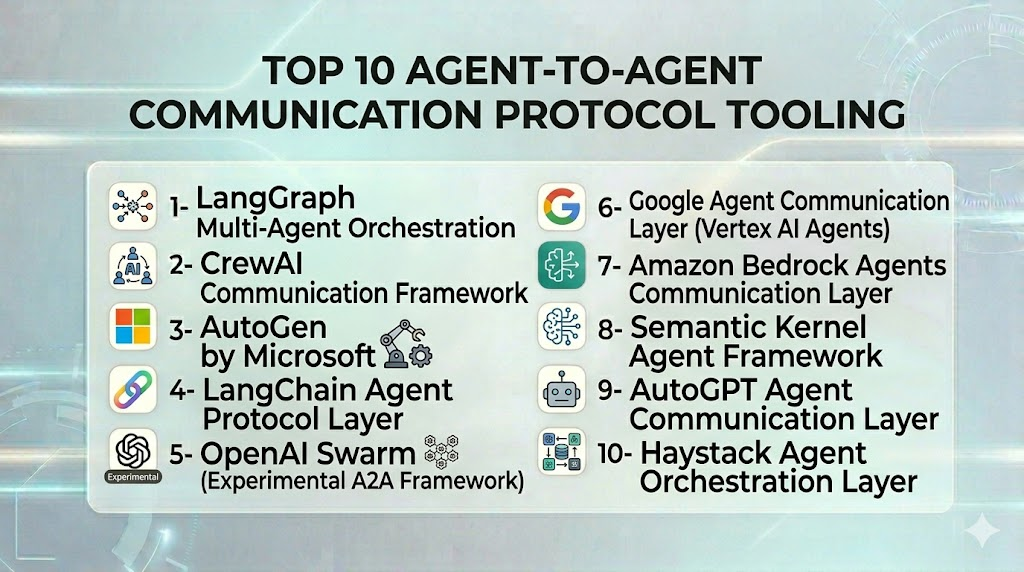
Top 10 Agent-to-Agent Communication Protocol Tooling
1- LangGraph Multi-Agent Orchestration
One-line verdict: Best for building structured, stateful multi-agent communication workflows.
Short description:
LangGraph enables developers to design graph-based multi-agent systems where agents communicate, share state, and execute complex workflows using structured orchestration logic.
Standout Capabilities
- Graph-based agent communication
- Stateful multi-agent workflows
- Human-in-the-loop integration
- Conditional routing between agents
- Shared memory management
- Tool execution orchestration
- Scalable agent pipelines
AI-Specific Depth
- Model support: Multi-model and BYO-model support
- RAG / knowledge integration: Native support via LangChain ecosystem
- Evaluation: LangSmith integration
- Guardrails: Framework-based safety controls
- Observability: Full tracing of agent interactions
Pros
- Strong orchestration model
- Highly flexible architecture
- Great developer ecosystem
Cons
- Requires engineering expertise
- Complex setup for beginners
- Not plug-and-play
Security & Compliance
Varies by deployment and implementation.
Deployment & Platforms
- Cloud
- Self-hosted
- Hybrid
Integrations & Ecosystem
- LangChain ecosystem
- LLM providers
- Vector databases
- APIs
Pricing Model
Open-source with enterprise offerings.
Best-Fit Scenarios
- Multi-agent AI systems
- Workflow orchestration
- AI engineering platforms
2- CrewAI Communication Framework
One-line verdict: Best for role-based collaborative agent communication systems.
Short description:
CrewAI enables multiple AI agents with defined roles to communicate and collaborate on complex tasks using structured coordination patterns.
Standout Capabilities
- Role-based agent collaboration
- Task delegation system
- Sequential and parallel workflows
- Lightweight orchestration
- Agent memory sharing
- Modular architecture
- Fast deployment
AI-Specific Depth
- Model support: BYO-model and multi-model support
- RAG / knowledge integration: External tool integrations
- Evaluation: Framework-based evaluation
- Guardrails: Customizable constraints
- Observability: Basic tracing support
Pros
- Simple multi-agent setup
- Flexible role definitions
- Good for experimentation
Cons
- Limited enterprise governance
- Observability still evolving
- Requires customization for scale
Security & Compliance
Varies by deployment.
Deployment & Platforms
- Cloud
- Self-hosted
Integrations & Ecosystem
- OpenAI
- Anthropic
- APIs
- Vector databases
Pricing Model
Open-source + enterprise support.
Best-Fit Scenarios
- Research prototypes
- Multi-agent collaboration
- Startup AI systems
3- AutoGen by Microsoft
One-line verdict: Best for enterprise-grade conversational multi-agent communication.
Short description:
AutoGen enables structured dialogue between multiple AI agents, allowing them to collaborate through conversation-driven workflows.
Standout Capabilities
- Conversational agent communication
- Multi-agent dialogue orchestration
- Human-in-the-loop support
- Code execution agents
- Tool usage integration
- Task decomposition
- Enterprise extensibility
AI-Specific Depth
- Model support: Azure OpenAI and external models
- RAG / knowledge integration: Azure ecosystem support
- Evaluation: Experimental evaluation tools
- Guardrails: Enterprise policy controls
- Observability: Conversation tracing
Pros
- Strong enterprise backing
- Flexible conversation-based design
- Good integration with Microsoft stack
Cons
- Requires technical setup
- Still evolving framework
- Limited standardized protocol layer
Security & Compliance
Enterprise Azure security controls.
Deployment & Platforms
- Cloud
- Hybrid via Azure
Integrations & Ecosystem
- Azure AI
- Microsoft tools
- APIs
- DevOps pipelines
Pricing Model
Open-source framework with Azure services cost.
Best-Fit Scenarios
- Enterprise AI systems
- Conversational agent workflows
- Microsoft ecosystem users
4- LangChain Agent Protocol Layer
One-line verdict: Best for building modular agent communication pipelines.
Short description:
LangChain provides foundational components for enabling agent-to-agent communication through tool calling, memory sharing, and structured workflows.
Standout Capabilities
- Modular agent architecture
- Tool calling system
- Memory-based coordination
- Chain-of-agents workflows
- API integrations
- RAG pipelines
- Flexible orchestration
AI-Specific Depth
- Model support: Multi-model support
- RAG / knowledge integration: Extensive ecosystem support
- Evaluation: LangSmith integration
- Guardrails: Framework-level controls
- Observability: Full tracing support
Pros
- Mature ecosystem
- Highly flexible
- Strong community
Cons
- Not a strict protocol layer
- Requires engineering effort
- Fragmented architecture at scale
Security & Compliance
Varies by deployment.
Deployment & Platforms
- Cloud
- Self-hosted
Integrations & Ecosystem
- LLM providers
- Vector databases
- APIs
- Enterprise systems
Pricing Model
Open-source + enterprise tools.
Best-Fit Scenarios
- Agent pipelines
- Research systems
- Custom AI apps
5- OpenAI Swarm (Experimental A2A Framework)
One-line verdict: Best for lightweight experimental agent coordination.
Short description:
Swarm is a minimal multi-agent coordination framework designed for experimenting with agent-to-agent communication patterns.
Standout Capabilities
- Lightweight agent routing
- Simple task delegation
- Multi-agent coordination
- Tool invocation support
- Experimental workflows
- Fast prototyping
- Minimal architecture
AI-Specific Depth
- Model support: OpenAI models primarily
- RAG / knowledge integration: External implementations required
- Evaluation: Not built-in
- Guardrails: Basic safety layers
- Observability: Limited
Pros
- Very simple architecture
- Fast prototyping
- Easy experimentation
Cons
- Not production-ready
- Limited governance
- Minimal observability
Security & Compliance
Not publicly stated.
Deployment & Platforms
- Cloud
- Local environments
Integrations & Ecosystem
- OpenAI APIs
- Custom tools
- Python ecosystems
Pricing Model
Open-source.
Best-Fit Scenarios
- Research prototypes
- Experimental A2A systems
- Learning multi-agent systems
6- Google Agent Communication Layer (Vertex AI Agents)
One-line verdict: Best for enterprise-grade agent communication in Google Cloud ecosystems.
Short description:
Google’s Vertex AI Agent framework enables structured multi-agent systems with strong integration into Google Cloud and enterprise data systems.
Standout Capabilities
- Enterprise agent orchestration
- Cloud-native communication
- Knowledge integration
- Multi-agent workflows
- Scalable architecture
- Event-driven systems
- Secure communication layer
AI-Specific Depth
- Model support: Gemini models
- RAG / knowledge integration: Google Cloud data sources
- Evaluation: Enterprise monitoring tools
- Guardrails: Policy-based controls
- Observability: Cloud logging and tracing
Pros
- Strong cloud-native design
- Enterprise scalability
- Deep Google integration
Cons
- Ecosystem dependency
- Limited portability
- Complex setup
Security & Compliance
Enterprise Google Cloud security.
Deployment & Platforms
- Cloud
Integrations & Ecosystem
- Google Cloud
- Vertex AI
- BigQuery
- Enterprise APIs
Pricing Model
Usage-based cloud pricing.
Best-Fit Scenarios
- Enterprise AI systems
- Cloud-native architectures
- Data-heavy workflows
7- Amazon Bedrock Agents Communication Layer
One-line verdict: Best for scalable multi-agent systems in AWS environments.
Short description:
AWS Bedrock Agents provide infrastructure for building and connecting autonomous agents across enterprise workloads.
Standout Capabilities
- Multi-agent orchestration
- AWS-native integration
- Tool invocation layer
- Scalable execution engine
- Secure communication
- Workflow automation
- Enterprise governance
AI-Specific Depth
- Model support: Multiple foundation models
- RAG / knowledge integration: AWS data services
- Evaluation: Cloud monitoring tools
- Guardrails: AWS policy controls
- Observability: CloudWatch integration
Pros
- Strong scalability
- Deep AWS integration
- Enterprise readiness
Cons
- AWS dependency
- Complex configuration
- Steep learning curve
Security & Compliance
AWS enterprise security standards.
Deployment & Platforms
- Cloud (AWS)
Integrations & Ecosystem
- AWS Lambda
- S3
- Bedrock models
- Enterprise systems
Pricing Model
Usage-based AWS pricing.
Best-Fit Scenarios
- AWS-native AI systems
- Enterprise automation
- Large-scale agent workloads
8- Semantic Kernel Agent Framework
One-line verdict: Best for .NET and enterprise developer ecosystems.
Short description:
Semantic Kernel enables structured agent orchestration and communication within enterprise software environments.
Standout Capabilities
- Modular agent design
- Plugin-based architecture
- Memory coordination
- Tool execution layer
- Enterprise extensibility
- Multi-language support
- Workflow orchestration
AI-Specific Depth
- Model support: Multi-model support
- RAG / knowledge integration: Plugin-based systems
- Evaluation: Limited built-in tools
- Guardrails: Custom implementations
- Observability: Logging integrations
Pros
- Enterprise-friendly
- Flexible architecture
- Strong Microsoft alignment
Cons
- Requires development effort
- Limited protocol standardization
- Early-stage ecosystem
Security & Compliance
Varies by deployment.
Deployment & Platforms
- Cloud
- On-premise
- Hybrid
Integrations & Ecosystem
- Microsoft stack
- APIs
- Enterprise systems
Pricing Model
Open-source.
Best-Fit Scenarios
- Enterprise developers
- .NET ecosystems
- Custom agent systems
9- AutoGPT Agent Communication Layer
One-line verdict: Best for autonomous multi-agent experimentation.
Short description:
AutoGPT enables agents to communicate and execute tasks autonomously using goal-driven workflows.
Standout Capabilities
- Autonomous task execution
- Multi-agent coordination
- Goal-based workflows
- Tool usage system
- Memory persistence
- Iterative reasoning
- Experimental architecture
AI-Specific Depth
- Model support: Multi-model support
- RAG / knowledge integration: External systems
- Evaluation: Experimental tools
- Guardrails: Minimal controls
- Observability: Basic logs
Pros
- Fully autonomous design
- Strong experimentation value
- Easy to extend
Cons
- Not production-ready
- Stability concerns
- Limited governance
Security & Compliance
Not publicly stated.
Deployment & Platforms
- Cloud
- Local
Integrations & Ecosystem
- APIs
- Open-source tools
- LLM providers
Pricing Model
Open-source.
Best-Fit Scenarios
- Research projects
- Autonomous AI experimentation
- Proof-of-concept systems
10- Haystack Agent Orchestration Layer
One-line verdict: Best for NLP-driven multi-agent retrieval systems.
Short description:
Haystack provides a framework for building agentic pipelines that include retrieval, reasoning, and agent communication.
Standout Capabilities
- Retrieval-based agent workflows
- Multi-step pipelines
- Document-based reasoning
- Modular components
- Search integration
- Workflow orchestration
- Enterprise extensibility
AI-Specific Depth
- Model support: Multi-model support
- RAG / knowledge integration: Strong built-in RAG support
- Evaluation: Pipeline evaluation tools
- Guardrails: Customizable constraints
- Observability: Logging and tracing
Pros
- Strong RAG capabilities
- Modular architecture
- Production-friendly
Cons
- Requires engineering expertise
- Not a pure A2A protocol layer
- Setup complexity
Security & Compliance
Varies by deployment.
Deployment & Platforms
- Cloud
- Self-hosted
Integrations & Ecosystem
- Search systems
- Vector databases
- APIs
- Enterprise tools
Pricing Model
Open-source.
Best-Fit Scenarios
- Knowledge-heavy systems
- Research pipelines
- Enterprise search agents
Comparison Table
| Tool Name | Best For | Deployment | Model Flexibility | Strength | Watch-Out | Public Rating |
|---|---|---|---|---|---|---|
| LangGraph | Stateful A2A workflows | Cloud/Self-hosted | Multi-model | Orchestration | Complexity | N/A |
| CrewAI | Role-based agents | Cloud/Self-hosted | BYO model | Simplicity | Limited governance | N/A |
| AutoGen | Conversational agents | Cloud | Azure/OpenAI | Dialogue systems | Evolving framework | N/A |
| LangChain | Agent pipelines | Cloud/Self-hosted | Multi-model | Flexibility | Not strict protocol | N/A |
| OpenAI Swarm | Experiments | Cloud | OpenAI models | Simplicity | Not production-ready | N/A |
| Vertex AI Agents | Enterprise cloud AI | Cloud | Gemini models | Scalability | Lock-in risk | N/A |
| AWS Bedrock Agents | AWS ecosystems | Cloud | Multi-model | Infrastructure scale | AWS dependency | N/A |
| Semantic Kernel | Enterprise dev | Hybrid | Multi-model | Extensibility | Setup effort | N/A |
| AutoGPT | Autonomous agents | Cloud/Local | Multi-model | Autonomy | Stability issues | N/A |
| Haystack | RAG + agents | Cloud/Self-hosted | Multi-model | Retrieval workflows | Engineering effort | N/A |
Scoring & Evaluation
| Tool | Core | Reliability | Guardrails | Integrations | Ease | Perf/Cost | Security | Support | Weighted Total |
|---|---|---|---|---|---|---|---|---|---|
| LangGraph | 9 | 8 | 7 | 9 | 6 | 8 | 7 | 8 | 7.9 |
| CrewAI | 8 | 7 | 7 | 8 | 8 | 8 | 7 | 8 | 7.7 |
| AutoGen | 8 | 8 | 7 | 8 | 7 | 8 | 8 | 8 | 7.9 |
| LangChain | 9 | 8 | 7 | 9 | 6 | 8 | 7 | 8 | 7.8 |
| OpenAI Swarm | 7 | 6 | 6 | 7 | 9 | 8 | 6 | 7 | 7.0 |
| Vertex AI Agents | 9 | 9 | 8 | 9 | 7 | 8 | 9 | 8 | 8.4 |
| AWS Bedrock Agents | 9 | 9 | 8 | 9 | 7 | 8 | 9 | 8 | 8.4 |
| Semantic Kernel | 8 | 8 | 7 | 8 | 7 | 8 | 8 | 8 | 7.8 |
| AutoGPT | 7 | 6 | 6 | 7 | 8 | 8 | 6 | 7 | 7.0 |
| Haystack | 8 | 8 | 7 | 8 | 7 | 8 | 8 | 8 | 7.8 |
Which Agent-to-Agent Communication Tool Is Right for You?
Solo / Freelancer
CrewAI or OpenAI Swarm are ideal for lightweight experimentation and learning.
SMB
LangChain, CrewAI, and Haystack offer flexible agent communication for early-stage systems.
Mid-Market
LangGraph and AutoGen provide structured orchestration with scalable architecture.
Enterprise
AWS Bedrock Agents and Vertex AI Agents deliver secure, scalable, cloud-native A2A systems.
Regulated Industries
Prefer platforms with audit logs, governance controls, and enterprise identity integration.
Budget vs Premium
Open-source frameworks are cost-efficient; cloud-native enterprise tools provide managed governance.
Build vs Buy
Build when designing custom agent ecosystems. Buy when scalability, security, and reliability are top priorities.
Common Mistakes & How to Avoid Them
- No standardized communication protocol
- Weak agent identity management
- Poor memory synchronization
- Over-complicated agent graphs
- Lack of observability
- Missing fallback mechanisms
- No evaluation framework
- Ignoring security between agents
- Tight coupling of agents
- Poor tool integration design
- Over-reliance on single model
- No governance or approval layer
FAQs
1- What is Agent-to-Agent communication?
It is the ability of AI agents to exchange messages, coordinate tasks, and collaborate autonomously.
2- Why is A2A important?
It enables scalable multi-agent systems that can solve complex tasks collaboratively.
3- Is there a standard A2A protocol?
Not yet fully standardized, but frameworks like LangGraph and AutoGen are emerging as de facto layers.
4- Can agents share memory?
Yes, many frameworks support shared or synchronized memory systems.
5- Are these systems production-ready?
Some enterprise tools are production-ready; open-source frameworks vary.
6- What is multi-agent orchestration?
It is the coordination of multiple AI agents working together on a task.
7- Do agents need APIs to communicate?
Yes, most systems rely on tool calling and API-based communication.
8- Can agents work across cloud providers?
Yes, but interoperability depends on framework design.
9- What is the biggest risk in A2A systems?
Security, uncontrolled actions, and lack of observability.
10- Do A2A systems replace workflows?
They augment workflows rather than fully replacing them.
11- Are open-source A2A tools reliable?
They are powerful but require engineering maturity.
12- What is the future of A2A communication?
Standardized protocols, multi-agent economies, and autonomous enterprise systems.
Conclusion
Agent-to-Agent Communication Protocol Tooling is becoming the backbone of multi-agent AI systems, enabling autonomous collaboration between specialized AI agents. Tools like LangGraph, CrewAI, AutoGen, and AWS Bedrock Agents are shaping how agents coordinate, share memory, and execute distributed workflows. The ecosystem is still evolving, but it is rapidly moving toward standardized communication layers, enterprise-grade governance, and scalable multi-agent architectures.
