Introduction
Agentic Customer Support Platforms represent the next evolution of customer service technology. Unlike traditional chatbots that follow predefined scripts, agentic support systems use AI agents capable of reasoning, planning, taking actions, and resolving customer issues across multiple systems with minimal human intervention. These platforms can understand customer intent, retrieve information from knowledge bases, interact with business applications, execute workflows, and escalate issues when necessary.
As organizations face growing customer expectations and increasing support volumes, agentic AI is becoming a strategic investment. Modern platforms combine large language models, workflow automation, retrieval-augmented generation, tool calling, and enterprise integrations to deliver faster resolutions, improved customer satisfaction, and reduced operational costs. The shift from simple conversational AI to autonomous support agents is reshaping how businesses approach customer experience.
Real-World Use Cases
- Automated customer service ticket resolution
- Account management and subscription support
- Technical troubleshooting and diagnostics
- Order tracking and fulfillment inquiries
- IT helpdesk and employee support
- Omnichannel customer engagement
Evaluation Criteria for Buyers
When evaluating Agentic Customer Support Platforms, consider:
- Autonomous resolution capabilities
- Multi-channel support
- AI reasoning and workflow execution
- Knowledge management integration
- Human handoff mechanisms
- Security and governance controls
- Evaluation and testing capabilities
- Observability and analytics
- CRM and business system integrations
- Cost optimization features
- Scalability and reliability
- Administrative controls
Best for: Enterprises, SaaS companies, e-commerce businesses, financial services organizations, telecommunications providers, healthcare providers, and customer-centric businesses seeking scalable support automation.
Not ideal for: Very small businesses with limited support volume, organizations requiring exclusively human-led service, or companies lacking structured knowledge resources.
What’s Changed in Agentic Customer Support Platforms
- AI agents increasingly resolve issues without human intervention.
- Multi-step workflow execution has become a standard capability.
- Customer support agents can now interact directly with business systems.
- Human approval workflows are embedded for sensitive actions.
- Omnichannel experiences are becoming fully unified.
- AI evaluation and testing frameworks are maturing rapidly.
- Prompt-injection defenses are becoming critical security requirements.
- Cost and latency optimization through model routing is increasing.
- Customer conversations now include multimodal interactions.
- Observability tools provide detailed execution tracing.
- Knowledge-grounded responses are replacing generic chatbot answers.
- Enterprises demand greater governance and auditability.
Quick Buyer Checklist
Before selecting a platform, verify:
- □ Autonomous task execution capabilities
- □ CRM and support system integrations
- □ Knowledge base connectivity
- □ Human escalation workflows
- □ AI evaluation and testing features
- □ Security and compliance controls
- □ Audit logging capabilities
- □ Cost monitoring tools
- □ Omnichannel support
- □ Administrative governance controls
- □ Model flexibility
- □ Vendor lock-in considerations
- □ Analytics and observability
- □ Enterprise scalability
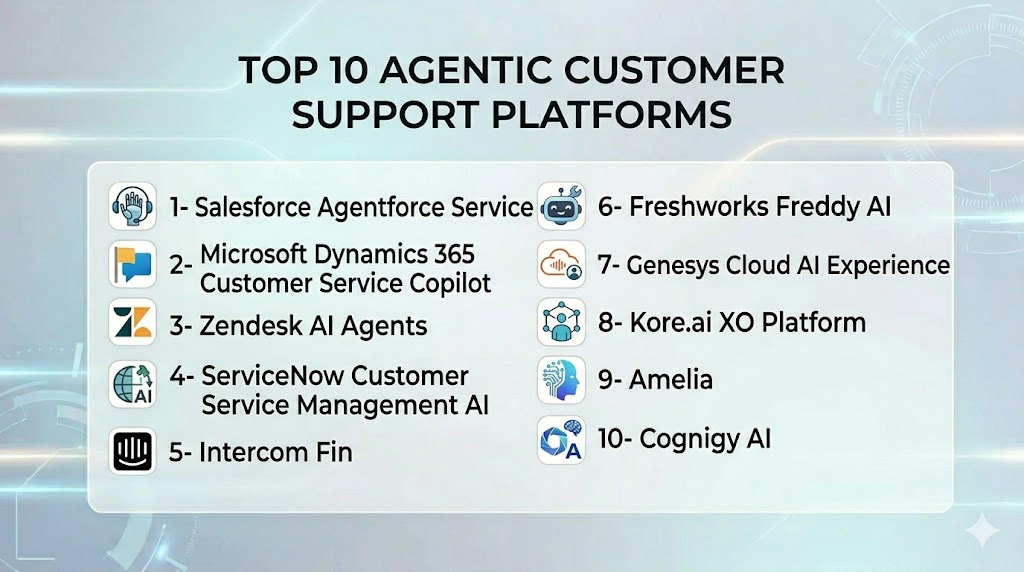
Top 10 Agentic Customer Support Platforms
1- Salesforce Agentforce Service
One-line verdict: Best for enterprises seeking deeply integrated AI-powered customer service automation.
Short description:
Salesforce Agentforce Service enables organizations to deploy autonomous support agents that leverage CRM data, workflows, and enterprise knowledge to resolve customer issues efficiently.
Standout Capabilities
- CRM-native support automation
- Autonomous case resolution
- Customer workflow execution
- Service Cloud integration
- Enterprise governance
- Knowledge-driven responses
- Omnichannel engagement
AI-Specific Depth
- Model support: Multi-model ecosystem
- RAG / knowledge integration: Salesforce knowledge and data sources
- Evaluation: Monitoring and analytics capabilities
- Guardrails: Enterprise governance controls
- Observability: Operational dashboards
Pros
- Deep CRM integration
- Strong enterprise capabilities
- Scalable service operations
Cons
- Salesforce ecosystem dependency
- Enterprise pricing
- Configuration complexity
Security & Compliance
Enterprise authentication, audit logging, RBAC, and administrative controls.
Deployment & Platforms
- Cloud
- Web
Integrations & Ecosystem
- Service Cloud
- Data Cloud
- CRM systems
- APIs
- Partner ecosystem
Pricing Model
Enterprise subscription.
Best-Fit Scenarios
- Large customer service organizations
- CRM-centric businesses
- Omnichannel support operations
2- Microsoft Dynamics 365 Customer Service Copilot
One-line verdict: Best for enterprises using Microsoft technologies and business applications.
Short description:
Microsoft’s AI-powered support platform combines customer service workflows with autonomous AI assistance and enterprise-grade governance.
Standout Capabilities
- Enterprise service automation
- Knowledge management integration
- Agent assistance
- Workflow execution
- Microsoft ecosystem integration
- Security controls
- Service optimization
AI-Specific Depth
- Model support: Microsoft-hosted AI models
- RAG / knowledge integration: Microsoft Graph and enterprise connectors
- Evaluation: Built-in monitoring
- Guardrails: Enterprise governance
- Observability: Analytics dashboards
Pros
- Strong Microsoft integration
- Enterprise security
- Familiar business workflows
Cons
- Microsoft ecosystem focus
- Licensing complexity
- Customization effort
Security & Compliance
Enterprise identity management, auditability, encryption, and governance controls.
Deployment & Platforms
- Cloud
- Web
Integrations & Ecosystem
- Dynamics 365
- Microsoft 365
- Power Platform
- Azure services
Pricing Model
Subscription-based licensing.
Best-Fit Scenarios
- Enterprise support centers
- Internal helpdesks
- Microsoft-first organizations
3- Zendesk AI Agents
One-line verdict: Best for customer support teams seeking rapid AI adoption.
Short description:
Zendesk AI Agents provide autonomous support capabilities integrated with ticketing, customer interactions, and knowledge management systems.
Standout Capabilities
- AI-powered ticket handling
- Knowledge integration
- Omnichannel support
- Customer intent detection
- Workflow automation
- Self-service support
- Operational analytics
AI-Specific Depth
- Model support: Hosted AI services
- RAG / knowledge integration: Native knowledge base integration
- Evaluation: Performance monitoring
- Guardrails: Administrative controls
- Observability: Analytics and reporting
Pros
- Easy deployment
- Mature support ecosystem
- Strong customer experience focus
Cons
- Limited deep customization
- Less workflow flexibility than enterprise platforms
- Advanced features may require higher tiers
Security & Compliance
Enterprise access controls and administrative oversight.
Deployment & Platforms
- Cloud
- Web
Integrations & Ecosystem
- CRM systems
- Knowledge bases
- APIs
- Business applications
Pricing Model
Tiered subscription.
Best-Fit Scenarios
- SaaS companies
- Mid-market support teams
- Customer success operations
4- ServiceNow Customer Service Management AI
One-line verdict: Best for organizations combining service workflows with AI automation.
Short description:
ServiceNow extends customer service operations through AI agents capable of workflow automation, case resolution, and service orchestration.
Standout Capabilities
- Workflow orchestration
- Service automation
- Case management
- AI-powered assistance
- Enterprise governance
- Operational visibility
- Process automation
AI-Specific Depth
- Model support: Multi-model ecosystem
- RAG / knowledge integration: Enterprise knowledge systems
- Evaluation: Operational analytics
- Guardrails: Policy enforcement
- Observability: Workflow tracing
Pros
- Strong workflow capabilities
- Enterprise scalability
- Governance focus
Cons
- Complex implementation
- Premium pricing
- Specialized expertise required
Security & Compliance
Enterprise authentication, audit logging, RBAC, and governance controls.
Deployment & Platforms
- Cloud
- Web
Integrations & Ecosystem
- ITSM
- CRM
- Enterprise applications
- APIs
Pricing Model
Enterprise subscription.
Best-Fit Scenarios
- Large enterprises
- Complex support operations
- Regulated industries
5- Intercom Fin
One-line verdict: Best for SaaS companies seeking autonomous customer support.
Short description:
Intercom Fin uses AI-powered support agents to resolve customer issues, answer questions, and automate support workflows.
Standout Capabilities
- AI-first support
- Autonomous conversations
- Knowledge integration
- Customer self-service
- Fast deployment
- Conversation management
- Analytics
AI-Specific Depth
- Model support: Hosted AI services
- RAG / knowledge integration: Knowledge base connectivity
- Evaluation: Conversation analytics
- Guardrails: Platform controls
- Observability: Support reporting
Pros
- User-friendly experience
- Fast implementation
- Strong SaaS focus
Cons
- Less enterprise customization
- Platform dependency
- Limited advanced orchestration
Security & Compliance
Administrative controls and enterprise security features.
Deployment & Platforms
- Cloud
- Web
Integrations & Ecosystem
- CRM tools
- Support platforms
- APIs
- Business applications
Pricing Model
Subscription-based.
Best-Fit Scenarios
- SaaS support teams
- Startup customer service
- Digital businesses
6- Freshworks Freddy AI
One-line verdict: Best for mid-market organizations seeking practical AI-powered support automation.
Short description:
Freddy AI enhances customer service operations with AI agents, workflow automation, and knowledge-based assistance.
Standout Capabilities
- Ticket automation
- Customer self-service
- AI assistance
- Workflow support
- Analytics
- Omnichannel engagement
- Knowledge management
AI-Specific Depth
- Model support: Hosted AI models
- RAG / knowledge integration: Native knowledge systems
- Evaluation: Support analytics
- Guardrails: Administrative controls
- Observability: Performance monitoring
Pros
- Easy adoption
- Mid-market friendly
- Good value proposition
Cons
- Limited advanced autonomy
- Less enterprise governance
- Smaller ecosystem
Security & Compliance
Access controls, auditing, and administrative management.
Deployment & Platforms
- Cloud
- Web
Integrations & Ecosystem
- CRM
- Ticketing systems
- APIs
- Productivity tools
Pricing Model
Tiered subscriptions.
Best-Fit Scenarios
- Mid-market support teams
- Customer service operations
- Growing businesses
7- Genesys Cloud AI Experience
One-line verdict: Best for contact centers requiring advanced customer engagement capabilities.
Short description:
Genesys combines contact center technology with AI-powered customer support automation and intelligent routing.
Standout Capabilities
- Contact center AI
- Intelligent routing
- Customer engagement
- Workflow automation
- Analytics
- Omnichannel interactions
- Workforce optimization
AI-Specific Depth
- Model support: Hosted AI ecosystem
- RAG / knowledge integration: Enterprise knowledge sources
- Evaluation: Contact center analytics
- Guardrails: Administrative policies
- Observability: Operational visibility
Pros
- Contact center expertise
- Omnichannel support
- Enterprise scalability
Cons
- Contact center focus
- Complexity
- Premium pricing
Security & Compliance
Enterprise security and administrative controls.
Deployment & Platforms
- Cloud
- Web
Integrations & Ecosystem
- CRM systems
- Contact center platforms
- APIs
- Workforce tools
Pricing Model
Enterprise subscription.
Best-Fit Scenarios
- Large contact centers
- Telecommunications
- Customer experience operations
8- Kore.ai XO Platform
One-line verdict: Best for enterprises building highly customized customer support agents.
Short description:
Kore.ai enables organizations to design AI-powered customer support agents with workflow automation and enterprise integrations.
Standout Capabilities
- Conversational AI
- Workflow automation
- Enterprise integrations
- Agent customization
- Multi-channel deployment
- Governance controls
- Analytics
AI-Specific Depth
- Model support: Multi-model support
- RAG / knowledge integration: Enterprise connectors
- Evaluation: Testing capabilities
- Guardrails: Enterprise controls
- Observability: Monitoring tools
Pros
- Flexible customization
- Enterprise focus
- Strong integration support
Cons
- Learning curve
- Implementation effort
- Enterprise pricing
Security & Compliance
Enterprise authentication, governance, and auditing features.
Deployment & Platforms
- Cloud
- Hybrid
Integrations & Ecosystem
- CRM systems
- APIs
- Enterprise applications
- Contact center tools
Pricing Model
Enterprise licensing.
Best-Fit Scenarios
- Enterprise support automation
- Custom service workflows
- Large-scale deployments
9- Amelia
One-line verdict: Best for enterprises seeking conversational AI with service automation.
Short description:
Amelia combines conversational AI with workflow execution to automate customer interactions and service requests.
Standout Capabilities
- Conversational automation
- Workflow execution
- Service management
- Knowledge access
- Enterprise integrations
- Analytics
- Omnichannel support
AI-Specific Depth
- Model support: Proprietary and integrated AI services
- RAG / knowledge integration: Enterprise knowledge systems
- Evaluation: Performance analytics
- Guardrails: Governance controls
- Observability: Operational reporting
Pros
- Strong conversational capabilities
- Enterprise focus
- Service automation
Cons
- Complex deployments
- Premium pricing
- Specialized implementation
Security & Compliance
Enterprise security controls and governance capabilities.
Deployment & Platforms
- Cloud
- Hybrid
Integrations & Ecosystem
- Enterprise applications
- APIs
- Service management systems
- CRM platforms
Pricing Model
Enterprise subscription.
Best-Fit Scenarios
- Financial services
- Enterprise customer support
- Service automation
10- Cognigy AI
One-line verdict: Best for organizations requiring enterprise-grade conversational automation.
Short description:
Cognigy provides AI-powered customer support automation with workflow orchestration and enterprise-scale deployment capabilities.
Standout Capabilities
- Conversational AI
- Workflow automation
- Omnichannel engagement
- Enterprise deployment
- Governance controls
- Analytics
- Customer journey support
AI-Specific Depth
- Model support: Multi-model ecosystem
- RAG / knowledge integration: Enterprise connectors
- Evaluation: Monitoring and testing
- Guardrails: Administrative controls
- Observability: Analytics dashboards
Pros
- Enterprise scalability
- Strong conversational experiences
- Flexible integrations
Cons
- Enterprise complexity
- Higher implementation effort
- Premium positioning
Security & Compliance
Enterprise authentication, auditability, and governance controls.
Deployment & Platforms
- Cloud
- Hybrid
Integrations & Ecosystem
- CRM platforms
- APIs
- Contact center solutions
- Business applications
Pricing Model
Enterprise licensing.
Best-Fit Scenarios
- Global enterprises
- Customer experience transformation
- Omnichannel service operations
Comparison Table
| Tool Name | Best For | Deployment | Model Flexibility | Strength | Watch-Out | Public Rating |
|---|---|---|---|---|---|---|
| Salesforce Agentforce Service | Enterprise CRM support | Cloud | Multi-model | CRM-native automation | Salesforce dependency | N/A |
| Microsoft Dynamics 365 Copilot | Enterprise support | Cloud | Hosted | Microsoft integration | Licensing complexity | N/A |
| Zendesk AI Agents | SaaS support | Cloud | Hosted | Ease of deployment | Limited customization | N/A |
| ServiceNow CSM AI | Enterprise workflows | Cloud | Multi-model | Workflow orchestration | Complexity | N/A |
| Intercom Fin | SaaS companies | Cloud | Hosted | Fast implementation | Platform dependency | N/A |
| Freshworks Freddy AI | Mid-market support | Cloud | Hosted | Value and simplicity | Smaller ecosystem | N/A |
| Genesys Cloud AI | Contact centers | Cloud | Hosted | Customer engagement | Premium pricing | N/A |
| Kore.ai XO Platform | Enterprise customization | Cloud/Hybrid | Multi-model | Flexibility | Learning curve | N/A |
| Amelia | Service automation | Cloud/Hybrid | Proprietary | Conversational AI | Complex deployment | N/A |
| Cognigy AI | Global enterprises | Cloud/Hybrid | Multi-model | Omnichannel support | Enterprise complexity | N/A |
Scoring & Evaluation
| Tool | Core | Reliability/Eval | Guardrails | Integrations | Ease | Perf/Cost | Security/Admin | Support | Weighted Total |
|---|---|---|---|---|---|---|---|---|---|
| Salesforce Agentforce Service | 9 | 8 | 9 | 9 | 8 | 8 | 9 | 8 | 8.6 |
| Microsoft Dynamics 365 Copilot | 9 | 8 | 9 | 8 | 8 | 8 | 9 | 8 | 8.5 |
| Zendesk AI Agents | 8 | 8 | 7 | 8 | 9 | 8 | 8 | 8 | 8.1 |
| ServiceNow CSM AI | 9 | 8 | 9 | 8 | 7 | 8 | 9 | 8 | 8.3 |
| Intercom Fin | 8 | 8 | 7 | 7 | 9 | 8 | 7 | 8 | 7.9 |
| Freshworks Freddy AI | 8 | 7 | 7 | 7 | 9 | 8 | 7 | 8 | 7.8 |
| Genesys Cloud AI | 8 | 8 | 8 | 8 | 7 | 8 | 8 | 8 | 8.0 |
| Kore.ai XO Platform | 8 | 8 | 8 | 8 | 7 | 8 | 8 | 8 | 8.0 |
| Amelia | 8 | 8 | 8 | 7 | 7 | 8 | 8 | 8 | 7.9 |
| Cognigy AI | 8 | 8 | 8 | 8 | 7 | 8 | 8 | 8 | 8.0 |
Which Agentic Customer Support Platform Is Right for You?
Solo / Freelancer
Intercom Fin and Zendesk AI Agents offer simplicity, rapid deployment, and manageable operational overhead.
SMB
Freshworks Freddy AI, Zendesk AI Agents, and Intercom Fin provide practical automation without requiring extensive enterprise infrastructure.
Mid-Market
Genesys Cloud AI, Kore.ai XO Platform, and ServiceNow offer stronger workflow automation and scalability.
Enterprise
Salesforce Agentforce Service, Microsoft Dynamics 365 Copilot, and ServiceNow provide the strongest governance, integration depth, and operational control.
Regulated Industries
Prioritize platforms with strong auditability, governance controls, approval workflows, and enterprise security features.
Budget vs Premium
Budget-conscious organizations should evaluate Freshworks Freddy AI and Zendesk AI Agents, while premium buyers may benefit from Salesforce, Microsoft, and ServiceNow.
Build vs Buy
Buy when speed, support, and governance are priorities. Build custom solutions when differentiation and workflow flexibility are strategic requirements.
Common Mistakes & How to Avoid Them
- Deploying agents without testing
- Ignoring knowledge quality
- Over-automating sensitive requests
- Weak escalation processes
- Lack of observability
- Poor prompt governance
- Missing security reviews
- No cost monitoring
- Insufficient staff training
- Ignoring customer feedback
- Vendor lock-in risks
- Weak evaluation frameworks
FAQs
1- What is an Agentic Customer Support Platform?
An Agentic Customer Support Platform uses AI agents capable of reasoning, planning, and taking actions to resolve customer issues autonomously.
2- How is it different from a traditional chatbot?
Traditional chatbots follow predefined rules, while agentic systems can make decisions, execute workflows, and interact with business applications.
3- Can these platforms resolve support tickets automatically?
Yes, many modern platforms can autonomously resolve common customer issues when connected to appropriate systems and workflows.
4- Do they support human escalation?
Yes, enterprise platforms typically include human-in-the-loop workflows and escalation mechanisms.
5- What role does RAG play in customer support?
RAG helps agents retrieve accurate information from company knowledge bases, reducing hallucinations and improving response quality.
6- Are these platforms secure for enterprise use?
Most enterprise-focused solutions provide governance controls, audit logs, access management, and administrative oversight.
7- How important is observability?
Observability helps teams understand agent performance, diagnose issues, monitor costs, and improve service quality.
8- Can these platforms support multiple communication channels?
Yes, many support web chat, email, messaging applications, contact centers, and mobile channels.
9- How should organizations measure success?
Key metrics include resolution rates, customer satisfaction, response times, escalation rates, and operational efficiency improvements.
10- Are these platforms suitable for regulated industries?
Yes, provided they offer strong governance, auditability, security controls, and compliance management capabilities.
11- What are the biggest implementation risks?
Poor knowledge quality, insufficient testing, weak governance, and lack of observability are among the most common risks.
12- What is the future of agentic customer support?
The future involves increasingly autonomous agents capable of handling complex workflows while operating under strict governance and human oversight.
Conclusion
Agentic Customer Support Platforms are transforming customer service by enabling AI agents to move beyond simple conversations and actively resolve customer issues. Enterprise leaders such as Salesforce Agentforce Service, Microsoft Dynamics 365 Customer Service Copilot, and ServiceNow Customer Service Management AI are driving adoption among large organizations, while Zendesk AI Agents, Intercom Fin, and Freshworks Freddy AI make advanced support automation accessible to smaller teams. The best platform depends on your existing technology stack, governance requirements, support volume, and automation goals. Organizations should begin with a focused pilot, establish strong evaluation and observability practices, validate governance controls, and then scale successful deployments across customer support operations
