Introduction
AI Citizen Service Chatbots use artificial intelligence, natural language processing, machine learning, and conversational automation to help governments, public institutions, and civic organizations provide faster and more accessible services to citizens.
Government agencies handle large volumes of citizen inquiries related to public services, documentation, payments, registrations, healthcare programs, transportation, permits, benefits, and community information. Traditional service channels such as phone support, emails, and physical offices can become overloaded, resulting in longer response times and reduced citizen satisfaction.
AI-powered citizen service chatbots automate conversations by understanding citizen requests, providing accurate information, guiding users through processes, and connecting people with relevant government services.
These platforms help organizations:
- Provide 24/7 citizen support
- Automate common service inquiries
- Reduce pressure on government call centers
- Improve public service accessibility
- Support multiple languages
- Guide citizens through digital processes
- Improve service delivery efficiency
AI citizen service chatbot solutions are used by:
- Government departments
- Municipal organizations
- Public agencies
- Healthcare authorities
- Educational institutions
- Transportation organizations
- Public service providers
Modern platforms combine conversational AI, natural language understanding, workflow automation, knowledge management, multilingual support, and analytics.
The goal of these solutions is to make public services easier, faster, and more accessible for citizens.
How AI Citizen Service Chatbots Work
Citizen Query Understanding
AI analyzes:
- User questions
- Intent
- Language
- Context
- Service requirements
Knowledge Retrieval
Chatbots access:
- Government information
- Service databases
- Policy documents
- FAQs
- Public resources
Automated Assistance
AI provides:
- Service guidance
- Application instructions
- Status information
- Process explanations
Workflow Integration
Chatbots connect with:
- Government portals
- Case management systems
- Payment platforms
- Citizen databases
Continuous Improvement
AI improves through:
- Conversation analysis
- User feedback
- Updated knowledge sources
- New service information
Common Use Cases
- Government information services
- Citizen complaint handling
- Permit and license assistance
- Tax support
- Public benefits guidance
- Healthcare information services
- Transportation assistance
- Education service support
- Municipal help desks
- Emergency information support
Why AI Citizen Service Chatbots Matter
24/7 Public Support
Citizens can access information outside traditional office hours.
Faster Service Delivery
AI reduces waiting times for common requests.
Improved Accessibility
Chatbots help citizens access services through digital channels.
Reduced Administrative Work
Automation allows staff to focus on complex cases.
Better Citizen Experience
Conversational interfaces make public services easier to use.
Evaluation Criteria for Buyers
Conversational Accuracy
Chatbots should understand citizen questions correctly.
Knowledge Management
Platforms should provide reliable and updated information.
Multilingual Support
Solutions should support diverse citizen populations.
Integration Capability
Important integrations include government portals, CRM systems, databases, and workflow platforms.
Security and Privacy
Citizen information requires strong protection.
Analytics and Reporting
Organizations need insights into service usage and citizen needs.
Accessibility
Solutions should support inclusive digital access.
Key Trends
AI-Powered Digital Government
Governments are adopting AI to improve citizen interactions.
Multilingual Public Services
AI is helping organizations serve diverse populations.
Automated Government Workflows
Chatbots are becoming connected with digital service processes.
Intelligent Virtual Assistants
Public agencies are moving beyond simple FAQ bots toward advanced assistants.
Omnichannel Citizen Engagement
Services are becoming available across websites, mobile apps, and messaging platforms.
Responsible AI in Public Services
Organizations are focusing on transparency, security, and fairness.
Methodology
The following platforms were evaluated using:
- AI conversational capabilities
- Citizen service features
- Workflow automation
- Ease of use
- Integrations and ecosystem
- Security and privacy
- Performance and reliability
- Support and community
- Price and value
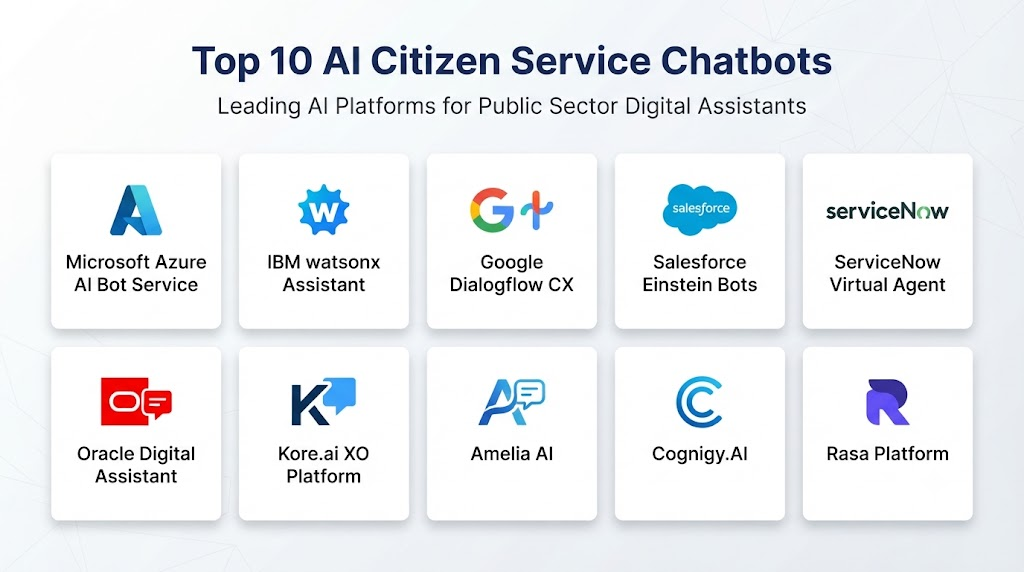
Top 10 AI Citizen Service Chatbots
1. Microsoft Azure AI Bot Service
Microsoft Azure AI Bot Service provides conversational AI capabilities for building digital assistants and citizen-facing services.
Key Features
- Conversational AI
- Natural language processing
- Multichannel support
- Workflow integration
- Knowledge connection
- Language support
- Analytics
- Security controls
- Enterprise integrations
- Custom chatbot development
Pros
- Strong cloud ecosystem
- Enterprise scalability
- Broad integration options
- Developer flexibility
- Strong security capabilities
Cons
- Requires technical expertise
- Configuration effort needed
- Cloud dependency
Platforms
Cloud-based platform.
Deployment or Support
Azure cloud deployment.
Security & Compliance
Enterprise security controls.
Integrations & Ecosystem
Government portals, Microsoft services, databases, and enterprise applications.
Support & Community
Microsoft support ecosystem.
2. IBM watsonx Assistant
IBM watsonx Assistant provides AI-powered virtual assistant capabilities.
Key Features
- Natural language understanding
- Conversational workflows
- Knowledge retrieval
- Virtual assistance
- Intent recognition
- Analytics
- Multichannel support
- Enterprise integrations
- Automation
- AI management tools
Pros
- Strong AI capabilities
- Enterprise-ready platform
- Good knowledge management
- Supports complex conversations
- Flexible deployment options
Cons
- Requires configuration
- Enterprise-focused
- Implementation effort
Platforms
Cloud-based platform.
Deployment or Support
Cloud and enterprise deployment options.
Security & Compliance
Enterprise controls vary.
Integrations & Ecosystem
Enterprise systems, databases, and service platforms.
Support & Community
Enterprise support.
3. Google Dialogflow CX
Google Dialogflow CX provides conversational AI tools for building advanced virtual agents.
Key Features
- Natural language processing
- Conversation design
- Intent recognition
- Multilingual support
- Voice and chat channels
- Analytics
- Workflow automation
- Integration APIs
- Knowledge assistance
- Developer tools
Pros
- Strong language understanding
- Scalable cloud platform
- Good multilingual support
- Flexible conversation design
- Developer-friendly
Cons
- Requires technical knowledge
- Configuration complexity
- Cloud expertise needed
Platforms
Cloud-based platform.
Deployment or Support
Google Cloud deployment.
Security & Compliance
Google Cloud security controls.
Integrations & Ecosystem
Cloud services, applications, and communication channels.
Support & Community
Google Cloud support.
4. Salesforce Einstein Bots
Salesforce Einstein Bots provides AI-powered customer and service automation capabilities.
Key Features
- Conversational automation
- CRM integration
- Case creation
- Knowledge management
- Workflow automation
- Service routing
- Analytics
- Customer engagement
- Personalization
- Reporting
Pros
- Strong CRM integration
- Good workflow automation
- Enterprise adoption
- Useful service analytics
- Easy connection with Salesforce data
Cons
- Best for Salesforce environments
- Requires configuration
- Enterprise pricing
Platforms
Cloud-based platform.
Deployment or Support
Salesforce cloud platform.
Security & Compliance
Enterprise security controls.
Integrations & Ecosystem
Salesforce applications, CRM systems, and enterprise platforms.
Support & Community
Salesforce support ecosystem.
5. ServiceNow Virtual Agent
ServiceNow Virtual Agent provides AI-powered conversational support for enterprise and public service workflows.
Key Features
- Virtual assistance
- Workflow automation
- Knowledge management
- Service requests
- Case management
- AI conversations
- Reporting
- Integration support
- Process automation
- Self-service capabilities
Pros
- Strong workflow automation
- Enterprise platform integration
- Good service management capabilities
- Scalable
- Supports complex processes
Cons
- Implementation complexity
- Requires ServiceNow expertise
- Enterprise-focused
Platforms
Web-based and cloud platform.
Deployment or Support
Cloud-based enterprise platform.
Security & Compliance
Enterprise security controls.
Integrations & Ecosystem
Service management systems, databases, and enterprise applications.
Support & Community
Enterprise support.
6. Oracle Digital Assistant
Oracle Digital Assistant provides AI conversational capabilities for organizations.
Key Features
- Virtual assistants
- Natural language processing
- Multilingual conversations
- Workflow automation
- Knowledge integration
- Analytics
- Enterprise integrations
- Service automation
- Intent recognition
- Developer tools
Pros
- Enterprise integration
- Strong Oracle ecosystem
- Good automation capabilities
- Supports multiple channels
- Scalable
Cons
- Best suited for Oracle environments
- Requires expertise
- Enterprise implementation
Platforms
Cloud platform.
Deployment or Support
Oracle Cloud deployment.
Security & Compliance
Enterprise security controls.
Integrations & Ecosystem
Oracle applications, databases, and enterprise systems.
Support & Community
Oracle support ecosystem.
7. Kore.ai XO Platform
Kore.ai XO Platform provides conversational AI automation capabilities.
Key Features
- Virtual assistants
- Conversation automation
- Natural language processing
- Workflow automation
- Multichannel support
- Knowledge management
- Analytics
- Bot development tools
- Enterprise integrations
- AI management
Pros
- Strong conversational capabilities
- Flexible deployment
- Good enterprise automation
- Supports complex workflows
- Multichannel support
Cons
- Requires configuration
- Enterprise-focused
- Learning curve
Platforms
Cloud-based platform.
Deployment or Support
Cloud and enterprise deployment options.
Security & Compliance
Security controls vary.
Integrations & Ecosystem
Enterprise applications, APIs, and workflow systems.
Support & Community
Customer support.
8. Amelia AI
Amelia provides AI-powered virtual agent and digital assistant capabilities.
Key Features
- Conversational AI
- Virtual agents
- Workflow automation
- Knowledge management
- Customer assistance
- Analytics
- Multichannel support
- Process automation
- Enterprise integrations
- AI training tools
Pros
- Strong virtual assistant capabilities
- Enterprise automation
- Good conversation handling
- Supports multiple industries
- Workflow integration
Cons
- Requires setup
- Enterprise-focused
- Advanced configuration needed
Platforms
Cloud-based platform.
Deployment or Support
Cloud and enterprise deployment.
Security & Compliance
Security controls vary.
Integrations & Ecosystem
Enterprise applications and service platforms.
Support & Community
Customer support.
9. Cognigy.AI
Cognigy.AI provides conversational AI automation for customer and public service interactions.
Key Features
- AI virtual agents
- Natural language processing
- Voice automation
- Chat support
- Workflow integration
- Analytics
- Multilingual support
- Knowledge management
- Automation tools
- Conversation management
Pros
- Strong conversational automation
- Good enterprise scalability
- Multichannel support
- Flexible workflows
- Useful analytics
Cons
- Requires implementation
- Enterprise-focused
- Configuration complexity
Platforms
Cloud-based platform.
Deployment or Support
Cloud deployment.
Security & Compliance
Security controls vary.
Integrations & Ecosystem
Enterprise systems, communication platforms, and APIs.
Support & Community
Customer support.
10. Rasa Platform
Rasa provides open-source conversational AI development capabilities.
Key Features
- Natural language understanding
- Custom chatbot development
- Conversation management
- AI models
- Developer tools
- Workflow customization
- Integration APIs
- Deployment flexibility
- Analytics
- Enterprise support options
Pros
- High customization
- Flexible deployment
- Developer control
- Open-source foundation
- Strong community
Cons
- Requires technical expertise
- More development effort
- Maintenance responsibility
Platforms
Cloud and self-hosted options.
Deployment or Support
Flexible deployment models.
Security & Compliance
Depends on deployment environment.
Integrations & Ecosystem
APIs, applications, databases, and enterprise systems.
Support & Community
Community and enterprise support.
Comparison Table
| Tool Name | Best For | Platform(s) Supported | Deployment | Standout Feature | Public Rating |
|---|---|---|---|---|---|
| Azure AI Bot Service | Government digital assistants | Cloud | Azure | Enterprise AI platform | N/A |
| IBM watsonx Assistant | AI service automation | Cloud | Cloud | AI conversations | N/A |
| Dialogflow CX | Advanced conversational AI | Cloud | Google Cloud | Language understanding | N/A |
| Salesforce Einstein Bots | CRM-based services | Cloud | Salesforce | CRM integration | N/A |
| ServiceNow Virtual Agent | Workflow automation | Cloud | Cloud | Service workflows | N/A |
| Oracle Digital Assistant | Enterprise assistants | Cloud | Oracle Cloud | Enterprise integration | N/A |
| Kore.ai XO | Conversational automation | Cloud | Cloud | Bot development | N/A |
| Amelia AI | Digital assistants | Cloud | Cloud | Virtual agents | N/A |
| Cognigy.AI | Enterprise automation | Cloud | Cloud | Conversational workflows | N/A |
| Rasa | Custom AI assistants | Cloud/Self-hosted | Flexible | Developer control | N/A |
Weighted Evaluation
| Tool Name | Core Features 25% | Ease of Use 15% | Integrations & Ecosystem 15% | Security & Compliance 10% | Performance & Reliability 10% | Support & Community 10% | Price/Value 15% | Total |
|---|---|---|---|---|---|---|---|---|
| Azure AI Bot Service | 25 | 13 | 15 | 10 | 10 | 10 | 11 | 94 |
| IBM watsonx Assistant | 24 | 13 | 14 | 10 | 10 | 10 | 11 | 92 |
| Dialogflow CX | 24 | 13 | 15 | 10 | 10 | 10 | 11 | 93 |
| Salesforce Einstein Bots | 23 | 14 | 15 | 10 | 10 | 10 | 10 | 92 |
| ServiceNow Virtual Agent | 24 | 12 | 15 | 10 | 10 | 10 | 10 | 91 |
| Oracle Digital Assistant | 23 | 13 | 15 | 10 | 10 | 10 | 10 | 91 |
| Kore.ai XO | 24 | 13 | 14 | 10 | 10 | 10 | 11 | 92 |
| Amelia AI | 23 | 13 | 13 | 10 | 10 | 10 | 11 | 90 |
| Cognigy.AI | 23 | 13 | 14 | 10 | 10 | 10 | 11 | 91 |
| Rasa | 23 | 11 | 14 | 10 | 10 | 10 | 13 | 91 |
Which AI Citizen Service Chatbot Is Right for You?
Choose Microsoft Azure AI Bot Service when governments need scalable digital assistants.
Choose IBM watsonx Assistant when advanced AI conversations are required.
Choose Google Dialogflow CX when multilingual conversational experiences are important.
Choose Salesforce Einstein Bots when citizen services are connected with CRM workflows.
Choose ServiceNow Virtual Agent when workflow automation is the priority.
Choose Oracle Digital Assistant when Oracle ecosystem integration is needed.
Choose Kore.ai XO Platform when organizations need flexible conversational automation.
Choose Amelia AI when intelligent virtual agents are required.
Choose Cognigy.AI when enterprise conversational automation is important.
Choose Rasa when organizations need highly customized chatbot development.
Implementation Playbook
Phase 1: Define Citizen Service Goals
- Identify citizen needs
- Select service areas
- Define chatbot objectives
- Establish governance requirements
- Identify success metrics
Phase 2: Prepare Knowledge Sources
- Collect service information
- Connect databases
- Organize FAQs
- Review policies
- Prepare multilingual content
Phase 3: Deploy AI Chatbot
- Configure conversations
- Connect workflows
- Test citizen interactions
- Enable channels
- Monitor performance
Phase 4: Measure Results
- Track citizen satisfaction
- Analyze common requests
- Improve responses
- Reduce service workload
- Optimize workflows
Phase 5: Maintain Digital Services
- Update knowledge sources
- Review conversations
- Improve AI models
- Monitor security
- Maintain accessibility
Common Mistakes
- Providing outdated information
- Ignoring accessibility needs
- Failing to protect citizen data
- Poor knowledge management
- Over-automating complex decisions
- Not providing human escalation options
- Ignoring multilingual requirements
- Deploying without testing
FAQs
1. What are AI Citizen Service Chatbots?
AI Citizen Service Chatbots are digital assistants that help citizens access information and government services through conversational interfaces.
2. How do AI chatbots improve public services?
They provide faster responses, automate common requests, and improve access to government information.
3. Can AI chatbots replace government employees?
No. They support employees by handling routine questions while staff manage complex cases.
4. What services can citizen chatbots provide?
They can support applications, registrations, payments, public information, and service guidance.
5. Do AI citizen chatbots support multiple languages?
Many platforms provide multilingual capabilities.
6. Are citizen chatbot systems secure?
Organizations should evaluate privacy protection, access controls, and security practices.
7. Can AI chatbots connect with government databases?
Many platforms integrate with databases, portals, and workflow systems.
8. How do governments measure chatbot success?
Organizations measure response accuracy, citizen satisfaction, usage rates, and service efficiency.
9. Can chatbots handle complex citizen requests?
They can handle many requests but should provide escalation options for complex cases.
10. What should governments consider before selecting an AI citizen chatbot?
They should evaluate accuracy, security, integrations, accessibility, scalability, and cost.
Conclusion
AI Citizen Service Chatbots are transforming public service delivery by helping governments provide faster, more accessible, and more efficient citizen support.Microsoft Azure AI Bot Service, IBM watsonx Assistant, Google Dialogflow CX, and Salesforce Einstein Bots provide strong conversational capabilities, while ServiceNow, Oracle, Kore.ai, and Rasa support broader automation needs.The most effective citizen service chatbot programs combine AI technology with accurate information, human oversight, strong security practices, and inclusive design. AI should help governments improve citizen experiences while building more responsive and accessible digital services.
