Introduction
AI Inference API Management Platforms are the control layer that sits between applications and AI models to manage how inference requests are routed, secured, optimized, and monitored. In plain English, they act as a “smart traffic system” for AI usage—deciding which model to call, how to balance performance vs cost, how to enforce safety rules, and how to observe everything happening in production.
These platforms have become essential because modern AI applications no longer rely on a single model. Instead, organizations use multiple LLMs, embeddings models, and fine-tuned systems across cloud providers and open-source stacks. Without a management layer, teams face rising costs, inconsistent outputs, weak observability, and security risks like prompt injection or data leakage.
Real-world use cases include:
- Routing requests between multiple LLM providers based on cost or latency
- Centralizing AI API keys and access control
- Monitoring token usage and inference cost across teams
- Enforcing guardrails for safe AI outputs in production apps
- Running A/B tests across models and prompts
- Logging AI interactions for audit and compliance workflows
What buyers should evaluate:
- Multi-model routing and fallback capability
- Cost and latency optimization controls
- Observability (logs, traces, token tracking)
- Evaluation and testing workflows for AI outputs
- Guardrails and prompt injection protection
- Data privacy, retention, and governance controls
- BYO model and open-source support
- RAG and vector database integration support
- Deployment flexibility (cloud, hybrid, self-hosted)
- Risk of vendor lock-in
- Scalability under production traffic
- Admin controls like RBAC and audit logs
Best for: CTOs, AI engineers, platform teams, SaaS companies, and enterprises building production-grade LLM applications.
Not ideal for: early prototypes, single-model apps with low traffic, or teams that do not need routing, governance, or observability layers.
What’s Changed in AI Inference API Management Platforms
- Shift from basic API proxies to AI-native inference routers
- Increased adoption of multi-model orchestration and dynamic routing
- Strong focus on token-level cost optimization
- Built-in prompt injection detection and content filtering
- Expansion of agentic workflows with tool calling support
- Real-time traceability of prompts, reasoning, and outputs
- Integration of RAG pipelines directly into inference layers
- Growing importance of evaluation frameworks for hallucination testing
- Rise of policy-as-code for AI governance
- Stronger enterprise demand for data residency and privacy controls
- Improved fallback routing across multiple AI providers
- Emergence of edge-based AI inference gateways
Quick Buyer Checklist
- Support for multiple LLM providers
- BYO model capability (open-source or custom models)
- Built-in evaluation or testing workflows
- Strong observability (logs, traces, cost metrics)
- Guardrails for safety and compliance
- Latency optimization and caching support
- Data privacy and retention control options
- RBAC, SSO, and audit logging
- RAG and vector database compatibility
- Deployment flexibility (cloud, hybrid, self-hosted)
- Vendor lock-in avoidance strategy
- Cost transparency at token/request level
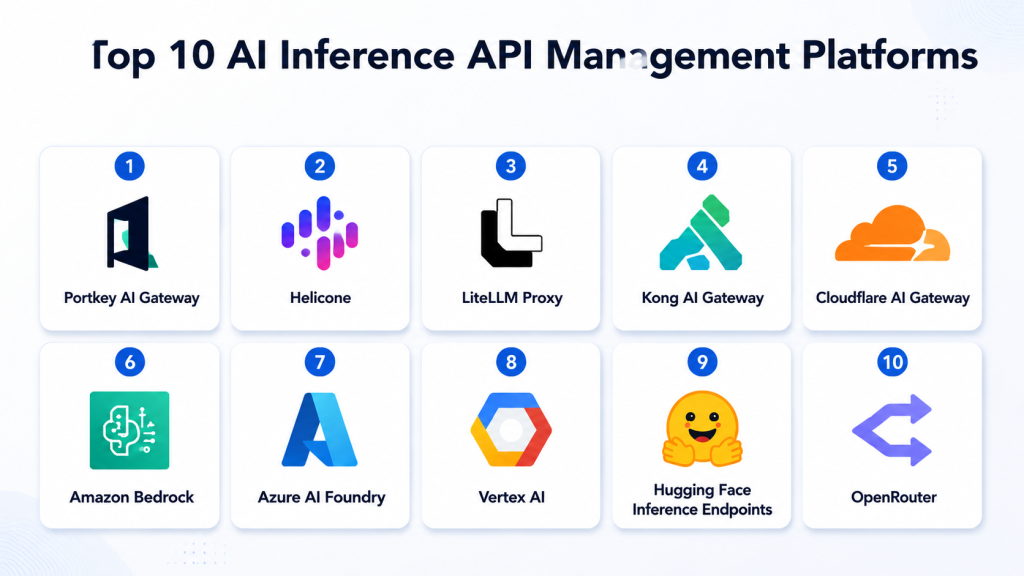
Top 10 AI Inference API Management Platforms (Updated)
1- Portkey AI Gateway
One-line verdict: Best for enterprises needing multi-model routing, observability, and AI traffic control at scale.
Short description:
Portkey AI Gateway provides a unified control layer for managing multiple LLM providers. It is widely used by engineering teams building production-grade AI systems that require routing, cost control, and observability.
Standout Capabilities
- Multi-LLM routing with fallback logic
- Centralized API key and credential management
- Request/response logging for all AI calls
- Real-time cost and token tracking
- Policy-based routing rules
- Prompt version management support
- Developer-friendly API abstraction
- Production-grade observability dashboard
AI-Specific Depth
- Model support: Multi-provider + BYO models
- RAG / knowledge integration: External integration support
- Evaluation: A/B testing and prompt comparison workflows (varies)
- Guardrails: Policy-based filtering and routing rules
- Observability: Full tracing, latency, token, and cost metrics
Pros
- Strong multi-model abstraction
- Excellent observability layer
- Flexible routing and fallback system
Cons
- Requires engineering setup effort
- Advanced governance features need configuration
- Evaluation capabilities still evolving
Security & Compliance
Not publicly stated in full detail.
Deployment & Platforms
- Cloud and self-hosted options available
- API-first architecture
Integrations & Ecosystem
Works across modern AI stacks with:
- OpenAI-compatible APIs
- Vector databases via external systems
- Observability tools
- CI/CD pipelines
- Backend frameworks
Pricing Model
Usage-based and enterprise licensing model (details not publicly stated)
Best-Fit Scenarios
- Multi-model SaaS platforms
- AI cost optimization systems
- Enterprise AI orchestration layers
2- Helicone
One-line verdict: Best for observability, debugging, and monitoring LLM applications in production.
Short description:
Helicone acts as an observability proxy for AI requests, giving developers deep insight into prompts, responses, latency, and cost behavior.
Standout Capabilities
- Full request/response logging
- Token and cost tracking per call
- Prompt debugging interface
- Dataset replay for evaluation
- User-level usage analytics
- Filtering and tagging AI requests
- Performance dashboards
- Integration via proxy layer
AI-Specific Depth
- Model support: Multi-provider via proxy
- RAG / knowledge integration: External only
- Evaluation: Replay-based testing workflows
- Guardrails: Not core feature
- Observability: Strong tracing and analytics layer
Pros
- Excellent debugging capabilities
- Easy integration via proxy
- Strong developer experience
Cons
- Not a full routing engine
- Limited governance controls
- Requires external tools for evaluation depth
Security & Compliance
Not publicly stated.
Deployment & Platforms
- Cloud-based proxy system
- API integration model
Integrations & Ecosystem
- OpenAI-compatible APIs
- Backend applications
- Serverless environments
- SDK-based integrations
Pricing Model
Freemium and usage-based tiers (varies)
Best-Fit Scenarios
- LLM debugging and monitoring
- AI product observability
- Prompt optimization workflows
3- LiteLLM Proxy
One-line verdict: Best open-source unified API layer for multi-model LLM routing and standardization.
Short description:
LiteLLM Proxy is an open-source system that unifies multiple LLM APIs under a single interface for routing, fallback, and cost tracking.
Standout Capabilities
- Unified API for multiple LLM providers
- Lightweight routing engine
- Model fallback configuration
- Cost tracking per request
- Open-source flexibility
- Custom routing rules
- Multi-cloud compatibility
- Easy deployment in containers
AI-Specific Depth
- Model support: Multi-provider + BYO models
- RAG / knowledge integration: External only
- Evaluation: Limited native support
- Guardrails: Basic configuration-based controls
- Observability: Basic logging and metrics
Pros
- Fully open-source and flexible
- Easy API standardization
- Lightweight and scalable
Cons
- Limited enterprise governance
- Requires engineering expertise
- Minimal built-in evaluation tools
Security & Compliance
Not publicly stated.
Deployment & Platforms
- Self-hosted (Docker/Kubernetes)
- Cloud deployment possible
Integrations & Ecosystem
- OpenAI-compatible APIs
- Cloud LLM providers
- Kubernetes environments
- Custom backend systems
Pricing Model
Open-source with optional enterprise support (varies)
Best-Fit Scenarios
- Developer-first AI infrastructure
- Startup AI backend systems
- Multi-provider routing setups
4- Kong AI Gateway
One-line verdict: Best enterprise API gateway extended for AI governance and traffic management.
Short description:
Kong AI Gateway extends traditional API management into AI workloads, adding governance, routing, and security controls for LLM APIs.
Standout Capabilities
- Enterprise API gateway architecture
- Policy-based request control
- Rate limiting and traffic shaping
- Plugin-based extensibility
- Authentication and authorization layers
- Hybrid deployment support
- API lifecycle management
- Observability integrations
AI-Specific Depth
- Model support: External LLM APIs
- RAG / knowledge integration: Plugin-based integration
- Evaluation: Not native
- Guardrails: Policy enforcement layer
- Observability: API-level monitoring
Pros
- Strong enterprise API governance
- Highly scalable architecture
- Mature ecosystem
Cons
- Not AI-native architecture
- Complex configuration
- Requires customization for AI workflows
Security & Compliance
- RBAC and authentication support (varies)
- Audit logging available in enterprise setups
Deployment & Platforms
- Cloud, hybrid, and on-prem deployments
Integrations & Ecosystem
- API ecosystem tools
- Kubernetes integration
- Enterprise identity providers
- Observability platforms
Pricing Model
Enterprise licensing (Not publicly stated)
Best-Fit Scenarios
- Large enterprise API governance
- Regulated industries
- Hybrid API + AI workloads
5- Cloudflare AI Gateway
One-line verdict: Best for edge-based AI routing with global performance optimization.
Short description:
Cloudflare AI Gateway provides edge-level routing for AI requests, optimizing latency, caching, and security at global scale.
Standout Capabilities
- Edge-based AI request routing
- Global latency optimization
- Token usage tracking
- Built-in caching mechanisms
- Traffic analytics dashboards
- API protection at edge
- Multi-provider abstraction layer
- Scalable global network
AI-Specific Depth
- Model support: Multi-provider APIs
- RAG / knowledge integration: External only
- Evaluation: Not native
- Guardrails: Edge-based filtering
- Observability: Strong request-level analytics
Pros
- Extremely low latency routing
- Global scalability
- Built-in caching advantages
Cons
- Limited AI evaluation tools
- Vendor ecosystem dependency
- Less customization than open-source tools
Security & Compliance
Not publicly stated.
Deployment & Platforms
- Cloud (edge network)
Integrations & Ecosystem
- Cloudflare ecosystem
- External AI APIs
- Web and backend systems
Pricing Model
Usage-based (varies)
Best-Fit Scenarios
- High-traffic AI applications
- Global SaaS platforms
- Latency-sensitive inference systems
6- Amazon Bedrock
One-line verdict: Best AWS-native managed inference platform for enterprise multi-model AI workloads.
Short description:
Amazon Bedrock provides managed access to foundation models with enterprise-grade scaling, security, and integration into AWS services.
Standout Capabilities
- Managed multi-model inference layer
- Serverless AI deployment
- Deep AWS ecosystem integration
- Scalable AI workloads
- Built-in security controls
- Model switching support
- Enterprise governance tools
- API-based inference access
AI-Specific Depth
- Model support: Multiple foundation models
- RAG / knowledge integration: AWS-native services
- Evaluation: Limited native tools
- Guardrails: Built-in safety mechanisms
- Observability: Cloud-native monitoring
Pros
- Strong enterprise reliability
- Deep AWS integration
- Highly scalable infrastructure
Cons
- AWS vendor lock-in
- Complex pricing structure
- Limited flexibility outside AWS
Security & Compliance
Not publicly stated per feature detail.
Deployment & Platforms
- AWS cloud only
Integrations & Ecosystem
- AWS services ecosystem
- IAM and security tools
- Data lakes and pipelines
- ML services
Pricing Model
Usage-based (varies)
Best-Fit Scenarios
- AWS-native enterprises
- Large-scale AI deployments
- Regulated workloads in AWS
7- Azure AI Foundry
One-line verdict: Best for Microsoft ecosystem enterprises building governed AI inference pipelines.
Short description:
Azure AI Foundry enables orchestration, deployment, and governance of AI inference within Microsoft Azure environments.
Standout Capabilities
- Multi-model orchestration
- Enterprise governance controls
- Secure AI API management
- Workflow automation tools
- Azure-native AI integration
- Identity and access integration
- Monitoring and telemetry
- AI pipeline orchestration
AI-Specific Depth
- Model support: Azure OpenAI + external models
- RAG / knowledge integration: Azure AI Search
- Evaluation: Limited native evaluation tools
- Guardrails: Enterprise policy controls
- Observability: Azure Monitor integration
Pros
- Strong governance and compliance
- Deep Microsoft ecosystem integration
- Enterprise-ready architecture
Cons
- Platform lock-in
- Complex setup
- Limited portability
Security & Compliance
Enterprise-grade Azure security (Not publicly stated per detail)
Deployment & Platforms
- Azure cloud
Integrations & Ecosystem
- Microsoft ecosystem tools
- Power Platform
- Security and identity systems
- Data services
Pricing Model
Usage-based (varies)
Best-Fit Scenarios
- Microsoft-first enterprises
- Regulated industries
- Large AI deployments
8- Vertex AI
One-line verdict: Best for AI inference tightly integrated with Google Cloud ML and data systems.
Short description:
Vertex AI provides managed inference endpoints and ML orchestration within Google Cloud’s AI ecosystem.
Standout Capabilities
- Managed model deployment
- Scalable inference endpoints
- ML pipeline integration
- AutoML support
- Monitoring and logging tools
- Data integration with BigQuery
- Model registry and versioning
- Training + inference pipeline support
AI-Specific Depth
- Model support: Google models + BYO
- RAG / knowledge integration: BigQuery + vector systems
- Evaluation: Model evaluation pipelines
- Guardrails: Policy-based controls
- Observability: Cloud monitoring tools
Pros
- Strong ML ecosystem
- Scalable infrastructure
- Deep data integration
Cons
- Google Cloud lock-in
- Complex configuration
- Less abstraction for multi-cloud routing
Security & Compliance
Not publicly stated.
Deployment & Platforms
- Google Cloud only
Integrations & Ecosystem
- BigQuery
- GKE Kubernetes
- Data pipelines
- ML tools ecosystem
Pricing Model
Usage-based (varies)
Best-Fit Scenarios
- Data-heavy AI workloads
- GCP-native enterprises
- ML pipeline-driven systems
9- Hugging Face Inference Endpoints
One-line verdict: Best for deploying open-source models as scalable managed inference APIs.
Short description:
Hugging Face Inference Endpoints allow teams to deploy open-source models with managed scaling and API access.
Standout Capabilities
- Managed open-source model hosting
- GPU-based inference endpoints
- Model registry integration
- Scalable deployment system
- Version control for models
- API-based inference access
- Easy deployment pipeline
- Wide model ecosystem support
AI-Specific Depth
- Model support: Open-source models
- RAG / knowledge integration: External systems
- Evaluation: Limited native tools
- Guardrails: Not core feature
- Observability: Basic metrics
Pros
- Strong open-source ecosystem
- Easy deployment workflow
- Flexible model selection
Cons
- GPU costs can scale quickly
- Limited governance features
- Requires external observability tools
Security & Compliance
Not publicly stated.
Deployment & Platforms
- Cloud-hosted endpoints
Integrations & Ecosystem
- Hugging Face ecosystem
- Python SDKs
- ML workflows
- External AI tools
Pricing Model
Usage-based GPU inference (varies)
Best-Fit Scenarios
- Open-source LLM deployment
- Research and experimentation
- Prototype-to-production ML apps
10- OpenRouter
One-line verdict: Best unified API for accessing multiple LLM providers with minimal setup complexity.
Short description:
OpenRouter provides a single API endpoint to access multiple LLM providers, simplifying model switching and routing.
Standout Capabilities
- Unified API across multiple LLM providers
- Simple model switching
- Lightweight integration layer
- Multi-model abstraction
- Usage tracking dashboard
- Developer-friendly setup
- Fast onboarding
- Broad model access
AI-Specific Depth
- Model support: Multi-provider routing
- RAG / knowledge integration: External only
- Evaluation: Not native
- Guardrails: Not core feature
- Observability: Basic usage tracking
Pros
- Extremely easy integration
- Broad model availability
- Fast prototyping support
Cons
- Limited enterprise governance
- Minimal observability depth
- No advanced routing controls
Security & Compliance
Not publicly stated.
Deployment & Platforms
- Cloud API service
Integrations & Ecosystem
- OpenAI-compatible APIs
- Multi-model ecosystems
- Developer tools
- Backend systems
Pricing Model
Usage-based (varies)
Best-Fit Scenarios
- Developers testing multiple models
- Lightweight AI applications
- Rapid prototyping environments
Comparison Table (Top 10)
| Tool Name | Best For | Deployment | Model Flexibility | Strength | Watch-Out | Public Rating |
|---|---|---|---|---|---|---|
| Portkey AI Gateway | AI routing & observability | Cloud/Self-hosted | Multi-model | Routing control | Setup complexity | N/A |
| Helicone | LLM observability | Cloud/Proxy | Multi-provider | Debugging depth | Not full gateway | N/A |
| LiteLLM Proxy | Open-source routing | Self-hosted | Multi-model | Flexibility | Limited governance | N/A |
| Kong AI Gateway | Enterprise API control | Hybrid | External models | API governance | Not AI-native | N/A |
| Cloudflare AI Gateway | Edge AI routing | Cloud | Multi-provider | Low latency | Limited eval tools | N/A |
| Amazon Bedrock | Enterprise inference | Cloud | Multi-model | AWS integration | Vendor lock-in | N/A |
| Azure AI Foundry | Enterprise AI governance | Cloud | Multi-model | Compliance layer | Microsoft lock-in | N/A |
| Vertex AI | ML + AI pipelines | Cloud | Multi-model | Data integration | Complexity | N/A |
| Hugging Face Endpoints | Open-source hosting | Cloud | Open-source | Model ecosystem | GPU cost scaling | N/A |
| OpenRouter | Unified LLM API | Cloud | Multi-provider | Simplicity | Limited controls | N/A |
Scoring & Evaluation (Transparent Rubric)
Scoring is comparative across platforms based on production readiness, observability depth, governance maturity, and flexibility in AI inference management.
| Tool | Core | Reliability/Eval | Guardrails | Integrations | Ease | Perf/Cost | Security/Admin | Support | Weighted Total |
|---|---|---|---|---|---|---|---|---|---|
| Portkey AI Gateway | 9 | 8 | 7 | 9 | 8 | 8 | 8 | 7 | 8.2 |
| Helicone | 7 | 7 | 5 | 8 | 9 | 8 | 6 | 7 | 7.2 |
| LiteLLM Proxy | 8 | 6 | 5 | 7 | 8 | 8 | 6 | 6 | 7.0 |
| Kong AI Gateway | 9 | 6 | 7 | 9 | 6 | 7 | 9 | 8 | 7.7 |
| Cloudflare AI Gateway | 8 | 6 | 7 | 8 | 8 | 9 | 8 | 7 | 7.9 |
| Amazon Bedrock | 9 | 7 | 8 | 9 | 7 | 8 | 9 | 8 | 8.3 |
| Azure AI Foundry | 9 | 7 | 8 | 9 | 7 | 8 | 9 | 8 | 8.3 |
| Vertex AI | 9 | 7 | 7 | 9 | 6 | 8 | 9 | 8 | 8.0 |
| Hugging Face Endpoints | 8 | 6 | 5 | 8 | 9 | 7 | 6 | 7 | 7.3 |
| OpenRouter | 7 | 5 | 4 | 7 | 9 | 8 | 6 | 6 | 6.8 |
Top 3 for Enterprise
- Amazon Bedrock
- Azure AI Foundry
- Kong AI Gateway
Top 3 for SMB
- Portkey AI Gateway
- Cloudflare AI Gateway
- Helicone
Top 3 for Developers
- LiteLLM Proxy
- OpenRouter
- Helicone
Which AI Inference API Management Platform Is Right for You?
Solo / Freelancer
Best fit: OpenRouter, Helicone
Focus on fast setup, low complexity, and experimentation across models.
SMB
Best fit: Portkey AI Gateway, Cloudflare AI Gateway
Focus on cost control, routing efficiency, and basic observability.
Mid-Market
Best fit: Portkey AI Gateway, Kong AI Gateway, Vertex AI
Need balance of governance, scaling, and integration depth.
Enterprise
Best fit: Amazon Bedrock, Azure AI Foundry, Kong AI Gateway
Prioritize compliance, governance, and enterprise-scale operations.
Regulated industries
Best fit: Azure AI Foundry, Amazon Bedrock, Kong AI Gateway
Focus on auditability, access control, and secure deployment models.
Budget vs premium
- Budget: LiteLLM, OpenRouter, Helicone
- Premium: AWS Bedrock, Azure AI Foundry, Vertex AI
Build vs buy (when to DIY)
- Build when you need full control (LiteLLM, open-source proxies)
- Buy when governance, compliance, and scalability are critical
Implementation Playbook (30 / 60 / 90 Days)
30 Days
- Connect 1–2 LLM providers
- Implement basic routing or proxy layer
- Enable logging and cost tracking
- Define success metrics (latency, cost, quality)
- Start prompt version tracking
60 Days
- Add guardrails for safety
- Implement RBAC and access control
- Build evaluation workflows (A/B testing, regression testing)
- Introduce fallback routing
- Optimize token usage patterns
90 Days
- Scale multi-region or hybrid deployment
- Deploy advanced observability dashboards
- Automate anomaly detection for AI failures
- Implement governance and audit workflows
- Optimize cost across models dynamically
Common Mistakes & How to Avoid Them
- Launching AI apps without observability
- Ignoring token-level cost tracking
- Using only one LLM provider
- Skipping evaluation and testing pipelines
- No prompt version control strategy
- Lack of fallback routing logic
- Over-permissioned API access
- No guardrails for unsafe outputs
- Underestimating prompt injection risks
- Treating AI APIs like traditional REST APIs
- No governance or audit logging
- Poor cost forecasting for inference usage
- Missing multi-model abstraction layer
- Not separating dev vs production inference flows
FAQs
1. What is an AI inference API management platform?
It is a system that manages how AI models are accessed, routed, and monitored in production applications.
It helps optimize cost, performance, and security across multiple AI providers.
2. Why are these platforms important?
They prevent uncontrolled AI costs and improve reliability by centralizing routing and observability.
They are essential for production-scale AI systems.
3. Do I need this if I only use one model?
Not always. If you only use one model and low traffic, a gateway may be unnecessary.
But scaling or multi-model setups benefit significantly.
4. What is model routing in AI systems?
Model routing selects the best AI model dynamically based on cost, latency, or task type.
It improves efficiency and resilience.
5. What is BYO model support?
BYO (Bring Your Own Model) allows integration of custom or open-source models.
This reduces vendor lock-in and increases flexibility.
6. Do these platforms support RAG?
Some support RAG natively, while others integrate with external vector databases.
Support varies widely by tool.
7. How do they help reduce cost?
They optimize model selection, cache responses, and track token usage.
This avoids unnecessary expensive inference calls.
8. What are AI guardrails?
Guardrails enforce safety rules to prevent harmful or unsafe outputs.
They include filtering, policy enforcement, and jailbreak protection.
9. Can I self-host these tools?
Yes, some tools like LiteLLM support self-hosting.
Enterprise tools usually offer cloud or hybrid options.
10. How important is observability?
Very important for debugging, cost tracking, and performance monitoring.
Without it, AI systems become difficult to manage at scale.
11. What is the biggest risk in AI inference systems?
The biggest risks are cost overruns, data leakage, and lack of monitoring.
Proper gateways mitigate these issues.
12. Can I switch between tools later?
Yes, but switching becomes easier if you use abstraction layers early.
Without it, vendor lock-in can be significant.
Conclusion
AI Inference API Management Platforms are becoming core infrastructure for modern AI applications. They bring structure to an otherwise fragmented ecosystem of models, APIs, and workflows.
