Introduction
AI Personalized Streaming Recommendation Tools use artificial intelligence, machine learning, deep learning, natural language processing, collaborative filtering, content-based algorithms, and user behavior analytics to recommend movies, TV shows, music, podcasts, videos, games, and digital content based on individual user preferences.
Streaming platforms operate in an environment where users have access to thousands or millions of content options. The challenge is no longer only providing content; it is helping each viewer quickly discover relevant content that matches their interests, mood, viewing history, and engagement patterns.
Traditional recommendation systems relied heavily on simple popularity rankings, categories, and manually created genres. Modern AI recommendation engines analyze large amounts of behavioral and contextual data, including watch history, search activity, ratings, completion rates, skips, device type, viewing time, location patterns, and similar user behavior.
AI-powered streaming recommendation systems help platforms increase user engagement, improve retention, reduce churn, optimize content discovery, and create personalized experiences at scale.
These systems are widely used across:
- Video streaming platforms
- Music streaming services
- Podcast platforms
- Gaming platforms
- News applications
- Educational content platforms
- Creator platforms
- Digital entertainment marketplaces
Modern AI recommendation platforms combine:
- Collaborative filtering
- Content-based recommendations
- Deep learning models
- Natural language understanding
- User embeddings
- Context-aware recommendations
- Real-time personalization
- A/B testing
- Recommendation analytics
Real-world Use Cases
- Movie and TV recommendations
- Music playlist generation
- Personalized home screens
- Content discovery
- Next-video suggestions
- Podcast recommendations
- Personalized trailers
- User retention optimization
- Content ranking
- Audience segmentation
- Streaming engagement analytics
Why AI Personalized Recommendations Matter
Streaming services compete for user attention. A viewer who cannot quickly find interesting content may leave the platform or switch to another service.
AI recommendation systems help solve this challenge by:
- Improving content discovery
- Increasing watch time
- Reducing decision fatigue
- Creating personalized experiences
- Supporting content monetization
- Improving customer retention
- Helping users discover niche content
For content providers, recommendations also help improve catalog utilization by bringing older, specialized, or less visible content to the right audience.
Evaluation Criteria for Buyers
Recommendation Accuracy
The system should provide relevant suggestions based on user interests, behavior patterns, and content characteristics.
Personalization Depth
Strong platforms adapt recommendations based on individual preferences rather than relying only on broad audience categories.
Real-Time Processing
Streaming environments require recommendations that can update quickly based on recent actions such as watching, skipping, searching, or adding content to lists.
Scalability
Large platforms need systems capable of handling millions of users, content items, and recommendation requests.
Explainability
Organizations increasingly need to understand why content is recommended and how ranking decisions are made.
Privacy and Security
Recommendation systems often process sensitive behavioral data. Organizations should consider consent management, data governance, access control, encryption, and privacy requirements.
Integration Capability
Platforms should integrate with content management systems, analytics platforms, data warehouses, customer platforms, and streaming applications.
Key Trends
Generative AI Recommendations
Generative AI enables more conversational discovery experiences where users can describe what they want to watch instead of browsing categories.
Context-Aware Personalization
Recommendation systems increasingly consider:
- Time of day
- Device type
- Viewing environment
- Current session behavior
- User mood signals
- Recent interests
Multimodal Recommendations
Modern systems analyze multiple content signals:
- Video frames
- Audio
- Metadata
- Reviews
- Descriptions
- User behavior
Explainable Recommendations
Platforms are moving toward transparent recommendations that explain why a movie, song, or video was suggested.
Hybrid Recommendation Models
The strongest systems combine multiple approaches:
- Collaborative filtering
- Content similarity
- User embeddings
- Deep learning
- Business rules
Real-Time Personalization
Streaming platforms increasingly update recommendations instantly instead of relying only on historical user profiles.
Methodology
The following platforms were evaluated based on:
- Recommendation capabilities
- AI personalization quality
- Integration ecosystem
- Scalability
- Analytics capabilities
- Enterprise readiness
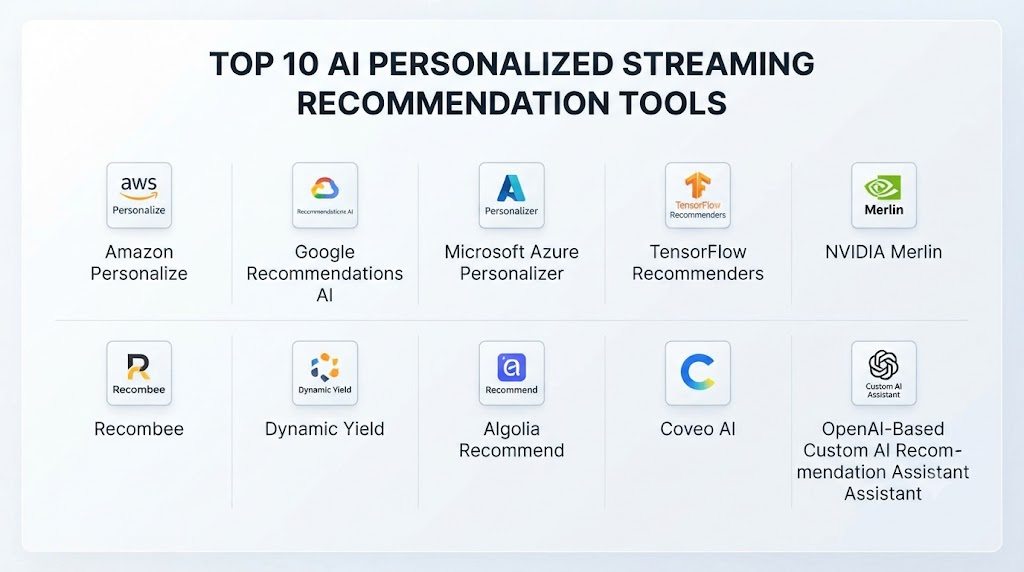
Top 10 AI Personalized Streaming Recommendation Tools
1. Amazon Personalize
Amazon Personalize is a machine learning recommendation service designed for developers and businesses that need personalized product, content, media, and streaming recommendations.
Key Features
- Real-time recommendations
- User personalization
- Content recommendations
- Ranking optimization
- Machine learning models
- Event tracking
- API-based integration
- Scalable recommendation infrastructure
Pros
- Enterprise-scale infrastructure
- Managed machine learning service
- Strong AWS ecosystem integration
- Supports real-time recommendations
- Reduces ML development effort
Cons
- Requires AWS expertise
- Customization may require engineering resources
- Costs depend on usage
Platforms
Cloud APIs, AWS services, and application integrations.
Deployment or Support
Cloud-based deployment.
Security & Compliance
AWS security controls and compliance capabilities depend on architecture and selected services.
Integrations & Ecosystem
AWS analytics, data platforms, streaming applications, customer platforms, and content systems.
Support & Community
AWS documentation, developer resources, enterprise support, and partner ecosystem.
2. Google Recommendations AI
Google Recommendations AI provides machine learning-based recommendation capabilities for personalized content discovery, commerce, and digital experiences.
Key Features
- Personalized recommendations
- User behavior modeling
- Ranking optimization
- Real-time personalization
- Machine learning APIs
- Analytics integration
- Cloud deployment
- Recommendation management
Pros
- Strong machine learning infrastructure
- Enterprise cloud scalability
- Advanced personalization capabilities
- Good analytics ecosystem
Cons
- Requires Google Cloud expertise
- Implementation can require data engineering
- Pricing varies by usage
3. Microsoft Azure Personalizer
Azure Personalizer helps applications choose personalized content, recommendations, and experiences using reinforcement learning.
Key Features
- Reinforcement learning
- Personalization APIs
- Ranking decisions
- User context analysis
- Real-time recommendations
- Feedback optimization
- Azure integration
Pros
- Strong enterprise ecosystem
- Real-time decision-making
- Flexible application integration
- Good governance capabilities
Cons
- Requires Azure development knowledge
- Needs quality behavioral data
- Configuration requires experimentation
4. TensorFlow Recommenders
TensorFlow Recommenders is an open-source framework for building customized recommendation systems using TensorFlow machine learning technologies.
Key Features
- Recommendation model building
- Deep learning workflows
- Candidate retrieval
- Ranking models
- Custom algorithms
- Research flexibility
- Model experimentation
Pros
- Highly customizable
- Open-source ecosystem
- Strong ML community
- Suitable for advanced teams
Cons
- Requires machine learning expertise
- Infrastructure management required
- Higher development effort
5. NVIDIA Merlin
NVIDIA Merlin is an open-source framework designed for building large-scale recommendation systems using GPU acceleration.
Key Features
- Deep learning recommendations
- GPU acceleration
- Large-scale ranking
- Feature engineering
- Model optimization
- Real-time inference
- Enterprise deployment support
Pros
- Excellent performance
- Designed for massive recommendation workloads
- Strong AI infrastructure support
- Useful for media-scale systems
Cons
- Requires technical expertise
- Hardware optimization knowledge needed
- Complex implementation
6. Recombee
Recombee provides recommendation APIs for websites, applications, streaming platforms, and digital content services.
Key Features
- Content recommendations
- Personalized ranking
- User profiling
- Recommendation APIs
- Real-time updates
- Analytics
- Business rules
Pros
- Easy API integration
- Fast implementation
- Suitable for digital content platforms
- Flexible recommendation logic
Cons
- Less customizable than building custom models
- Advanced requirements may need additional development
7. Dynamic Yield
Dynamic Yield provides AI-powered personalization, recommendations, experimentation, and customer experience optimization.
Key Features
- Personalized recommendations
- A/B testing
- Audience segmentation
- Experience personalization
- Behavioral analytics
- Content optimization
Pros
- Strong personalization workflows
- Good experimentation tools
- Enterprise customer experience focus
Cons
- Primarily focused on personalization platforms
- Enterprise pricing may be significant
8. Algolia Recommend
Algolia Recommend provides AI-powered recommendation APIs designed for search, discovery, and digital experiences.
Key Features
- Recommendation APIs
- Content discovery
- User personalization
- Search integration
- Ranking optimization
- Analytics
Pros
- Easy developer integration
- Strong search ecosystem
- Fast implementation
- Good API performance
Cons
- Requires integration with content systems
- Advanced personalization needs customization
9. Coveo AI
Coveo provides AI-powered search, recommendations, personalization, and knowledge discovery solutions for enterprise digital experiences.
Key Features
- AI recommendations
- Personalized search
- Content discovery
- Machine learning ranking
- User insights
- Enterprise analytics
Pros
- Strong enterprise search capabilities
- Good personalization workflows
- Supports complex information environments
Cons
- Enterprise implementation complexity
- Higher investment requirements
10. OpenAI-Based Custom AI Recommendation Assistant
An OpenAI-based custom recommendation assistant combines large language models with recommendation engines, user behavior analytics, content databases, and streaming platforms to create conversational and personalized discovery experiences.
Key Features
- Conversational recommendations
- Content discovery assistance
- User preference analysis
- Personalized explanations
- Natural language search
- Recommendation summaries
- Hybrid AI ranking
- Streaming platform integration
Pros
- Highly customizable
- Natural conversational discovery
- Flexible integration options
- Can combine multiple recommendation signals
- Supports personalized explanations
Cons
- Requires custom development
- Needs quality user data
- Requires governance for recommendation fairness and privacy
Platforms
- Web applications
- Mobile applications
- Streaming platforms
- Enterprise content platforms
- APIs
Deployment or Support
- Cloud
- Private cloud
- Hybrid deployment
Security & Compliance
- Access controls
- Data governance
- Encryption
- Privacy management
- Enterprise security practices
Integrations & Ecosystem
- Streaming services
- Content databases
- CMS platforms
- Analytics systems
- Customer platforms
- Data warehouses
Support & Community
- Developer ecosystem
- API documentation
- Enterprise implementation support
Comparison Table
| Tool Name | Best For | Platform(s) Supported | Deployment | Standout Feature | Public Rating |
|---|---|---|---|---|---|
| Amazon Personalize | Streaming recommendations | AWS, APIs | Cloud | Managed ML recommendations | N/A |
| Google Recommendations AI | Enterprise personalization | Google Cloud | Cloud | Advanced ML infrastructure | N/A |
| Azure Personalizer | Real-time personalization | Azure | Cloud | Reinforcement learning | N/A |
| TensorFlow Recommenders | Custom recommendation systems | Open source | Self-managed | ML flexibility | N/A |
| NVIDIA Merlin | Large-scale recommendations | Cloud and GPU systems | Cloud/Private | GPU acceleration | N/A |
| Recombee | Content platforms | APIs | Cloud | Fast integration | N/A |
| Dynamic Yield | Experience personalization | Enterprise platforms | Cloud | Experimentation | N/A |
| Algolia Recommend | Search-driven discovery | APIs | Cloud | Search integration | N/A |
| Coveo AI | Enterprise discovery | Cloud | Cloud | AI search and recommendations | N/A |
| OpenAI Custom Assistant | Conversational recommendations | APIs | Cloud/Hybrid | Natural-language discovery | N/A |
Weighted Evaluation
| Tool Name | Core Features 25% | Ease of Use 15% | Integrations & Ecosystem 15% | Security & Compliance 10% | Performance & Reliability 10% | Support & Community 10% | Price/Value 15% | Total |
|---|---|---|---|---|---|---|---|---|
| Amazon Personalize | 24 | 12 | 15 | 10 | 10 | 10 | 12 | 93 |
| Google Recommendations AI | 24 | 11 | 15 | 10 | 10 | 10 | 11 | 91 |
| Azure Personalizer | 23 | 12 | 15 | 10 | 9 | 10 | 12 | 91 |
| TensorFlow Recommenders | 25 | 8 | 13 | 9 | 10 | 10 | 14 | 89 |
| NVIDIA Merlin | 24 | 8 | 13 | 9 | 10 | 9 | 12 | 85 |
| Recombee | 21 | 14 | 12 | 8 | 9 | 9 | 13 | 86 |
| Dynamic Yield | 22 | 12 | 14 | 9 | 9 | 9 | 10 | 85 |
| Algolia Recommend | 21 | 14 | 14 | 9 | 10 | 9 | 12 | 89 |
| Coveo AI | 22 | 11 | 14 | 10 | 9 | 10 | 10 | 86 |
| OpenAI Custom Assistant | 25 | 9 | 15 | 8 | 9 | 9 | 12 | 87 |
Which AI Personalized Streaming Recommendation Tool Is Right for You?
Choose Amazon Personalize for scalable streaming recommendations with AWS infrastructure.
Choose Google Recommendations AI for enterprise personalization powered by Google Cloud machine learning.
Choose Azure Personalizer for real-time personalized decisions within Microsoft ecosystems.
Choose TensorFlow Recommenders for teams wanting complete control over recommendation models.
Choose NVIDIA Merlin for extremely large recommendation workloads requiring GPU acceleration.
Choose Recombee for fast API-based recommendation implementation.
Choose Dynamic Yield for customer experience personalization and experimentation.
Choose Algolia Recommend for search-focused content discovery.
Choose Coveo AI for enterprise knowledge discovery and personalized experiences.
Choose OpenAI-Based Custom Recommendation Assistant for conversational AI-powered streaming discovery.
Implementation Playbook
First 30 Days
- Define recommendation goals
- Identify content categories
- Collect user interaction data
- Establish privacy requirements
- Select pilot use cases
Days 31–60
- Integrate content catalogs
- Connect user behavior tracking
- Build recommendation models
- Test ranking quality
- Validate personalization
Days 61–90
- Deploy recommendations
- Monitor engagement metrics
- Improve ranking models
- Run experiments
- Optimize user experience
Common Mistakes
- Using only popularity-based recommendations
- Ignoring new-user cold-start problems
- Collecting unnecessary user data
- Lack of recommendation diversity
- Poor content metadata
- Ignoring privacy requirements
- Not testing recommendations
- Optimizing only for clicks
- Creating filter bubbles
- Failing to monitor recommendation quality
FAQs
1. What are AI Personalized Streaming Recommendation Tools?
They are AI-powered systems that analyze user behavior, content information, and contextual signals to recommend relevant movies, music, videos, podcasts, or other digital content.
2. How do AI recommendation systems work?
They combine user behavior analysis, machine learning models, content similarity, collaborative filtering, and ranking algorithms to predict which content a user may prefer.
3. Can AI recommendations work for new users?
Yes. Systems use popular content, demographic signals, content similarity, and exploration strategies to provide recommendations before enough personal data is available.
4. Which industries use AI recommendation engines?
Streaming media, music platforms, gaming, e-commerce, education, news, publishing, and digital entertainment platforms.
5. What data is required for recommendations?
Common signals include viewing history, searches, ratings, clicks, completion rates, content metadata, and user preferences.
6. Can recommendations happen in real time?
Yes. Modern recommendation systems can update suggestions based on recent actions such as watching a video, skipping content, or adding items to a list.
7. How do companies avoid recommendation bias?
Organizations use diversity controls, fairness evaluation, exploration strategies, and human review of recommendation behavior.
8. Are AI recommendations secure?
Companies should implement privacy controls, consent management, encryption, access restrictions, and responsible data governance.
9. Can AI explain why content was recommended?
Many modern systems can provide recommendation explanations based on viewing history, content similarity, or user preferences.
10. What should companies evaluate before adoption?
Consider recommendation accuracy, scalability, integrations, privacy, explainability, experimentation capabilities, deployment requirements, and business objectives.
Conclusion
AI Personalized Streaming Recommendation Tools are transforming digital entertainment by helping users discover relevant content while enabling platforms to improve engagement, retention, and content utilization.Managed cloud platforms such as Amazon Personalize, Google Recommendations AI, and Azure Personalizer help organizations deploy recommendations without building every machine learning component themselves. Open-source frameworks such as TensorFlow Recommenders and NVIDIA Merlin provide deeper customization for advanced teams. Platforms such as Recombee, Dynamic Yield, Algolia Recommend, and Coveo AI simplify recommendation implementation for digital experiences.
