Introduction
AI Tool Wear Prediction Systems use artificial intelligence (AI), machine learning (ML), industrial IoT, sensor analytics, computer vision, and predictive maintenance technologies to monitor cutting tool conditions, estimate remaining useful life, and optimize machining operations.
In modern manufacturing, cutting tools gradually wear during machining processes such as milling, turning, drilling, grinding, and CNC machining. Excessive tool wear can lead to poor surface quality, dimensional inaccuracies, higher scrap rates, unexpected machine downtime, and increased production costs.
Traditional tool replacement schedules are often based on fixed operating hours or manual inspections, which may result in replacing tools too early or too late. AI-powered tool wear prediction systems continuously analyze sensor data, spindle loads, vibration signals, acoustic emissions, temperature, cutting forces, and machine parameters to accurately estimate tool wear.
These platforms use machine learning, predictive analytics, digital twins, and condition monitoring models to optimize tool life, improve machining quality, reduce maintenance costs, and maximize equipment utilization.
Modern AI tool wear solutions integrate with CNC machines, Manufacturing Execution Systems (MES), Computerized Maintenance Management Systems (CMMS), Industrial IoT platforms, machine controllers, and production analytics systems.
They are widely used in automotive manufacturing, aerospace, precision engineering, metalworking, heavy machinery, medical device manufacturing, and industrial machining facilities.
Real-world Use Cases
- CNC tool life prediction
- Cutting tool monitoring
- Predictive tool replacement
- Surface quality improvement
- Machining process optimization
- Production downtime reduction
- Tool failure prevention
- Manufacturing quality control
- Condition-based maintenance
- Smart machining operations
Evaluation Criteria for Buyers
When selecting an AI Tool Wear Prediction System, consider:
- Prediction accuracy
- Sensor integration
- CNC compatibility
- Real-time monitoring
- Remaining useful life estimation
- Industrial IoT connectivity
- Analytics capabilities
- Scalability
- Security controls
- Ease of deployment
Best For
- CNC machining facilities
- Automotive manufacturers
- Aerospace manufacturers
- Precision engineering companies
- Industrial machining operations
Not Ideal For
Organizations without CNC equipment, machining operations, or machine monitoring infrastructure.
Key Trends
- AI-powered smart machining
- Predictive tool life estimation
- Intelligent CNC monitoring
- Edge AI manufacturing
- Digital twin machining
- Autonomous machining optimization
- Industrial IoT analytics
- AI-assisted machining quality
- Real-time tool condition monitoring
- Smart factory machining
Methodology
The platforms below were evaluated based on:
- AI tool wear prediction capabilities
- Manufacturing integration
- Analytics maturity
- Industrial compatibility
- Scalability
- Enterprise adoption
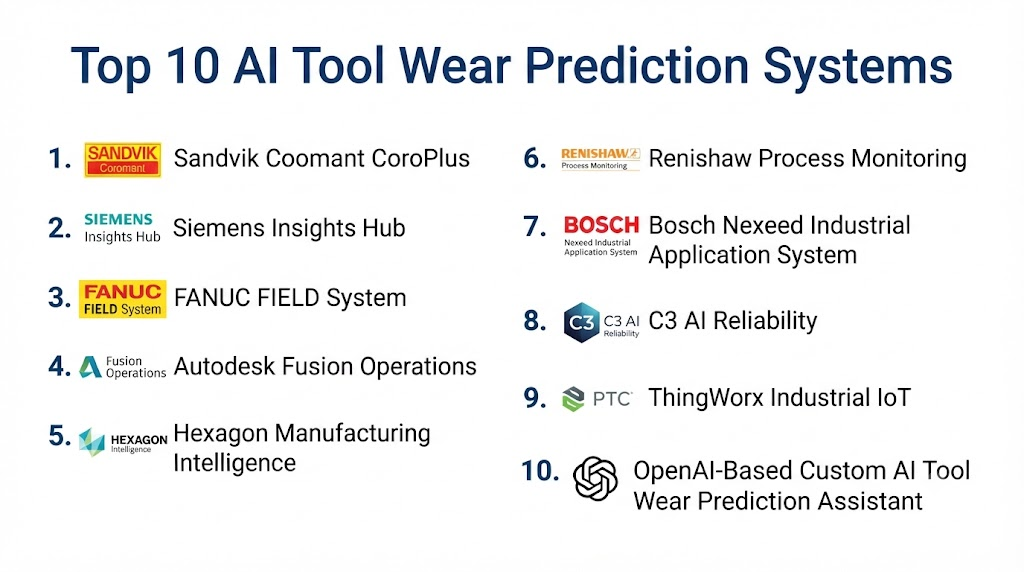
Top 10 AI Tool Wear Prediction Systems
1. Sandvik Coromant CoroPlus
Verdict: Best overall AI-powered tool wear monitoring platform.
Short Description: Sandvik Coromant CoroPlus combines machining analytics, connected tooling, and AI technologies to monitor tool conditions and optimize machining performance.
Key Features
- Tool life monitoring
- Machining analytics
- CNC integration
- Predictive maintenance
- Performance optimization
Pros
- Strong machining expertise
- Designed for industrial manufacturing
- Comprehensive tooling ecosystem
Cons
- Best suited for advanced machining environments
Deployment: Industrial machining operations
Security & Compliance: Enterprise industrial security controls
Integrations & Ecosystem: CNC machines, MES, IoT platforms, production systems
Support & Community: Enterprise support
Pricing Model: Custom enterprise pricing
Best-Fit Scenarios: High-volume machining operations
2. Siemens Insights Hub
Verdict: Industrial AI platform supporting predictive machining analytics.
Short Description: Siemens Insights Hub analyzes machine data, equipment performance, and operational conditions to improve machining reliability and tool management.
Key Features
- Industrial IoT analytics
- Equipment monitoring
- AI insights
- Predictive maintenance
- Manufacturing intelligence
Pros
- Strong industrial ecosystem
- Enterprise scalability
Cons
- General industrial platform with machining applications
3. FANUC FIELD System
Verdict: AI-enabled manufacturing optimization platform.
Short Description: FANUC FIELD System collects machine data and applies AI analytics to improve equipment performance, maintenance, and production efficiency.
Key Features
- Machine monitoring
- Predictive analytics
- CNC integration
- Equipment intelligence
- Factory analytics
Pros
- Strong CNC expertise
- Manufacturing-focused
Cons
- Best suited for FANUC environments
4. Autodesk Fusion Operations
Verdict: Manufacturing operations platform with machining analytics.
Short Description: Autodesk Fusion Operations helps manufacturers improve machining workflows, monitor production, and optimize manufacturing performance.
Key Features
- Production tracking
- Machine monitoring
- Workflow optimization
- Operational analytics
- Manufacturing dashboards
Pros
- Easy deployment
- Manufacturing-focused workflows
Cons
- Advanced AI capabilities vary
5. Hexagon Manufacturing Intelligence
Verdict: Smart manufacturing analytics platform.
Short Description: Hexagon combines manufacturing analytics, metrology, and AI technologies to improve machining quality and optimize production processes.
Key Features
- Quality analytics
- Process monitoring
- Metrology integration
- AI insights
- Manufacturing optimization
Pros
- Strong quality engineering expertise
- Advanced measurement capabilities
Cons
- Requires manufacturing integration
6. Renishaw Process Monitoring
Verdict: Precision manufacturing monitoring solution.
Short Description: Renishaw provides tool monitoring, process measurement, and machining analytics to improve CNC performance and machining accuracy.
Key Features
- Tool measurement
- Process monitoring
- CNC integration
- Quality assurance
- Automation support
Pros
- Excellent precision engineering
- Reliable measurement technologies
Cons
- More focused on measurement than AI
7. Bosch Nexeed Industrial Application System
Verdict: Connected manufacturing analytics platform.
Short Description: Bosch Nexeed uses industrial IoT and analytics to monitor manufacturing equipment, optimize production, and improve maintenance decisions.
Key Features
- Equipment monitoring
- Industrial analytics
- IoT integration
- Predictive insights
- Manufacturing dashboards
Pros
- Strong Industry 4.0 capabilities
- Flexible industrial integration
Cons
- Requires connected factory infrastructure
8. C3 AI Reliability
Verdict: Enterprise AI platform for equipment health prediction.
Short Description: C3 AI Reliability applies machine learning models to monitor industrial assets, predict failures, and improve maintenance planning.
Key Features
- AI diagnostics
- Predictive maintenance
- Equipment health monitoring
- Asset analytics
- Risk prediction
Pros
- Advanced AI capabilities
- Enterprise scalability
Cons
- General asset platform requiring machining customization
9. PTC ThingWorx Industrial IoT
Verdict: Industrial IoT platform for intelligent machining analytics.
Short Description: ThingWorx connects machine tools with industrial analytics to improve machining operations and maintenance planning.
Key Features
- IoT connectivity
- Machine monitoring
- Analytics
- Digital twins
- Manufacturing dashboards
Pros
- Strong IoT ecosystem
- Flexible integrations
Cons
- Requires IoT deployment expertise
10. OpenAI-Based Custom AI Tool Wear Prediction Assistant
Verdict: Flexible AI assistant for customized machining intelligence.
Short Description: Organizations can build custom AI tool wear prediction assistants using large language models integrated with CNC controllers, machine sensors, MES platforms, vibration monitoring systems, production databases, and machining analytics tools. These assistants can analyze tool conditions, summarize wear trends, recommend replacement timing, and support manufacturing engineers while requiring engineering validation.
Key Features
- Tool wear analysis
- Machining summaries
- Maintenance recommendations
- CNC knowledge support
- Operational reporting
Pros
- Highly customizable
- Flexible integrations
- Improves engineering productivity
Cons
- Requires machining expertise
- Validation required
Comparison Table
| Platform | AI Prediction | CNC Integration | Tool Monitoring | Manufacturing Analytics | Best Use |
|---|---|---|---|---|---|
| Sandvik Coromant CoroPlus | Excellent | Excellent | Excellent | Excellent | Tool Wear Prediction |
| Siemens Insights Hub | High | High | High | Excellent | Industrial Analytics |
| FANUC FIELD System | High | Excellent | High | High | CNC Manufacturing |
| Autodesk Fusion Operations | Medium | High | Medium | High | Manufacturing Operations |
| Hexagon Manufacturing Intelligence | High | High | High | Excellent | Precision Manufacturing |
| Renishaw Process Monitoring | Medium | Excellent | Excellent | High | Precision Machining |
| Bosch Nexeed | High | High | Medium | High | Smart Factory |
| C3 AI Reliability | Excellent | Medium | High | Excellent | Predictive Maintenance |
| ThingWorx | High | High | High | High | Industrial IoT |
| OpenAI Custom | Custom | Custom | Custom | Custom | AI Machining Assistant |
Evaluation & Scoring Table
| Platform | AI Capability 20% | Wear Prediction 20% | Analytics 15% | Integration 15% | Security 10% | Ease 10% | Value 10% | Total |
|---|---|---|---|---|---|---|---|---|
| Sandvik Coromant CoroPlus | 20 | 20 | 15 | 15 | 10 | 8 | 8 | 96 |
| Siemens Insights Hub | 18 | 18 | 15 | 15 | 10 | 8 | 8 | 92 |
| FANUC FIELD System | 18 | 19 | 14 | 15 | 10 | 8 | 8 | 92 |
| Hexagon Manufacturing Intelligence | 18 | 18 | 15 | 14 | 10 | 8 | 8 | 91 |
| C3 AI Reliability | 20 | 17 | 15 | 13 | 10 | 8 | 8 | 91 |
| Renishaw Process Monitoring | 16 | 18 | 14 | 14 | 10 | 8 | 8 | 88 |
| ThingWorx | 17 | 17 | 14 | 15 | 10 | 8 | 8 | 89 |
| Bosch Nexeed | 17 | 17 | 13 | 14 | 10 | 9 | 8 | 88 |
| Autodesk Fusion Operations | 16 | 16 | 13 | 13 | 10 | 9 | 8 | 85 |
| OpenAI Custom | 20 | 16 | 12 | 15 | 8 | 7 | 9 | 87 |
Which AI Tool Wear Prediction System Is Right for You?
| If your priority is… | Recommended Platform |
|---|---|
| Overall tool wear prediction | Sandvik Coromant CoroPlus |
| Industrial equipment analytics | Siemens Insights Hub |
| FANUC CNC environments | FANUC FIELD System |
| Manufacturing workflow optimization | Autodesk Fusion Operations |
| Precision manufacturing | Hexagon Manufacturing Intelligence |
| CNC measurement and monitoring | Renishaw Process Monitoring |
| Smart factory analytics | Bosch Nexeed |
| AI predictive maintenance | C3 AI Reliability |
| Industrial IoT machining | PTC ThingWorx |
| Custom AI machining assistant | OpenAI-Based AI Assistant |
Implementation Playbook
First 30 Days
- Identify critical machining operations
- Collect CNC and sensor data
- Define tool wear objectives
- Review existing maintenance processes
Days 31–60
- Integrate CNC machines with AI platform
- Configure predictive models
- Validate wear predictions
- Train engineering teams
Days 61–90
- Automate tool life monitoring
- Optimize replacement schedules
- Reduce machining downtime
- Improve production quality
Common Mistakes
- Poor sensor calibration
- Incomplete machining data
- Ignoring cutting parameter changes
- Weak CNC integration
- Overreliance on AI predictions
- Lack of engineering validation
- Poor maintenance planning
- Not retraining AI models
Frequently Asked Questions
1. What are AI Tool Wear Prediction Systems?
They are AI-powered platforms that monitor cutting tool conditions and predict when tools should be replaced.
2. How does AI predict tool wear?
AI analyzes machine data, vibration, cutting forces, temperature, spindle loads, and historical machining information.
3. Can AI replace machining engineers?
No. AI supports engineers by providing predictive insights and maintenance recommendations.
4. Which industries use AI tool wear prediction?
Automotive, aerospace, metalworking, medical device manufacturing, precision engineering, and industrial machining.
5. What data is required?
CNC machine data, sensor information, machining parameters, tool history, and production records.
6. Can AI reduce machining costs?
Yes. Better tool management reduces unnecessary replacements, downtime, and scrap.
7. Do these platforms integrate with CNC systems?
Many integrate with CNC controllers, MES, Industrial IoT platforms, and maintenance systems.
8. Are AI predictions always accurate?
Accuracy depends on sensor quality, machining data, and continuous model validation.
9. How is manufacturing data protected?
Organizations should use industrial cybersecurity, access controls, encryption, and secure network architectures.
10. What should companies evaluate before adoption?
Consider prediction accuracy, CNC compatibility, integrations, scalability, security, and operational requirements.
Conclusion
AI Tool Wear Prediction Systems are transforming precision manufacturing by enabling predictive tool management, reducing downtime, improving machining quality, and extending tool life. By combining artificial intelligence, machine learning, industrial IoT, and real-time machining analytics, these platforms help manufacturers achieve higher productivity and more efficient operations.Organizations implementing AI tool wear prediction solutions should focus on accurate sensor data, seamless CNC integration, continuous model validation, and collaboration between machining engineers and maintenance teams. Platforms such as Sandvik Coromant CoroPlus, Siemens Insights Hub, FANUC FIELD System, Hexagon Manufacturing Intelligence, and C3 AI Reliability demonstrate how artificial intelligence is advancing smart machining and enabling more intelligent manufacturing operations.
