Introduction
AI Worker Safety Monitoring Tools use artificial intelligence (AI), computer vision, Internet of Things (IoT), machine learning, and real-time analytics to improve workplace safety and reduce industrial risks.
Industrial environments such as factories, construction sites, warehouses, mining operations, and energy facilities involve multiple safety challenges including unsafe behaviors, restricted area access, missing personal protective equipment (PPE), equipment hazards, and environmental risks.
Traditional safety monitoring methods often depend on manual inspections, periodic audits, and human observation. These approaches may not provide continuous visibility into workplace conditions. AI-powered worker safety monitoring platforms analyze video feeds, sensor data, wearable devices, and environmental information to detect safety risks in real time.
These solutions use computer vision models, object detection, behavior analysis, IoT sensors, and predictive analytics to identify situations such as PPE violations, unsafe proximity to machinery, falls, hazardous movements, and restricted zone access.
Modern AI safety monitoring platforms integrate with Industrial IoT systems, surveillance cameras, access control systems, Environmental Health and Safety (EHS) platforms, Manufacturing Execution Systems (MES), and enterprise safety management solutions.
AI helps safety teams improve awareness, respond faster to incidents, and create safer workplaces while requiring proper deployment, privacy controls, and human oversight.
Real-world Use Cases
- PPE compliance monitoring
- Worker behavior analysis
- Fall detection
- Restricted area monitoring
- Machine safety monitoring
- Hazard identification
- Workplace analytics
- Environmental risk monitoring
- Industrial safety reporting
- Incident prevention
Evaluation Criteria for Buyers
When selecting an AI Worker Safety Monitoring Tool, consider:
- Computer vision accuracy
- IoT sensor integration
- Real-time alerts
- PPE detection capabilities
- Privacy and security controls
- Edge AI support
- EHS integration
- Scalability
- Reporting capabilities
- Deployment flexibility
Best For
- Manufacturing facilities
- Construction companies
- Warehouses
- Energy and utilities
- Industrial operations
Not Ideal For
Organizations without camera infrastructure, IoT connectivity, or clear workplace safety processes.
Key Trends
- AI-powered workplace safety
- Computer vision safety monitoring
- Edge AI cameras
- Smart PPE systems
- Connected worker technologies
- Predictive safety analytics
- Industrial IoT adoption
- Real-time hazard detection
- Automated compliance monitoring
- Digital EHS transformation
Methodology
The platforms below were evaluated based on:
- AI safety monitoring capabilities
- Vision and IoT support
- Real-time detection
- Industrial integration
- Scalability
- Enterprise adoption
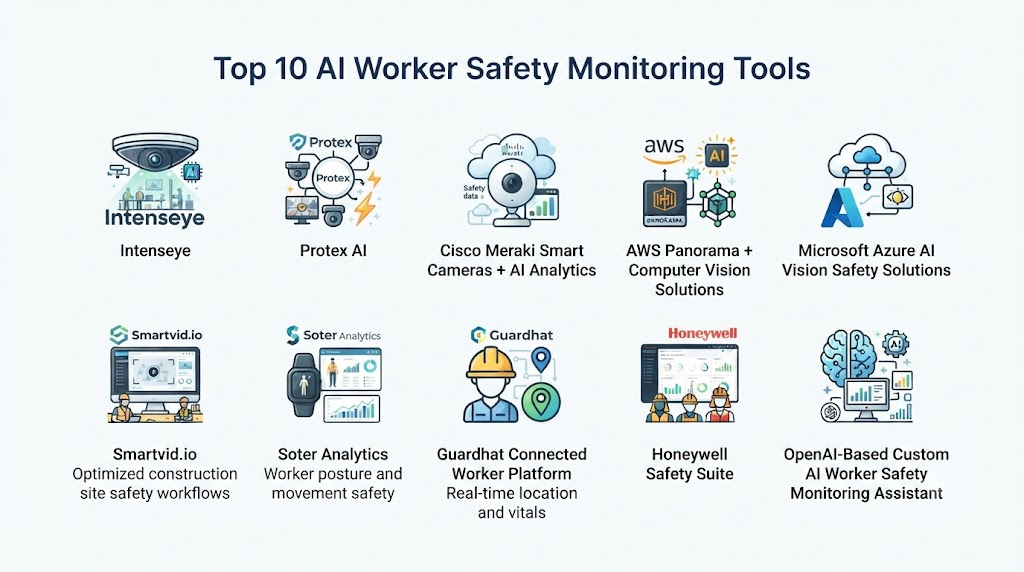
Top 10 AI Worker Safety Monitoring Tools
1. Intenseye
Verdict: Best overall AI-powered workplace safety monitoring platform.
Short Description: Intenseye uses computer vision and AI analytics to monitor workplace safety conditions, detect hazards, and improve safety compliance.
Key Features
- PPE detection
- Unsafe behavior detection
- Safety analytics
- Real-time alerts
- Camera-based monitoring
Pros
- Strong computer vision capabilities
- Designed for industrial safety
- Real-time monitoring
Cons
- Requires camera deployment planning
Deployment: Industrial facilities and workplaces
Security & Compliance: Safety data protection controls
Integrations & Ecosystem: Cameras, EHS platforms, workplace systems
Support & Community: Enterprise support
Pricing Model: Custom enterprise pricing
Best-Fit Scenarios: Manufacturing safety monitoring
2. Protex AI
Verdict: AI vision platform for industrial safety management.
Short Description: Protex AI provides computer vision-based workplace safety monitoring to identify hazards and improve operational safety.
Key Features
- Hazard detection
- Worker monitoring
- Safety analytics
- Incident prevention
- AI video analysis
Pros
- Strong industrial focus
- Real-time safety insights
Cons
- Requires suitable camera infrastructure
3. Cisco Meraki Smart Cameras + AI Analytics
Verdict: Connected camera-based safety monitoring solution.
Short Description: Cisco Meraki smart cameras combined with analytics capabilities help organizations monitor environments and identify safety-related events.
Key Features
- Smart video monitoring
- AI analytics
- Remote management
- Event detection
- Cloud-based management
Pros
- Strong networking ecosystem
- Easy cloud management
Cons
- Requires camera infrastructure
4. AWS Panorama + Computer Vision Solutions
Verdict: Flexible edge AI vision platform.
Short Description: AWS Panorama enables organizations to deploy computer vision applications on edge devices for industrial monitoring and safety use cases.
Key Features
- Edge AI processing
- Computer vision models
- Real-time analysis
- Camera integration
- Cloud connectivity
Pros
- Flexible AI deployment
- Scalable architecture
Cons
- Requires AI implementation expertise
5. Microsoft Azure AI Vision Safety Solutions
Verdict: Cloud AI platform for workplace vision analytics.
Short Description: Microsoft Azure AI Vision technologies support custom workplace safety applications using computer vision, analytics, and cloud intelligence.
Key Features
- Image and video analysis
- AI model development
- Cloud analytics
- Custom safety workflows
- Data integration
Pros
- Strong cloud ecosystem
- Flexible AI capabilities
Cons
- Requires customization
6. Smartvid.io
Verdict: AI-powered construction safety monitoring platform.
Short Description: Smartvid.io uses AI and video analytics to identify safety risks and improve construction site visibility.
Key Features
- Video analytics
- Safety risk detection
- Incident insights
- Site monitoring
- AI-based analysis
Pros
- Construction-focused capabilities
- Improves safety visibility
Cons
- Primarily focused on construction environments
7. Soter Analytics
Verdict: Connected worker safety monitoring platform.
Short Description: Soter Analytics combines wearable technology, AI analytics, and workplace data to reduce ergonomic and safety risks.
Key Features
- Wearable safety monitoring
- Ergonomic risk analysis
- Worker insights
- Safety analytics
- Real-time feedback
Pros
- Strong wearable technology
- Worker-focused approach
Cons
- Requires wearable adoption
8. Guardhat Connected Worker Platform
Verdict: IoT-based connected worker safety solution.
Short Description: Guardhat combines IoT devices, worker communications, and safety analytics to improve industrial worker protection.
Key Features
- Worker location tracking
- Safety alerts
- IoT monitoring
- Emergency communication
- Connected worker analytics
Pros
- Strong IoT capabilities
- Supports industrial environments
Cons
- Requires connected devices
9. Honeywell Safety Suite
Verdict: Enterprise workplace safety management platform.
Short Description: Honeywell Safety Suite combines safety management tools, connected devices, and analytics to improve workplace risk management.
Key Features
- Safety monitoring
- Incident management
- Connected safety devices
- Analytics
- Compliance support
Pros
- Strong industrial safety ecosystem
- Enterprise reliability
Cons
- Broad safety platform requiring configuration
10. OpenAI-Based Custom AI Worker Safety Monitoring Assistant
Verdict: Flexible AI assistant for customized workplace safety intelligence.
Short Description: Organizations can build custom AI worker safety assistants using computer vision models, IoT sensor data, camera systems, EHS platforms, and operational databases. These assistants can analyze safety events, summarize incidents, identify trends, and support safety decisions while requiring privacy controls and validation.
Key Features
- Safety event analysis
- Incident summaries
- Risk trend identification
- Compliance reporting
- Safety knowledge assistance
Pros
- Highly customizable
- Flexible integrations
- Improves safety insights
Cons
- Requires safety expertise
- Privacy validation required
Comparison Table
| Platform | AI Vision | IoT Support | Safety Analytics | Real-Time Alerts | Best Use |
|---|---|---|---|---|---|
| Intenseye | Excellent | High | Excellent | Excellent | Industrial Safety |
| Protex AI | Excellent | Medium | Excellent | Excellent | Workplace Vision Safety |
| Cisco Meraki Smart Cameras | High | High | High | High | Connected Monitoring |
| AWS Panorama | Excellent | High | High | High | Edge AI Safety |
| Azure AI Vision | Excellent | Medium | High | High | Custom Safety AI |
| Smartvid.io | High | Medium | High | High | Construction Safety |
| Soter Analytics | Medium | Excellent | High | High | Wearable Safety |
| Guardhat | Medium | Excellent | High | Excellent | Connected Workers |
| Honeywell Safety Suite | High | Excellent | Excellent | High | Enterprise Safety |
| OpenAI Custom | Custom | Custom | Custom | Custom | AI Safety Assistant |
Evaluation & Scoring Table
| Platform | AI Capability 20% | Safety Detection 20% | IoT Integration 15% | Analytics 15% | Security 10% | Ease 10% | Value 10% | Total |
|---|---|---|---|---|---|---|---|---|
| Intenseye | 20 | 20 | 14 | 15 | 10 | 8 | 8 | 95 |
| Protex AI | 20 | 19 | 13 | 15 | 10 | 8 | 8 | 93 |
| Honeywell Safety Suite | 18 | 19 | 15 | 15 | 10 | 8 | 8 | 93 |
| Guardhat | 17 | 18 | 15 | 14 | 10 | 9 | 8 | 91 |
| AWS Panorama | 19 | 18 | 14 | 14 | 10 | 8 | 8 | 91 |
| Azure AI Vision | 19 | 17 | 13 | 14 | 10 | 9 | 8 | 90 |
| Cisco Meraki | 17 | 17 | 15 | 14 | 10 | 9 | 8 | 90 |
| Soter Analytics | 17 | 18 | 15 | 13 | 10 | 9 | 8 | 90 |
| Smartvid.io | 17 | 17 | 13 | 14 | 10 | 8 | 8 | 87 |
| OpenAI Custom | 20 | 16 | 12 | 15 | 8 | 7 | 9 | 87 |
Which AI Worker Safety Monitoring Tool Is Right for You?
| If your priority is… | Recommended Platform |
|---|---|
| AI workplace vision monitoring | Intenseye |
| Industrial hazard detection | Protex AI |
| Smart camera safety monitoring | Cisco Meraki |
| Edge AI safety applications | AWS Panorama |
| Custom AI safety workflows | Azure AI Vision |
| Construction safety monitoring | Smartvid.io |
| Wearable worker safety | Soter Analytics |
| Connected worker protection | Guardhat |
| Enterprise safety management | Honeywell Safety Suite |
| Custom AI safety assistant | OpenAI-Based AI Assistant |
Implementation Playbook
First 30 Days
- Define safety monitoring objectives
- Identify workplace risks
- Review camera and IoT infrastructure
- Establish privacy guidelines
Days 31–60
- Deploy monitoring systems
- Configure AI detection models
- Integrate safety platforms
- Train safety teams
Days 61–90
- Automate safety alerts
- Analyze risk patterns
- Improve workplace compliance
- Expand AI safety monitoring
Common Mistakes
- Ignoring privacy requirements
- Poor camera placement
- Insufficient safety data
- Lack of employee communication
- Overreliance on AI alerts
- Weak integration with EHS systems
- Poor model validation
- Not updating safety workflows
Frequently Asked Questions
1. What are AI Worker Safety Monitoring Tools?
They are AI-powered platforms that monitor workplace conditions and identify safety risks using vision and IoT technologies.
2. How does AI improve workplace safety?
AI detects hazards, monitors compliance, and provides real-time safety insights.
3. Can AI replace safety officers?
No. AI supports safety teams by improving visibility and response speed.
4. Who uses AI safety monitoring systems?
Manufacturing companies, construction organizations, warehouses, energy companies, and industrial facilities.
5. What can AI cameras detect?
They can detect PPE compliance issues, unsafe behavior, restricted access, and workplace hazards.
6. Do these systems require cameras?
Many vision-based systems require cameras, while IoT-based systems use connected sensors and devices.
7. Are worker monitoring systems secure?
Organizations should implement privacy controls, access management, and secure data practices.
8. Can AI prevent workplace accidents?
AI helps identify risks early but requires proper safety processes and human action.
9. Can these platforms integrate with EHS systems?
Many integrate with safety management and industrial systems.
10. What should companies evaluate before adoption?
Consider AI accuracy, privacy, integrations, scalability, security, and workplace requirements.
Conclusion
AI Worker Safety Monitoring Tools are transforming industrial safety by combining computer vision, IoT sensors, and intelligent analytics to identify risks before incidents occur. These platforms help organizations improve safety compliance, enhance workplace visibility, and create proactive safety management practices.Organizations adopting AI safety monitoring solutions should focus on privacy protection, accurate deployment, employee acceptance, and integration with existing safety processes. Platforms such as Intenseye, Protex AI, Honeywell Safety Suite, Guardhat, and AWS Panorama demonstrate how artificial intelligence is improving workplace safety and enabling smarter industrial environments.
