Introduction
AI MES (Manufacturing Execution System) Augmentation Modules use artificial intelligence (AI), machine learning (ML), industrial analytics, and automation technologies to enhance Manufacturing Execution Systems with predictive intelligence, real-time decision support, process optimization, and automated operational insights.
Manufacturing Execution Systems are responsible for managing production operations, work orders, machine status, quality data, labor tracking, and production workflows. Traditional MES platforms provide operational visibility but often rely on predefined business rules and manual decision-making.
AI-powered MES augmentation modules extend MES capabilities by analyzing production data, identifying hidden patterns, predicting production issues, optimizing scheduling, improving quality control, recommending corrective actions, and automating operational decisions.
These solutions combine predictive analytics, computer vision, digital twins, industrial IoT, generative AI assistants, and machine learning models to improve manufacturing efficiency, reduce downtime, increase throughput, and support continuous improvement.
Modern AI MES modules integrate with ERP systems, SCADA platforms, PLCs, Industrial IoT devices, Quality Management Systems (QMS), Enterprise Asset Management (EAM), warehouse systems, and supply chain platforms.
They support industries including automotive, electronics, pharmaceuticals, aerospace, food manufacturing, chemicals, semiconductor production, and industrial automation.
Real-world Use Cases
- Production optimization
- Intelligent work order management
- AI-assisted production planning
- Predictive quality monitoring
- Digital work instructions
- Downtime prediction
- Operator assistance
- Manufacturing analytics
- Production bottleneck detection
- Continuous process improvement
Evaluation Criteria for Buyers
When selecting an AI MES Augmentation Module, consider:
- AI decision support capabilities
- MES compatibility
- Real-time production analytics
- Industrial IoT integration
- Predictive maintenance support
- Quality analytics
- Workflow automation
- Scalability
- Security controls
- Ease of deployment
Best For
- Manufacturing companies
- Smart factories
- Production managers
- Process engineers
- Industrial operations teams
Not Ideal For
Organizations without an MES platform, connected manufacturing systems, or digital production data.
Key Trends
- AI-powered MES intelligence
- Smart manufacturing execution
- Autonomous factory operations
- Predictive production analytics
- Digital manufacturing assistants
- AI-driven operator guidance
- Connected factory ecosystems
- Industrial IoT analytics
- Generative AI for manufacturing
- Real-time production optimization
Methodology
The platforms below were evaluated based on:
- AI MES capabilities
- Manufacturing intelligence
- Integration support
- Automation maturity
- Scalability
- Enterprise adoption
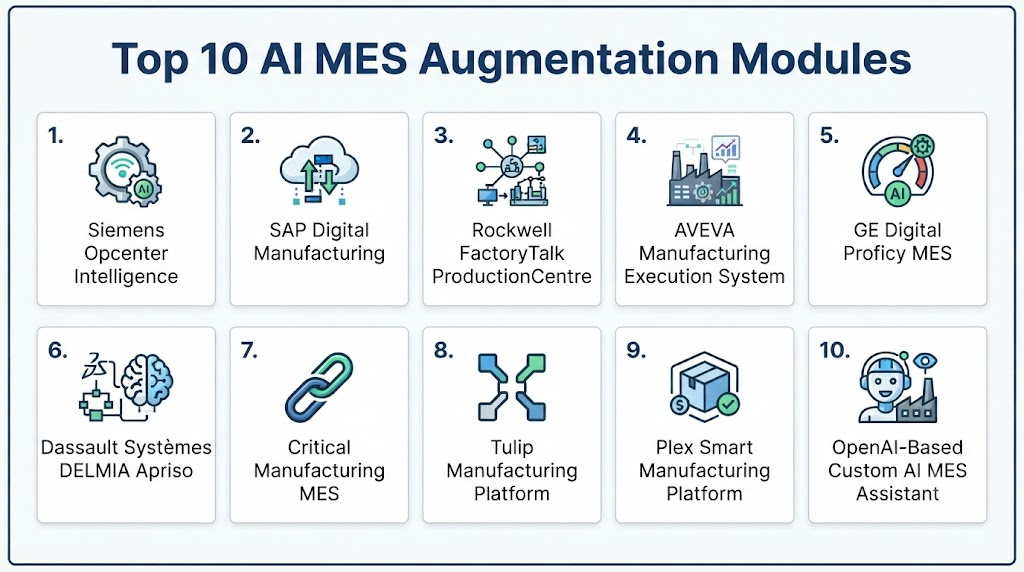
Top 10 AI MES Augmentation Modules
1. Siemens Opcenter Intelligence
Verdict: Best overall AI-powered MES augmentation platform.
Short Description: Siemens Opcenter Intelligence enhances MES operations with AI analytics, production intelligence, quality insights, and manufacturing optimization capabilities.
Key Features
- AI production analytics
- Manufacturing dashboards
- Quality intelligence
- Production optimization
- Real-time operational insights
Pros
- Strong manufacturing ecosystem
- Enterprise scalability
- Comprehensive MES integration
Cons
- Requires implementation expertise
Deployment: Enterprise manufacturing environments
Security & Compliance: Industrial security controls
Integrations & Ecosystem: MES, ERP, SCADA, IoT platforms, automation systems
Support & Community: Enterprise support
Pricing Model: Custom enterprise pricing
Best-Fit Scenarios: Large-scale manufacturing operations
2. SAP Digital Manufacturing
Verdict: Enterprise AI-enhanced MES platform.
Short Description: SAP Digital Manufacturing combines manufacturing execution with AI-powered analytics, production monitoring, and intelligent workflow automation.
Key Features
- Production monitoring
- AI analytics
- Manufacturing workflows
- Quality management
- ERP integration
Pros
- Strong SAP ecosystem
- Enterprise-grade capabilities
Cons
- Requires SAP expertise
3. Rockwell FactoryTalk ProductionCentre
Verdict: Industrial MES platform with AI-driven manufacturing insights.
Short Description: Rockwell FactoryTalk ProductionCentre enhances production operations through intelligent analytics, workflow automation, and operational visibility.
Key Features
- Manufacturing execution
- Production analytics
- Workflow management
- Real-time monitoring
- Industrial connectivity
Pros
- Strong automation ecosystem
- Reliable manufacturing integration
Cons
- Best suited for Rockwell environments
4. AVEVA Manufacturing Execution System
Verdict: AI-enabled manufacturing execution platform.
Short Description: AVEVA MES combines production execution, industrial analytics, and operational intelligence to improve manufacturing performance.
Key Features
- Production tracking
- Manufacturing analytics
- Quality monitoring
- Performance dashboards
- Industrial integration
Pros
- Strong industrial expertise
- Flexible manufacturing support
Cons
- Enterprise-focused implementation
5. GE Digital Proficy MES
Verdict: Manufacturing execution platform with AI-assisted production optimization.
Short Description: GE Digital Proficy MES helps manufacturers improve production visibility, operational efficiency, and process intelligence.
Key Features
- Production execution
- AI analytics
- Quality tracking
- Manufacturing intelligence
- Workflow automation
Pros
- Strong industrial capabilities
- Good manufacturing visibility
Cons
- Requires implementation planning
6. Dassault Systèmes DELMIA Apriso
Verdict: Digital manufacturing execution and operations platform.
Short Description: DELMIA Apriso provides manufacturing execution, production intelligence, and AI-assisted operational optimization across global factories.
Key Features
- Manufacturing execution
- Production optimization
- Process management
- Operational analytics
- Multi-site visibility
Pros
- Excellent enterprise capabilities
- Strong digital manufacturing support
Cons
- Complex deployment
7. Critical Manufacturing MES
Verdict: Modern MES platform with intelligent manufacturing capabilities.
Short Description: Critical Manufacturing MES provides AI-ready manufacturing execution, quality management, and production analytics for advanced factories.
Key Features
- Smart manufacturing
- Quality management
- Production analytics
- Workflow automation
- Industrial connectivity
Pros
- Modern cloud architecture
- Flexible deployment
Cons
- Requires manufacturing expertise
8. Tulip Manufacturing Platform
Verdict: Low-code manufacturing operations platform with AI-enabled workflows.
Short Description: Tulip helps manufacturers digitize production operations, collect factory data, and build AI-enhanced manufacturing applications.
Key Features
- Low-code applications
- Production tracking
- Digital work instructions
- AI workflows
- Factory analytics
Pros
- Easy customization
- Fast deployment
Cons
- Advanced MES features vary
9. Plex Smart Manufacturing Platform
Verdict: Cloud-native MES with AI-supported manufacturing analytics.
Short Description: Plex provides cloud manufacturing execution, production monitoring, quality management, and operational intelligence capabilities.
Key Features
- Cloud MES
- Manufacturing analytics
- Production monitoring
- Quality management
- ERP integration
Pros
- Cloud-native architecture
- Strong manufacturing workflows
Cons
- Requires cloud adoption
10. OpenAI-Based Custom AI MES Assistant
Verdict: Flexible AI assistant for customized MES augmentation.
Short Description: Organizations can build custom AI MES assistants using large language models integrated with MES platforms, ERP systems, IoT devices, production databases, quality systems, and operational analytics. These assistants can summarize production performance, recommend workflow improvements, analyze bottlenecks, explain production issues, and support manufacturing teams while requiring operational validation.
Key Features
- Production analysis
- AI operational summaries
- Manufacturing recommendations
- Workflow assistance
- Knowledge support
Pros
- Highly customizable
- Flexible integrations
- Improves operational productivity
Cons
- Requires manufacturing expertise
- Validation required
Comparison Table
| Platform | AI Capability | MES Integration | Manufacturing Analytics | Workflow Automation | Best Use |
|---|---|---|---|---|---|
| Siemens Opcenter Intelligence | Excellent | Excellent | Excellent | Excellent | Enterprise Manufacturing |
| SAP Digital Manufacturing | Excellent | Excellent | Excellent | High | SAP Manufacturing |
| Rockwell FactoryTalk ProductionCentre | High | Excellent | High | High | Industrial Automation |
| AVEVA MES | High | Excellent | High | High | Process Manufacturing |
| GE Digital Proficy MES | High | Excellent | Excellent | High | Manufacturing Intelligence |
| DELMIA Apriso | Excellent | Excellent | Excellent | Excellent | Global Manufacturing |
| Critical Manufacturing MES | High | Excellent | High | High | Smart Factories |
| Tulip | Medium | High | High | Excellent | Connected Operations |
| Plex Smart Manufacturing | High | Excellent | High | High | Cloud Manufacturing |
| OpenAI Custom | Custom | Custom | Custom | Custom | AI MES Assistant |
Evaluation & Scoring Table
| Platform | AI Capability 20% | MES Intelligence 20% | Analytics 15% | Integration 15% | Security 10% | Ease 10% | Value 10% | Total |
|---|---|---|---|---|---|---|---|---|
| Siemens Opcenter Intelligence | 20 | 20 | 15 | 15 | 10 | 8 | 8 | 96 |
| DELMIA Apriso | 19 | 20 | 15 | 15 | 10 | 8 | 8 | 95 |
| SAP Digital Manufacturing | 19 | 19 | 15 | 15 | 10 | 8 | 8 | 94 |
| GE Digital Proficy MES | 18 | 19 | 15 | 15 | 10 | 8 | 8 | 93 |
| AVEVA MES | 18 | 18 | 15 | 15 | 10 | 8 | 8 | 92 |
| Rockwell FactoryTalk ProductionCentre | 18 | 18 | 14 | 15 | 10 | 8 | 8 | 91 |
| Critical Manufacturing MES | 18 | 18 | 14 | 14 | 10 | 8 | 8 | 90 |
| Plex Smart Manufacturing | 17 | 18 | 14 | 14 | 10 | 9 | 8 | 90 |
| Tulip | 16 | 17 | 13 | 14 | 10 | 9 | 8 | 87 |
| OpenAI Custom | 20 | 16 | 12 | 15 | 8 | 7 | 9 | 87 |
Which AI MES Augmentation Module Is Right for You?
| If your priority is… | Recommended Platform |
|---|---|
| Enterprise MES intelligence | Siemens Opcenter Intelligence |
| SAP manufacturing operations | SAP Digital Manufacturing |
| Industrial automation | Rockwell FactoryTalk ProductionCentre |
| Process manufacturing | AVEVA MES |
| Manufacturing analytics | GE Digital Proficy MES |
| Global factory operations | DELMIA Apriso |
| Smart factory execution | Critical Manufacturing MES |
| Low-code manufacturing apps | Tulip |
| Cloud-native manufacturing | Plex Smart Manufacturing |
| Custom AI MES assistant | OpenAI-Based AI Assistant |
Implementation Playbook
First 30 Days
- Define MES enhancement goals
- Review production workflows
- Identify AI use cases
- Assess existing integrations
Days 31–60
- Integrate MES with AI modules
- Configure production analytics
- Validate AI recommendations
- Train production teams
Days 61–90
- Automate operational insights
- Optimize production workflows
- Improve decision-making
- Expand AI-powered MES capabilities
Common Mistakes
- Poor MES data quality
- Weak ERP integration
- Ignoring operator feedback
- Overreliance on AI recommendations
- Lack of workflow standardization
- Inadequate user training
- Missing validation processes
- Poor cybersecurity planning
Frequently Asked Questions
1. What are AI MES Augmentation Modules?
They are AI-powered solutions that extend Manufacturing Execution Systems with predictive analytics, automation, and intelligent decision support.
2. How does AI improve MES platforms?
AI analyzes production data, predicts issues, automates workflows, and provides actionable operational insights.
3. Can AI replace a Manufacturing Execution System?
No. AI augments MES platforms rather than replacing their core production management functions.
4. Who uses AI MES modules?
Manufacturing companies, production managers, process engineers, and smart factory teams.
5. What data do AI MES modules analyze?
They analyze production data, machine information, quality records, operator activities, work orders, and IoT sensor data.
6. Can AI improve manufacturing productivity?
Yes. AI helps optimize production schedules, reduce downtime, improve quality, and increase operational efficiency.
7. Do AI MES platforms integrate with ERP systems?
Many integrate with ERP, MES, SCADA, PLC, IoT, QMS, and EAM platforms.
8. Are AI recommendations fully automated?
Many recommendations can be automated, but important production decisions should still be validated by manufacturing experts.
9. How is manufacturing data protected?
Organizations should implement industrial cybersecurity, access controls, encryption, and governance policies.
10. What should companies evaluate before adoption?
Consider AI capabilities, MES compatibility, integrations, scalability, security, analytics, and operational requirements.
Conclusion
AI MES Augmentation Modules are transforming manufacturing execution by adding intelligent analytics, predictive decision-making, workflow automation, and real-time operational insights to traditional MES platforms. By combining artificial intelligence, industrial IoT, machine learning, and manufacturing analytics, these solutions help organizations improve production efficiency, quality, and operational visibility.Organizations adopting AI MES augmentation solutions should focus on high-quality manufacturing data, seamless system integration, operator collaboration, and continuous validation of AI-driven recommendations. Platforms such as Siemens Opcenter Intelligence, SAP Digital Manufacturing, DELMIA Apriso, GE Digital Proficy MES, and AVEVA MES demonstrate how artificial intelligence is advancing manufacturing execution and enabling smarter factory operations.
