Introduction
AI Industrial Anomaly Detection Tools use artificial intelligence (AI), machine learning (ML), deep learning, IoT analytics, and advanced monitoring technologies to identify unusual patterns, equipment abnormalities, and operational risks in industrial environments.
Modern industrial operations generate massive amounts of data from machines, sensors, production systems, control platforms, and connected devices. Detecting abnormal behavior manually can be difficult due to complex equipment interactions, changing operating conditions, and large-scale manufacturing environments.
AI-powered anomaly detection platforms analyze real-time operational data to identify deviations from normal behavior. These solutions detect early signs of equipment failure, production issues, cybersecurity risks, process instability, and quality problems before they become major operational disruptions.
These platforms use machine learning models, statistical analysis, time-series forecasting, digital twins, and pattern recognition algorithms to monitor industrial assets and processes. They support industries such as manufacturing, energy, automotive, aerospace, utilities, transportation, and smart infrastructure.
Modern AI anomaly detection solutions integrate with Industrial IoT platforms, Manufacturing Execution Systems (MES), Enterprise Asset Management (EAM), Supervisory Control and Data Acquisition (SCADA), and enterprise analytics systems.
AI helps operational teams detect problems faster and make informed decisions while requiring domain expertise, validation, and proper monitoring.
Real-world Use Cases
- Equipment fault detection
- Industrial machine monitoring
- Production anomaly identification
- Predictive maintenance support
- Process deviation detection
- Energy consumption monitoring
- Quality issue detection
- IoT sensor analytics
- Manufacturing optimization
- Operational risk management
Evaluation Criteria for Buyers
When selecting an AI Industrial Anomaly Detection Tool, consider:
- AI detection accuracy
- Real-time monitoring
- Sensor integration
- Time-series analytics
- Edge computing support
- Digital twin capabilities
- Alert management
- Industrial system integration
- Scalability
- Security controls
Best For
- Manufacturing companies
- Industrial operators
- Energy organizations
- Smart factory teams
- Asset-intensive industries
Not Ideal For
Organizations without reliable operational data, connected assets, or monitoring infrastructure.
Key Trends
- AI-powered industrial monitoring
- Edge AI analytics
- Digital twin-based anomaly detection
- Industrial IoT intelligence
- Autonomous operations
- Predictive analytics
- Real-time process monitoring
- Smart factory transformation
- Machine learning-based alerts
- Connected asset management
Methodology
The platforms below were evaluated based on:
- AI anomaly detection capabilities
- Industrial monitoring features
- Integration support
- Analytics maturity
- Scalability
- Enterprise adoption
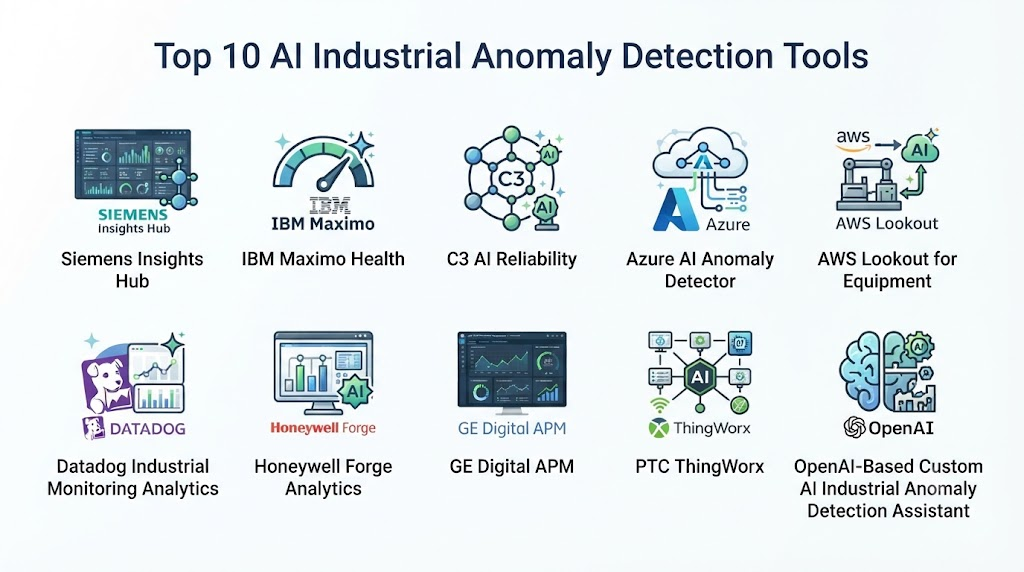
Top 10 AI Industrial Anomaly Detection Tools
1. Siemens Insights Hub
Verdict: Best overall industrial AI anomaly detection platform.
Short Description: Siemens Insights Hub combines industrial IoT, analytics, and AI technologies to monitor equipment behavior and detect operational anomalies.
Key Features
- Industrial IoT analytics
- Machine monitoring
- AI anomaly detection
- Asset intelligence
- Real-time insights
Pros
- Strong industrial ecosystem
- Supports large-scale operations
- Advanced analytics capabilities
Cons
- Requires industrial integration expertise
Deployment: Industrial and enterprise environments
Security & Compliance: Industrial security controls
Integrations & Ecosystem: IoT devices, automation systems, MES platforms
Support & Community: Enterprise support
Pricing Model: Custom enterprise pricing
Best-Fit Scenarios: Smart manufacturing operations
2. IBM Maximo Health
Verdict: Enterprise asset anomaly detection solution.
Short Description: IBM Maximo Health uses AI analytics to monitor asset conditions, identify risks, and improve equipment reliability.
Key Features
- Asset health monitoring
- AI risk prediction
- Condition analytics
- Maintenance insights
- Asset performance tracking
Pros
- Strong enterprise asset management
- Advanced analytics
Cons
- Requires implementation planning
3. C3 AI Reliability
Verdict: AI-powered reliability and anomaly detection platform.
Short Description: C3 AI Reliability applies machine learning models to identify equipment abnormalities and predict operational issues.
Key Features
- Machine learning analytics
- Asset monitoring
- Failure prediction
- Pattern recognition
- Data integration
Pros
- Advanced AI capabilities
- Enterprise scalability
Cons
- Requires strong data pipelines
4. Azure AI Anomaly Detector
Verdict: Cloud AI service for anomaly detection.
Short Description: Azure AI Anomaly Detection capabilities help organizations identify unusual patterns in time-series data from industrial systems.
Key Features
- Time-series analysis
- Machine learning models
- Real-time detection
- Cloud integration
- API-based deployment
Pros
- Flexible cloud platform
- Developer-friendly
Cons
- Requires customization
5. AWS Lookout for Equipment
Verdict: Cloud-based industrial equipment monitoring solution.
Short Description: AWS Lookout for Equipment uses machine learning to detect abnormal equipment behavior and improve maintenance decisions.
Key Features
- Equipment monitoring
- Sensor analytics
- ML anomaly detection
- Predictive insights
- Cloud deployment
Pros
- Scalable infrastructure
- Supports industrial IoT data
Cons
- Requires cloud expertise
6. Datadog Industrial Monitoring Analytics
Verdict: Observability platform supporting industrial monitoring workflows.
Short Description: Datadog provides analytics, monitoring, and anomaly detection capabilities for connected systems and operational environments.
Key Features
- Real-time monitoring
- Automated alerts
- Analytics dashboards
- Machine data visualization
- Integration support
Pros
- Strong monitoring ecosystem
- Fast deployment
Cons
- More general monitoring focus
7. Honeywell Forge Analytics
Verdict: Industrial analytics platform for operational anomaly detection.
Short Description: Honeywell Forge uses industrial data analytics and AI capabilities to identify abnormal operating conditions and improve asset performance.
Key Features
- Process monitoring
- AI analytics
- Equipment insights
- Operational intelligence
- Industrial integration
Pros
- Strong industrial expertise
- Enterprise reliability
Cons
- Best suited for industrial environments
8. GE Digital APM
Verdict: Industrial asset performance platform.
Short Description: GE Digital Asset Performance Management uses analytics and AI techniques to detect asset abnormalities and improve reliability.
Key Features
- Asset monitoring
- Risk analysis
- Predictive analytics
- Reliability management
- Industrial data integration
Pros
- Strong industrial asset expertise
- Supports complex equipment
Cons
- Enterprise deployment required
9. PTC ThingWorx
Verdict: Industrial IoT platform with anomaly detection capabilities.
Short Description: ThingWorx connects industrial assets with analytics tools to monitor performance and detect abnormal operating patterns.
Key Features
- IoT connectivity
- Asset monitoring
- Analytics
- Digital twins
- Workflow automation
Pros
- Flexible IoT ecosystem
- Strong integration capabilities
Cons
- Requires IoT implementation skills
10. OpenAI-Based Custom AI Industrial Anomaly Detection Assistant
Verdict: Flexible AI assistant for customized industrial monitoring workflows.
Short Description: Organizations can build custom AI anomaly detection assistants using large language models integrated with IoT platforms, sensor databases, SCADA systems, MES platforms, and operational analytics tools. These assistants can analyze equipment reports, summarize anomalies, identify trends, and support operational decisions while requiring engineering validation.
Key Features
- Operational data analysis
- Anomaly summaries
- Equipment insights
- Alert interpretation
- Knowledge assistance
Pros
- Highly customizable
- Flexible integrations
- Improves operational visibility
Cons
- Requires industrial expertise
- Validation required
Comparison Table
| Platform | AI Detection | Real-Time Monitoring | Industrial Integration | Analytics | Best Use |
|---|---|---|---|---|---|
| Siemens Insights Hub | Excellent | Excellent | Excellent | Excellent | Smart Manufacturing |
| IBM Maximo Health | Excellent | High | Excellent | Excellent | Asset Monitoring |
| C3 AI Reliability | Excellent | High | High | Excellent | Reliability Analytics |
| Azure AI Anomaly Detector | High | Excellent | Medium | High | Cloud Analytics |
| AWS Lookout for Equipment | High | Excellent | High | High | Equipment Monitoring |
| Datadog Analytics | High | Excellent | High | High | Operational Monitoring |
| Honeywell Forge | High | Excellent | Excellent | High | Industrial Operations |
| GE Digital APM | Excellent | High | Excellent | Excellent | Asset Performance |
| ThingWorx | High | High | Excellent | High | Industrial IoT |
| OpenAI Custom | Custom | Custom | Custom | Custom | AI Monitoring Assistant |
Evaluation & Scoring Table
| Platform | AI Capability 20% | Detection Accuracy 20% | Monitoring 15% | Integration 15% | Security 10% | Ease 10% | Value 10% | Total |
|---|---|---|---|---|---|---|---|---|
| Siemens Insights Hub | 20 | 20 | 15 | 15 | 10 | 8 | 8 | 96 |
| IBM Maximo Health | 19 | 20 | 15 | 15 | 10 | 8 | 8 | 95 |
| GE Digital APM | 19 | 19 | 15 | 15 | 10 | 8 | 8 | 94 |
| C3 AI Reliability | 20 | 18 | 14 | 14 | 10 | 8 | 8 | 92 |
| Honeywell Forge | 18 | 19 | 15 | 15 | 10 | 8 | 8 | 93 |
| AWS Lookout for Equipment | 18 | 18 | 14 | 14 | 10 | 9 | 8 | 91 |
| Azure AI Anomaly Detector | 18 | 17 | 14 | 13 | 10 | 9 | 8 | 89 |
| ThingWorx | 17 | 18 | 14 | 15 | 10 | 8 | 8 | 90 |
| Datadog Analytics | 17 | 17 | 14 | 14 | 10 | 9 | 8 | 89 |
| OpenAI Custom | 20 | 16 | 12 | 15 | 8 | 7 | 9 | 87 |
Which AI Industrial Anomaly Detection Tool Is Right for You?
| If your priority is… | Recommended Platform |
|---|---|
| Smart factory monitoring | Siemens Insights Hub |
| Asset health analytics | IBM Maximo Health |
| AI reliability monitoring | C3 AI Reliability |
| Cloud anomaly detection | Azure AI Anomaly Detector |
| Equipment monitoring | AWS Lookout for Equipment |
| Operational observability | Datadog Analytics |
| Industrial process analytics | Honeywell Forge |
| Asset performance management | GE Digital APM |
| Industrial IoT monitoring | PTC ThingWorx |
| Custom AI anomaly assistant | OpenAI-Based AI Assistant |
Implementation Playbook
First 30 Days
- Define anomaly detection goals
- Identify critical assets
- Collect sensor data
- Review monitoring requirements
Days 31–60
- Connect industrial systems
- Configure AI models
- Validate anomaly detection
- Train operations teams
Days 61–90
- Deploy monitoring workflows
- Optimize alerts
- Reduce operational risks
- Expand AI analytics
Common Mistakes
- Poor sensor data quality
- Too many false alerts
- Lack of operational context
- Weak system integration
- Ignoring cybersecurity
- Overreliance on AI alerts
- Poor model maintenance
- Lack of expert validation
Frequently Asked Questions
1. What are AI Industrial Anomaly Detection Tools?
They are AI-powered platforms that identify unusual patterns in industrial equipment and processes.
2. How does AI detect industrial anomalies?
AI analyzes operational data, sensor readings, and historical patterns to identify abnormal behavior.
3. Can AI prevent equipment failures?
AI helps detect early warning signs but does not eliminate all failures.
4. Who uses industrial anomaly detection platforms?
Manufacturing companies, energy providers, utilities, and industrial organizations.
5. What data do these tools analyze?
They analyze sensor data, machine information, production data, and operational records.
6. Can AI reduce downtime?
Yes. Early anomaly detection helps organizations address issues before failures occur.
7. Are AI alerts always accurate?
Accuracy depends on data quality, model performance, and operational validation.
8. Do these tools support IoT devices?
Many integrate with industrial sensors, IoT platforms, and automation systems.
9. How is industrial data protected?
Organizations should use secure networks, access controls, and cybersecurity practices.
10. What should buyers evaluate before adoption?
Consider AI accuracy, integrations, scalability, security, monitoring capabilities, and operational requirements.
Conclusion
AI Industrial Anomaly Detection Tools are transforming industrial operations by enabling faster identification of equipment issues, process deviations, and operational risks. By combining artificial intelligence, machine learning, IoT analytics, and real-time monitoring, these platforms help organizations improve reliability, reduce downtime, and optimize performance.Organizations adopting AI anomaly detection solutions should focus on data quality, system integration, cybersecurity, and operational validation. Platforms such as Siemens Insights Hub, IBM Maximo Health, C3 AI Reliability, Honeywell Forge, and GE Digital APM demonstrate how artificial intelligence is improving industrial intelligence and supporting smarter operational environments.
