Introduction
As AI adoption accelerates across enterprises, startups, and cloud-native organizations, serving machine learning and generative AI models efficiently has become a major operational challenge. Large Language Models, multimodal AI systems, computer vision workloads, and AI agents often experience unpredictable traffic spikes that can overwhelm static infrastructure. Overprovisioning resources leads to excessive cloud costs, while underprovisioning causes latency issues, poor user experiences, and failed requests.
Autoscaling Inference Orchestrators help organizations automatically manage model serving infrastructure by dynamically scaling compute resources based on workload demand. These platforms optimize GPU utilization, reduce inference costs, improve availability, and ensure consistent performance across AI applications. Modern orchestrators support Kubernetes environments, serverless AI deployments, multi-model serving, distributed inference, and advanced scheduling capabilities.
Real-world use cases include:
- Scaling customer-facing AI chatbots during peak traffic
- Managing GPU clusters for enterprise AI applications
- Supporting AI agents with variable workload demands
- Optimizing inference costs across cloud providers
- Serving multiple models from shared infrastructure
- Running multimodal AI systems at production scale
Evaluation Criteria for Buyers
When evaluating Autoscaling Inference Orchestrators, consider:
- Autoscaling intelligence
- GPU scheduling capabilities
- Kubernetes integration
- Multi-model serving support
- Latency optimization
- Cost efficiency
- Multi-cloud deployment options
- Observability and monitoring
- Security controls
- Operational complexity
Best for: AI platform teams, MLOps engineers, infrastructure teams, SaaS providers, cloud-native organizations, and enterprises deploying production AI systems.
Not ideal for: Small AI projects, experimental prototypes, or organizations with limited inference workloads.
What’s Changed in Autoscaling Inference Orchestrators
- GPU-aware autoscaling has become increasingly important.
- AI agents are driving demand for dynamic workload management.
- Serverless inference adoption continues to grow.
- Multi-model deployments are becoming standard.
- Kubernetes remains the dominant orchestration platform.
- Cost optimization is now a primary buying criterion.
- Demand for hybrid and multi-cloud support is increasing.
- Model routing and intelligent scheduling are becoming more sophisticated.
- Inference orchestration increasingly includes observability and governance.
- Enterprises are seeking unified platforms for training and inference workloads.
Quick Buyer Checklist
- Does the orchestrator support GPU autoscaling?
- Can it scale to zero when idle?
- Does it integrate with Kubernetes?
- Is multi-model serving supported?
- Can it optimize infrastructure costs?
- Does it provide observability and monitoring?
- Are hybrid and multi-cloud deployments supported?
- Can it handle AI agents and RAG workloads?
- Are security and access controls available?
- Does it support both open-source and proprietary models?
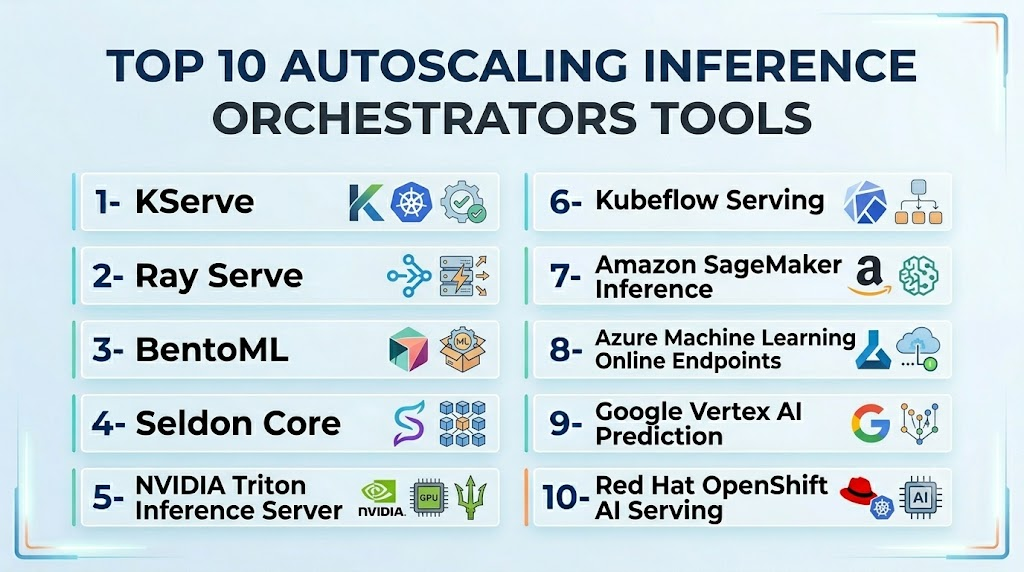
Top 10 Autoscaling Inference Orchestrators Tools
1- KServe
One-line verdict: Best overall open-source platform for Kubernetes-native autoscaling inference.
Short description:
KServe is one of the most widely adopted Kubernetes-based model serving platforms. It enables scalable, serverless inference while supporting advanced autoscaling, multi-model serving, and production-grade AI deployments.
Standout Capabilities
- Kubernetes-native architecture
- Serverless inference
- Scale-to-zero support
- Multi-model serving
- GPU autoscaling
- Canary deployments
- Advanced traffic management
AI-Specific Depth
- Model support: Open-source, proprietary, and custom models
- RAG / knowledge integration: Supported through infrastructure integrations
- Evaluation: External integrations required
- Guardrails: Not primary focus
- Observability: Strong Kubernetes ecosystem support
Pros
- Strong open-source ecosystem
- Excellent Kubernetes integration
- Production-proven architecture
Cons
- Requires Kubernetes expertise
- Operational complexity
- Initial setup effort
Security & Compliance
RBAC, Kubernetes security controls, network policies, and encryption options.
Deployment & Platforms
- Linux
- Kubernetes
- Cloud
- Hybrid
- On-premises
Integrations & Ecosystem
Supports Kubeflow, Istio, Knative, Prometheus, Grafana, OpenTelemetry, and cloud providers.
Pricing Model
Open-source.
Best-Fit Scenarios
- Enterprise Kubernetes environments
- Large-scale AI serving
- Multi-model deployments
2- Ray Serve
One-line verdict: Best for distributed AI applications and large-scale LLM deployments.
Short description:
Ray Serve provides scalable model serving capabilities built on the Ray distributed computing framework. It is widely used for LLM serving, AI agents, and distributed AI workloads.
Standout Capabilities
- Distributed inference
- Dynamic autoscaling
- LLM serving
- Multi-node deployments
- GPU scheduling
- Traffic routing
- AI agent support
AI-Specific Depth
- Model support: Multi-model and custom model support
- RAG / knowledge integration: Supported
- Evaluation: External tooling required
- Guardrails: External integrations
- Observability: Strong monitoring ecosystem
Pros
- Excellent scalability
- Strong distributed architecture
- Popular for generative AI workloads
Cons
- Learning curve
- Operational complexity
- Resource-intensive environments
Security & Compliance
Enterprise security depends on deployment configuration.
Deployment & Platforms
- Linux
- Kubernetes
- Cloud
- Hybrid
Integrations & Ecosystem
Ray ecosystem, Kubernetes, cloud providers, monitoring platforms.
Pricing Model
Open-source with enterprise offerings.
Best-Fit Scenarios
- LLM serving
- AI agent platforms
- Distributed AI applications
3- BentoML
One-line verdict: Best for developer-friendly AI model deployment and autoscaling.
Short description:
BentoML simplifies packaging, deployment, and autoscaling of machine learning models while supporting modern AI workloads and cloud-native deployments.
Standout Capabilities
- Model packaging
- Autoscaling support
- API generation
- Multi-framework compatibility
- Kubernetes deployment
- Monitoring integrations
AI-Specific Depth
- Model support: Extensive model support
- RAG / knowledge integration: Supported
- Evaluation: External tooling
- Guardrails: Limited native support
- Observability: Strong integrations
Pros
- Easy deployment workflow
- Strong developer experience
- Broad framework compatibility
Cons
- Enterprise features vary
- Requires infrastructure planning
- Advanced scaling needs expertise
Pricing Model
Open-source with enterprise options.
Best-Fit Scenarios
- AI startups
- Developer teams
- Production model deployment
4- Seldon Core
One-line verdict: Best for enterprise MLOps and advanced inference orchestration.
Short description:
Seldon Core is a Kubernetes-native serving platform that supports model deployment, scaling, monitoring, and governance for production AI systems.
Standout Capabilities
- Kubernetes-native serving
- Advanced autoscaling
- A/B testing
- Canary deployments
- Explainability integrations
- Enterprise monitoring
Pros
- Enterprise-ready
- Strong MLOps ecosystem
- Advanced deployment controls
Cons
- Complexity
- Kubernetes expertise required
- Enterprise configuration overhead
Best-Fit Scenarios
- Enterprise AI platforms
- Regulated environments
- Advanced deployment workflows
5- NVIDIA Triton Inference Server
One-line verdict: Best for GPU-intensive AI inference workloads.
Short description:
NVIDIA Triton provides high-performance inference serving with advanced scheduling, batching, and GPU optimization capabilities.
Standout Capabilities
- Dynamic batching
- GPU optimization
- Multi-framework support
- High-throughput inference
- Model ensembles
- Performance optimization
Pros
- Exceptional GPU utilization
- High performance
- Enterprise adoption
Cons
- GPU-centric
- Operational complexity
- Infrastructure requirements
Best-Fit Scenarios
- Computer vision
- LLM inference
- GPU clusters
6- Kubeflow Serving
One-line verdict: Best for organizations already using Kubeflow.
Short description:
Kubeflow Serving provides scalable inference deployment capabilities integrated within the broader Kubeflow ecosystem.
Standout Capabilities
- Kubeflow integration
- Autoscaling
- Pipeline integration
- Kubernetes-native deployment
- Model lifecycle management
Pros
- Strong Kubeflow integration
- Open-source
- Scalable architecture
Cons
- Kubeflow complexity
- Operational overhead
- Learning curve
Best-Fit Scenarios
- Existing Kubeflow users
- Enterprise ML platforms
- End-to-end ML pipelines
7- Amazon SageMaker Inference
One-line verdict: Best for AWS-native AI deployments.
Short description:
Amazon SageMaker provides managed inference endpoints with autoscaling, monitoring, and infrastructure optimization.
Standout Capabilities
- Managed endpoints
- Automatic scaling
- AWS integration
- Serverless inference
- Monitoring tools
Pros
- Managed service
- Easy deployment
- Strong AWS ecosystem
Cons
- AWS dependency
- Pricing complexity
- Vendor lock-in considerations
Best-Fit Scenarios
- AWS customers
- Enterprise AI deployments
- Managed infrastructure
8- Azure Machine Learning Online Endpoints
One-line verdict: Best for Microsoft-centric AI infrastructure.
Short description:
Azure Machine Learning Online Endpoints provide scalable inference hosting with autoscaling, monitoring, and governance controls.
Standout Capabilities
- Managed endpoints
- Autoscaling
- Governance controls
- Azure integration
- Monitoring tools
Pros
- Enterprise governance
- Azure ecosystem integration
- Scalable architecture
Cons
- Azure dependency
- Platform complexity
- Licensing considerations
Best-Fit Scenarios
- Microsoft enterprises
- Regulated industries
- Managed AI deployments
9- Google Vertex AI Prediction
One-line verdict: Best for Google Cloud AI serving workloads.
Short description:
Vertex AI Prediction provides managed model serving with automatic scaling, monitoring, and infrastructure management.
Standout Capabilities
- Managed inference
- Autoscaling
- Monitoring
- GCP integration
- Multi-model support
Pros
- Cloud-native simplicity
- Strong scalability
- Managed operations
Cons
- GCP dependency
- Vendor lock-in considerations
- Pricing varies
Best-Fit Scenarios
- GCP environments
- Enterprise AI serving
- Managed inference
10- Red Hat OpenShift AI Serving
One-line verdict: Best for hybrid cloud and enterprise Kubernetes deployments.
Short description:
OpenShift AI Serving provides enterprise-grade inference orchestration integrated with Red Hat’s Kubernetes platform.
Standout Capabilities
- Enterprise Kubernetes
- Hybrid cloud deployment
- Security controls
- Governance features
- Autoscaling support
Pros
- Enterprise support
- Hybrid cloud flexibility
- Strong governance
Cons
- Licensing costs
- Operational complexity
- Platform dependency
Best-Fit Scenarios
- Hybrid cloud environments
- Enterprise infrastructure
- Regulated sectors
Comparison Table
| Tool Name | Best For | Deployment | Model Flexibility | Strength | Watch-Out | Public Rating |
|---|---|---|---|---|---|---|
| KServe | Kubernetes AI serving | Cloud/Hybrid | Open-source & proprietary | Serverless autoscaling | Kubernetes complexity | N/A |
| Ray Serve | Distributed AI | Cloud/Hybrid | Multi-model | Distributed scaling | Learning curve | N/A |
| BentoML | Developer deployment | Cloud/Hybrid | Broad support | Simplicity | Enterprise features vary | N/A |
| Seldon Core | Enterprise MLOps | Cloud/Hybrid | Multi-model | Governance | Complexity | N/A |
| Triton | GPU inference | Cloud/On-prem | Multi-framework | Performance | GPU focus | N/A |
| Kubeflow Serving | Kubeflow users | Cloud/Hybrid | Multi-model | Ecosystem integration | Kubeflow complexity | N/A |
| SageMaker | AWS deployments | Cloud | Multi-model | Managed infrastructure | AWS dependency | N/A |
| Azure ML | Azure deployments | Cloud | Multi-model | Governance | Azure dependency | N/A |
| Vertex AI | GCP deployments | Cloud | Multi-model | Simplicity | GCP dependency | N/A |
| OpenShift AI | Hybrid enterprise | Hybrid | Multi-model | Enterprise support | Licensing | N/A |
Scoring & Evaluation
This scoring is comparative rather than absolute. Scores reflect autoscaling intelligence, infrastructure efficiency, deployment flexibility, observability, enterprise readiness, and operational capabilities.
| Tool | Core | Reliability/Eval | Guardrails | Integrations | Ease | Perf/Cost | Security/Admin | Support | Weighted Total |
|---|---|---|---|---|---|---|---|---|---|
| KServe | 10 | 8 | 7 | 9 | 7 | 10 | 8 | 8 | 8.8 |
| Ray Serve | 9 | 8 | 6 | 9 | 7 | 10 | 8 | 8 | 8.5 |
| BentoML | 8 | 7 | 6 | 8 | 9 | 8 | 7 | 8 | 7.9 |
| Seldon Core | 9 | 8 | 8 | 9 | 6 | 9 | 9 | 8 | 8.5 |
| Triton | 9 | 8 | 6 | 8 | 7 | 10 | 8 | 8 | 8.4 |
| Kubeflow Serving | 8 | 7 | 6 | 9 | 6 | 8 | 8 | 7 | 7.7 |
| SageMaker | 8 | 8 | 8 | 8 | 9 | 8 | 9 | 9 | 8.3 |
| Azure ML | 8 | 8 | 9 | 8 | 8 | 8 | 9 | 8 | 8.3 |
| Vertex AI | 8 | 8 | 8 | 8 | 9 | 8 | 8 | 8 | 8.1 |
| OpenShift AI | 8 | 8 | 9 | 8 | 7 | 8 | 9 | 9 | 8.2 |
Which Autoscaling Inference Orchestrator Is Right for You?
Solo / Freelancer
BentoML offers the easiest path to deploying and scaling AI models without managing complex infrastructure.
SMB
SageMaker, Vertex AI, and BentoML provide strong managed-service experiences while reducing operational burden.
Mid-Market
Ray Serve, KServe, and Triton offer scalability and flexibility for growing AI workloads.
Enterprise
KServe, Seldon Core, OpenShift AI, Azure ML, and SageMaker provide governance, scalability, and operational controls.
Regulated Industries
Focus on platforms with governance, RBAC, auditing, security controls, and compliance support.
Budget vs Premium
- Budget: BentoML, KServe, Ray Serve
- Premium: OpenShift AI, Azure ML, SageMaker
Build vs Buy
Use managed cloud platforms if operational simplicity is the priority. Choose open-source orchestrators when customization and infrastructure control are more important.
Common Mistakes & How to Avoid Them
- Overprovisioning GPU resources
- Ignoring scale-to-zero capabilities
- Poor autoscaling configurations
- Insufficient observability
- Failing to benchmark performance
- Lack of cost monitoring
- Ignoring multi-cloud requirements
- Poor capacity planning
- Missing governance controls
- Vendor lock-in without evaluation
- Inadequate security controls
- Overcomplicated deployment architectures
FAQs
1. What is an Autoscaling Inference Orchestrator?
It is a platform that automatically manages and scales AI inference infrastructure based on workload demand.
2. Why are these tools important?
They help organizations reduce costs, improve performance, and maintain reliable AI services.
3. Do they support Large Language Models?
Yes. Most modern orchestrators support LLMs, multimodal models, and AI agents.
4. What is scale-to-zero?
Scale-to-zero automatically shuts down idle resources and restarts them when traffic returns.
5. Do I need Kubernetes?
Many leading orchestrators are Kubernetes-based, though managed cloud services abstract much of the complexity.
6. Can they reduce cloud costs?
Yes. Autoscaling helps eliminate unnecessary resource consumption and improves utilization.
7. Are open-source options available?
Yes. KServe, Ray Serve, BentoML, Kubeflow Serving, and Seldon Core are popular open-source solutions.
8. Which tool is best for enterprises?
KServe, Seldon Core, OpenShift AI, SageMaker, and Azure ML are strong enterprise choices.
9. Which platform is easiest to use?
Managed cloud services such as SageMaker, Vertex AI, and Azure ML generally require less operational effort.
10. Can they support AI agents?
Yes. Modern orchestrators increasingly support agentic AI workloads and distributed inference.
11. What role does GPU autoscaling play?
GPU autoscaling dynamically adjusts GPU resources based on demand, improving efficiency and reducing costs.
12. When should organizations adopt an inference orchestrator?
Organizations should consider them when AI applications reach production scale and require reliable, cost-efficient infrastructure.
Conclusion
Autoscaling Inference Orchestrators have become foundational components of modern AI infrastructure. As organizations deploy increasingly complex AI systems, including LLMs, AI agents, multimodal applications, and enterprise copilots, the ability to dynamically scale inference workloads is critical for balancing performance, reliability, and cost.
The best solution depends on your infrastructure strategy, operational expertise, and deployment requirements. Open-source platforms such as KServe, Ray Serve, and BentoML offer flexibility and customization, while managed services like SageMaker, Azure ML, and Vertex AI provide operational simplicity. Enterprises requiring governance, hybrid cloud support, and advanced controls may find Seldon Core or OpenShift AI particularly compelling.
