Introduction
BNPL platforms, or Buy Now Pay Later platforms, help shoppers split purchases into smaller installments instead of paying the full amount upfront. For merchants, these tools are more than payment buttons. They can support conversion, average order value, customer acquisition, checkout flexibility, and repeat purchases across online and in-store channels.
BNPL matters now because consumers expect flexible payment options, while regulators and merchants are paying closer attention to affordability, transparency, repayment terms, fraud prevention, and responsible lending. Modern BNPL platforms are also becoming more integrated with e-commerce, mobile wallets, open banking, identity verification, risk scoring, and merchant analytics.
Real-world use cases include:
- Fashion, beauty, and lifestyle brands offering installment checkout
- Electronics and furniture retailers supporting higher-ticket purchases
- Travel and hospitality businesses helping customers spread booking costs
- Marketplaces improving checkout flexibility for multiple product categories
- Omnichannel retailers offering BNPL both online and in-store
Evaluation Criteria for Buyers:
- Checkout conversion impact
- Merchant fees and settlement model
- Consumer repayment flexibility
- Fraud and risk controls
- Geographic coverage
- E-commerce and POS integrations
- Compliance and responsible lending posture
- Reporting and merchant analytics
- Customer support and dispute handling
- Brand fit and shopper trust
Best for: BNPL platforms are best for e-commerce teams, retail brands, marketplaces, fintech-led merchants, travel companies, and consumer product businesses that want to offer flexible payment options without building credit infrastructure themselves. They are especially useful for SMBs, mid-market retailers, and enterprise brands that want to improve conversion, reduce checkout friction, and support higher-value purchases.
Not ideal for: BNPL may not be ideal for businesses with very low-ticket purchases, highly regulated products, subscription-only models, or customers who prefer traditional card, UPI, wallet, bank transfer, or invoice-based payments. It may also be less suitable when a merchant cannot absorb BNPL fees or when credit-risk exposure, refund complexity, or regulatory compliance requirements outweigh the commercial benefit.
Key Trends in BNPL Platforms
- Responsible lending is becoming central: BNPL providers are placing more focus on affordability checks, repayment transparency, soft credit checks, spending limits, and customer protection.
- Regulation is becoming more detailed: Markets are moving toward clearer disclosure rules, licensing expectations, complaint handling, and stronger oversight of short-term consumer credit.
- BNPL is becoming more embedded: Instead of appearing only as a checkout option, BNPL is increasingly integrated into wallets, super apps, marketplaces, banking apps, and retailer loyalty programs.
- AI-driven risk scoring is improving decisions: Providers are using smarter fraud detection, behavioral signals, repayment history, and transaction context to approve or decline purchases in real time.
- Omnichannel BNPL is expanding: Retailers want the same installment experience across websites, mobile apps, physical stores, QR codes, and POS terminals.
- Merchant analytics are becoming more important: Brands want data on approval rates, basket size, repeat customers, refunds, disputes, and channel performance.
- Regional BNPL specialists are gaining strength: Local providers are growing in markets where language, payment habits, regulation, and consumer behavior differ from global platforms.
- Premium merchants want brand-safe experiences: Luxury, travel, and high-value retail brands are focusing on BNPL experiences that feel controlled, transparent, and aligned with brand trust.
- Open banking and bank-account data are influencing approvals: Some platforms are exploring stronger affordability checks and lower-risk decisioning using verified financial data.
- Pricing pressure is increasing: Merchants are comparing BNPL fees against cards, wallets, bank payments, and alternative financing options before committing.
How We Selected These Tools Methodology
- Selected platforms with strong market recognition in BNPL, installment payments, or merchant checkout financing.
- Considered global and regional relevance to include both large international providers and strong local-market specialists.
- Prioritized tools that support merchant use cases, not only consumer-facing apps.
- Reviewed feature completeness across checkout, repayment options, risk controls, merchant dashboards, and settlement workflows.
- Considered ecosystem strength, including e-commerce plugins, APIs, POS support, wallets, and marketplace integrations.
- Evaluated practical fit across SMB, mid-market, enterprise, and regional retail environments.
- Considered compliance posture signals such as transparency, customer verification, repayment disclosure, and dispute-handling maturity.
- Avoided invented ratings, certifications, or unsupported security claims.
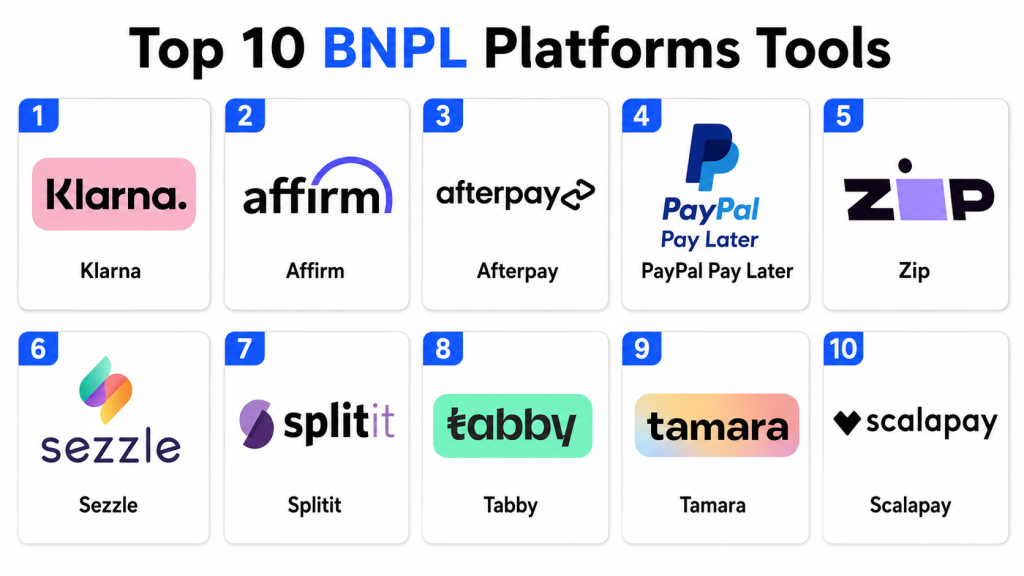
Top 10 BNPL Platforms Tools
1- Klarna
Short description: Klarna is one of the most widely recognized BNPL and shopping payment platforms, serving merchants that want flexible checkout, installment options, and consumer-facing shopping experiences. It supports use cases across fashion, beauty, electronics, home goods, lifestyle, and marketplace commerce. Klarna is especially strong for brands that want BNPL combined with shopper discovery, app-based engagement, and global payment reach. It is suited for SMBs, mid-market retailers, and enterprise merchants that need a known BNPL brand at checkout. Its value comes from combining payment flexibility, merchant tools, consumer recognition, and broad e-commerce ecosystem support. Buyers should still evaluate fees, approval rates, refund handling, and regional availability before adopting it.
Key Features
- Pay later and installment payment options
- Merchant checkout integrations
- Consumer shopping app ecosystem
- Online and in-store payment support in selected markets
- Merchant reporting and performance insights
- Risk assessment and fraud controls
- Brand-recognized checkout experience
Pros
- Strong global brand recognition among online shoppers
- Broad merchant ecosystem and e-commerce compatibility
- Useful for brands that want checkout plus shopping discovery
Cons
- Merchant fees may be higher than traditional payment methods
- Feature availability can vary by country and merchant category
- Some businesses may need careful compliance and refund workflow planning
Platforms / Deployment
Web / iOS / Android
Cloud
Security & Compliance
Klarna commonly provides account security, payment controls, and merchant risk processes. Specific certifications, controls, and compliance coverage can vary by region and contract.
SOC 2: Not publicly stated
ISO 27001: Not publicly stated
GDPR: Relevant in applicable regions
MFA: Varies / N/A
Audit logs and RBAC: Varies / N/A
Integrations & Ecosystem
Klarna integrates with major commerce environments and payment workflows, making it easier for merchants to add BNPL to checkout without building financing logic internally.
- E-commerce platform plugins
- Payment service provider integrations
- Merchant APIs
- In-store and POS support in selected markets
- Marketplace and retail partner ecosystem
- Consumer app and shopping discovery channels
Support & Community
Klarna provides merchant onboarding, documentation, and support resources. Support depth can vary depending on merchant size, geography, and commercial agreement. Large merchants may receive stronger account support, while smaller merchants may rely more on self-service resources and standard support channels.
2- Affirm
Short description: Affirm is a major BNPL and point-of-sale financing platform known for transparent installment options, especially in markets where consumers want clear payment terms. It is commonly associated with larger purchases, retail financing, travel, electronics, furniture, fitness, and lifestyle commerce. Affirm works well for merchants that want flexible financing beyond basic pay-in-four models. It is a strong fit for mid-market and enterprise merchants that need structured installment plans, shopper trust, and payment messaging across the buying journey. Its appeal is strongest where merchants want to improve affordability for higher-ticket purchases. Buyers should compare approval rates, supported regions, fee structures, and customer experience before choosing it.
Key Features
- Installment financing at checkout
- Pay-over-time options for different purchase sizes
- Merchant dashboard and reporting
- Payment messaging across product and checkout pages
- Risk and underwriting workflows
- E-commerce and platform integrations
- Consumer-facing repayment management
Pros
- Strong fit for higher-ticket purchases
- Clear payment-term positioning can support consumer trust
- Useful for merchants that need more than simple short-term installments
Cons
- Availability may vary by region and merchant category
- Merchant pricing should be reviewed carefully
- Not always the simplest option for very small-ticket purchases
Platforms / Deployment
Web / iOS / Android
Cloud
Security & Compliance
Affirm operates in a regulated consumer finance environment and uses security and risk controls appropriate for payment and lending workflows. Specific certifications and controls should be verified during vendor review.
SOC 2: Not publicly stated
ISO 27001: Not publicly stated
GDPR: Varies / N/A
MFA: Varies / N/A
Audit logs and RBAC: Varies / N/A
Integrations & Ecosystem
Affirm works with commerce platforms, payment processors, and merchant checkout experiences to support installment financing and promotional payment messaging.
- E-commerce platform integrations
- Payment gateway partnerships
- Merchant APIs
- Product page and checkout messaging
- Retail and travel merchant ecosystem
- Analytics and reporting workflows
Support & Community
Affirm offers merchant resources, integration documentation, and onboarding support. Enterprise merchants may receive more hands-on implementation and account management, while smaller businesses should evaluate available self-service documentation and support response expectations.
3- Afterpay
Short description: Afterpay is a widely known BNPL platform, especially popular in retail categories such as fashion, beauty, accessories, lifestyle, and consumer products. It focuses on simple installment payment experiences that help shoppers split purchases while allowing merchants to offer flexible checkout. Afterpay is particularly useful for brands with younger, mobile-first, and e-commerce-heavy customer bases. It is often used by retailers that want an easy-to-understand pay-in-installments option without making checkout feel complex. Its strength is shopper familiarity, merchant adoption, and retail-focused positioning. Businesses should assess geography, settlement terms, returns, disputes, and customer support workflows before implementation.
Key Features
- Installment payment options
- Retail-focused checkout experience
- Merchant dashboard and performance insights
- Online and in-store payment support in selected markets
- Consumer app discovery ecosystem
- E-commerce integrations
- Risk assessment and repayment controls
Pros
- Strong fit for fashion, beauty, and lifestyle retail
- Simple shopper experience
- Good brand recognition in BNPL-heavy markets
Cons
- Not ideal for every high-ticket financing scenario
- Country availability and features may vary
- Merchant fees and dispute workflows need careful review
Platforms / Deployment
Web / iOS / Android
Cloud
Security & Compliance
Afterpay uses payment, account, and risk controls as part of its BNPL operations. Specific certifications and enterprise security controls should be verified directly during procurement.
SOC 2: Not publicly stated
ISO 27001: Not publicly stated
GDPR: Varies / N/A
MFA: Varies / N/A
Audit logs and RBAC: Varies / N/A
Integrations & Ecosystem
Afterpay supports merchant checkout integrations and retail partner ecosystems, helping brands add installment payments without designing their own financing model.
- E-commerce plugins
- Payment and checkout integrations
- In-store support in selected regions
- Merchant analytics
- Consumer shopping app
- Retail marketing opportunities
Support & Community
Afterpay provides merchant support resources, onboarding guidance, and integration documentation. Support quality may depend on merchant size, region, and implementation complexity. Retailers should clarify support SLAs, refund processes, and escalation channels before launch.
4- PayPal Pay Later
Short description: PayPal Pay Later brings BNPL-style payment flexibility into the PayPal ecosystem, making it attractive for merchants that already accept PayPal or want to offer installment options through a familiar payment brand. It is useful for businesses that want flexible checkout without adding too many separate providers. PayPal’s broad consumer reach and payment infrastructure can make adoption easier for merchants already using PayPal checkout. It is suitable for SMBs, digital sellers, marketplaces, and retailers that want payment flexibility inside an established wallet and payment network. Its biggest strength is trust and familiarity. Buyers should check regional availability, product terms, and whether PayPal’s Pay Later options match their target customers and order values.
Key Features
- Pay later options within PayPal checkout
- Familiar consumer wallet experience
- Merchant payment integration through PayPal
- Checkout financing messaging where available
- Mobile and web payment flows
- Fraud and payment protection processes
- Broad digital commerce ecosystem
Pros
- Strong consumer trust and brand familiarity
- Easy fit for merchants already using PayPal
- Reduces need for separate BNPL vendor complexity
Cons
- BNPL options vary by country
- Less specialized than some dedicated BNPL platforms
- Merchant control over financing experience may be limited
Platforms / Deployment
Web / iOS / Android
Cloud
Security & Compliance
PayPal provides mature payment security capabilities, account protection, encryption, fraud monitoring, and authentication features. Specific merchant controls and compliance details depend on product, region, and account setup.
SOC 2: Not publicly stated
ISO 27001: Not publicly stated
GDPR: Relevant in applicable regions
MFA: Available for user accounts
Audit logs and RBAC: Varies / N/A
Integrations & Ecosystem
PayPal Pay Later benefits from PayPal’s broader payments ecosystem, making it especially useful for merchants already using PayPal checkout or payment processing.
- PayPal checkout
- E-commerce platform integrations
- Payment APIs
- Wallet-based payment flows
- Marketplace payment support
- Merchant reporting tools
Support & Community
PayPal provides broad documentation, merchant help resources, and support channels. Because PayPal serves many business types, support experience may vary. Merchants with complex financing, refund, or dispute needs should review support options before relying on it as their primary BNPL solution.
5- Zip
Short description: Zip is a BNPL provider offering installment payment options for merchants and consumers across selected markets. It is often used by retailers that want flexible payments across online and in-store channels. Zip can be a strong option for brands looking for a recognizable BNPL solution with support for everyday retail categories. It is suitable for SMBs and mid-market merchants that want a checkout option designed around installments and customer affordability. Zip’s value depends heavily on market fit, consumer adoption, and integration availability in the merchant’s region. Buyers should compare settlement speed, fees, approval rates, and shopper experience before selecting it.
Key Features
- Installment payment options
- Merchant checkout tools
- Online and in-store usage in selected markets
- Consumer app experience
- Merchant reporting
- Risk and repayment controls
- Retail-focused payment flows
Pros
- Good fit for retail and omnichannel merchants
- Recognizable BNPL brand in supported markets
- Supports flexible customer payment experiences
Cons
- Availability varies by region
- Not always the best fit for complex enterprise financing
- Merchant economics should be reviewed carefully
Platforms / Deployment
Web / iOS / Android
Cloud
Security & Compliance
Zip uses payment and account security controls as part of its BNPL service. Specific certifications, audit capabilities, and compliance claims should be confirmed during vendor evaluation.
SOC 2: Not publicly stated
ISO 27001: Not publicly stated
GDPR: Varies / N/A
MFA: Varies / N/A
Audit logs and RBAC: Varies / N/A
Integrations & Ecosystem
Zip supports merchant checkout integrations and retail payment workflows for brands that want installment options without building financing infrastructure.
- E-commerce integrations
- Payment gateway support in selected markets
- Merchant APIs
- In-store payment options where available
- Consumer app discovery
- Reporting and performance insights
Support & Community
Zip provides merchant onboarding and support resources. Availability and support depth can vary by country and account type. Merchants should confirm onboarding timelines, technical support access, and refund/dispute processes before launch.
6- Sezzle
Short description: Sezzle is a BNPL platform focused on flexible installment payments, commonly used by e-commerce merchants and retail brands. It is often attractive for smaller and mid-sized merchants that want a straightforward BNPL option with shopper-friendly repayment experiences. Sezzle can help reduce checkout friction for customers who prefer splitting purchases instead of paying upfront. It is particularly relevant for fashion, accessories, beauty, home, and lifestyle commerce. Its strength is simplicity, merchant accessibility, and retail fit. Businesses should review supported regions, fee models, integration options, and whether Sezzle’s customer base aligns with their target audience.
Key Features
- Installment checkout options
- Consumer repayment management
- Merchant dashboard
- E-commerce plugin support
- Risk and fraud controls
- Payment messaging tools
- Retail-focused BNPL experience
Pros
- Good fit for SMB and mid-market e-commerce brands
- Simple installment experience for shoppers
- Useful for lifestyle and retail categories
Cons
- Regional availability can be limited
- May not match all enterprise financing needs
- Support depth and advanced controls should be reviewed
Platforms / Deployment
Web / iOS / Android
Cloud
Security & Compliance
Sezzle uses payment security and customer account controls as part of its platform. Specific certifications and enterprise compliance details should be verified directly.
SOC 2: Not publicly stated
ISO 27001: Not publicly stated
GDPR: Varies / N/A
MFA: Varies / N/A
Audit logs and RBAC: Varies / N/A
Integrations & Ecosystem
Sezzle integrates with common e-commerce workflows and merchant checkout systems, making it accessible for online sellers that need a simple BNPL option.
- E-commerce plugins
- Merchant dashboard
- Checkout payment integrations
- APIs where available
- Product and checkout payment messaging
- Retail partner ecosystem
Support & Community
Sezzle provides merchant support resources and onboarding guidance. Smaller merchants may benefit from straightforward setup, but businesses with complex operational requirements should confirm technical support, escalation paths, and dispute workflows.
7- Splitit
Short description: Splitit is a BNPL-style installment platform that differs from many providers because it is often positioned around using existing credit card limits to split payments. This makes it useful for merchants that want installment flexibility without always introducing a separate consumer loan experience. It can be valuable for higher-ticket items, B2C retail, travel, healthcare-adjacent commerce where allowed, and premium purchases. Splitit may appeal to merchants that want a card-based installment model with a different risk and approval approach from traditional BNPL. It is best for businesses that already sell to card-holding customers and want to reduce upfront purchase friction. Buyers should carefully evaluate card network compatibility, customer eligibility, fees, and operational fit.
Key Features
- Card-based installment payment model
- Pay-over-time options using existing credit
- Merchant checkout integration
- Support for higher-value purchases
- API-based implementation options
- Merchant reporting
- Reduced need for separate consumer loan onboarding in some flows
Pros
- Useful for higher-ticket purchases
- Different model from standard BNPL providers
- Can work well for merchants with card-heavy customers
Cons
- Not ideal for customers without sufficient card limits
- May be less familiar to some shoppers
- Integration and eligibility details need careful review
Platforms / Deployment
Web
Cloud
Security & Compliance
Splitit operates in payment and installment workflows where security and compliance requirements are important. Specific certifications and controls should be verified with the vendor.
SOC 2: Not publicly stated
ISO 27001: Not publicly stated
GDPR: Varies / N/A
MFA: Varies / N/A
Audit logs and RBAC: Varies / N/A
Integrations & Ecosystem
Splitit supports merchant checkout and payment integrations designed for card-based installments, making it relevant for businesses that want installment payments without a fully separate BNPL lending experience.
- Merchant APIs
- Payment processor integrations
- Checkout integrations
- Card network compatibility workflows
- Reporting tools
- Enterprise commerce support
Support & Community
Splitit provides merchant resources and implementation guidance. Businesses should confirm technical onboarding timelines, payment processor compatibility, support tiers, and handling of refunds, cancellations, and failed payments.
8- Tabby
Short description: Tabby is a BNPL platform with strong relevance in the Middle East and nearby markets, serving merchants that want installment payments tailored to regional consumer behavior. It is commonly used by fashion, beauty, electronics, lifestyle, and marketplace businesses. Tabby is useful for merchants operating in markets where local payment preferences, language, retail behavior, and regional trust matter. It supports both consumer flexibility and merchant growth through BNPL checkout options. Its biggest advantage is regional specialization and market familiarity. Buyers should evaluate country coverage, settlement currency, customer support language, compliance expectations, and integration compatibility.
Key Features
- Regional BNPL payment options
- Installment checkout for online merchants
- Consumer app and shopping ecosystem
- Merchant dashboard
- Retail and marketplace support
- Risk and repayment controls
- Localized payment experience
Pros
- Strong fit for Middle East-focused retailers
- Localized customer and merchant experience
- Useful for fashion, lifestyle, and marketplace commerce
Cons
- Not a universal global BNPL solution
- Features may vary by country
- Merchants outside supported regions may need alternatives
Platforms / Deployment
Web / iOS / Android
Cloud
Security & Compliance
Tabby uses payment and account security controls for BNPL operations. Specific compliance frameworks, certifications, and enterprise controls should be verified directly.
SOC 2: Not publicly stated
ISO 27001: Not publicly stated
GDPR: Varies / N/A
MFA: Varies / N/A
Audit logs and RBAC: Varies / N/A
Integrations & Ecosystem
Tabby integrates with merchant checkout systems and regional commerce workflows, helping retailers offer installment payments in supported markets.
- E-commerce integrations
- Merchant APIs
- Checkout payment options
- Consumer app discovery
- Regional retail partnerships
- Merchant reporting tools
Support & Community
Tabby provides merchant onboarding and support in its operating regions. Merchants should evaluate local account management, language support, dispute handling, and documentation depth based on their market and business size.
9- Tamara
Short description: Tamara is a BNPL and shopping payments platform focused on markets in the Middle East, especially for merchants that need regional payment flexibility and localized customer experiences. It supports retailers, marketplaces, and consumer brands that want installment and pay-later options at checkout. Tamara can be valuable for businesses selling fashion, beauty, electronics, home goods, and lifestyle products in supported markets. Its strength is regional relevance, consumer familiarity, and alignment with local commerce patterns. It is a strong option for merchants that prioritize Gulf-region growth. Buyers should review availability, merchant fees, settlement models, and support capabilities before selecting it.
Key Features
- Pay later and installment payment options
- Regional checkout experience
- Consumer-facing app and payment flows
- Merchant dashboard
- E-commerce and payment integrations
- Risk and repayment controls
- Retail and marketplace support
Pros
- Strong regional fit for Middle East commerce
- Useful for retailers targeting local shopper behavior
- Supports flexible checkout experiences
Cons
- Limited relevance outside supported regions
- Integration options may vary by platform
- Enterprise controls should be validated during procurement
Platforms / Deployment
Web / iOS / Android
Cloud
Security & Compliance
Tamara uses payment and account controls as part of BNPL operations. Specific certifications and compliance details are not always publicly stated and should be confirmed with the vendor.
SOC 2: Not publicly stated
ISO 27001: Not publicly stated
GDPR: Varies / N/A
MFA: Varies / N/A
Audit logs and RBAC: Varies / N/A
Integrations & Ecosystem
Tamara connects with merchant checkout and regional commerce platforms, helping businesses provide installment options for local customers.
- E-commerce integrations
- Merchant APIs
- Checkout payment support
- Regional retail ecosystem
- Consumer shopping experience
- Merchant analytics
Support & Community
Tamara provides onboarding and merchant support in its core markets. Businesses should confirm support response times, integration assistance, refund processes, and escalation channels based on contract level.
10- Scalapay
Short description: Scalapay is a BNPL platform with strong relevance for European retail, especially brands in fashion, beauty, lifestyle, travel, and consumer goods. It helps merchants offer installment payment options at checkout while giving shoppers a simpler way to spread purchases. Scalapay is a good option for European merchants that want a regionally focused BNPL provider with retail-oriented positioning. It is suited for SMBs, mid-market brands, and selected enterprise retailers that want checkout flexibility in supported markets. Its main value is localized BNPL fit and merchant-friendly checkout experiences. Buyers should validate country support, merchant fees, refund handling, and technical integration options.
Key Features
- Installment payment options
- Retail-focused checkout experience
- E-commerce integrations
- Merchant dashboard
- Consumer app and shopping experience
- Regional market support
- Risk and repayment controls
Pros
- Strong fit for European retail categories
- Useful for fashion, beauty, and lifestyle merchants
- Localized BNPL experience in supported markets
Cons
- Regional availability may be narrower than global providers
- Not ideal for all enterprise financing use cases
- Compliance and support details should be verified directly
Platforms / Deployment
Web / iOS / Android
Cloud
Security & Compliance
Scalapay uses payment and customer account controls as part of its service. Specific security certifications and enterprise compliance details should be confirmed during vendor review.
SOC 2: Not publicly stated
ISO 27001: Not publicly stated
GDPR: Relevant in applicable regions
MFA: Varies / N/A
Audit logs and RBAC: Varies / N/A
Integrations & Ecosystem
Scalapay integrates with commerce and checkout workflows to help merchants offer installment payments in supported European markets.
- E-commerce platform integrations
- Merchant APIs
- Checkout payment options
- Retail partner ecosystem
- Consumer app experience
- Merchant reporting
Support & Community
Scalapay provides merchant onboarding and support resources. Businesses should evaluate documentation quality, technical support availability, account management, and dispute-handling workflows before going live.
Comparison Table Top 10
| Tool Name | Best For | Platform(s) Supported | Deployment | Standout Feature | Public Rating |
|---|---|---|---|---|---|
| Klarna | Global retail and shopper discovery | Web, iOS, Android | Cloud | Strong consumer brand and shopping ecosystem | N/A |
| Affirm | Higher-ticket retail and financing | Web, iOS, Android | Cloud | Transparent installment financing | N/A |
| Afterpay | Fashion, beauty, lifestyle retail | Web, iOS, Android | Cloud | Simple retail-focused installment model | N/A |
| PayPal Pay Later | Merchants already using PayPal | Web, iOS, Android | Cloud | Pay later inside a trusted wallet ecosystem | N/A |
| Zip | Omnichannel retail in supported markets | Web, iOS, Android | Cloud | Flexible installment checkout | N/A |
| Sezzle | SMB and mid-market e-commerce | Web, iOS, Android | Cloud | Accessible BNPL for retail merchants | N/A |
| Splitit | Card-based installments and higher-value purchases | Web | Cloud | Installments using existing credit card limits | N/A |
| Tabby | Middle East retail and marketplaces | Web, iOS, Android | Cloud | Regional BNPL specialization | N/A |
| Tamara | Gulf-region e-commerce and retail | Web, iOS, Android | Cloud | Localized Middle East checkout experience | N/A |
| Scalapay | European fashion and lifestyle retail | Web, iOS, Android | Cloud | Regional European BNPL fit | N/A |
Evaluation & Scoring of BNPL Platforms
The scoring below is a comparative analyst model for buyer shortlisting. It does not represent public customer ratings, official rankings, or guaranteed performance. Scores should be interpreted based on business fit, geography, merchant category, risk appetite, and integration requirements.
| Tool Name | Core 25% | Ease 15% | Integrations 15% | Security 10% | Performance 10% | Support 10% | Value 15% | Weighted Total 0–10 |
| Klarna | 9 | 8 | 9 | 8 | 8 | 8 | 8 | 8.35 |
| Affirm | 9 | 8 | 8 | 8 | 8 | 8 | 8 | 8.25 |
| Afterpay | 8 | 9 | 8 | 8 | 8 | 8 | 8 | 8.15 |
| PayPal Pay Later | 8 | 9 | 9 | 8 | 9 | 8 | 8 | 8.45 |
| Zip | 8 | 8 | 8 | 7 | 8 | 7 | 8 | 7.80 |
| Sezzle | 8 | 8 | 7 | 7 | 7 | 7 | 8 | 7.55 |
| Splitit | 8 | 7 | 7 | 7 | 8 | 7 | 7 | 7.35 |
| Tabby | 8 | 8 | 7 | 7 | 8 | 8 | 8 | 7.75 |
| Tamara | 8 | 8 | 7 | 7 | 8 | 8 | 8 | 7.75 |
| Scalapay | 8 | 8 | 7 | 7 | 8 | 7 | 8 | 7.65 |
These scores help compare platforms at a high level, but they should not replace a pilot. A platform with a slightly lower score may still be the best choice if it has stronger regional adoption, lower merchant fees, better customer approval rates, or smoother checkout fit for your target audience. Buyers should validate settlement timing, refund workflows, customer support, compliance terms, and integration quality before making a final decision.
Which BNPL Platform Is Right for You?
Solo / Freelancer
Solo sellers and small creators should prioritize simplicity, fast setup, and low operational burden. If you already use PayPal, PayPal Pay Later may be the easiest path because it fits into an existing payment workflow. Sezzle can also be useful for small online stores that want a dedicated BNPL option without a complex enterprise rollout. The main goal should be easy checkout flexibility, not advanced financing complexity.
SMB
SMBs should look for platforms with simple onboarding, strong e-commerce plugins, clear merchant pricing, and easy refund handling. Afterpay, Sezzle, Zip, and Klarna can be practical depending on geography and customer fit. For SMBs selling fashion, beauty, lifestyle, or accessories, simple installment messaging can help improve conversion. The best choice depends on where your customers live and which BNPL brands they already trust.
Mid-Market
Mid-market merchants need a stronger balance of conversion impact, reporting, integration quality, settlement reliability, and customer support. Klarna, Affirm, Afterpay, PayPal Pay Later, and Zip are worth shortlisting for broader retail use cases. Businesses selling higher-ticket items should consider Affirm or Splitit, while regional merchants in the Middle East may evaluate Tabby and Tamara. Mid-market buyers should run controlled tests across approval rates, cart conversion, and post-purchase support.
Enterprise
Enterprise retailers should prioritize compliance readiness, risk controls, global or regional scale, account management, APIs, data reporting, and operational reliability. Klarna, Affirm, Afterpay, and PayPal Pay Later are often strong enterprise candidates, depending on the market. Enterprises with region-specific expansion plans may also need Tabby, Tamara, or Scalapay for local coverage. Large merchants should negotiate commercial terms, confirm SLA expectations, and test the platform across multiple channels.
Budget vs Premium
Budget-focused merchants should not choose BNPL only by the lowest fee. A cheaper option may deliver lower approval rates, weaker shopper trust, or limited support. Premium providers may charge more but can offer better brand recognition, stronger integrations, and improved checkout conversion. The right decision should compare total value, including conversion lift, average order value, repeat purchases, refund handling, and customer satisfaction.
Feature Depth vs Ease of Use
Some platforms are simple and retail-friendly, while others offer deeper financing options for higher-value purchases. Afterpay, Sezzle, and Zip can be easier for straightforward installment checkout. Affirm and Splitit may be stronger when merchants need more financing depth or higher-ticket purchase support. Klarna and PayPal Pay Later can provide broader ecosystem advantages. Choose feature depth only if your business truly needs it.
Integrations & Scalability
For e-commerce merchants, integration quality can decide success or failure. Look for plugins for your platform, clean APIs, checkout messaging tools, refund automation, and POS compatibility if you sell in-store. Enterprises should also review data exports, reporting, multi-region support, and operational workflows. A BNPL platform should scale with your checkout volume without creating manual work for finance, support, and operations teams.
Security & Compliance Needs
Security and compliance matter because BNPL touches payments, customer identity, repayment behavior, disputes, and consumer finance rules. Buyers should review encryption, access controls, fraud prevention, data processing terms, dispute handling, and compliance obligations in each operating region. If your business operates in multiple countries, confirm whether the provider can support local regulations, customer disclosures, complaints, and affordability expectations.
Frequently Asked Questions FAQs
1- What is a BNPL platform?
A BNPL platform lets shoppers buy products immediately and pay in smaller installments over time. For merchants, it works as a checkout payment option that can improve affordability and reduce purchase hesitation. Most platforms manage repayment workflows, risk checks, and customer payment collection.
2- How do BNPL platforms make money?
BNPL platforms commonly earn revenue from merchant fees, consumer fees in some cases, financing charges on certain products, or a mix of commercial models. The exact model varies by provider, country, repayment plan, and merchant contract. Businesses should always review fee structures carefully before implementation.
3- Is BNPL better than credit cards?
BNPL is not always better than credit cards; it depends on the customer and purchase type. BNPL can feel simpler for short-term installments, while credit cards may offer rewards, broader acceptance, or longer credit lines. Merchants should offer BNPL as an additional option rather than assuming it replaces cards.
4- Which BNPL platform is best for small businesses?
Small businesses should prioritize easy setup, simple pricing, e-commerce compatibility, and customer familiarity. PayPal Pay Later, Sezzle, Afterpay, Zip, and Klarna may be practical depending on geography. The best choice is the one your customers trust and your team can manage easily.
5- Which BNPL platform is best for enterprise retailers?
Enterprise retailers should shortlist providers based on scale, compliance, reporting, regional coverage, APIs, and account support. Klarna, Affirm, Afterpay, and PayPal Pay Later are common enterprise-level considerations. Regional expansion may also require platforms like Tabby, Tamara, or Scalapay.
6- Does BNPL increase sales?
BNPL can help improve conversion and average order value when customers want flexibility, especially for mid-ticket and high-ticket purchases. However, results depend on product category, customer profile, pricing, checkout placement, and approval rates. Merchants should test performance before making it a permanent strategy.
7- What are common mistakes when choosing a BNPL provider?
Common mistakes include focusing only on merchant fees, ignoring refund workflows, failing to check regional availability, and not testing customer approval rates. Some merchants also forget to train support teams on BNPL-related questions. A pilot helps reveal these issues before full rollout.
8- Are BNPL platforms safe?
BNPL platforms can be safe when they use strong payment security, fraud controls, customer authentication, and responsible lending practices. Merchants should still review vendor security documentation, data handling terms, and compliance obligations. Safety depends on both the provider and how the merchant implements it.
9- How long does BNPL implementation take?
Implementation can be quick for standard e-commerce plugins, but more complex for enterprise checkout, POS systems, custom apps, or multi-region operations. Setup time depends on technical resources, approval processes, testing needs, and contract review. Merchants should plan both technical and operational onboarding.
10- Can BNPL work for in-store retail?
Yes, many BNPL providers support in-store retail in selected markets through QR codes, POS integrations, wallet flows, or app-based payment experiences. Availability varies by provider and country. Retailers should confirm POS compatibility and staff training requirements before launch.
11- What alternatives exist to BNPL?
Alternatives include credit cards, debit cards, digital wallets, store credit, installment loans, bank transfers, UPI, invoice payments, and loyalty-based financing. For B2B businesses, invoice terms or trade credit may be more suitable. The best alternative depends on customer behavior and transaction value.
12- Should every e-commerce store offer BNPL?
Not every store needs BNPL. It works best when customers hesitate because of upfront cost, when order values are meaningful, or when competitors already offer flexible payments. Very low-ticket products, low-margin businesses, or highly regulated categories may not benefit enough to justify the cost.
Conclusion
BNPL platforms have become an important part of modern commerce, but the best choice depends on customer behavior, region, product category, order value, compliance needs, and checkout strategy. Klarna, Affirm, Afterpay, PayPal Pay Later, Zip, Sezzle, Splitit, Tabby, Tamara, and Scalapay each serve different merchant scenarios rather than one universal use case. Global retailers may prioritize scale and brand recognition, while regional merchants may prefer localized providers with stronger market fit. SMBs should focus on simple setup and clear pricing, while enterprises should validate APIs, security, reporting, support, and compliance readiness. The smartest is to shortlist two or three platforms, run a controlled pilot, compare conversion and approval rates, check refund and dispute workflows, and validate integrations before scaling BNPL across all channels.
