Introduction
Cloud Identity Security Tools help organizations control who can access systems, applications, cloud platforms, and sensitive data. These tools ensure that only verified users and devices get access based on identity, role, and security policies.
As companies move to cloud-first environments and remote work becomes standard, identity has become the new security boundary. Attackers increasingly target passwords, sessions, and privileged accounts instead of traditional network entry points.
Common use cases include secure login management, multi-factor authentication, identity governance, privileged access control, and monitoring suspicious user behavior. These tools also help enforce Zero Trust policies and reduce insider threats.
Buyers should evaluate authentication strength, access control features, governance capabilities, integration support, automation, compliance readiness, and scalability.
Best for: Enterprises, SaaS companies, IT teams, security teams, and organizations managing cloud applications and remote users.
Not ideal for: Very small businesses with simple login needs or teams that only need basic password management.
Key Trends in Cloud Identity Security Tools
- Shift toward Zero Trust identity-first security models
- AI-based detection of abnormal login behavior
- Growth of passwordless authentication methods
- Increased focus on privileged access protection
- Expansion of identity governance and compliance automation
- Strong adoption of SaaS identity integration frameworks
- Rise of machine identity and service account protection
- Cloud-native identity security becoming standard
- Real-time risk scoring for user sessions
- Integration with SIEM, SOAR, and DevSecOps tools
How We Selected These Tools (Methodology)
- Market adoption and industry recognition
- Identity security feature completeness
- Cloud and hybrid compatibility
- Integration ecosystem strength
- Security controls and governance depth
- Support for enterprise-scale environments
- Ability to manage both human and machine identities
- Reliability and performance stability
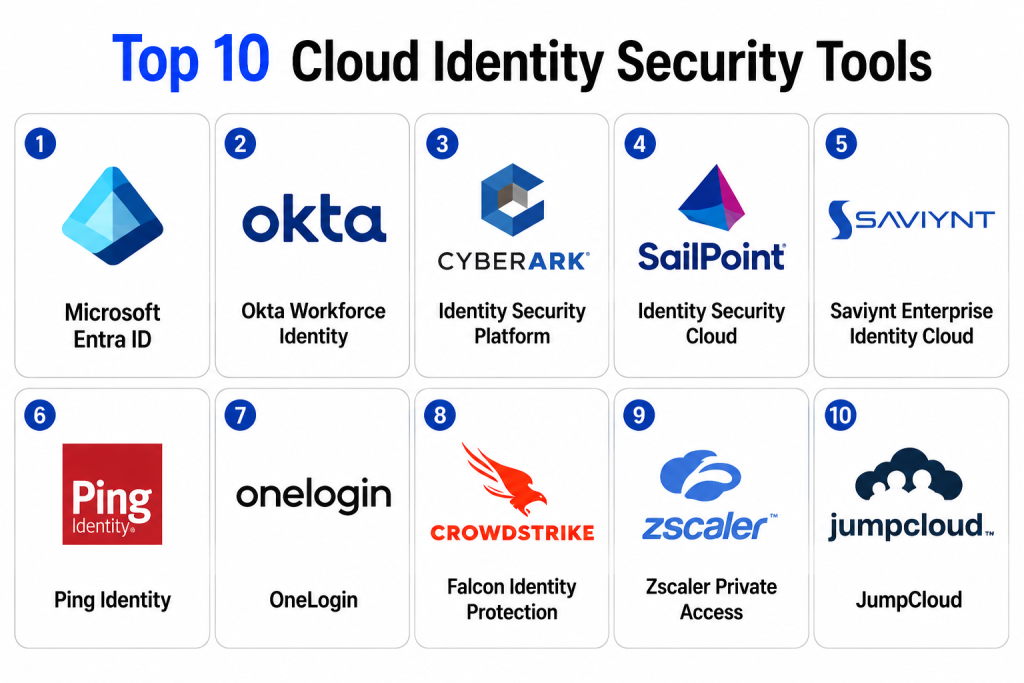
Top 10 Cloud Identity Security Tools
1 — Microsoft Entra ID
Short description:
Microsoft Entra ID is a cloud identity platform used for managing user authentication and access control. It supports SSO, MFA, and conditional access policies.
It is widely used in enterprise Microsoft ecosystems.
It helps secure access across cloud and hybrid environments.
It is designed for large-scale identity management.
Key Features
- Single sign-on across applications
- Conditional access policies
- Multi-factor authentication
- Identity protection and risk detection
- Privileged identity management
- Access reviews and governance
Pros
- Strong enterprise identity coverage
- Deep Microsoft ecosystem integration
- Highly scalable
Cons
- Complex for beginners
- Advanced features require configuration
- Best suited for Microsoft environments
Platforms / Deployment
- Web
- Cloud
- Hybrid
Security & Compliance
Supports MFA, SSO, RBAC, audit logs, encryption, and conditional access. Compliance certifications vary by deployment.
Integrations & Ecosystem
- Microsoft 365
- Azure services
- Security tools
- SaaS applications
- API-based integrations
Support & Community
Strong documentation, enterprise support, and large user community.
2 — Okta Workforce Identity
Short description:
Okta provides cloud identity management for secure user access.
It enables SSO, MFA, and lifecycle management.
It supports thousands of SaaS applications.
It is widely used in enterprise and mid-market companies.
Key Features
- Single sign-on
- Adaptive MFA
- User lifecycle automation
- Universal directory
- Access policies
- Device context authentication
Pros
- Easy SaaS integration
- Strong authentication system
- Vendor-neutral identity support
Cons
- Pricing can be high
- Complex setups in large environments
- Some features require add-ons
Platforms / Deployment
- Web
- Cloud
Security & Compliance
Supports SSO, MFA, RBAC, audit logs, encryption, and policy enforcement.
Integrations & Ecosystem
- Google Workspace
- Salesforce
- Microsoft 365
- Slack
- Service platforms
- HR systems
Support & Community
Strong documentation and enterprise support ecosystem.
3 — CyberArk Identity Security Platform
Short description:
CyberArk focuses on privileged access and identity protection.
It secures admin accounts and sensitive credentials.
It prevents unauthorized access to critical systems.
It is widely used in regulated industries.
Key Features
- Privileged access management
- Secrets management
- Session monitoring
- Just-in-time access
- Endpoint privilege control
- Identity threat detection
Pros
- Strong privileged access security
- Excellent enterprise security controls
- High compliance suitability
Cons
- Complex implementation
- Requires skilled management
- Higher cost structure
Platforms / Deployment
- Web
- Cloud
- Hybrid
Security & Compliance
Supports MFA, RBAC, encryption, audit logs, and privileged session control.
Integrations & Ecosystem
- Cloud platforms
- SIEM tools
- ITSM systems
- Identity providers
- DevOps tools
Support & Community
Enterprise-grade support and strong security community presence.
4 — SailPoint Identity Security Cloud
Short description:
SailPoint focuses on identity governance and access control.
It helps manage who has access to what systems.
It automates access reviews and compliance checks.
It is widely used in large enterprises.
Key Features
- Identity governance
- Access certifications
- Role management
- Lifecycle automation
- Policy enforcement
- Identity analytics
Pros
- Strong compliance capabilities
- Excellent governance features
- Good enterprise scalability
Cons
- Complex deployment
- Less focus on real-time threats
- Requires mature processes
Platforms / Deployment
- Web
- Cloud
- Hybrid
Security & Compliance
Supports RBAC, audit logs, encryption, and governance policies.
Integrations & Ecosystem
- HR systems
- SaaS apps
- ITSM tools
- Cloud platforms
- Enterprise directories
Support & Community
Strong enterprise support and implementation partners.
5 — Saviynt Enterprise Identity Cloud
Short description:
Saviynt provides identity governance and cloud access management.
It focuses on compliance and access risk control.
It manages SaaS and cloud permissions.
It is used by large enterprises.
Key Features
- Identity governance
- Cloud entitlement management
- Access certification
- Risk analysis
- Policy automation
- Privileged access governance
Pros
- Strong cloud access visibility
- Good compliance support
- Enterprise-grade governance
Cons
- Complex setup
- Learning curve for teams
- Best for large organizations
Platforms / Deployment
- Web
- Cloud
Security & Compliance
Supports audit logs, RBAC, encryption, and policy-based controls.
Integrations & Ecosystem
- AWS
- Azure
- SAP
- ServiceNow
- HR systems
Support & Community
Enterprise support and consulting services available.
6 — Ping Identity
Short description:
Ping Identity provides authentication and identity federation tools.
It supports complex enterprise identity environments.
It enables secure access across systems and APIs.
It is widely used in hybrid infrastructure setups.
Key Features
- Identity federation
- SSO and MFA
- API security
- Risk-based authentication
- Access management
- Hybrid identity support
Pros
- Strong federation capabilities
- Flexible deployment
- Enterprise-ready
Cons
- Requires technical expertise
- Complex architecture
- Higher configuration effort
Platforms / Deployment
- Web
- Cloud
- Hybrid
Security & Compliance
Supports MFA, SSO, RBAC, encryption, and audit logging.
Integrations & Ecosystem
- SaaS platforms
- Cloud providers
- APIs
- Enterprise directories
Support & Community
Enterprise support and technical documentation available.
7 — OneLogin
Short description:
OneLogin offers cloud identity and access management.
It provides SSO and MFA capabilities.
It helps manage SaaS application access.
It is popular among mid-sized businesses.
Key Features
- SSO authentication
- MFA security
- User provisioning
- Access policies
- Directory integration
- Adaptive authentication
Pros
- Easy to deploy
- Good SaaS integration
- User-friendly platform
Cons
- Limited advanced governance
- Not ideal for complex enterprises
- Some features need upgrades
Platforms / Deployment
- Web
- Cloud
Security & Compliance
Supports MFA, SSO, RBAC, encryption, and logs.
Integrations & Ecosystem
- Microsoft 365
- Google Workspace
- Salesforce
- Slack
- Workday
Support & Community
Standard enterprise support and documentation.
8 — CrowdStrike Falcon Identity Protection
Short description:
CrowdStrike focuses on identity threat detection and response.
It identifies credential-based attacks and misuse.
It helps SOC teams detect identity risks.
It integrates with endpoint security systems.
Key Features
- Identity threat detection
- Credential attack monitoring
- Risk scoring
- Lateral movement detection
- Privilege monitoring
- SOC integration
Pros
- Strong threat detection
- Good SOC integration
- Advanced security intelligence
Cons
- Not a full IAM platform
- Requires security expertise
- Works best with CrowdStrike ecosystem
Platforms / Deployment
- Web
- Cloud
- Hybrid
Security & Compliance
Supports monitoring, encryption, and security event logging.
Integrations & Ecosystem
- SIEM tools
- Endpoint security
- Cloud platforms
- Security APIs
Support & Community
Strong enterprise support and security research community.
9 — Zscaler Private Access
Short description:
Zscaler Private Access provides Zero Trust access to applications.
It replaces traditional VPN systems.
It enforces identity-based access policies.
It secures remote and hybrid users.
Key Features
- Zero Trust access
- Identity-based policies
- Application segmentation
- Secure remote access
- Device-based controls
- Cloud access security
Pros
- Strong Zero Trust model
- Reduces network exposure
- Good for remote teams
Cons
- Not a full IAM system
- Requires integration setup
- Depends on identity provider
Platforms / Deployment
- Web
- Cloud
Security & Compliance
Supports encryption, identity-based policies, and secure access controls.
Integrations & Ecosystem
- Okta
- Microsoft Entra ID
- CrowdStrike
- SIEM tools
Support & Community
Enterprise support and deployment services available.
10 — JumpCloud
Short description:
JumpCloud is a cloud directory platform for identity and device management.
It supports SSO, MFA, and user management.
It works across multiple operating systems.
It is ideal for SMB and IT teams.
Key Features
- Cloud directory services
- SSO authentication
- MFA security
- Device management
- User lifecycle control
- Policy enforcement
Pros
- Easy to use
- Cross-platform support
- Good SMB fit
Cons
- Limited enterprise governance
- Not deeply specialized
- May need add-ons
Platforms / Deployment
- Web
- Cloud
Security & Compliance
Supports MFA, SSO, RBAC, encryption, and logs.
Integrations & Ecosystem
- Google Workspace
- Microsoft 365
- AWS
- Slack
- GitHub
Support & Community
Good documentation and SMB-focused support.
Comparison Table
| Tool | Best For | Platforms | Deployment | Standout Feature | Public Rating |
|---|---|---|---|---|---|
| Microsoft Entra ID | Enterprise identity | Web | Cloud/Hybrid | Conditional access | N/A |
| Okta | SaaS identity | Web | Cloud | SSO ecosystem | N/A |
| CyberArk | Privileged security | Web | Cloud/Hybrid | PAM controls | N/A |
| SailPoint | Governance | Web | Cloud/Hybrid | Access reviews | N/A |
| Saviynt | Cloud governance | Web | Cloud | CIEM | N/A |
| Ping Identity | Federation | Web | Cloud/Hybrid | API identity | N/A |
| OneLogin | SMB IAM | Web | Cloud | Easy SSO | N/A |
| CrowdStrike | Identity threats | Web | Cloud | Threat detection | N/A |
| Zscaler | Zero Trust access | Web | Cloud | Secure access | N/A |
| JumpCloud | SMB directory | Web | Cloud | Cross-platform control | N/A |
Evaluation & Scoring
| Tool | Core (25%) | Ease (15%) | Integrations (15%) | Security (10%) | Performance (10%) | Support (10%) | Value (15%) | Total |
|---|---|---|---|---|---|---|---|---|
| Microsoft Entra ID | 9.5 | 8.5 | 9.6 | 9.3 | 9.2 | 9.0 | 8.8 | 9.1 |
| Okta | 9.2 | 9.0 | 9.5 | 9.0 | 9.1 | 8.8 | 8.5 | 9.0 |
| CyberArk | 9.4 | 8.0 | 8.8 | 9.6 | 9.0 | 9.0 | 8.0 | 8.9 |
| SailPoint | 9.0 | 8.0 | 8.8 | 9.0 | 8.8 | 8.7 | 8.2 | 8.6 |
| Saviynt | 8.9 | 8.0 | 8.7 | 9.0 | 8.7 | 8.5 | 8.3 | 8.5 |
| Ping Identity | 8.8 | 8.1 | 8.9 | 8.9 | 8.8 | 8.5 | 8.2 | 8.5 |
| CrowdStrike | 8.6 | 8.3 | 8.6 | 9.1 | 9.0 | 8.7 | 8.1 | 8.5 |
| Zscaler | 8.5 | 8.4 | 8.7 | 8.9 | 9.0 | 8.6 | 8.0 | 8.4 |
| OneLogin | 8.2 | 8.8 | 8.4 | 8.5 | 8.5 | 8.2 | 8.6 | 8.4 |
| JumpCloud | 8.0 | 8.9 | 8.2 | 8.4 | 8.4 | 8.1 | 8.8 | 8.3 |
Interpret scores as comparative indicators. Higher scores show stronger capability across identity security needs, but final selection depends on company size, architecture, compliance needs, and integration requirements.
Which Cloud Identity Security Tool Is Right for You?
Solo / Freelancer
JumpCloud is the most practical option for managing identity, devices, and basic security controls.
SMB
OneLogin, JumpCloud, and Okta are strong choices for SaaS access and authentication.
Mid-Market
Okta, Microsoft Entra ID, Ping Identity, and OneLogin work well for scaling identity management.
Enterprise
Microsoft Entra ID, CyberArk, SailPoint, Saviynt, and Okta are strong enterprise-grade solutions.
Budget vs Premium
- Budget: JumpCloud, OneLogin
- Mid-range: Okta
- Premium: CyberArk, SailPoint, Saviynt, Microsoft Entra ID
Feature Depth vs Ease of Use
- Deep governance: SailPoint, Saviynt
- Ease of use: JumpCloud, OneLogin
- Balanced: Okta, Microsoft Entra ID
Integrations & Scalability
Okta and Microsoft Entra ID provide the strongest ecosystem scalability for SaaS-heavy environments.
Security & Compliance Needs
CyberArk, SailPoint, and Saviynt are best for compliance-heavy and high-security environments.
Frequently Asked Questions
1. What are cloud identity security tools?
They are platforms that manage user authentication, access control, and identity protection across cloud systems.
They help prevent unauthorized access and credential misuse.
They enforce security policies for users and devices.
They also support governance and compliance needs.
2. Why are identity tools important?
Identity is the primary entry point for attackers today.
Most breaches involve compromised credentials or weak access controls.
These tools reduce risk through MFA and access policies.
They also help organizations manage growing SaaS environments.
3. Are these tools suitable for small businesses?
Yes, but smaller teams should choose simpler platforms.
JumpCloud and OneLogin are more suitable for SMBs.
Enterprise platforms may be too complex for small teams.
Cost and setup complexity should be evaluated carefully.
4. Do identity tools support MFA?
Yes, most platforms include multi-factor authentication.
It adds an extra layer of login security.
MFA helps prevent password-based attacks.
It is a standard feature in modern identity platforms.
5. Can these tools integrate with SaaS applications?
Yes, integration with SaaS apps is a core capability.
They support thousands of cloud applications.
SSO simplifies login across systems.
Integration depth varies by vendor.
6. What is the difference between IAM and PAM?
IAM manages general user access across systems.
PAM focuses on privileged or admin accounts.
PAM adds stronger controls and monitoring.
Both are often used together in enterprises.
7. How long does implementation take?
It depends on complexity and number of applications.
Simple setups can take days or weeks.
Enterprise deployments may take months.
Planning and integration are key factors.
8. Do these tools help with compliance?
Yes, they support audits and access governance.
They provide logs, access reviews, and reporting.
Compliance depends on correct configuration.
They are widely used in regulated industries.
9. What are common mistakes when using identity tools?
Common mistakes include poor access design and weak MFA rollout.
Ignoring privileged account protection is another issue.
Lack of regular access reviews increases risk.
Poor integration planning can cause security gaps.
10. Can organizations switch identity platforms easily?
Switching is possible but complex.
Identity systems are deeply integrated with applications.
Migration requires careful planning and testing.
A phased rollout is recommended.
Conclusion
Cloud identity security tools are essential for protecting modern digital environments where users, devices, and applications are distributed across cloud systems. Each platform serves different needs—from simple SaaS access management to advanced privileged access governance and identity threat detection.The best choice depends on your organization’s size, security maturity, compliance requirements, and existing technology stack. Instead of choosing one tool blindly, shortlist two or three platforms, test integrations, validate security controls, and run a pilot before full deployment.
